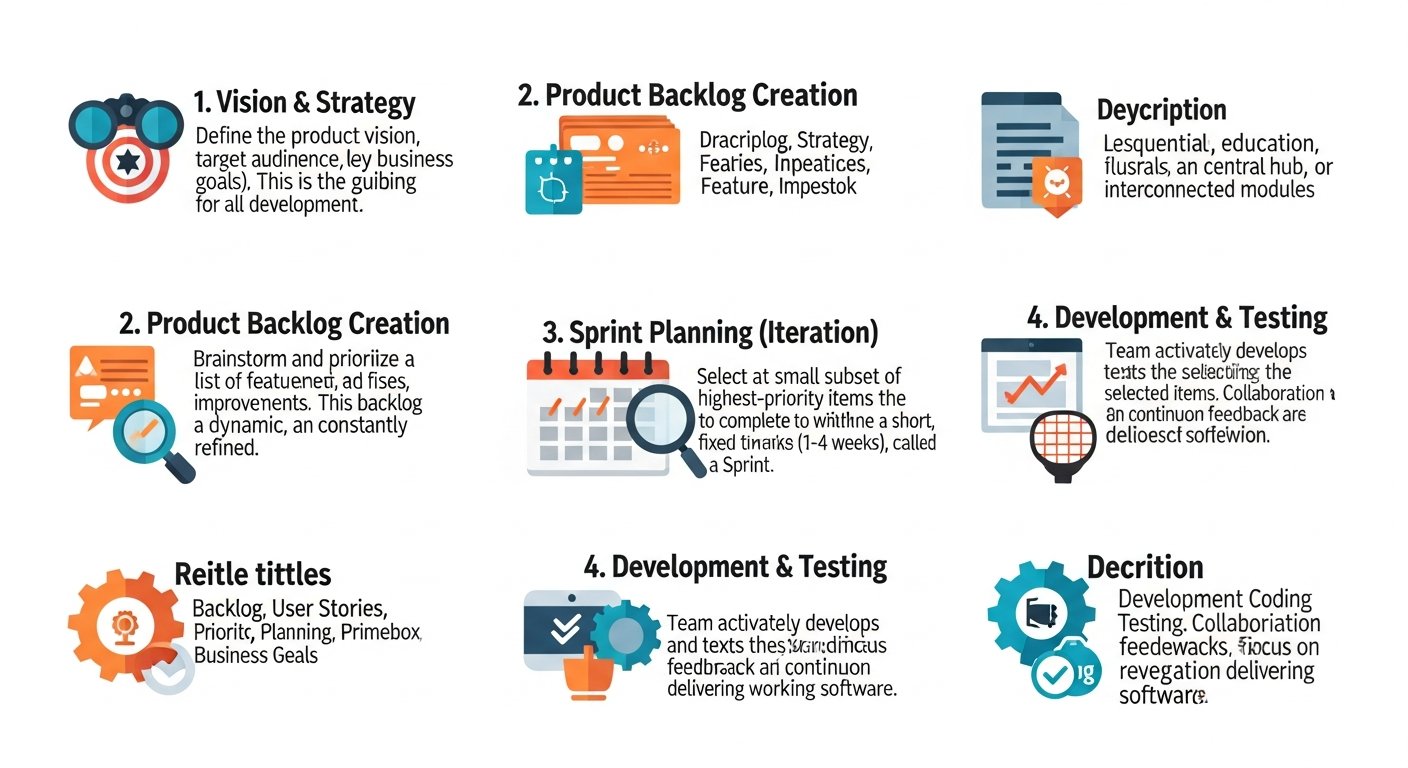
Agile Product Development for Startups: A Comprehensive Guide to Rapid Growth & Innovation
For any startup navigating the volatile landscape of today’s tech industry, the ability to adapt, innovate, and deliver value at speed is not just an advantage—it’s a necessity. This is precisely where agile product development for startups becomes an indispensable strategic asset. It’s an iterative, customer-centric approach that empowers early-stage companies to efficiently develop products, respond to market shifts, and achieve validated learning crucial for sustained growth. By embracing Agile principles, startups can optimize their limited resources, accelerate their time-to-market, and build products that genuinely resonate with their target users, significantly reducing the risks inherent in new ventures. This guide will unpack how Agile methodologies provide the framework for rapid iteration, continuous improvement, and ultimately, a stronger foundation for your tech startup’s success.
This comprehensive guide will explore the core concepts of agile product development, its essential methodologies like Scrum and Kanban, and provide a step-by-step implementation plan tailored for startups. We will also delve into key metrics for measuring success, common challenges faced by early-stage companies, and strategies for integrating Agile with overall startup growth, including investor relations and scaling operations. By the end, you’ll have a clear roadmap to leverage agile product development to foster rapid innovation, achieve product-market fit, and secure a competitive edge in the dynamic startup ecosystem.
What is Agile Product Development for Startups?
At its core, Agile Product Development is a flexible, iterative, and incremental approach to designing, building, and launching products. Instead of a linear, sequential ‘waterfall’ model, Agile emphasizes collaboration, customer feedback, and adaptability throughout the entire development lifecycle. Originating from the software development industry, its principles have expanded to revolutionize how all types of products and services are brought to market, especially within fast-paced environments like startups.
The essence of Agile lies in breaking down large projects into smaller, manageable chunks called ‘iterations’ or ‘sprints,’ typically lasting 1-4 weeks. Each iteration delivers a potentially shippable increment of the product, allowing teams to gather feedback early and frequently, adapting their plans based on real-world usage and evolving customer needs. This continuous loop of building, measuring, and learning ensures that resources are focused on features that truly add value, minimizing waste and maximizing relevance.
What are the Core Principles of the Agile Manifesto for Startups?
The Agile Manifesto, penned in 2001, articulates the foundational values and principles that guide this development philosophy. Understanding these is crucial for any startup aiming to embed Agile effectively:
- Individuals and interactions over processes and tools: While tools are helpful, the people doing the work and how they collaborate are paramount.
- Working software over comprehensive documentation: A functional product that delivers value is more important than exhaustive, often outdated, documentation.
- Customer collaboration over contract negotiation: Engaging with customers throughout the development process ensures the product meets their actual needs.
- Responding to change over following a plan: The ability to adapt to new information and changing requirements is more valuable than rigid adherence to an initial plan.
These four values are supported by twelve more detailed principles, all emphasizing frequent delivery, continuous feedback, sustainable pace, technical excellence, and simplicity.
What are the Key Characteristics of Agile Teams in a Startup Environment?
For Agile to thrive, teams must embody certain characteristics that foster efficiency and innovation:
- Cross-functional: Agile teams possess all the skills necessary to complete a project end-to-end, from design and development to testing and deployment, without relying heavily on external departments.
- Self-organizing: Teams have the autonomy to decide the best way to accomplish their work, rather than being dictated by external management. This fosters ownership and innovative problem-solving.
- Empowered: Members are trusted to make decisions, removing bottlenecks and accelerating progress.
- Collaborative: Open communication and continuous interaction within the team and with stakeholders are central to resolving issues and aligning on goals.
- Customer-centric: Every decision is made with the end-user in mind, aiming to deliver maximum value and satisfaction.
Why is Agile Product Development Essential for Startups?
The unique environment of a startup—characterized by high uncertainty, limited resources, and the urgent need for market validation—makes Agile Product Development not just beneficial, but truly essential. Traditional development methodologies often falter under these conditions, leading to wasted effort and missed market opportunities. Agile, conversely, is built to thrive in such dynamic settings.
How Does Agile Product Development Help Startups Navigate Market Volatility and Customer Needs?
Startups operate in highly dynamic markets where customer preferences, technological trends, and competitive landscapes can shift rapidly. An Agile approach provides the flexibility needed to pivot quickly. By delivering incremental product releases and gathering immediate customer feedback, startups can:
- Validate assumptions quickly: Instead of building a full product based on untested hypotheses, Agile encourages launching Minimum Viable Products (MVPs) to collect real user data.
- Adapt to changing demands: If market feedback reveals a different direction is needed, Agile’s iterative cycles allow for course correction with minimal waste of time and resources.
- Build customer loyalty: By involving customers in the development process and consistently delivering features they value, startups can foster strong relationships and build a loyal user base.
How Does Agile Product Development Optimize Resource Allocation and Reduce Risk for Startups?
For startups, every dollar and every hour counts. Agile methodologies are inherently designed for efficiency and risk mitigation:
- Efficient resource utilization: Focusing on delivering the most valuable features first ensures that limited engineering and design resources are always applied to high-impact work.
- Early detection of issues: Frequent testing and integration reduce the chances of encountering major problems late in the development cycle, which are far more costly to fix.
- Reduced financial risk: By building products incrementally and validating each step, startups avoid investing heavily in features or entire products that might not find market fit, thereby conserving precious seed or venture capital funding.
- Improved predictability: While flexibility is key, Agile metrics like velocity can help teams understand their capacity, leading to more realistic timelines and expectations for investors.
How Does Agile Product Development Accelerate Time-to-Market and Iteration Speed for Startups?
In the startup world, speed to market can be the difference between success and failure. Agile methodologies are designed to accelerate this process:
- Rapid delivery of value: Short sprints and continuous integration mean that working software is produced regularly, enabling startups to launch new features or even entire products much faster than traditional methods.
- Faster learning cycles: The ‘build-measure-learn’ loop is central to Agile. Each iteration provides new data points, allowing startups to learn about their product and market, then quickly incorporate those learnings into the next development cycle.
- Competitive advantage: Being able to respond faster to market opportunities or competitor moves allows startups to gain an early foothold and maintain a competitive edge.

What are the Key Agile Methodologies for Startup Success?
While the Agile Manifesto provides the overarching philosophy, several distinct methodologies offer practical frameworks for implementing Agile Product Development. For startups, choosing the right methodology often depends on the specific project, team structure, and desired outcomes. The most prominent and effective for early-stage companies include Scrum, Kanban, and the Lean Startup approach.
What is Scrum and How Does it Benefit Startups?
Scrum is arguably the most popular Agile framework, highly structured yet flexible, making it ideal for startups tackling complex projects with evolving requirements. It emphasizes cross-functional teams, specific roles, and time-boxed iterations. For a deeper dive, explore Scrum.org.
- Key Components:
- Sprints: Fixed-length iterations (typically 1-4 weeks) during which a ‘Done,’ usable, and potentially shippable product increment is created.
- Product Backlog: A prioritized, dynamic list of all features, functions, requirements, enhancements, and fixes that need to be delivered for the product. The Product Owner is responsible for its content, availability, and ordering.
- Sprint Backlog: A subset of the Product Backlog selected for the current sprint, detailing the work the Development Team plans to accomplish.
- Daily Scrum (Stand-up): A 15-minute daily meeting where the Development Team synchronizes activities and creates a plan for the next 24 hours, focusing on progress toward the Sprint Goal.
- Sprint Review: Held at the end of the sprint to inspect the increment and adapt the Product Backlog if needed. Stakeholders and the team collaborate on what to do next.
- Sprint Retrospective: An opportunity for the Scrum Team to inspect itself and create a plan for improvements to be enacted during the next sprint.
- Key Roles:
- Product Owner: Represents the voice of the customer and stakeholders, responsible for maximizing the value of the product resulting from the work of the Development Team.
- Scrum Master: A servant-leader who helps the team understand and enact Scrum practices, removing impediments and fostering an environment conducive to success.
- Development Team: A self-organizing, cross-functional group of professionals who do the work of delivering a potentially shippable increment of product.
For startups, Scrum provides a powerful rhythm for consistent delivery, clear accountability, and continuous feedback loops that are vital for rapidly iterating on a product.
What is Kanban and How Does it Benefit Startups?
Kanban, meaning “visual signal” or “card” in Japanese, is a methodology focused on visualizing workflow, limiting work-in-progress (WIP), and maximizing efficiency. It’s particularly well-suited for startups with continuous flow production, maintenance, or operations where work arrives sporadically and needs immediate attention. Learn more about Kanban at Kanban.com.
- Key Principles:
- Visualize the Workflow: Use a Kanban board (physical or digital) to show all work items and their status (e.g., To Do, In Progress, Testing, Done).
- Limit Work in Progress (WIP): Restrict the number of items in each stage of the workflow to prevent bottlenecks and ensure focus.
- Manage Flow: Continuously monitor and improve the flow of work, identifying and resolving impediments.
- Make Policies Explicit: Clearly define how work moves through the system.
- Implement Feedback Loops: Regularly review how the system is performing and adapt as needed.
- Improve Collaboratively, Evolve Experimentally: Encourage continuous improvement through shared understanding and scientific method.
Kanban offers startups extreme flexibility and transparency, allowing teams to quickly adapt to incoming priorities without the fixed time-boxes of sprints. It’s excellent for optimizing existing processes and improving predictability in a continuous delivery environment.
What is Lean Startup and How Does it Complement Agile Product Development for Startups?
While not strictly an Agile methodology in the same way Scrum or Kanban are, the Lean Startup approach, popularized by Eric Ries, deeply complements and often underpins how startups apply Agile. It’s a scientific approach to creating and managing startups, emphasizing rapid experimentation and validated learning. Explore Eric Ries’s work on Lean Startup principles.
- The Build-Measure-Learn Loop:
- Build: Quickly create an MVP (Minimum Viable Product) to test a core hypothesis about the product or business model.
- Measure: Collect quantitative and qualitative data on how users interact with the MVP. Focus on actionable metrics, not vanity metrics.
- Learn: Analyze the data to gain insights. This learning informs whether to “pivot” (change strategy) or “persevere” (continue with the current strategy, iterating on the product).
The Lean Startup methodology is invaluable for startups because it focuses on reducing waste and uncertainty. It ensures that product development efforts are always aligned with customer needs and market demand, preventing startups from building products nobody wants. It’s often used in conjunction with Scrum (for building) and Kanban (for managing flow and measuring).
Choosing the right Agile methodology, or often a hybrid approach, empowers startups to maximize their potential for innovation and growth by providing structured yet adaptable frameworks for product delivery.
| Methodology | Key Principle | Best Suited For (Startup Context) | Core Practices | Primary Startup Benefit |
|---|---|---|---|---|
| Scrum | Iterative & Incremental Delivery | Complex projects with evolving requirements; teams needing structured rhythm. | Sprints, Product Backlog, Daily Scrums, Sprint Reviews, Retrospectives, Product Owner, Scrum Master. | Predictable delivery, rapid feedback, clear roles & responsibilities. |
| Kanban | Visualize Workflow, Limit WIP, Manage Flow | Continuous flow production; operations or maintenance teams; projects with frequently changing priorities. | Kanban board, WIP limits, Lead/Cycle Time tracking, explicit policies. | Extreme flexibility, improved efficiency & throughput, transparency of bottlenecks. |
| Lean Startup | Build-Measure-Learn Loop, Validated Learning | All startups, especially those in early stages validating product-market fit or business models. | MVP development, A/B testing, cohort analysis, pivot/persevere decisions. | Reduces waste, accelerates market validation, ensures customer-centricity. |
How to Implement Agile Product Development in Your Startup: A Step-by-Step Guide
Implementing Agile Product Development successfully requires more than just adopting a framework; it necessitates a cultural shift and a deliberate, structured approach. For startups, this implementation needs to be pragmatic, focusing on maximizing value while navigating resource constraints. Here’s a step-by-step guide to integrate Agile into your startup’s DNA.
Step 1: How to Build Your Cross-Functional Agile Team for a Startup?
The foundation of any successful Agile implementation is the team itself. Start with a small, dedicated group:
- Identify Key Roles: Even for a lean startup, define a Product Owner (who champions the product vision and customer needs), a Scrum Master (if using Scrum, to facilitate processes and remove impediments), and a Development Team (engineers, designers, QA specialists). Often, one person may wear multiple hats initially.
- Foster Cross-Functionality: Ensure the team has all the necessary skills to deliver a product increment independently. This minimizes external dependencies and speeds up development.
- Promote Self-Organization & Empowerment: Trust your team members to determine the best way to achieve their goals. Provide them with the autonomy and resources needed to make decisions and solve problems collectively.
- Cultivate Collaboration: Encourage open communication, empathy, and a shared understanding of the product vision. Co-location, if possible, can enhance this.
Step 2: How to Define Your Product Vision and Backlog for Agile Product Development?
Before building, you need a clear direction:
- Establish a Clear Product Vision: Articulate the overarching goal and purpose of your product. What problem does it solve? Who is it for? What impact will it have? This vision guides all subsequent decisions.
- Create an Initial Product Backlog: Based on your vision and initial market research, brainstorm all potential features, functionalities, and improvements. Document these as user stories (e.g., “As a [type of user], I want [some goal], so that [some reason]”).
- Prioritize the Backlog: The Product Owner, in collaboration with the team and stakeholders, must continuously prioritize the backlog. Focus on delivering the highest value, most critical features first, often starting with an MVP. Techniques like MoSCoW (Must-have, Should-have, Could-have, Won’t-have) or RICE (Reach, Impact, Confidence, Effort) can be useful.
- Refine Continuously: The product backlog is a living document. It should be regularly reviewed, updated, and re-prioritized based on new market insights, customer feedback, and technical discoveries.
Step 3: How to Plan and Execute Sprints in Agile Product Development (for Scrum)?
For startups adopting Scrum, this step is central to iterative delivery:
- Sprint Planning: At the start of each sprint (e.g., every two weeks), the team meets to select items from the top of the Product Backlog to work on. They define a Sprint Goal and create a detailed Sprint Backlog, outlining the tasks needed to complete the selected items.
- Daily Stand-ups (Daily Scrum): Hold a short, 15-minute daily meeting where each team member briefly shares:
- What they accomplished yesterday.
- What they plan to accomplish today.
- Any impediments blocking their progress.
This ensures alignment, identifies blockers quickly, and keeps the team focused on the Sprint Goal.
- Focused Development: During the sprint, the development team works autonomously to complete the tasks in the Sprint Backlog. The Scrum Master helps remove any impediments.
- Continuous Testing and Integration: Integrate testing throughout the sprint to catch bugs early. Aim for a “Done” increment by the end of the sprint, meaning it’s fully tested and potentially shippable.
Step 4: How to Implement Continuous Feedback and Adaptation in Agile Product Development?
Agile’s power lies in its adaptability:
- Sprint Review: At the end of each sprint, the team demonstrates the completed increment to stakeholders (investors, advisors, early customers). Gather feedback on the working product and discuss what to build next.
- Sprint Retrospective: After the Sprint Review, the team meets internally to reflect on the sprint itself. What went well? What could be improved (processes, tools, communication)? How can the team work more effectively in the next sprint? Implement agreed-upon improvements immediately.
- User Feedback Loops: Beyond formal sprint reviews, integrate mechanisms for continuous user feedback. This could include beta testing, user interviews, analytics, and in-app feedback tools. Use this direct customer input to inform backlog prioritization and future development.
- Embrace Pivoting: Be prepared to pivot your product or even your business model if validated learning suggests a different direction is more viable. Agile’s flexibility supports these strategic shifts better than rigid plans.
By following these steps, startups can systematically integrate Agile Product Development, fostering a culture of rapid innovation, continuous learning, and customer-centricity that is crucial for sustainable growth.

Measuring Success & Continuous Improvement in Agile Startups
For startups, demonstrating progress and making data-driven decisions is paramount. Agile methodologies provide a rich set of metrics and practices for measuring success, identifying areas for improvement, and communicating value to stakeholders, including potential investors. It’s not just about building fast, but building smart, and consistently getting better at it.
What are the Essential Agile Metrics for Startup Growth?
Tracking the right metrics helps startups understand their development efficiency, product quality, and market impact. Here are some key Agile metrics:
- Velocity:
- Definition: The amount of work a Scrum Development Team completes in a sprint, typically measured in story points (a relative estimate of effort, complexity, and uncertainty) or ideal hours.
- Why it Matters for Startups: Provides a reliable indicator of the team’s capacity and throughput. It helps with future sprint planning, forecasting product delivery timelines, and managing investor expectations. Consistent velocity demonstrates team stability and predictability.
- How to Track: Sum the story points of all completed items in a sprint. Calculate the average velocity over several sprints to get a more stable prediction.
- Lead Time:
- Definition: The total time elapsed from when a customer requests a feature (or an idea is conceived) until it is delivered to the customer.
- Why it Matters for Startups: Measures the overall responsiveness of the product development process from idea to market. Shorter lead times indicate a more agile and efficient system, crucial for rapid market adaptation.
- How to Track: Record the date an item enters the backlog and the date it’s released to users.
- Cycle Time:
- Definition: The time it takes for a work item to move from “in progress” to “done” within the development workflow.
- Why it Matters for Startups: Focuses on the efficiency of the internal development process. Optimizing cycle time directly impacts how quickly features are built and ready for release, which is vital for maintaining momentum and reducing WIP.
- How to Track: Record the start time when an item moves into “in progress” and the end time when it reaches “done.”
- Customer Satisfaction (CSAT/NPS):
- Definition: Measures how satisfied customers are with the product or specific features (CSAT) or their willingness to recommend the product (NPS – Net Promoter Score).
- Why it Matters for Startups: The ultimate measure of product-market fit and value delivery. High satisfaction scores validate product decisions and drive organic growth. It directly links development efforts to business outcomes.
- How to Track: Implement in-app surveys, email surveys, or feedback forms after feature releases.
- Burn-down/up Charts:
- Definition: Burn-down charts show the remaining work in a sprint or project over time, while burn-up charts show the amount of work completed over time.
- Why it Matters for Startups: Provides a visual representation of progress and helps identify if the team is on track to meet its sprint or project goals. Essential for transparency and early identification of potential delays.
- How to Track: Plot remaining (or completed) story points/tasks against the days in a sprint/project.
How Can Retrospectives Enhance Team and Process in Agile Startups?
While metrics provide quantitative insights, retrospectives offer qualitative depth and are the engine of continuous improvement in Agile. They are dedicated sessions for the team to reflect on their recent work and how they worked.
- Purpose: Retrospectives (typically at the end of each sprint) are designed to:
- Identify successes and what went well.
- Uncover challenges, impediments, and areas for improvement.
- Brainstorm and agree on actionable steps to improve processes, tools, collaboration, or team dynamics for the next sprint.
- Benefits for Startups:
- Fosters a Culture of Learning: Encourages the team to openly discuss problems and experiment with solutions without blame.
- Enhances Team Cohesion: Builds trust and psychological safety, empowering team members to contribute to process improvement.
- Optimizes Processes: Leads to incremental, but significant, improvements in efficiency, quality, and predictability over time.
- Addresses Technical Debt: Often, retrospectives can surface discussions about technical debt and lead to plans to address it proactively.
By diligently tracking relevant metrics and actively engaging in retrospectives, startups can ensure their Agile implementation is not just about speed, but also about sustainable growth, informed decision-making, and constant evolution towards excellence.
| Metric | Definition | Why it Matters for Startups | How to Track (Examples) |
|---|---|---|---|
| Velocity | Amount of work a team completes in a sprint (e.g., story points). | Predicts future capacity, aids investor reporting, demonstrates team stability. | Sum of story points completed per sprint; average over 3-5 sprints. |
| Lead Time | Time from idea inception to delivery to the customer. | Measures overall responsiveness; crucial for rapid market adaptation. | Date backlog item created to date feature released. |
| Cycle Time | Time an item spends actively in the development workflow (“in progress” to “done”). | Indicates internal process efficiency; identifies bottlenecks in production. | Start time of work item to end time of work item in a specific workflow stage. |
| Customer Satisfaction (CSAT/NPS) | Measures user happiness with product/features or likelihood to recommend. | Ultimate measure of product-market fit; drives organic growth and validates value. | In-app surveys (e.g., “How satisfied are you with X feature?”), Net Promoter Score questions. |
| Burn-down/up Charts | Visual representation of work remaining (burn-down) or work completed (burn-up) over time. | Tracks progress against sprint/project goals; transparently flags potential delays. | Plot remaining story points against sprint days (burn-down); plot completed points against time (burn-up). |
What are the Common Challenges in Agile Product Development for Startups & How to Overcome Them?
While Agile Product Development offers tremendous advantages for startups, its implementation isn’t without hurdles. Startups often face unique constraints and dynamics that can make adopting and sustaining Agile practices challenging. Recognizing these common pitfalls and having strategies to overcome them is crucial for long-term success.
How Can Startups Overcome Scope Creep and Maintain Focus in Agile Product Development?
One of the most persistent challenges, especially in dynamic startup environments, is scope creep – the uncontrolled growth or change in a project’s scope. This often occurs due to rapid market shifts, evolving stakeholder demands, or an internal desire to add “just one more feature.” The antithesis of agility, scope creep can quickly derail a startup’s limited resources and time.
- How to Overcome:
- Robust Product Ownership: Empower a strong Product Owner who rigorously maintains the Product Backlog, saying “no” to non-essential requests and ensuring alignment with the core product vision.
- Clear Sprint Goals: Each sprint must have a well-defined, immutable goal. Once a sprint begins, the scope should be protected from changes, allowing the team to focus intently.
- Prioritization Frameworks: Consistently use prioritization methods (e.g., MoSCoW, RICE) to evaluate new ideas against existing backlog items, ensuring only the highest value work proceeds.
- Visible Backlog: Maintain a highly visible and transparent Product Backlog, so everyone understands what is being worked on and what is not.
- Time-boxing: Strict adherence to sprint durations helps contain scope. If a feature can’t fit into the current sprint, it goes back into the prioritized backlog for a future iteration.
How Can Startups Manage Resource Constraints and Technical Debt in Agile Product Development?
Startups inherently operate with limited resources—be it budget, personnel, or time. This often leads to difficult trade-offs and the temptation to take shortcuts, which can accumulate as technical debt. Technical debt refers to the extra development work that arises when code is not perfectly optimized or a quick-and-dirty solution is implemented instead of a better approach. While sometimes necessary, unmanaged technical debt can significantly slow down future development and increase maintenance costs.
- How to Overcome:
- Strategic Prioritization: When faced with limited resources, ruthlessly prioritize features that deliver immediate value and validate core hypotheses. De-prioritize “nice-to-haves.”
- Automated Testing: Invest in automated testing from day one. This reduces manual QA effort, catches bugs early, and prevents the accumulation of quality-related technical debt.
- Allocate “Spike” Sprints or Time: Dedicate small portions of sprint time (e.g., 10-20% of capacity) to refactoring, bug fixing, or exploring better technical solutions.
- Educate Stakeholders: Help investors and non-technical founders understand the long-term cost of technical debt and the importance of investing in code quality.
- Continuous Integration/Continuous Delivery (CI/CD): Implement CI/CD pipelines to automate builds, tests, and deployments, reducing manual effort and potential errors.
How Can Startups Foster a Culture of Transparency and Adaptability for Agile Product Development?
Agile thrives on transparency, open communication, and a willingness to adapt. However, startup cultures, particularly those accustomed to top-down decision-making or siloed departments, can struggle with this shift. Resistance to change, fear of failure, or a lack of psychological safety can hinder true Agile adoption.
- How to Overcome:
- Lead by Example: Founders and leaders must champion Agile values. Their commitment to transparency, openness to feedback, and willingness to adapt are contagious.
- Promote Psychological Safety: Create an environment where team members feel safe to voice concerns, admit mistakes, and experiment without fear of reprisal. Retrospectives are key for this.
- Communicate “Why”: Clearly explain the benefits of Agile to all team members and stakeholders. Help them understand how it supports the startup’s mission and individual growth.
- Regular Communication Channels: Establish routines like daily stand-ups, regular demos, and review sessions to ensure information flows freely and decisions are transparent.
- Celebrate Learning and Iteration: Frame “failures” or pivots not as mistakes, but as valuable learning opportunities that guide the startup towards success.
By proactively addressing these challenges, startups can harness the full power of Agile Product Development, transforming potential obstacles into opportunities for growth and resilience.
How to Integrate Agile Product Development with Overall Startup Growth Strategy?
Agile Product Development isn’t just a methodology for building software; it’s a strategic philosophy that can profoundly influence a startup’s entire growth trajectory. When integrated thoughtfully, Agile can become a cornerstone of your business model, impacting everything from investor relations to scaling operations.
What is Agile’s Role in Investor Relations and Funding Rounds for Startups?
Securing funding is a critical aspect of startup growth, and Agile practices can significantly enhance a startup’s appeal to investors, particularly venture capitalists (VCs) and angel investors. VCs are inherently risk-averse but also seek high-growth potential. Agile addresses both concerns:
- Demonstrating Traction and Validation: Agile’s emphasis on MVPs, rapid iteration, and continuous customer feedback means startups can consistently demonstrate validated learning and real user engagement. This proves market fit, reduces perceived risk, and provides concrete evidence of progress that investors look for.
- Predictability and Transparency: While Agile embraces flexibility, metrics like velocity, burn-down charts, and clear sprint goals provide a level of predictability regarding future deliveries. Transparent product backlogs and regular sprint reviews allow investors to see exactly what’s being built and why, fostering confidence.
- Efficient Resource Utilization: Investors are keen to see their capital used wisely. Agile’s focus on delivering high-value features first and minimizing waste through iterative development resonates strongly with financially astute stakeholders.
- Adaptability to Market Shifts: The ability to pivot quickly based on market signals or competitive threats is a huge selling point. Agile teams are inherently designed for this adaptability, reassuring investors that the startup can navigate unforeseen challenges.
In pitch decks and investor updates, highlight your Agile process, your rapid iteration cycles, and how you use customer feedback to drive product decisions. This demonstrates a mature, data-driven approach to product development.
How Can Startups Scale Agile Practices as They Grow?
As a startup matures and grows, the challenges of maintaining agility can multiply. More teams, more products, and more complex organizational structures can inadvertently lead back to slower, more bureaucratic processes. Successfully scaling Agile requires deliberate planning and adaptation.
- Maintain Autonomy and Empowerment: As teams grow, resist the urge to centralize control. Continue to empower cross-functional teams with autonomy over how they achieve their goals.
- Align Product Vision Across Teams: For multiple Agile teams working on different parts of a larger product, a clear, unified product vision is paramount. Implement a “product increment” or “program increment” concept where multiple teams align on a shared, larger objective for a longer period (e.g., quarterly).
- Implement “Scrum of Scrums” or SAFe Principles:
- Scrum of Scrums: A meeting where representatives from multiple Scrum teams coordinate their work, identify dependencies, and resolve impediments that affect multiple teams.
- Scaled Agile Framework (SAFe): For very large organizations, SAFe provides a comprehensive framework for scaling Agile across many teams, incorporating concepts like Agile Release Trains (ARTs) and program-level planning. While SAFe can be heavy for early-stage startups, understanding its principles can inform scaling strategies.
- Invest in Agile Coaching and Training: As new hires join and the organization expands, continuous training and dedicated Agile coaches can help embed and sustain Agile principles across the growing workforce.
- Tooling and Automation: Leverage advanced Agile project management tools and increase automation (CI/CD) to manage complexity and maintain efficiency as the number of work items and teams grows.
- Foster a Culture of Experimentation: Even at scale, maintain the “build-measure-learn” mindset. Encourage teams to experiment with new processes and tools, and adapt their Agile implementation to their evolving needs.
By thoughtfully integrating Agile Product Development throughout its lifecycle, from initial concept to scaling operations, a startup can build a robust foundation for continuous innovation, customer satisfaction, and sustained market leadership in the dynamic tech landscape of 2026 and beyond.