Data Privacy Regulations for Startups: A Comprehensive Compliance Guide
In the dynamic world of technology, where innovation drives rapid scaling, tech startups face a unique imperative: mastering data privacy regulations for startups. These regulations are not merely legal hurdles but foundational elements for building trust, ensuring market access, and sustaining long-term growth. Navigating the complex landscape of data privacy regulations, such as the General Data Protection Regulation (GDPR) and the California Consumer Privacy Act (CCPA), is crucial for safeguarding sensitive information and avoiding severe penalties.
For a tech startup, understanding and implementing a robust data privacy strategy is paramount. It involves more than just a legal checklist; it’s about embedding a privacy-first culture that resonates with customers and investors alike. This comprehensive guide will illuminate the essential compliance steps, explore key legal frameworks, and outline best practices to help your startup ensure secure growth, foster customer loyalty, and circumvent costly financial and reputational damages related to data privacy regulations for startups.
Why are Data Privacy Regulations Crucial for Tech Startups?
The digital economy thrives on data, making data privacy an increasingly critical concern globally. For tech startups, operating often with lean teams and aggressive growth targets, the evolving landscape of data privacy regulations presents both significant challenges and strategic opportunities. This section delves into why data privacy is non-negotiable for success and the core principles that form the bedrock of these global laws.
Why is Data Privacy Non-Negotiable for Startup Success?
In today’s interconnected world, consumers are more aware and protective of their personal data than ever before. For tech startups, neglecting data privacy can have catastrophic consequences, ranging from hefty fines to irreparable damage to brand reputation. Beyond mere compliance, a strong commitment to data privacy builds trust, which is the ultimate currency in the digital age. Startups that prioritize privacy from inception are better positioned to attract and retain users, secure investment, and expand into new markets. It’s a strategic differentiator, signaling reliability and ethical conduct to stakeholders who increasingly value data protection. Furthermore, many investors now scrutinize a startup’s data governance practices as part of their due diligence, recognizing the financial and reputational risks associated with non-compliance.
What Key Principles Underpin Global Data Privacy Laws?
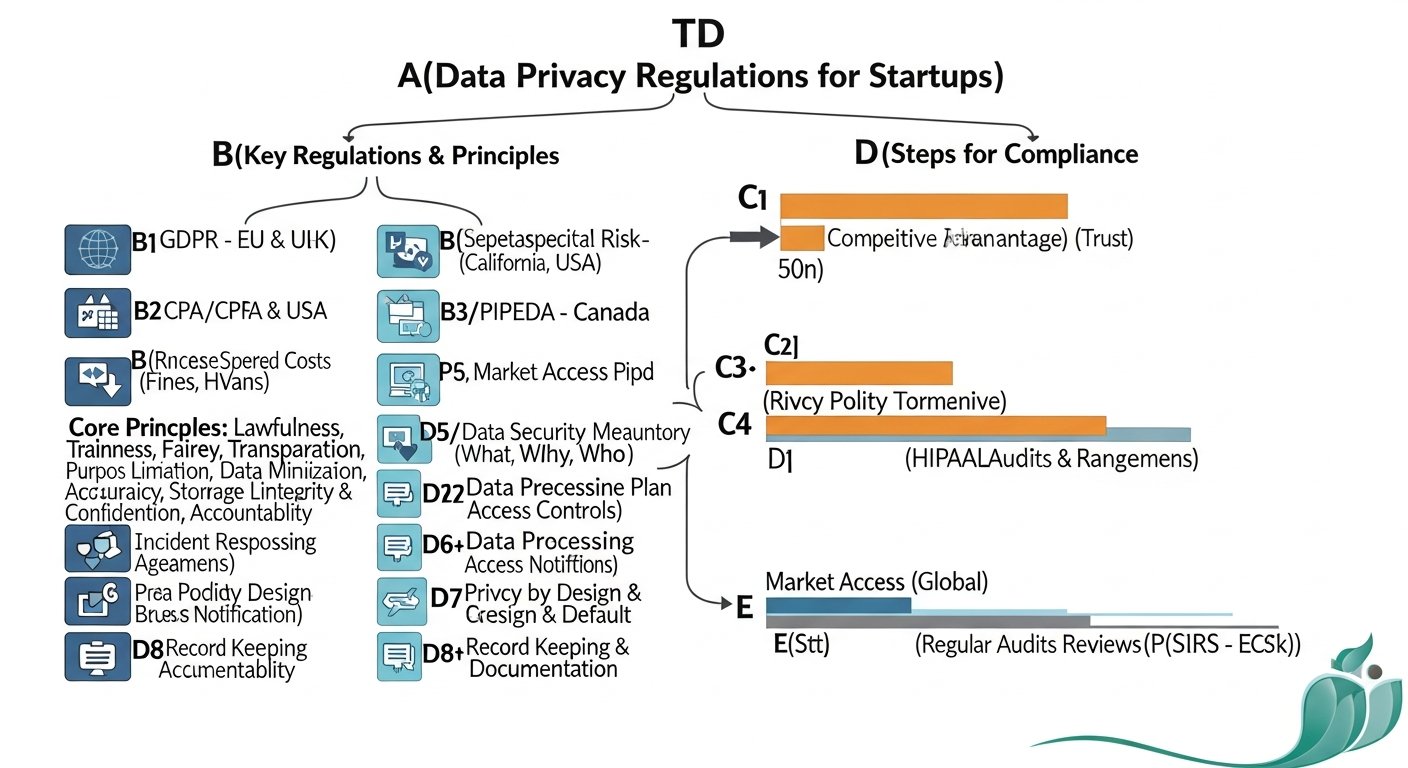
Despite their regional variations, most modern data privacy regulations share a common set of foundational principles designed to protect individuals’ rights and control over their personal data. Understanding these principles is key for any tech startup seeking to establish a robust and globally compliant privacy framework.
- Lawfulness, Fairness, and Transparency: Personal data must be processed lawfully, fairly, and in a transparent manner in relation to the data subject. This means being clear about what data is collected, why it’s collected, and how it will be used.
- Purpose Limitation: Data should be collected for specified, explicit, and legitimate purposes and not further processed in a manner that is incompatible with those purposes.
- Data Minimization: Only collect personal data that is adequate, relevant, and limited to what is necessary for the purposes for which it is processed. Avoid collecting excessive or unnecessary data.
- Accuracy: Personal data must be accurate and, where necessary, kept up to date. Inaccurate data should be rectified or erased without delay.
- Storage Limitation: Data should be kept in a form which permits identification of data subjects for no longer than is necessary for the purposes for which the personal data are processed.
- Integrity and Confidentiality: Data must be processed in a manner that ensures appropriate security of the personal data, including protection against unauthorized or unlawful processing and against accidental loss, destruction, or damage, using appropriate technical or organizational measures.
- Accountability: The data controller (your startup) is responsible for, and must be able to demonstrate compliance with, the above principles. This includes maintaining records of processing activities and implementing appropriate data protection policies.

Which Data Privacy Regulations Apply to Your Startup?
Determining which data privacy regulations apply to your startup is often the first and most critical step in achieving compliance. Given the global nature of tech, a startup may fall under the purview of multiple regulations, even if it operates primarily from a single location. This section outlines the major regulations and their specific applicability to tech startups.
What is GDPR and How Does it Protect EU Data Subjects?
The General Data Protection Regulation (GDPR) is a landmark data privacy law enacted by the European Union. Its reach, however, extends far beyond the EU’s borders, making it arguably the most impactful regulation for tech startups worldwide.
- Geographic Scope: GDPR applies to any organization, regardless of its location, that processes the personal data of individuals residing in the European Union or European Economic Area (EEA). This means if your startup has EU customers, users, or employees, GDPR likely applies to you.
- Data Subject Rights: GDPR empowers individuals with significant rights over their personal data. These include:
- Right to be informed: Individuals have the right to know how their data is being processed.
- Right of access: Individuals can request access to their personal data held by an organization.
- Right to rectification: Individuals can request inaccurate data to be corrected.
- Right to erasure (“Right to be forgotten”): Individuals can request their data to be deleted under certain circumstances.
- Right to restrict processing: Individuals can request the suspension of processing their data.
- Right to data portability: Individuals can request their data in a structured, commonly used, machine-readable format.
- Right to object: Individuals can object to the processing of their data for specific purposes, such as direct marketing.
- Rights in relation to automated decision making and profiling: Individuals have rights regarding decisions made solely based on automated processing.
- Consent Requirements: GDPR sets a high bar for consent, requiring it to be freely given, specific, informed, and unambiguous. Silence, pre-ticked boxes, or inactivity does not constitute consent. Startups must be able to demonstrate that consent was given.
- Data Breach Notification: Organizations must report certain types of data breaches to the relevant supervisory authority within 72 hours of becoming aware of it, and often to affected individuals without undue delay.
- Penalties: GDPR penalties are severe. Fines can reach up to €20 million or 4% of the company’s annual global turnover, whichever is higher, for serious infringements. This is a significant risk for any startup.
- Applicability to Startups: Even a small tech startup offering a SaaS product, a mobile app, or an e-commerce platform that serves even a single EU resident must comply. Resources like data protection officers (DPO) may be required depending on the scale and nature of processing.
What are CCPA and CPRA, and How Do They Impact California Residents?
The California Consumer Privacy Act (CCPA) and its successor, the California Privacy Rights Act (CPRA), provide robust privacy protections for residents of California, USA.
- Geographic Scope: CCPA/CPRA applies to businesses that collect personal information from California residents and meet specific thresholds (e.g., annual gross revenue over $25 million, or processing personal information of 100,000+ consumers/households/devices).
- Consumer Rights: CPRA expands upon CCPA, granting California consumers rights including:
- Right to know: What personal information is collected, used, shared, or sold.
- Right to delete: Request deletion of personal information.
- Right to opt-out: Of the sale or sharing of personal information.
- Right to correct: Inaccurate personal information.
- Right to limit use and disclosure of sensitive personal information: This includes specific categories like health, financial, and precise geolocation data.
- Definition of “Selling” and “Sharing”: CPRA broadens the definition of “sharing” to include cross-context behavioral advertising, regardless of monetary exchange.
- Data Breach Notification: While not as prescriptive as GDPR, California has robust data breach notification laws that often align with CCPA/CPRA expectations for security measures.
- Penalties: Fines can range from $2,500 per violation to $7,500 for intentional violations, plus statutory damages for data breaches.
- Applicability to Startups: Many tech startups, particularly those with a user base in the US, will quickly meet the CPRA’s thresholds due to rapid growth or data processing volumes. It’s essential to assess this early.
What is HIPAA and How Does it Apply to Health Tech Startups?
The Health Insurance Portability and Accountability Act (HIPAA) is a US federal law that establishes national standards to protect sensitive patient health information from being disclosed without the patient’s consent or knowledge.
- Geographic Scope: Applies in the United States to “covered entities” (health plans, healthcare clearinghouses, and healthcare providers) and their “business associates” (those who perform services for covered entities involving Protected Health Information or PHI).
- Protected Health Information (PHI): Any information that can be used to identify an individual and relates to their past, present, or future physical or mental health or condition, the provision of healthcare to the individual, or the past, present, or future payment for the provision of healthcare to the individual.
- Core Rules: HIPAA consists of several rules:
- Privacy Rule: Sets standards for the protection of individually identifiable health information.
- Security Rule: Establishes national standards for protecting electronic PHI.
- Breach Notification Rule: Requires covered entities and their business associates to provide notification following a breach of unsecured PHI.
- Penalties: HIPAA violations carry significant civil and criminal penalties, often structured in tiers based on the level of negligence, reaching tens of thousands to millions of dollars per violation type per year.
- Applicability to Startups: Any health tech startup dealing with patient data, such as telemedicine platforms, fitness trackers that integrate with health records, or AI diagnostics tools, must achieve HIPAA compliance. Even if your startup isn’t a “covered entity,” if you process PHI on behalf of one, you are a “business associate” and must comply through a Business Associate Agreement (BAA).
What are Other Emerging Global Data Privacy Regulations for Startups?
Beyond the major players, a growing number of countries are enacting their own comprehensive data privacy regulations. Tech startups with global ambitions must monitor and adapt to these evolving frameworks.
- LGPD (Lei Geral de Proteção de Dados – Brazil): Modeled after GDPR, Brazil’s LGPD applies to any processing of personal data that occurs in Brazil, or involves data subjects located in Brazil, or is for the purpose of offering goods/services to individuals in Brazil. It grants similar data subject rights and carries substantial penalties.
- PIPL (Personal Information Protection Law – China): China’s PIPL is one of the world’s strictest data privacy laws, effective from late 2021. It applies broadly to the processing of personal information of natural persons within China and even outside China if the purpose is to provide products or services to persons inside China. It has stringent requirements for cross-border data transfers, explicit consent, and DPO appointments.
- Other Regional Laws: Many other regions are following suit, including Canada (PIPEDA), Australia (Privacy Act), India (DPDP), and various US states (e.g., Virginia’s CDPA, Colorado’s CPA, Utah’s UCPA, Connecticut’s CTDPA). These often share common principles but have specific nuances regarding scope, rights, and enforcement.
- Applicability to Startups: A global tech startup will likely need a flexible compliance strategy that can adapt to multiple regulatory requirements. It’s crucial to identify your target markets and assess their respective privacy laws during product development and market entry planning.
Table 1: Key Data Privacy Regulations for Startups
| Regulation (Entity) | Geographic Scope (Attribute) | Key Principles (Attribute) | Data Subject Rights (Attribute) | Maximum Penalties (Attribute) | Key Startup Action (Attribute) |
|---|---|---|---|---|---|
| GDPR | EU/EEA residents (worldwide applicability) | Lawfulness, fairness, transparency, purpose limitation, data minimization, accuracy, storage limitation, integrity, confidentiality, accountability. | Access, rectification, erasure, restrict processing, data portability, object, automated decision-making. | €20M or 4% of global annual turnover (whichever is higher). | Consent management, DPO, breach notification, DPIA. |
| CCPA/CPRA | California residents (based on thresholds) | Transparency, accountability, consumer control over personal information. | Know, delete, opt-out of sale/sharing, correct, limit use of sensitive PI. | $2.5k-$7.5k per violation, statutory damages for breaches. | “Do Not Sell/Share My Personal Information” link, data mapping, service provider contracts. |
| HIPAA | US (Covered Entities & Business Associates handling PHI) | Privacy (PHI disclosure), Security (ePHI protection), Breach Notification. | Access, amendment, accounting of disclosures, request restrictions. | Tiers up to $50k per violation (cap $1.5M/year), criminal penalties. | BAAs, robust security controls, risk assessments, staff training. |
| LGPD | Brazil residents/processing in Brazil | Similar to GDPR: purpose, adequacy, necessity, free access, quality, transparency, security, prevention, non-discrimination, accountability, data subject rights. | Access, rectification, erasure, portability, revoke consent, opposition, review automated decisions. | 2% of company’s Brazilian revenue (cap R$50M per infringement). | Data Protection Impact Assessments, DPO, consent records. |
| PIPL | China residents/processing within China or targeting China | Lawfulness, legitimacy, necessity, transparency, purpose limitation, data minimization, accountability. | Access, copy, rectify, delete, revoke consent, object to processing, explanation for automated decisions. | RMB 50M or 5% of previous year’s annual revenue, business suspension. | Strict consent, DPO, cross-border transfer security assessments, impact assessments. |
How Can Startups Build a Robust Data Privacy Compliance Framework?
Achieving and maintaining compliance with data privacy regulations is an ongoing process that requires a structured approach. For tech startups, this means integrating privacy considerations into every stage of their product development and business operations. Here are actionable steps to build a robust compliance framework.
How Do Startups Conduct a Data Inventory and Mapping Exercise?
Before you can protect data, you must know what data you have. A data inventory identifies all personal data your startup collects, stores, processes, and transmits. Data mapping then visualizes the flow of this data throughout your systems and with third parties. This exercise is foundational because it helps you:
- Identify categories of personal data (e.g., customer names, email addresses, IP addresses, health data).
- Determine the purpose and legal basis for processing each type of data.
- Locate where data is stored (databases, cloud services, physical files).
- Understand who has access to the data (employees, third-party vendors).
- Identify cross-border data transfers and their mechanisms.
- Pinpoint potential privacy risks and areas of non-compliance.
For startups, this can be done incrementally, starting with your core product and expanding as your data footprint grows. Tools for data discovery and mapping can automate parts of this process, helping lean teams manage complexity.
How Do Startups Develop a Robust Privacy Policy and Terms of Service?
Your Privacy Policy is a public declaration of your data handling practices, crucial for transparency. Your Terms of Service (or Terms of Use) outline the contractual agreement between your startup and its users. Both documents must be clear, concise, easily accessible, and legally compliant.
- Privacy Policy Elements:
- What personal data you collect and how.
- The purposes for which data is processed.
- The legal basis for processing (e.g., consent, contract, legitimate interest).
- How data is stored, secured, and retained.
- Who your startup shares data with (third-party vendors, partners).
- Information on cross-border data transfers.
- Data subject/consumer rights and how users can exercise them.
- Contact information for privacy inquiries.
- Effective date and notification of changes.
- Startup Relevance: Ensure your Privacy Policy is not just a template. Customize it to reflect your startup’s actual data practices. For example, if you collect unique telemetry data for product improvement, explain this clearly. Regularly review and update these documents as your product evolves or new regulations emerge.
How Can Startups Implement Effective Consent Management Mechanisms?
Many data privacy regulations, especially GDPR and CPRA, hinge on valid consent for certain data processing activities. For tech startups, effective consent management is paramount.
- Granular Consent: Users should be able to give separate consent for different processing purposes (e.g., essential cookies vs. marketing cookies).
- Clear and Unambiguous: Consent requests should be presented in plain language, not buried in jargon.
- Opt-in, Not Opt-out: Pre-checked boxes are generally not acceptable. Users must actively affirm their consent.
- Easy Withdrawal: Users must be able to withdraw consent as easily as they gave it.
- Record Keeping: Your startup must maintain records of consent (who, when, what was agreed to) to demonstrate compliance.
- Cookie Banners and Preference Centers: Implement user-friendly interfaces, such as cookie consent banners, that allow users to manage their preferences.
How Do Startups Establish Data Breach Response Protocols?
No system is entirely impervious to attack. A data breach response plan is critical for managing the aftermath of a security incident effectively, minimizing harm, and meeting regulatory notification requirements.
- Identification: Define procedures for promptly detecting and confirming a data breach.
- Containment: Steps to limit the damage and prevent further unauthorized access.
- Assessment: Evaluate the nature, scope, and impact of the breach, including the types of data affected and the number of individuals.
- Notification: Clearly outline who needs to be notified (regulatory authorities, affected individuals, internal stakeholders) and within what timeframe, according to applicable laws (e.g., 72 hours for GDPR).
- Remediation: Actions to fix vulnerabilities and prevent recurrence.
- Documentation: Maintain detailed records of the incident and all response activities.
For startups, a clear, pre-defined plan saves critical time and reduces panic during a crisis, ensuring timely compliance with strict notification deadlines.
Should Startups Appoint a Data Protection Officer (DPO) or Privacy Lead?
Certain regulations, like GDPR, mandate the appointment of a Data Protection Officer (DPO) for organizations meeting specific criteria (e.g., large-scale processing of special categories of data, public authorities). Even if not legally required, appointing a dedicated Privacy Lead is a best practice for tech startups.
- Responsibilities of a DPO/Privacy Lead:
- Advising the organization on data protection obligations.
- Monitoring compliance with data protection laws and internal policies.
- Acting as a contact point for supervisory authorities and data subjects.
- Conducting Data Protection Impact Assessments (DPIAs).
- Providing training and awareness for employees.
- Startup Relevance: For resource-constrained startups, this might initially be an existing team member with relevant skills or an outsourced DPO service. The key is to have a designated individual or team responsible for overseeing privacy compliance.
How Can Startups Ensure Third-Party Vendor Compliance?
Modern tech startups rely heavily on a web of third-party vendors for everything from cloud hosting (AWS, Azure, GCP) to analytics (Google Analytics) and CRM (Salesforce). Each vendor that processes personal data on your behalf is a potential weak link in your privacy chain.
- Due Diligence: Thoroughly vet potential vendors for their security and privacy practices. Ask for certifications (e.g., ISO 27001), audit reports (e.g., SOC 2), and their own privacy policies.
- Data Processing Agreements (DPAs): Under GDPR and similar laws, you must have a DPA (or similar contract, e.g., a Business Associate Agreement for HIPAA) with any third-party data processor. These contracts legally bind vendors to protect data according to your instructions and applicable laws.
- Ongoing Monitoring: Regularly review vendor contracts and ensure they are upholding their commitments. Understand their sub-processors and data transfer mechanisms.

What are the Strategic Advantages of Data Privacy Compliance for Startups?
While often perceived as a burden, robust data privacy compliance can be a significant strategic asset for tech startups. It moves beyond mere risk mitigation to become a catalyst for growth, trust, and market differentiation.
How Does Data Privacy Compliance Foster Customer Trust and Brand Reputation?
In an era of frequent data breaches and privacy scandals, consumers are increasingly wary of how their personal data is handled. For a startup, demonstrating a proactive commitment to data privacy is a powerful way to build and maintain trust.
- Differentiation: A privacy-first approach sets your startup apart from competitors who might treat privacy as an afterthought.
- Customer Loyalty: Users are more likely to engage with and remain loyal to companies they trust with their data. This translates to higher retention rates and positive word-of-mouth.
- Brand Equity: A strong privacy posture enhances your brand reputation, portraying your startup as responsible, ethical, and reliable. This positive image can attract more users, partners, and talent.
For tech startups, where early user adoption and word-of-mouth are crucial, building a reputation for privacy excellence can be an invaluable asset.
How Does Data Privacy Compliance Unlock New Markets and Investment Opportunities?
Compliance is a key to expanding market reach and securing funding, especially for startups operating globally or seeking significant investment.
- Global Market Access: Adhering to regulations like GDPR or PIPL is often a prerequisite for entering specific international markets. A compliant startup can expand its user base globally without fear of immediate legal challenges.
- Investor Confidence: Investors are increasingly scrutinizing a startup’s privacy and cybersecurity readiness. A well-documented compliance framework reduces perceived legal and financial risks, making your startup a more attractive investment. It signals maturity, good governance, and foresight.
- Partnerships and Acquisitions: Larger companies and potential acquirers conduct extensive due diligence on privacy practices. Being compliant makes your startup a more appealing partner or acquisition target, potentially increasing its valuation.
How Does Data Privacy Compliance Mitigate Legal Risks and Financial Penalties?
Perhaps the most immediate and tangible benefit of data privacy compliance is the mitigation of legal and financial risks. Non-compliance can result in staggering fines that no startup can afford, along with other severe consequences.
- Avoiding Fines: As seen with GDPR’s €20 million or 4% turnover penalty and CCPA’s multi-thousand-dollar violations, non-compliance can be crippling. Proactive compliance is a cost-effective alternative to reactive damage control.
- Preventing Lawsuits: Data breaches and privacy violations can lead to class-action lawsuits and individual claims, resulting in significant legal costs, settlements, and damages.
- Protecting IP and Data Assets: Robust privacy and security measures, part of a comprehensive compliance strategy, also protect your startup’s own intellectual property and sensitive business data from unauthorized access or theft.
- Reputational Damage: Beyond financial penalties, regulatory investigations and public perception of a data breach can severely harm a startup’s reputation, making it difficult to recover, attract new users, or raise capital.
What Are the Biggest Data Privacy Challenges for Growing Startups?
While the benefits of compliance are clear, tech startups, particularly those experiencing rapid growth, face unique and often formidable challenges in maintaining robust data privacy practices. These challenges require strategic thinking and agile solutions.
What are the Challenges of Scaling Data Privacy Compliance with Rapid Growth?
One of the most significant challenges for a successful tech startup is how to scale data privacy compliance at the same pace as its user base, data volume, and team size. What works for 100 users might fail for 100,000.
- Resource Constraints: Startups typically have limited legal, security, and financial resources compared to established enterprises. Hiring dedicated privacy professionals or investing in expensive compliance software can be a stretch.
- Product Velocity vs. Privacy-by-Design: The pressure to rapidly iterate and launch new features can sometimes conflict with the slower, more deliberate process of integrating Privacy-by-Design principles into every stage of development.
- Increasing Data Volume and Complexity: As a startup grows, it collects more data from more sources, making data inventory, mapping, and lifecycle management increasingly complex.
- Geographic Expansion: Entering new markets brings new local regulations, requiring continuous adaptation of policies and practices.
What are the Challenges of Navigating Cross-Border Data Transfers?
Many tech startups inherently operate across borders, dealing with users, servers, and team members in different countries. This immediately triggers complex rules around international data transfers, particularly for data originating from the EU (under GDPR) or China (under PIPL).
- Adequacy Decisions: The EU permits data transfers to countries deemed “adequate” (e.g., Japan, UK) which offer comparable data protection. For other countries, specific safeguards are required.
- Standard Contractual Clauses (SCCs): These are pre-approved contractual clauses by the European Commission that must be incorporated into agreements with data importers outside the EU/EEA.
- Transfer Impact Assessments (TIAs): Following the Schrems II ruling, organizations must assess if the laws of the recipient country undermine the effectiveness of SCCs or other transfer mechanisms. This is a complex legal and technical exercise.
- Localization Requirements: Some countries (e.g., China with PIPL) have strict data localization requirements, mandating that certain data remains within their borders, posing infrastructure and compliance challenges.
How Do AI and New Technologies Impact Data Privacy for Startups?
Tech startups are often at the forefront of adopting and developing cutting-edge technologies like Artificial Intelligence (AI), Machine Learning (ML), and blockchain. While these technologies offer immense potential, they also introduce novel privacy challenges.
- Bias in Algorithms: AI systems trained on biased data can lead to discriminatory outcomes that violate privacy principles.
- Data Minimization Challenges: ML models often require vast datasets for training, which can conflict with data minimization principles. Anonymization and pseudonymization techniques must be robust.
- Explainability and Transparency: “Black box” AI models can make it difficult to explain how personal data is being used or how decisions are being made, challenging transparency and data subject rights (e.g., the right to explanation under GDPR).
- Ethical AI Concerns: Beyond legal compliance, startups must navigate the ethical implications of using new technologies, considering fairness, accountability, and potential societal impact.
How Can Startups Future-Proof Their Data Privacy Strategy?
In a landscape where data privacy regulations are constantly evolving and technology is advancing at an unprecedented pace, a static compliance approach is insufficient. For sustainable growth, tech startups must adopt a future-proof data privacy strategy that embraces continuous improvement and a strong privacy culture.
Why is Continuous Monitoring and Adaptation Essential for Data Privacy?
Data privacy is not a one-time project; it’s an ongoing journey. Regulations change, new technologies emerge, and your startup’s own data practices will evolve. Therefore, continuous monitoring and adaptation are essential.
- Stay Informed: Regularly monitor updates to existing regulations and be aware of new laws being proposed in your target markets. Subscribe to legal and industry newsletters.
- Regular Audits and Reviews: Conduct periodic internal and external audits of your data processing activities, security measures, and compliance framework. Review your privacy policy, terms of service, and vendor agreements annually, or when significant changes occur.
- Incident Response Drills: Periodically test your data breach response plan through simulated drills to ensure your team is prepared and your protocols are effective.
- Technology Stack Assessment: As you adopt new tools and platforms, assess their privacy implications and ensure they align with your compliance obligations.
How Can Startups Cultivate a Privacy-First Company Culture?
Ultimately, the most effective data privacy strategy is one that is embedded in the very culture of your startup. A “privacy-first” culture means that every employee, from developers to marketers, understands their role in protecting personal data.
- Leadership Buy-in: Privacy initiatives must be championed from the top down. Leadership needs to demonstrate commitment through resources, policies, and communication.
- Employee Training: Regular, comprehensive training for all employees on data privacy principles, company policies, and specific regulatory requirements is crucial. This should include how to identify and report potential privacy incidents.
- Privacy-by-Design and Default: Integrate privacy considerations into the earliest stages of product development (Privacy-by-Design) and ensure that default settings are the most privacy-friendly (Privacy-by-Default).
- Internal Policies and Guidelines: Develop clear internal policies for data handling, access controls, data retention, and security best practices. Make these accessible and enforceable.
- Open Communication: Foster an environment where employees feel comfortable raising privacy concerns or suggesting improvements without fear of reprisal.
By making privacy a core value, your startup not only meets regulatory requirements but also builds a more resilient, trustworthy, and ultimately, successful organization.
Table 2: Startup Data Privacy Compliance Checklist
| Compliance Area (Entity) | Action Required (Attribute) | Startup Relevance (Attribute) | Resources/Tools (Attribute) |
|---|---|---|---|
| Data Mapping | Inventory all personal data collected, stored, processed, and shared. Document data flows. | Essential first step to understand your data footprint; informs all other compliance efforts. | Spreadsheets, specialized data mapping software, privacy consultants. |
| Privacy Policy | Draft/update clear, comprehensive, and accessible policy reflecting actual data practices. | Builds trust, legally required for transparency, must be tailored to your services. | Legal counsel, privacy policy generators (templates as starting point). |
| Consent Management | Implement mechanisms for obtaining, managing, and documenting user consent. | Crucial for GDPR/CPRA, impacts marketing, analytics, and cookie usage. | Consent Management Platforms (CMPs), in-app privacy settings. |
| Data Breach Protocol | Develop and test an incident response plan for data breaches, including notification procedures. | Minimizes damage, ensures timely legal notification, mitigates reputational harm. | Internal security team, incident response plan templates, legal advice. |
| DPO/Privacy Lead | Appoint a designated individual or outsource DPO services to oversee privacy compliance. | Ensures ongoing accountability, expert guidance, central point of contact. | Internal hire, fractional DPO, external privacy consulting firm. |
| Employee Training | Provide regular training on data privacy principles, policies, and best practices for all staff. | Human element is key to security; reduces internal risks, fosters privacy culture. | Online training modules, internal workshops, security awareness platforms. |
| Vendor Agreements | Ensure Data Processing Agreements (DPAs) or BAAs are in place with all third-party processors. | Extends your privacy obligations to vendors; crucial for supply chain security. | Legal counsel for drafting DPAs, vendor management platforms. |
| Security Measures | Implement appropriate technical and organizational security measures to protect data. | Fundamental to preventing breaches; legal requirement under most regulations. | Encryption, access controls, vulnerability scanning, security audits, cybersecurity tools. |
The landscape of data privacy regulations for startups is undeniably complex and ever-changing, but approaching it strategically offers substantial benefits beyond mere avoidance of penalties. By embedding privacy into your core operations, fostering a privacy-first culture, and continuously adapting to new requirements, your tech startup can build deeper customer trust, unlock new market opportunities, and establish a foundation for sustainable, ethical growth in the digital age. This proactive stance transforms compliance from a daunting obligation into a powerful competitive advantage.
References
- General Data Protection Regulation (GDPR) Official Text
- California Consumer Privacy Act (CCPA) Official Information
- Health Insurance Portability and Accountability Act (HIPAA) Overview
- Lei Geral de Proteção de Dados (LGPD) Overview
- Personal Information Protection Law (PIPL) of the People’s Republic of China