DevOps Explained for Startup Founders 2026: Build Faster, Scale Smarter, Dominate Your Niche
As an ambitious startup founder, your greatest assets are speed, agility, and the relentless pursuit of customer value. In the hyper-competitive landscape of 2026, simply having a great idea isn’t enough. You need to build, iterate, and deploy at a pace that leaves competitors trailing, all while maintaining rock-solid stability and security. This is where DevOps becomes not just a buzzword, but a foundational strategy for survival and exponential growth. Forget the notion that DevOps is solely for tech giants; for startups, it’s the strategic imperative that transforms your development pipeline from a bottleneck into a competitive weapon. This guide cuts through the jargon, offering a sharp, practical roadmap to understanding and leveraging DevOps to scale your venture smarter, faster, and with unparalleled resilience.
What is DevOps (Beyond the Buzzword)? The Startup Imperative
At its core, DevOps isn’t a tool, a single role, or even a methodology in isolation. It’s a cultural philosophy and a set of practices designed to integrate development (Dev) and operations (Ops) teams, breaking down silos that traditionally hinder software delivery. Its ultimate goal for a startup is simple: to shorten the systems development life cycle and provide continuous delivery with high software quality. Think of it as the ultimate convergence of people, process, and technology, orchestrated to deliver value to your users faster and more reliably.
For a startup, the urgency of adopting DevOps is amplified. You operate with limited resources, tight deadlines, and the constant pressure to innovate. Traditional, siloed approaches where developers “throw code over the wall” to operations often lead to:
- Slower Time-to-Market: Hand-offs are bottlenecks. Each manual step adds delays, pushing back critical feature releases.
- Increased Risk: Manual deployments are prone to human error, leading to outages, security vulnerabilities, and costly downtime.
- Developer Burnout: Developers spend less time innovating and more time troubleshooting deployment issues or waiting on ops.
- Higher Operational Costs: Inefficient processes and reactive firefighting drain resources that could be invested in growth.
DevOps counters these challenges by fostering a culture of shared responsibility, collaboration, and automation. Instead of “Dev vs. Ops,” it’s “Dev AND Ops” working together from ideation to deployment and beyond. This unified approach means your startup can:
- Accelerate Innovation: Faster feedback loops mean you can test hypotheses, learn, and adapt your product based on real user data, often deploying multiple times a day.
- Enhance Reliability & Stability: Automated, repeatable processes drastically reduce errors, leading to more stable applications and fewer disruptions. Data from industry reports consistently show that high-performing DevOps teams have 7x lower change failure rates.
- Improve Security Posture: By integrating security practices (DevSecOps) early and continuously into the development pipeline, you proactively identify and mitigate vulnerabilities, rather than patching reactively.
- Optimize Resource Utilization: Automation frees up your lean team to focus on high-value tasks – building features, strategizing, and customer engagement – instead of manual toil.
- Scale Efficiently: As your user base grows, DevOps practices like Infrastructure as Code and containerization allow you to scale your infrastructure up or down programmatically, avoiding costly over-provisioning or performance bottlenecks.
Ultimately, DevOps is about building a sustainable competitive advantage. It’s about transforming your ability to respond to market demands, pivot strategies, and deliver an exceptional user experience, setting your startup on a trajectory for long-term success.
The Core Pillars of DevOps: CALMS and CI/CD, Your Startup’s Engine
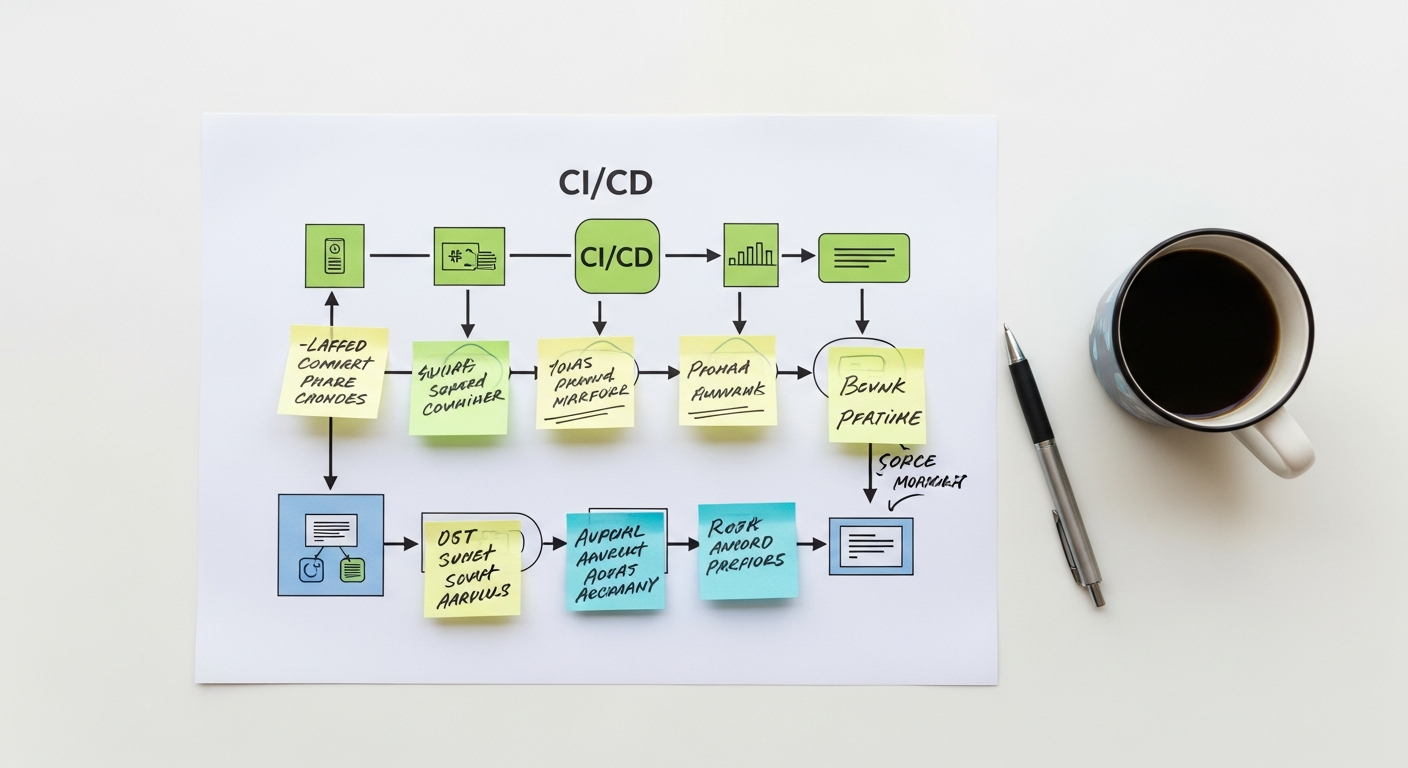
To truly grasp DevOps, founders need to understand its foundational principles and practices. We often distill the philosophy into an acronym: CALMS, complemented by the engine that drives continuous delivery: CI/CD.
CALMS: The Cultural & Operational Framework
CALMS stands for Culture, Automation, Lean, Measurement, and Sharing. Each element is crucial for a successful DevOps transformation:
- Culture: This is the bedrock. It’s about breaking down traditional organizational silos between development, operations, and even security teams. It promotes collaboration, shared responsibility, empathy, and psychological safety. For a startup, this means fostering an environment where everyone understands the end-to-end delivery process, feels empowered to contribute, and focuses on collective success. It’s moving from “that’s not my job” to “how can we make this better, together?”
- Automation: The backbone of efficiency. Automating repetitive, manual tasks across the entire software delivery lifecycle – from code integration and testing to infrastructure provisioning and deployment – reduces human error, increases speed, and frees up valuable engineering time. This is where tools shine, replacing tedious checklists with reliable, scriptable processes.
- Lean: Applying Lean manufacturing principles to software development. This means identifying and eliminating waste (e.g., unnecessary steps, waiting times, defects), focusing on delivering value continuously, and optimizing flow. For startups, lean principles translate into smaller batch sizes for changes, rapid iteration, and a relentless focus on what truly matters to the customer.
- Measurement: “What gets measured gets managed.” DevOps emphasizes collecting data at every stage of the pipeline. This includes deployment frequency, lead time for changes, mean time to recovery (MTTR), change failure rate, and application performance metrics. These metrics provide objective insights into bottlenecks, areas for improvement, and the overall health of your delivery process, enabling data-driven decision-making.
- Sharing: Fostering knowledge sharing and transparency across teams. This includes sharing tools, practices, lessons learned (both successes and failures), and feedback. A culture of sharing builds collective intelligence, reduces duplicated effort, and accelerates learning within your organization.
CI/CD: The Engine of Continuous Delivery
While CALMS defines the philosophy, Continuous Integration (CI), Continuous Delivery (CD), and Continuous Deployment (CD) are the practical methodologies that bring DevOps to life. They are the engine driving your startup’s ability to release software rapidly and reliably.
- Continuous Integration (CI):
- What it is: Developers frequently merge their code changes into a central repository (e.g., Git). Each merge triggers an automated build and test process.
- Why it matters for startups: Prevents “integration hell” where merging large chunks of code at the end of a sprint leads to complex conflicts and bugs. CI catches issues early, making them easier and cheaper to fix. It ensures your codebase is always in a working, releasable state.
- Key practices: Frequent commits, automated builds, automated unit/integration tests.
- Continuous Delivery (CD):
- What it is: An extension of CI, where code changes are automatically built, tested, and prepared for release to production. The key here is that the software is always in a deployable state, though the actual deployment to production is a manual step (often a button click).
- Why it matters for startups: Gives you the confidence that you can release new features or bug fixes to customers at any time, on demand, with minimal risk. It drastically reduces release anxiety and enables faster response to market changes.
- Key practices: Automated end-to-end testing, artifact management, environment provisioning.
- Continuous Deployment (CD):
- What it is: The pinnacle of CI/CD, where every change that passes all automated tests is automatically deployed to production without human intervention.
- Why it matters for startups: Achieves the fastest possible time-to-market for new features and bug fixes. While not every startup starts here, it’s an aspirational goal for mature DevOps practices, enabling true continuous innovation.
- Key practices: Robust automated testing, comprehensive monitoring, feature flags for controlled rollouts.
Together, CALMS provides the cultural and operational blueprint, while CI/CD builds the automated pipeline that makes your startup agile, resilient, and relentlessly focused on delivering value.
Key DevOps Practices & Tools for Startups in 2026
Implementing DevOps effectively requires more than just a philosophy; it demands practical tools and techniques that automate and streamline your workflow. For startups, choosing the right tools is critical – you need powerful, scalable solutions that don’t break the bank or require an army of engineers to manage. Here’s a breakdown of essential practices and the modern tools that enable them:
1. Version Control & Collaboration
- Practice: Every line of code, configuration file, and even documentation should be tracked. This enables collaboration, historical tracking, and easy rollback.
- Tools:
- Git: The industry standard for distributed version control. Essential.
- GitHub / GitLab / Bitbucket: Cloud-based platforms built on Git, offering code hosting, pull requests (for code review), issue tracking, and increasingly, integrated CI/CD capabilities. GitLab is particularly strong for its “everything in one platform” approach, while GitHub Actions provides powerful CI/CD directly within GitHub repos.
2. Infrastructure as Code (IaC)
- Practice: Managing and provisioning infrastructure (servers, networks, databases, load balancers) through code, rather than manual configuration. This makes infrastructure repeatable, versionable, and scalable.
- Why it matters for startups: Eliminates “snowflake” servers, ensures consistent environments (dev, staging, prod), and dramatically speeds up environment provisioning.
- Tools:
- Terraform (HashiCorp): Cloud-agnostic tool for defining and provisioning infrastructure using a declarative language (HCL). Excellent for managing resources across AWS, Azure, GCP, and more.
- AWS CloudFormation / Azure Resource Manager / Google Cloud Deployment Manager: Native IaC tools for specific cloud providers. Great if you’re heavily invested in a single cloud.
- Ansible (Red Hat): An agentless automation engine for configuration management, application deployment, and orchestration. Ideal for automating software installation and configuration on existing servers.
3. Containerization & Orchestration
- Practice: Packaging applications and their dependencies into lightweight, portable, self-sufficient units (containers). This ensures your application runs consistently across different environments. Orchestration manages the lifecycle of these containers at scale.
- Why it matters for startups: Solves “it works on my machine” problems, enables microservices architectures, improves resource utilization, and simplifies scaling.
- Tools:
- Docker: The de facto standard for containerization. Essential for building and running containers.
- Kubernetes (K8s): The leading container orchestration platform. Manages containerized workloads and services, automating deployment, scaling, and management. While complex, managed Kubernetes services (EKS on AWS, AKS on Azure, GKE on GCP) make it accessible for startups.
- AWS Fargate / Azure Container Instances / Google Cloud Run: Serverless container options that allow you to run containers without managing the underlying servers, perfect for startups looking to minimize operational overhead.
4. CI/CD Pipeline Automation
- Practice: Automating the entire software delivery pipeline from code commit to deployment.
- Why it matters for startups: Enables rapid, reliable, and frequent releases, crucial for fast iteration and competitive advantage.
- Tools:
- GitHub Actions: Deeply integrated with GitHub, easy to use, and offers a vast marketplace of actions. Ideal for teams already on GitHub.
- GitLab CI/CD: Fully integrated into GitLab, offering powerful and flexible pipelines. A strong choice if you use GitLab for version control.
- Jenkins: A highly extensible, open-source automation server. While powerful, it requires more setup and maintenance, often better suited for larger teams with dedicated ops.
- CircleCI / Travis CI: Popular cloud-based CI/CD services known for their ease of use and quick setup.
5. Monitoring & Logging
- Practice: Continuously collecting and analyzing data on application performance, infrastructure health, and user behavior. This provides visibility into your systems and helps quickly identify and resolve issues.
- Why it matters for startups: Proactive problem-solving, understanding system bottlenecks, and ensuring a smooth user experience.
- Tools:
- Prometheus & Grafana: A powerful open-source combination for metric collection (Prometheus) and visualization/dashboarding (Grafana).
- ELK Stack (Elasticsearch, Logstash, Kibana): A popular open-source suite for collecting, processing, and visualizing logs.
- Datadog / New Relic / Dynatrace: Commercial, all-in-one observability platforms offering comprehensive monitoring, logging, tracing, and alerting, often with a higher price point but less management overhead. Many offer startup-friendly tiers.
By strategically adopting these practices and leveraging these tools, your startup can build a robust, automated, and efficient software delivery pipeline that scales with your ambition.
Building Your DevOps Roadmap: A Step-by-Step Guide for Founders

As a founder, you don’t need to become a DevOps engineer, but you absolutely need a strategic understanding to guide your team. Here’s a practical, step-by-step roadmap to integrate DevOps into your startup, focusing on impact and sustainability:
Step 1: Assess Your Current State & Define Your “Why”
- Action: Conduct an honest assessment. Where are your biggest bottlenecks in software delivery? Is it slow deployments, frequent bugs, lack of environment consistency, or painful manual processes?
- Founder Insight: Don’t just implement DevOps because it’s trendy. Define clear, measurable goals. Do you want to reduce deployment time by 50%? Decrease critical bugs by 30%? Increase deployment frequency from monthly to daily? These KPIs will guide your efforts and demonstrate ROI.
Step 2: Start Small, Think Big – The Pilot Project Approach
- Action: Don’t attempt a “big bang” transformation. Identify a single, relatively contained project or a specific pain point that can serve as your DevOps pilot. This could be automating the deployment of a specific microservice or setting up CI for a new feature module.
- Founder Insight: Small wins build momentum and demonstrate value. A successful pilot creates internal champions and provides valuable lessons learned before you scale. For example, automating the build and test for just one repository can already save hours per week.
Step 3: Foster Collaboration & Break Down Silos
- Action: Encourage developers and operations personnel (even if it’s just one person wearing multiple hats) to work together from the outset of a project. Use shared communication channels (Slack, Microsoft Teams) and joint planning sessions.
- Founder Insight: DevOps is 80% culture, 20% tools. As the founder, you set the tone. Emphasize shared responsibility for the product’s success, not just individual components. Promote empathy between roles.
Step 4: Prioritize Automation (The Low-Hanging Fruit First)
- Action: Begin automating the most repetitive, error-prone, and time-consuming manual tasks.
- Version Control: Ensure all code and configurations are in Git.
- Automated Builds & Tests (CI): Set up a basic CI pipeline (e.g., GitHub Actions, GitLab CI) for automatic building and running unit/integration tests on every code commit.
- Basic Deployment Scripting: Even a simple script to deploy to your staging environment is a huge step forward.
- Founder Insight: Automation isn’t about eliminating jobs; it’s about eliminating toil. It frees your skilled engineers to focus on innovation. Invest in tools and training here; the ROI is immediate. Data shows organizations with high automation levels deploy 200x more frequently.
Step 5: Embrace Infrastructure as Code (IaC)
- Action: Start defining your infrastructure in code using tools like Terraform. Begin with non-critical environments (dev, staging) before moving to production.
- Founder Insight: IaC is your blueprint for scalability and disaster recovery. It ensures consistency, reduces configuration drift, and makes it easy to spin up new environments or recover quickly from failures. This is non-negotiable for serious scaling.
Step 6: Implement Robust Monitoring & Feedback Loops
- Action: Deploy monitoring and logging solutions (e.g., Prometheus/Grafana, Datadog) to gain real-time visibility into your applications and infrastructure. Set up alerts for critical issues.
- Founder Insight: You can’t improve what you don’t measure. Monitoring provides the data to identify bottlenecks, validate changes, and ensure your users are having a good experience. Integrate feedback from monitoring directly back into your development cycle.
Step 7: Iterate, Learn, and Continuously Improve
- Action: DevOps is a journey, not a destination. Regularly review your processes, analyze your metrics, and gather feedback from your team. What’s working? What isn’t? What new tools or practices could further enhance efficiency?
- Founder Insight: Foster a culture of continuous learning and experimentation. Celebrate successes, and learn from failures without blame. Encourage your team to dedicate a portion of their time to “DevOps improvements” or “technical debt reduction.”
By following this roadmap, your startup can systematically build a powerful DevOps capability, ensuring you’re not just keeping pace, but setting the pace in your market.
DevOps in Action: Real-World Startup Success Stories (and Pitfalls to Avoid)
The theoretical benefits of DevOps are compelling, but its true power is best illustrated through real-world impact. While I can’t name specific current startups without potentially missing the 2026 mark, we can look at patterns of success and common missteps.
Success Story Pattern: The Rapid Scaling Innovator
Consider a hypothetical SaaS startup, “MarketPulse AI,” offering real-time market insights. In its early days, MarketPulse faced common startup challenges: slow deployments (weekly, at best), frequent “hotfixes” needed after releases, and developers spending significant time on manual server provisioning. Their founder, realizing the market was moving fast, initiated a DevOps transformation.
- Initial Phase: They started by adopting Git for everything (code, configurations, docs) and implementing a basic CI pipeline using GitHub Actions. Developers were encouraged to commit daily, and automated unit tests ran on every push. This immediately reduced integration issues.
- Mid-Phase: Next, they embraced Infrastructure as Code with Terraform to manage their AWS resources. This allowed them to spin up identical staging environments for every feature branch, dramatically improving testing confidence. They containerized their microservices with Docker and deployed them to a managed Kubernetes service (EKS), enabling seamless scaling.
- Advanced Phase: They built out a full CI/CD pipeline, achieving multiple deployments to production daily. Monitoring with Datadog provided deep insights into application performance and user experience, with alerts feeding directly into their communication channels. Security scanning was integrated into their CI pipeline (DevSecOps).
The Result: MarketPulse AI went from weekly, risky deployments to daily, confident releases. Their Mean Time To Recovery (MTTR) for critical issues dropped by 80%. This agility allowed them to quickly launch new AI models, respond to competitor moves, and gather customer feedback at an unprecedented pace, ultimately capturing significant market share and attracting a major acquisition offer. Their development team, freed from manual toil, focused on innovation, leading to a highly engaged and productive workforce.
Common Pitfalls to Avoid for Startups:
While the benefits are clear, the path isn’t without its hazards. Founders must steer clear of these common traps:
- The “Big Bang” Approach: Attempting to implement all DevOps practices and tools simultaneously across your entire organization. This almost always leads to overwhelmed teams, resistance, and failure.
- Founder Fix: Start small, pick one or two high-impact areas (like CI or IaC for a new service), prove its value, and then expand incrementally.
- Ignoring the Culture Aspect: Focusing solely on tools and automation without addressing the underlying cultural shift towards collaboration and shared responsibility. If Dev and Ops still blame each other, no tool will fix it.
- Founder Fix: Lead by example. Foster a blame-free culture, encourage cross-functional meetings, and celebrate collective achievements. Emphasize “you build it, you run it” ownership.
- Tool-Hopping & Over-Engineering: Adopting too many complex tools too quickly, or choosing enterprise-grade solutions that are overkill for a startup’s needs. This adds unnecessary complexity and maintenance burden.
- Founder Fix: Prioritize simplicity and practicality. Start with managed services (e.g., managed Kubernetes, cloud CI/CD) and open-source tools that have strong community support. Only introduce complexity when your actual scaling needs demand it.
- Lack of Leadership Buy-in & Investment: Seeing DevOps as a “tech” problem rather than a strategic business imperative. Without consistent support, resources, and recognition from leadership, teams will struggle to make lasting changes.
- Founder Fix: Be the champion. Allocate budget for tools, training, and dedicated time for engineers to improve processes. Communicate the business value of DevOps to your board and investors.
- Forgetting Security: Treating security as an afterthought or a separate stage at the very end of the pipeline. This leads to costly fixes and vulnerabilities.
- Founder Fix: Integrate security from the start (DevSecOps). Automate security scanning in your CI pipeline, conduct regular vulnerability assessments, and educate your team on secure coding practices.
By learning from these patterns, your startup can strategically navigate its DevOps journey, maximizing impact while minimizing risk.
Measuring DevOps Success: Metrics That Matter for Founders
As a founder, you live and breathe data. When investing in DevOps, you need tangible metrics to track progress, demonstrate ROI, and make informed decisions. The DORA (DevOps Research and Assessment) metrics are widely recognized as the gold standard for measuring the performance of software delivery. Focus on these four key metrics:
1. Lead Time for Changes
- What it is: The time it takes for a code change to go from commit to successfully running in production. This measures the efficiency of your entire development pipeline.
- Why it matters for startups: A shorter lead time means you can deliver new features and bug fixes to customers faster, respond to market changes more rapidly, and out-innovate competitors. High-performing teams can achieve lead times in hours, not weeks or months.
- Founder Action: Track this metric over time. If it’s consistently high, investigate bottlenecks in your CI/CD pipeline, manual approval steps, or integration issues.
2. Deployment Frequency
- What it is: How often your organization successfully releases to production.
- Why it matters for startups: High deployment frequency indicates an efficient, automated, and low-risk release process. It allows for continuous feedback, smaller batch sizes of changes (which are easier to troubleshoot), and faster iteration. Elite performers deploy multiple times a day.
- Founder Action: Aim to increase this over time. If you’re only deploying weekly or monthly, you’re likely holding back innovation. Automate more, improve testing, and trust your pipeline.
3. Mean Time To Recovery (MTTR)
- What it is: The average time it takes to restore service after a production incident or failure.
- Why it matters for startups: Inevitably, things will go wrong. Your ability to recover quickly directly impacts customer satisfaction, revenue, and your brand’s reputation. A low MTTR demonstrates resilience. Elite performers recover in less than an hour.
- Founder Action: Invest in robust monitoring, alerting, and automated rollback/recovery mechanisms. Conduct post-mortems (blameless reviews) after every incident to learn and improve.
4. Change Failure Rate
- What it is: The percentage of changes to production that result in degraded service, requiring remediation (e.g., hotfix, rollback).
- Why it matters for startups: A high failure rate indicates issues in your testing, integration, or deployment processes, leading to instability, customer churn, and wasted engineering effort. Elite performers maintain a change failure rate below 15%.
- Founder Action: If this metric is high, focus on improving automated testing (unit, integration, end-to-end), code review processes, and ensuring consistent environments.
Bonus Metric: Developer Satisfaction / Engagement
- What it is: While not a direct DORA metric, tracking your team’s satisfaction with their development environment, tools, and processes is crucial.
- Why it matters for startups: Happy, productive engineers are your most valuable asset. DevOps should reduce friction, frustration, and toil, allowing them to focus on creative problem-solving. High churn in your tech team due to frustrating processes is a silent killer.
- Founder Action: Conduct regular surveys, one-on-ones, and create forums for feedback. Address pain points proactively.
By consistently tracking these metrics, you gain a clear, data-driven view of your DevOps maturity and its direct impact on your startup’s performance. These aren’t just tech metrics; they are business metrics that directly correlate with your ability to innovate, retain customers, and achieve market leadership.
Conclusion: Your Startup’s Future is Built on DevOps
In the dynamic and hyper-competitive landscape of 2026, DevOps is no longer an optional luxury for startups; it’s an essential strategy for survival, growth, and market dominance. It’s the framework that enables you to transform ambitious ideas into tangible value for your customers at an unparalleled pace, with unwavering quality and resilience.
As a founder, your role is not to become a DevOps expert, but to champion its principles, understand its strategic implications, and empower your team with the culture, processes, and tools to implement it effectively. By embracing collaboration, automating relentlessly, operating lean, measuring everything, and sharing knowledge, you’re not just optimizing your tech stack—you’re building an organization that can adapt, innovate, and scale with unmatched agility.
Start small, focus on immediate pain points, and iterate. The journey might seem daunting, but the competitive advantage gained from faster deployments, higher reliability, and a more engaged engineering team is immeasurable. The future of your startup depends on your ability to build faster, scale smarter, and continuously deliver value. DevOps is how you get there. Begin your transformation today.
FAQ: DevOps for Startup Founders
Q1: Is DevOps only for large enterprises with huge IT teams?
A1: Absolutely not. While large enterprises benefit, DevOps is arguably even more critical for startups. With limited resources and a need for rapid iteration, startups gain immense value from the efficiency, automation, and speed that DevOps provides. It allows lean teams to achieve disproportionately high output and maintain agility against larger, slower competitors. Think of it as a force multiplier for your small, ambitious team.
Q2: How much does it cost to implement DevOps for a startup?
A2: The cost varies widely. Initial investment often involves cloud services (AWS, Azure, GCP), CI/CD tools (many have free tiers or startup credits), and potentially some commercial monitoring tools. The biggest “cost” might be the time investment from your existing engineers for learning and implementation. However, the ROI is typically very high, as DevOps reduces operational costs, improves efficiency, and accelerates time-to-market, which directly impacts revenue and customer retention. Many powerful open-source tools (Git, Docker, Kubernetes, Prometheus, Grafana) are free, and cloud providers offer managed services that reduce operational overhead.
Q3: What’s the main difference between DevOps and Agile methodology?
A3: