Building Your Startup’s Tech Stack: A Strategic Blueprint for Ambitious Founders
In the frenetic world of startups, where every decision can dictate trajectory, your tech stack isn’t merely a collection of tools – it’s the very foundation of your product, operations, and future scalability. Too often, founders view technology as a tactical necessity rather than a strategic asset. This oversight leads to technical debt, slow innovation, and missed market opportunities. This article cuts through the noise, offering a sharp, data-driven guide to architecting a robust tech stack that fuels growth, attracts talent, and positions your startup for long-term success. Consider this your blueprint from a senior tech strategist, designed to equip you with actionable insights and frameworks, not just buzzwords.
The Strategic Imperative: Why Your Tech Stack Isn’t Just “IT”
Many founders, especially those without a deep technical background, initially perceive the “tech stack” as the domain of engineers – a necessary evil to build the product. This perspective is a critical misstep. Your tech stack is an active participant in your business strategy, influencing everything from time-to-market and operational efficiency to talent acquisition and investor confidence. Ignoring its strategic weight is akin to building a skyscraper on a shaky foundation.
Consider the common pitfalls. An ill-conceived tech stack can rapidly accumulate technical debt, a hidden cost that slows development, increases maintenance overhead, and stifles innovation. A recent study by Stripe found that poor developer experience and inefficient tools cost companies an estimated $300 billion annually in lost productivity. For a startup, this translates directly to reduced runway and a compromised competitive edge. Furthermore, a non-scalable architecture can lead to debilitating outages and performance issues precisely when your product gains traction, eroding user trust. Security vulnerabilities, often a byproduct of rushed or poorly integrated solutions, can be catastrophic, leading to data breaches and reputational damage.
Conversely, a strategically built tech stack offers profound advantages. It enables rapid iteration, allowing you to test hypotheses and pivot quickly based on market feedback. It attracts top-tier engineering talent, as skilled developers are drawn to modern, well-maintained environments. It provides a clear path for scalability, ensuring your infrastructure can handle explosive growth without breaking the bank or breaking down. Moreover, a well-documented and robust tech stack instills confidence in investors, signaling a mature approach to product development and risk management. This isn’t just about code; it’s about building a resilient, adaptable business.
Deconstructing the Modern Tech Stack: Core Components
A contemporary tech stack is a multi-layered ecosystem, each component serving a distinct purpose while ideally integrating seamlessly with others. Understanding these layers is crucial for making informed decisions.
Core Product Development
This is the heart of your offering, the software that directly delivers value to your customers.
* Frontend (User Interface): This is what users see and interact with.
* Languages & Frameworks: JavaScript is ubiquitous. React, Vue.js, and Angular are the dominant frontend frameworks, offering robust component-based architectures and vibrant ecosystems. TypeScript is increasingly popular for adding type safety to JavaScript, reducing bugs and improving code maintainability.
* Examples: Netflix uses React extensively for its user interface to deliver a highly dynamic and responsive experience across devices.
* Backend (Server-Side Logic & Data Management): This powers the frontend, handling data, business logic, and integrations.
* Languages & Frameworks: Python (with frameworks like Django and Flask) is favored for its readability, rapid development, and extensive libraries, especially for data science and AI. Node.js (with Express.js) is excellent for real-time applications and APIs, leveraging JavaScript across the stack. Go is gaining traction for high-performance, concurrent systems, while Ruby on Rails remains a solid choice for rapid web application development.
* Databases:
* Relational (SQL): PostgreSQL is a powerful, open-source object-relational database known for its reliability, feature set, and extensibility. MySQL is another popular choice.
* NoSQL: MongoDB is a document database suitable for flexible, semi-structured data. Redis is an in-memory data store, often used for caching and real-time data processing, offering blazing-fast performance.
* Mobile Development:
* Native: For high-performance, platform-specific experiences, Swift (iOS) and Kotlin (Android) are the go-to languages.
* Cross-Platform: React Native and Flutter allow a single codebase to deploy to both iOS and Android, significantly reducing development time and cost, albeit with some potential trade-offs in native feel or access to specific device features.
Infrastructure & DevOps
This layer ensures your product runs reliably, securely, and efficiently.
* Cloud Providers: The backbone of modern applications. Amazon Web Services (AWS) dominates with a vast array of services. Google Cloud Platform (GCP) offers strong data analytics and AI capabilities. Microsoft Azure integrates well with enterprise environments. Choosing one often depends on existing expertise, specific service needs, and cost structures.
* Containerization & Orchestration: Docker packages applications and their dependencies into portable containers, ensuring consistent environments. Kubernetes orchestrates these containers at scale, managing deployment, scaling, and load balancing across clusters. This is critical for microservices architectures.
* CI/CD (Continuous Integration/Continuous Deployment): Automates the process of building, testing, and deploying code changes. GitHub Actions, GitLab CI/CD, and Jenkins are popular tools that streamline development workflows, enabling faster and more reliable releases.
* Monitoring & Logging: Essential for understanding application health and debugging issues. Datadog, New Relic, and Prometheus/Grafana provide observability. The ELK Stack (Elasticsearch, Logstash, Kibana) is a powerful open-source suite for log aggregation and analysis.
Business Operations & Growth
Beyond the core product, these tools power your sales, marketing, customer support, and internal collaboration.
* CRM (Customer Relationship Management): Manages customer interactions and data. Salesforce, HubSpot, and Pipedrive are industry leaders, offering sales automation, contact management, and reporting.
* Marketing Automation: Automates repetitive marketing tasks. HubSpot, Mailchimp, and ActiveCampaign help with email campaigns, lead nurturing, and social media management.
* Analytics: Provides insights into user behavior and business performance. Google Analytics 4 (GA4) is crucial for web and app tracking. Mixpanel and Amplitude offer advanced product analytics for understanding user journeys and feature adoption.
* Project Management & Collaboration: Organizes tasks and facilitates teamwork. Jira (for agile development), Asana, and Trello are widely used. Slack and Microsoft Teams are indispensable for internal communication.
* Customer Support: Manages customer inquiries and provides assistance. Zendesk and Intercom offer ticketing systems, live chat, and knowledge bases.
* Payment Processing: Securely handles transactions. Stripe and PayPal are industry standards, offering robust APIs and global reach.
The E-A-S-Y Framework for Tech Stack Selection
Choosing the right tools amidst a sea of options can feel overwhelming. To cut through the complexity, I propose the E-A-S-Y Framework – a practical lens through which to evaluate every potential addition to your tech stack.
1. Experience & Expertise (E)
* Internal Team Skills: What technologies are your current engineers proficient in? Leveraging existing expertise reduces ramp-up time, accelerates development, and minimizes hiring challenges. A team already skilled in Python and Django, for instance, will be far more productive building with those tools than with a new, unfamiliar language like Go.
* Talent Pool Availability: Can you easily hire engineers with the required skills? Choosing niche or bleeding-edge technologies might make hiring difficult and expensive. Conversely, widely adopted technologies like React or Node.js boast vast talent pools. Check job boards and developer communities to gauge availability.
* Community Support: Does the technology have a thriving community? Strong community support translates to abundant resources, tutorials, forums, and third-party libraries, which can be invaluable for troubleshooting and accelerating development. Open-source projects with active contributors often excel here.
2. Agility & Scalability (A)
* Future-Proofing & Growth Potential: Can your chosen tools scale with your user base and data volume? Architecting for scalability from day one, even if you don’t need it immediately, prevents costly re-platforming later. Consider solutions that are horizontally scalable (can add more servers) rather than just vertically scalable (can make existing servers more powerful).
* Flexibility & Interoperability (APIs): How easily can different components of your stack communicate? Prioritize tools with robust, well-documented APIs (Application Programming Interfaces). This enables seamless integration, reduces vendor lock-in, and allows you to swap out components if better alternatives emerge without rebuilding your entire system.
* Vendor Lock-in: How difficult would it be to migrate away from a specific vendor or technology? While convenience is appealing, deep reliance on proprietary services can limit your options and create significant switching costs down the line. Balance the benefits of integrated ecosystems with the risk of being trapped.
3. Security & Compliance (S)
* Security Features: Is the technology inherently secure? Does it offer features like encryption, access controls, and regular security updates? This is non-negotiable. A single breach can be fatal for a startup.
* Compliance Requirements: Does your industry or target market have specific regulatory requirements (e.g., GDPR for European users, HIPAA for healthcare, PCI DSS for payments)? Your tech stack must support these from day one. Using cloud providers with certifications (SOC 2, ISO 27001) is a strong starting point.
* Vulnerability Management: How are security vulnerabilities handled by the vendor or community? Look for transparent patch cycles, security advisories, and a history of responsive fixes.
4. Yield & ROI (Y)
* Total Cost of Ownership (TCO): Beyond licensing fees, consider hosting costs, maintenance, developer salaries, training, and potential integration costs. Open-source tools might be “free,” but require internal expertise and resources for management. SaaS tools have subscription costs but offload maintenance.
* Developer Productivity: Does the tool accelerate development or slow it down? A highly productive framework, even if initially more complex, can significantly reduce time-to-market and ongoing development costs. Consider factors like ease of debugging, availability of libraries, and clear documentation.
* Operational Overhead: How much effort is required to deploy, monitor, and maintain the solution? Serverless functions, for example, dramatically reduce operational overhead compared to managing your own servers. Factor in the cost of dedicated DevOps personnel if you choose more complex infrastructure.
By systematically evaluating each potential tech stack component against the E-A-S-Y framework, you can move beyond gut feelings and make data-informed decisions that truly support your startup’s strategic objectives.
From MVP to Scale: Evolving Your Tech Stack
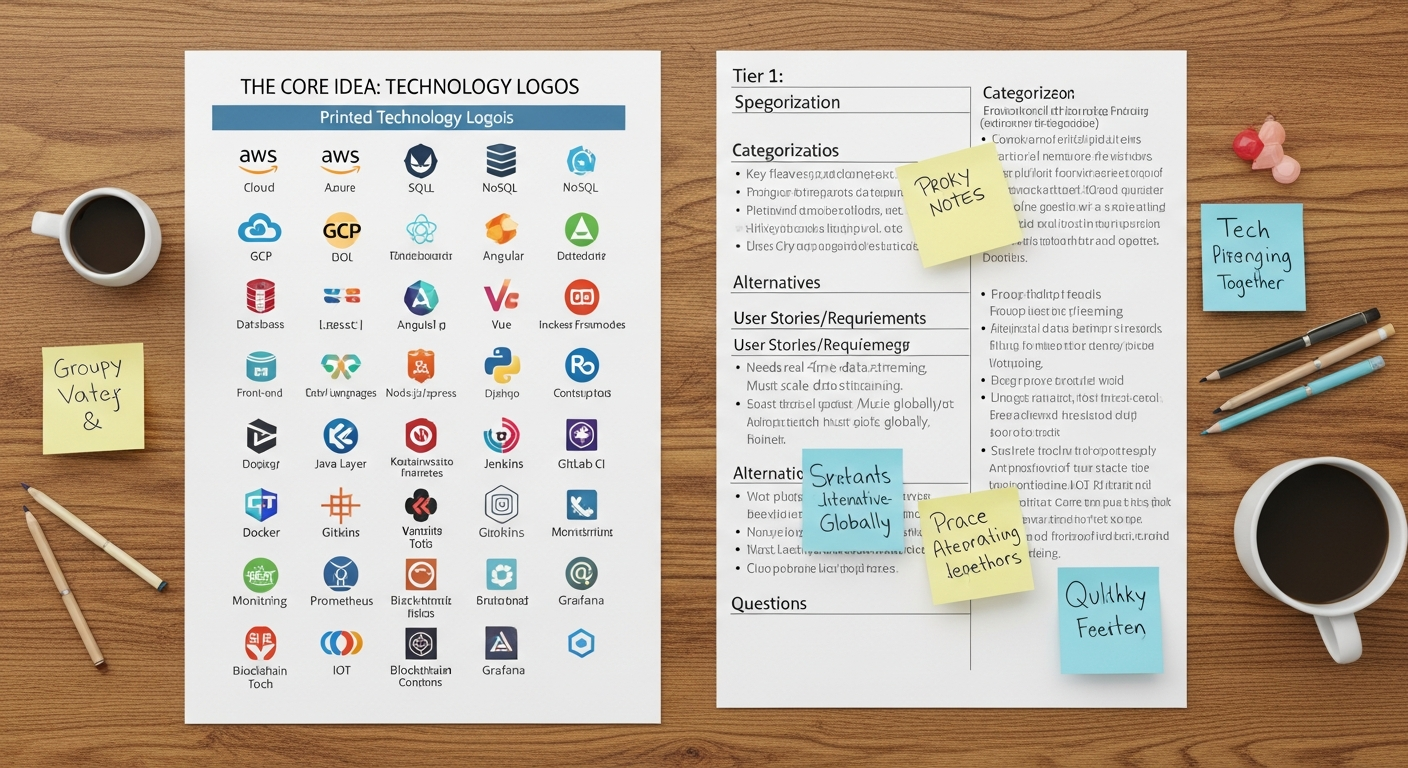
Your tech stack isn’t a static entity; it’s a living organism that must evolve with your startup. What’s perfect for an MVP might become a bottleneck at scale.
Phase 1: MVP & Validation – Speed, Cost-Efficiency, Off-the-Shelf
At this stage, your primary goal is to validate your core hypothesis with minimal resources and maximum speed.
* Focus: Build the absolute core functionality that delivers your unique value proposition. Avoid feature creep.
* Strategy: Prioritize off-the-shelf, managed services, and potentially no-code/low-code solutions to get to market quickly.
* Examples:
* Frontend: Use a simple JavaScript library or even a no-code platform like Webflow for a landing page and basic UI.
* Backend: Leverage Backend-as-a-Service (BaaS) like Firebase (GCP) or AWS Amplify for authentication, database, and hosting. These abstract away much of the infrastructure complexity. Python with Flask or Node.js with Express can be deployed on serverless platforms like AWS Lambda for quick API development.
* Database: Start with a managed relational database like AWS RDS (PostgreSQL) or MongoDB Atlas.
* CRM/Marketing: Begin with free tiers of HubSpot or Mailchimp.
* Payment: Integrate directly with Stripe Checkout.
* Key takeaway: Don’t over-engineer. Your MVP is about learning, not perfection. Embrace pragmatism.
Phase 2: Early Growth & Product-Market Fit – Robustness, Developer Experience, Performance
Once you’ve validated your MVP and found early product-market fit, it’s time to solidify your foundation and optimize for sustainable growth.
* Focus: Enhance user experience, improve performance, and build out more complex features.
* Strategy: Transition from purely off-the-shelf to more robust frameworks and dedicated infrastructure where needed. Optimize for developer productivity and maintainability.
* Examples:
* Frontend: Standardize on a major framework like React or Vue.js for a rich, scalable UI. Implement TypeScript for better code quality.
* Backend: Move towards more structured frameworks like Django or NestJS for clearer architecture and easier maintenance. Consider microservices for separating concerns as your product grows.
* Infrastructure: Introduce Docker for consistent development and deployment environments. Begin setting up basic CI/CD pipelines (e.g., GitHub Actions).
* Analytics: Implement Mixpanel or Amplitude for deeper product usage insights.
* Customer Support: Adopt a dedicated tool like Zendesk or Intercom.
* Key takeaway: Balance speed with stability. Invest in tools that support rapid feature development without compromising quality.
Phase 3: Scaling & Optimization – Enterprise-Grade, Automation, Specialization
At this stage, your startup is experiencing significant growth, and your tech stack needs to handle high traffic, complex data, and a growing engineering team.
* Focus: Optimize for cost, performance, reliability, and security at scale. Support a larger, more specialized engineering organization.
* Strategy: Adopt enterprise-grade solutions, implement advanced automation, and potentially leverage specialized infrastructure components.
* Examples:
* Infrastructure: Full adoption of Kubernetes for container orchestration. Advanced use of cloud services (e.g., serverless functions for specific workloads, specialized databases like Google Cloud Spanner or AWS DynamoDB for extreme scale).
* Data Engineering: Implement data pipelines (e.g., with Apache Kafka or managed services like AWS Kinesis) and data warehousing solutions (e.g., Snowflake, Google BigQuery) for advanced analytics and business intelligence.
* DevOps: Mature CI/CD with automated testing, canary deployments, and robust monitoring with tools like Datadog.
* Security: Implement advanced security measures like Web Application Firewalls (WAFs), intrusion detection systems, and regular penetration testing.
* Key takeaway: Focus on efficiency and automation. Invest in specialized tools and expertise to manage complexity and ensure continuous uptime and performance under heavy load. The “build vs. buy” decision becomes more nuanced here, with custom solutions considered for core differentiators and off-the-shelf for commodities.
Practical Implementation: Best Practices & Pitfalls to Avoid
Building a tech stack isn’t just about selecting tools; it’s about disciplined execution and continuous refinement.
Best Practices for Tech Stack Implementation:
1. Start Lean, Iterate Fast: Adopt the “Minimum Viable Product” philosophy to your tech stack itself. Begin with the simplest viable solution and add complexity only when absolutely necessary, driven by clear business needs. This minimizes initial costs and technical debt.
2. Prioritize Open Standards & APIs: Wherever possible, choose technologies that adhere to open standards and offer robust, well-documented APIs. This fosters interoperability, reduces vendor lock-in, and simplifies future integrations or migrations.
3. Invest in Robust Security from Day One: Security is not an afterthought. Implement security best practices (e.g., least privilege, encryption in transit and at rest, regular security audits) from the very first line of code and infrastructure deployment.
4. Document Everything: From architecture decisions and API specifications to deployment procedures and troubleshooting guides, comprehensive documentation is invaluable. It reduces onboarding time for new hires, minimizes knowledge silos, and ensures operational continuity.
5. Regularly Review and Audit Your Stack: Technology evolves rapidly. Schedule quarterly or semi-annual reviews to assess if your current tools still meet your needs, identify underutilized services, and evaluate emerging alternatives. Be prepared to deprecate or replace components that no longer serve your strategic goals.
6. Foster a Culture of Technical Excellence: Encourage your engineering team to take ownership of the tech stack. Promote continuous learning, code reviews, and shared responsibility for maintaining a high-quality, efficient, and secure environment.
Common Pitfalls to Avoid:
1. Over-Engineering from the Start: The temptation to build for “future scale” that never materializes can lead to unnecessary complexity, increased costs, and slower development. Focus on solving current problems, not hypothetical ones.
2. Blindly Chasing “Shiny New Objects”: Don’t adopt a new technology simply because it’s trending. Every new tool introduces complexity and learning curves. Evaluate new technologies rigorously against the E-A-S-Y framework and ensure they solve a real problem for your startup.
3. Ignoring Technical Debt: Delaying necessary refactoring or taking shortcuts to meet deadlines will inevitably lead to a brittle, hard-to-maintain system. Budget time for technical debt repayment as part of your regular development cycles.
4. Vendor Lock-in (Unintentionally): While cloud providers offer immense convenience, deeply embedding your architecture with proprietary services without an exit strategy can make future migrations prohibitively expensive. Understand the implications of your choices.
5. Underestimating Operational Overhead: A powerful tool might require significant operational expertise (e.g., managing a self-hosted Kubernetes cluster vs. using a managed service). Factor in the human cost of maintaining complex systems.
6. Lack of Centralized Knowledge: If only one or two engineers understand critical parts of the stack, your startup faces a significant risk if they leave. Documentation and cross-training are essential.
Future-Proofing Your Tech Stack: Trends to Watch
The tech landscape is in constant flux. While you shouldn’t chase every trend, understanding key trajectories allows for more resilient, future-proof decisions.
* AI/ML Integration: Beyond merely using AI-powered SaaS tools, the ability to integrate machine learning models directly into your product workflows and infrastructure will become a competitive differentiator. This includes MLOps practices for deploying and managing models at scale.
* Serverless Computing (FaaS): Services like AWS Lambda, Google Cloud Functions, and Azure Functions continue to mature. They abstract away server management, offering unparalleled scalability and pay-per-execution cost models, ideal for event-driven architectures and microservices.
* Edge Computing: As IoT devices proliferate and real-time processing becomes critical, moving computation closer to data sources (the “edge”) reduces latency and bandwidth costs. Relevant for specific industries like manufacturing, autonomous vehicles, or real-time analytics.
* Web3 and Blockchain (Niche): While not universally applicable, for startups in FinTech, supply chain, digital identity, or gaming, understanding decentralized technologies and smart contracts will be crucial.
* Low-Code/No-Code Platforms: These platforms are evolving beyond simple websites, enabling rapid development of internal tools, workflows, and even sophisticated applications. They empower business users and can significantly accelerate non-core development, freeing engineers for complex tasks.
* Data Mesh Architectures: For data-intensive startups, moving from centralized data lakes to a decentralized “data mesh” approach, where data is treated as a product owned by domain teams, can improve data discoverability, quality, and governance at scale.
These trends highlight a common theme: increasing abstraction, automation, and focus on developer experience. By carefully considering how these shifts align with your long-term vision, you can build a tech stack that not only meets today’s demands but is also adaptable to tomorrow’s innovations.
FAQ: Building Your Startup’s Tech Stack
Q1: How much should I budget for my startup’s tech stack?
A1: There’s no one-size-fits-all answer, as it depends heavily on your product’s complexity, anticipated user load, and chosen technologies. For an MVP, you might start with a few hundred dollars per month for managed cloud services and SaaS tools (e.g., Firebase, free tiers of CRM). As you scale, this can quickly escalate to thousands, then tens of thousands, and eventually hundreds of thousands per month. A good rule of thumb is to allocate 10-20% of your operational budget to technology infrastructure and tools, excluding engineering salaries. Always factor in total cost of ownership (TCO), including hosting, licenses, maintenance, and potential integration costs.
Q2: Should I prioritize open-source or commercial tools for my tech stack?
A2: Both have merits. Open-source tools (e.g., PostgreSQL, Linux, Python frameworks) offer flexibility, community support, and often no direct licensing costs, but require internal expertise for setup, maintenance, and security. Commercial tools (SaaS, proprietary software) provide managed services, dedicated support, and often a smoother user experience, but come with recurring subscription fees and potential vendor lock-in. For startups, a hybrid approach is often best: leverage open-source for core development where you have expertise, and opt for commercial SaaS for non-differentiating functions like CRM, marketing automation, or customer support to reduce operational overhead.
Q3: When should I consider rebuilding my tech stack?
A3: Rebuilding (a “rewrite”) is a major undertaking and should be a last resort. Consider it only when your current stack: 1) severely hinders your ability to deliver new features rapidly, 2) causes frequent, critical performance or stability issues, 3) becomes prohibitively expensive to maintain, or 4) poses significant security risks that cannot be patched. Before a full rewrite, explore options like targeted refactoring, migrating specific microservices, or replacing individual problematic components. A phased migration is almost always preferable to a “big bang” rewrite.
Q4: How do I manage technical debt effectively?
A4: Technical debt is inevitable, but it must be managed proactively. First, acknowledge its existence and track it (e.g., in your project management tool). Second, allocate dedicated time in each sprint or development cycle (e.g., 10-20% of engineering time) specifically for addressing technical debt, refactoring, and improving code quality. Third, prioritize debt repayment based on business impact – tackle debt that significantly slows down development, introduces critical bugs, or poses security risks. Finally, foster a culture where engineers are empowered to identify and propose solutions for technical debt, integrating it into the definition of “done.”
Q5: What’s the biggest mistake founders make when building their tech stack?
A5: The biggest mistake is treating the tech stack as a purely technical decision, separate from business strategy. This leads to either over-engineering from day one (building for scale you don’t have) or under-investing in fundamental infrastructure (leading to technical debt and scalability issues). A related mistake is choosing technologies based solely on hype or personal preference rather than a rigorous evaluation against business needs, team expertise, and long-term goals. The tech stack must be aligned with your product roadmap, growth projections, and financial runway, evaluated through a strategic lens like the E-A-S-Y framework.
Conclusion
Your startup’s tech stack is more than a list of software; it’s a strategic investment, a critical enabler of your vision, and a direct reflection of your commitment to long-term success. By approaching its construction with the discipline of a senior tech strategist – prioritizing scalability, security, cost-efficiency, and developer productivity – you lay a foundation that not only supports your ambitious goals but actively propels your startup forward.
Avoid the allure of the “shiny new object” and the pitfalls of short-sighted decisions. Embrace a lean, iterative approach, guided by frameworks like E-A-S-Y, and continuously adapt your stack as your business evolves. The right tech stack empowers you to innovate faster, scale smarter, and ultimately, build a resilient and impactful company. Start planning strategically today, and watch your startup thrive.
“`json
{
“@context”: “https://schema.org”,
“@graph”: [
{
“@type”: “Article”,
“mainEntityOfPage”: {
“@type”: “WebPage”,
“@id”: “https://www.eamped.com/blog/build-startup-tech-stack”
},
“headline”: “Building Your Startup’s Tech Stack: A Strategic Blueprint for Ambitious Founders”,
“image”: [
“https://www.eamped.com/images/tech-stack-hero.jpg”,
“https://www.eamped.com/images/tech-stack-diagram.png”
],
“datePublished”: “2024-05-15T09:00:00+00:00”,
“dateModified”: “2024-05-15T09:00:00+00:00”,
“author”: {
“@type”: “Person”,
“name”: “Eamped Content Team”
},
“publisher”: {
“@type”: “Organization”,
“name”: “Eamped”,
“logo”: {
“@type”: “ImageObject”,
“url”: “https://www.eamped.com/images/eamped-logo.png”
}
},
“description”: “A comprehensive, practical guide for startup founders and entrepreneurs on how to strategically build a tech stack that fuels growth, attracts talent, and ensures long-term scalability. Learn about core components, a strategic framework (E-A-S-Y), evolution stages, best practices, pitfalls, and future trends.”,
“articleSection”: [
“Technology & Software”
],
“keywords”: “startup tech stack, build tech stack, startup technology, software selection, cloud infrastructure, SaaS tools, DevOps, frontend, backend, database, product development, E-A-S-Y framework, tech strategy, startup founder guide”
},
{
“@type”: “FAQPage”,
“mainEntity”: [
{
“@type”: “Question”,
“name”: “How much should I budget for my startup’s tech stack?”,
“acceptedAnswer”: {
“@type”: “Answer”,
“text”: “There’s no one-size-fits-all answer, as it depends heavily on your product’s complexity, anticipated user load, and chosen technologies. For an MVP, you might start with a few hundred dollars per month for managed cloud services and SaaS tools (e.g., Firebase, free tiers of CRM). As