Crafting Conversion Powerhouses: Your 2026 Guide to High-Converting Landing Pages
The Unseen Foundation: Strategy Before Design
Before you even think about headlines or hero images, a successful landing page is built on a bedrock of strategic clarity. Without this, you’re merely decorating a digital brochure, hoping for the best. A senior tech strategist knows that conversion isn’t an accident; it’s the inevitable outcome of precise planning.
Define Your Objective with Precision
Every high-converting landing page has one, and only one, primary goal. This singular focus is paramount. Are you aiming for:
- Lead Generation: Capturing email addresses for a newsletter, whitepaper, or webinar sign-up?
- Sales: Driving direct purchases of a product or service?
- Sign-ups: Encouraging free trial registrations, demo requests, or account creations?
- Event Registration: Getting attendees for a specific online or offline event?
Clarity here dictates every subsequent design and copy choice. If your goal is to generate leads for a SaaS product, your page shouldn’t also be trying to sell a one-time service package. Diluting the objective dilutes the conversion rate.
Know Your Audience Inside Out
Who are you talking to? What are their deepest pain points, their most pressing desires, their aspirations? Generic messaging converts no one. Develop detailed user personas. Understand their demographics, psychographics, online behavior, and the specific problem your product or service solves for them. Tools like Google Analytics 4 (GA4) for demographic insights and Hotjar for behavioral data can illuminate who your actual visitors are and what they’re doing on your site. The more intimately you understand your audience, the more resonant your message will be.
The Offer: Irresistible Value Proposition
- What is it?
- Who is it for?
- What problem does it solve or benefit does it provide?
- Why should I choose this over alternatives?
For example, Slack’s early value proposition was clear: “Where work happens.” It wasn’t about features; it was about the outcome. Your offer must be perceived as highly valuable and relevant to your target audience, making the act of conversion feel like a no-brainer.
Traffic Source Alignment
How will users arrive at this page? The source of your traffic fundamentally shapes the landing page’s content and messaging. A user clicking a Google Ad for “AI-powered CRM” has a different intent and expectation than someone arriving from an organic search for “best sales tools,” or a social media post about “boosting productivity.”
- Paid Ads (PPC): Your landing page must have high message match with the ad copy and keywords. This ensures continuity and reduces bounce rates.
- Organic Search: Optimize for relevant keywords, but focus on comprehensive, problem-solving content that satisfies search intent.
- Social Media: Content should be highly visual, concise, and immediately engaging, reflecting the often-impulsive nature of social clicks.
- Email Marketing: Leverage the existing relationship; the page can be more direct and assume a certain level of familiarity.
Failing to align your landing page with its traffic source is like inviting someone to a party for one reason and then completely changing the theme once they arrive. Disorientation leads to departure.
Architectural Blueprint: Elements of a High-Converting Landing Page
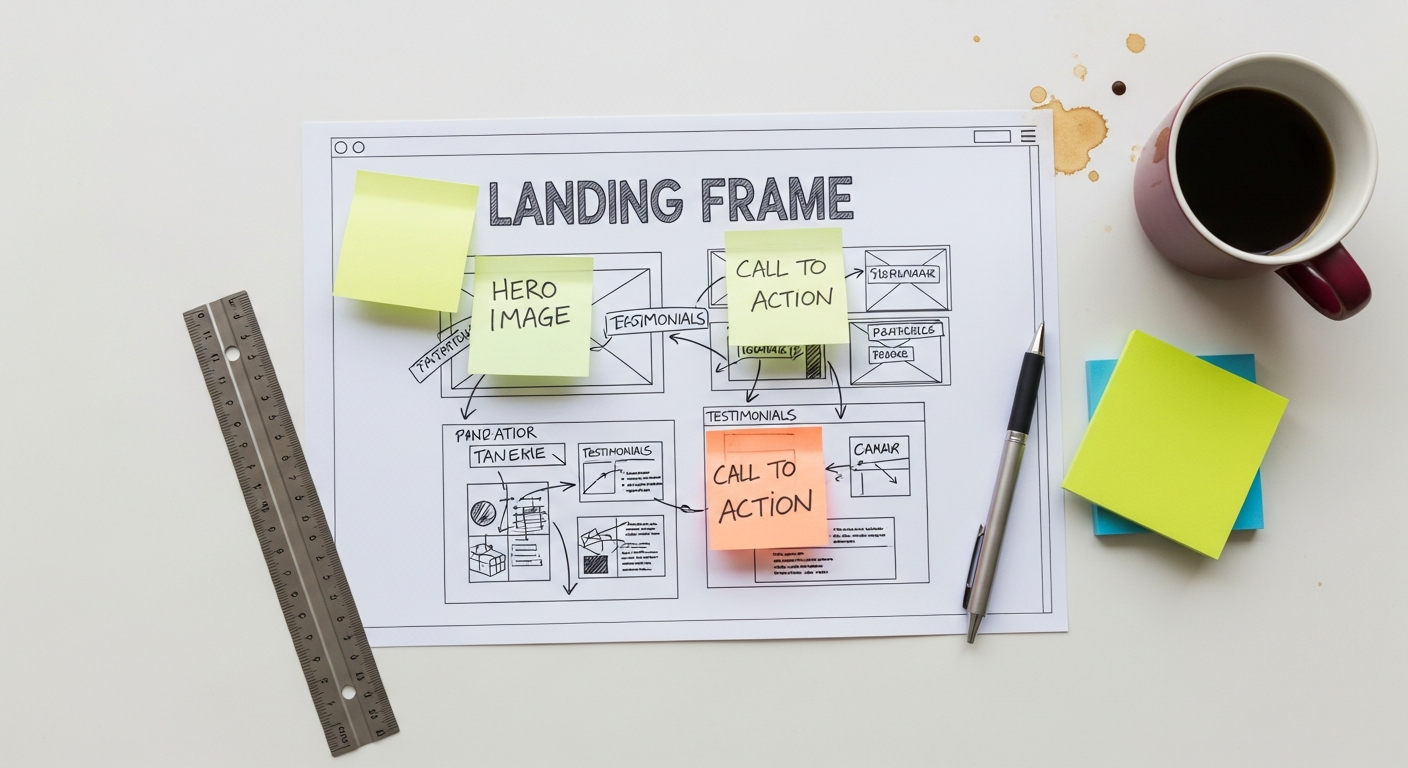
Once your strategy is locked, it’s time to translate it into a compelling digital experience. Every element on your landing page must serve the singular conversion goal, guiding the user towards action with clarity and confidence.
The Magnetic Headline & Subheadline
Your headline is the first, and often only, chance to grab attention. It needs to be clear, concise, and benefit-driven. It should immediately communicate your value proposition. The subheadline then elaborates, adding more context or a secondary benefit.
- Headline Principles:
- Clarity over Cleverness: Don’t make users think.
- Benefit-Oriented: What will they gain?
- Match Intent: Align with the ad or link that brought them here.
- Example: Instead of “Our New Software,” try “Boost Your Sales by 30% with Our AI-Powered CRM.” A subheadline might add: “Streamline customer interactions and automate follow-ups, so your team can focus on closing deals.”
A strong headline immediately validates the visitor’s click and encourages them to read on.
Compelling Copy That Sells (Benefits, Not Features)
This is where many startups stumble. Founders often obsess over features, assuming users care about the “how.” Users care about the “what’s in it for me?” Your copy must speak directly to your audience’s pain points and present your solution as the antidote.
- Problem-Agitate-Solve (PAS) Framework:
- Problem: Identify your audience’s core challenge. “Struggling to manage customer inquiries across multiple channels?”
- Agitate: Amplify the negative consequences of that problem. “Lost leads, frustrated customers, and overworked support staff are costing you revenue.”
- Solve: Introduce your product as the clear, simple solution. “Our unified CRM dashboard consolidates all communications, automating responses and empowering your team to deliver exceptional service.”
- Concise & Scannable: Use short paragraphs, bullet points, and bold text to break up content. Users scan, they don’t read long blocks of text.
- Storytelling: Where appropriate, weave in micro-stories or use language that evokes an emotional connection, illustrating how life improves with your solution.
Remember, you’re not just selling a product; you’re selling a better outcome, a simpler life, or a more efficient business.
Visual Hierarchy & Design Psychology
Design is not merely aesthetics; it’s a powerful psychological tool. A well-designed landing page guides the user’s eye, emphasizes critical information, and builds trust.
- Above the Fold: The most crucial elements (headline, main value proposition, primary CTA, hero image/video) must be visible without scrolling on most screen sizes. This is your immediate impact zone.
- Whitespace: Don’t clutter the page. Ample whitespace improves readability, reduces cognitive load, and highlights key elements.
- Visual Flow: Use F-patterns or Z-patterns to anticipate how users scan pages. Place your most important information along these natural eye-tracking paths.
- Color Psychology: Use colors strategically to evoke emotion and direct attention. For example, green often signifies action or growth, while blue suggests trust and reliability. Ensure brand consistency.
- High-Quality Imagery/Video: Use professional, relevant images or a concise explainer video that reinforces your message without distracting. Avoid generic stock photos.
A visually appealing and intuitively navigable page reduces friction and enhances the user experience, subtly pushing them towards conversion.
The Irresistible Call-to-Action (CTA)
Your CTA is the gateway to conversion. It must be:
- Clear & Specific: “Download My Free Guide,” “Start Your 14-Day Free Trial,” “Get My Instant Quote.” Avoid vague terms like “Submit” or “Click Here.”
- Prominent: Use contrasting colors, a larger font, and strategic placement (above the fold, at logical end points of copy sections).
- Urgent (where appropriate): “Claim Your Spot Now,” “Limited Time Offer.”
- Benefit-Oriented: Reinforce what the user gains by clicking. “Unlock Your Productivity,” “Generate More Leads.”
A/B test different CTA copy, colors, and placements. Even minor changes can yield significant conversion lifts. The goal is to make the next step undeniable.
Trust & Social Proof
In 2026, trust is the new currency. Users are savvier and more skeptical. You need to provide tangible reasons for them to trust you.
- Testimonials: Authentic quotes from satisfied customers, ideally with photos, names, and company affiliations. Video testimonials are even more powerful.
- Client Logos: If you work with recognizable brands, display their logos prominently. This instantly borrows credibility.
- Review Scores/Badges: Integrate ratings from platforms like G2, Capterra, or Trustpilot. Showing you’re “4.8 stars on 500+ reviews” is compelling.
- Security Badges: For e-commerce or sensitive data collection, display SSL certificates or payment gateway logos (e.g., “Secure Checkout powered by Stripe”).
- Case Studies/Success Stories: Briefly highlight how others have achieved success using your product/service.
- Statistics: “Used by over 10,000 businesses,” or “Achieved 200% ROI in 3 months.”
Statistics show that 93% of consumers read online reviews before making a purchase, and social proof can increase conversion rates by up to 15%. Don’t leave it out.
Forms That Don’t Scare Away
Forms are often the final hurdle. Too many fields, unclear instructions, or a lack of trust can lead to immediate abandonment.
- Minimalism: Only ask for essential information. Every extra field decreases your conversion rate. If you only need an email for a download, don’t ask for a phone number.
- Clear Labeling & Placeholders: Make it obvious what information is required in each field.
- Privacy Assurance: Add a small line of text near the form button like “We respect your privacy. Your information will not be shared.” Link to your privacy policy.
- Multi-Step Forms: For longer forms, breaking them into smaller, digestible steps can reduce perceived effort and increase completion rates.
- Error Handling: Provide immediate, clear feedback if a user makes an error, guiding them to correct it.
Test your forms rigorously. A smooth, reassuring form experience is critical for sealing the deal.
Mobile-First Responsiveness
This isn’t a “nice-to-have” for 2026; it’s non-negotiable. Over 50% of web traffic comes from mobile devices, and Google prioritizes mobile-friendly sites. Your landing page must look and function flawlessly on smartphones and tablets.
- Fluid Layouts: Content and images should scale and rearrange gracefully across different screen sizes.
- Tap Targets: Buttons and links should be large enough and spaced adequately for easy tapping.
- Fast Loading: Mobile users are impatient. Optimize images, leverage browser caching, and minimize code to ensure lightning-fast load times.
Ignoring mobile optimization is effectively turning away half of your potential customers.
The Tech Stack: Tools for Building & Optimizing
You don’t need to be a coding wizard to build high-converting landing pages. A robust tech stack empowers you to design, deploy, track, and optimize efficiently.
Landing Page Builders
These platforms offer drag-and-drop interfaces, templates, and integrated A/B testing, making professional-grade landing page creation accessible to everyone.
- Unbounce: A powerful, feature-rich platform known for its AI-powered Smart Traffic and Smart Copy, along with robust A/B testing capabilities. Ideal for serious marketers.
- Instapage: Offers an intuitive builder, extensive template library, and advanced collaboration features, focusing on ad-to-page message match.
- Leadpages: A more budget-friendly option, excellent for beginners, with a focus on lead generation and a solid template selection.
- Webflow: While not strictly a “landing page builder,” Webflow offers unparalleled design freedom and customizability for those with more technical design skills, allowing for highly unique and performant pages.
Analytics & Tracking
You can’t optimize what you can’t measure. These tools provide the data necessary for informed decisions.
- Google Analytics 4 (GA4): The industry standard for website analytics. Crucial for tracking traffic sources, user behavior, conversion events, and understanding your audience.
- Hotjar: Provides visual insights into user behavior with heatmaps (where users click, move, and scroll), session recordings (watching actual user journeys), and feedback polls. Invaluable for identifying friction points.
- Crazy Egg: Similar to Hotjar, offering heatmaps, scroll maps, and confetti reports to visualize user engagement.
A/B Testing Platforms
These are essential for data-driven optimization, allowing you to compare different versions of your page to see which performs better.
- Most dedicated landing page builders (Unbounce, Instapage) have robust A/B testing built-in.
- VWO (Visual Website Optimizer): A comprehensive platform for A/B testing, multivariate testing, and personalization.
- Optimizely: An enterprise-grade platform offering advanced experimentation and feature flagging capabilities.
CRM & Marketing Automation Integration
Seamlessly connect your landing pages to your broader marketing and sales ecosystem.
- HubSpot: A powerful all-in-one platform for CRM, marketing automation, sales, and service. Integrates deeply with landing page forms to capture leads and trigger workflows.
- Salesforce: The leading CRM, essential for larger organizations, allowing for advanced lead routing and sales process integration.
- ActiveCampaign: Excellent for email marketing automation and CRM, ensuring leads captured on your landing page are immediately nurtured with personalized sequences.
Automating lead capture and follow-up saves time and ensures no valuable prospect falls through the cracks.
The Conversion Catalyst: Optimization & A/B Testing
Building a landing page is just the first step. The real magic happens in continuous optimization. Think of your landing page as a living entity that constantly needs refinement based on real-world performance data.
Data-Driven Hypothesis Generation
Never guess. Every change you make should be an informed hypothesis. Instead of saying, “I think a red button will convert better,” formulate it as: “Changing the CTA button color from blue to red will increase click-through rate by 10% because red evokes urgency.”
- Analyze Data: Use GA4 and Hotjar to identify weak spots: high bounce rates on certain sections, low scroll depth, drop-offs at the form.
- Brainstorm Solutions: Based on the data, brainstorm potential improvements.
- Formulate Hypothesis: Clearly state what you expect to happen and why.
A/B Testing Best Practices
This is your scientific method for improving conversion rates.
- Test One Variable at a Time: Change only one element (headline, CTA copy, image) between your control (original) and variation. If you change multiple things, you won’t know which change caused the impact.
- Ensure Sufficient Sample Size: Don’t draw conclusions from small numbers. Run your tests long enough to gather statistically significant data. Tools like Optimizely’s A/B Test Sample Size Calculator can help.
- Run Tests Concurrently: A/B tests should run at the same time to mitigate external factors like seasonality or marketing campaigns.
- Focus on Primary Metrics: While you’ll track many metrics, your A/B test should be designed to impact your primary conversion goal.
A/B testing is a marathon, not a sprint. Be patient, be rigorous, and let the data lead the way.
Key Metrics to Track (Beyond Conversion Rate)
While the conversion rate is king, a holistic view requires tracking other performance indicators:
- Bounce Rate: The percentage of visitors who leave after viewing only one page. A high bounce rate indicates a mismatch between expectations and content.
- Time on Page: How long users spend engaging with your content. Longer times often correlate with higher engagement.
- Scroll Depth: How far down the page users scroll. Reveals if critical information below the fold is being seen.
- Form Completion Rate: For pages with forms, the percentage of users who start and complete the form.
- Click-Through Rate (CTR) on CTA: The percentage of users who click your primary call-to-action.
By monitoring these metrics, you gain a deeper understanding of user behavior and pinpoint areas for improvement.
Iterative Improvement: The Conversion Flywheel
Conversion optimization is a continuous loop:
- Analyze: Review your analytics data to identify problems.
- Hypothesize: Formulate a testable idea to solve a problem.
- Test: Implement an A/B test.
- Implement: Roll out the winning variation.
- Repeat: The process never truly ends; there’s always room for improvement.
This iterative approach ensures your landing pages are always evolving, adapting to user behavior, and maximizing their conversion potential.
Advanced Tactics for 2026 & Beyond
To truly stand out in 2026, consider these advanced strategies that leverage cutting-edge technology and deeper psychological insights.
Personalization at Scale
Generic experiences are becoming obsolete. Personalization means tailoring your landing page content based on who the visitor is, where they came from, or their past interactions.
- Dynamic Content: Display different headlines, images, or even entire sections of copy based on referral source, geographic location, or user segments (e.g., “Welcome, [Company Name] Admin” for returning users).
- Tools: Platforms like Unbounce (with Dynamic Text Replacement), Mutiny, or Optimizely allow for sophisticated personalization without complex coding.
Highly personalized experiences can increase conversion rates by 10-20% because they make users feel understood and valued.
AI-Powered Copywriting & Design Assistance
AI isn’t here to replace human creativity but to augment it, especially for rapid ideation and iteration.
- AI Copywriting Tools: Platforms like Jasper AI or Copy.ai can generate multiple headline variations, body copy paragraphs, and CTA suggestions in seconds. Use them for brainstorming and refining, not as a direct copy-paste solution.
- AI Design Tools: AI can assist in generating image concepts (Midjourney, DALL-E 3) or suggesting optimal layouts based on conversion best practices.
Leverage AI to accelerate your content creation, allowing your team to focus on strategic oversight and final polish.
Video Integration
Video is a potent engagement tool. A well-placed, concise video can explain complex concepts, build emotional connection, and demonstrate value far more effectively than text alone.
- Explainer Videos: A short (60-90 second) video above the fold can quickly convey your value proposition.
- Video Testimonials: Authentic customer testimonials on video are incredibly persuasive.
- Product Demos: A quick visual tour of your product in action.
Speed & Performance
Page load speed is a critical ranking factor for Google and a major determinant of user experience. Slow pages kill conversions.
- Core Web Vitals: Google’s initiative to quantify user experience through metrics like Largest Contentful Paint (LCP), Cumulative Layout Shift (CLS), and First Input Delay (FID). Optimize for these.
- Image Optimization: Compress images without sacrificing quality (use WebP format where possible).
- Content Delivery Networks (CDNs): Serve content from servers geographically closer to your users for faster delivery.
- Minimize Code: Reduce unnecessary JavaScript and CSS.
A 1-second delay in page response can result in a 7% reduction in conversions. Speed is paramount.
Legal Compliance & Privacy
With increasing data privacy regulations (like GDPR and CCPA), ensuring your landing pages are compliant is non-negotiable. Building trust also means transparency.
- Clear Privacy Policy Link: Prominently link to your privacy policy near forms.
- Consent Checkboxes: For marketing communications, use explicit opt-in checkboxes.
- Cookie Consent Banners: Implement a clear and compliant cookie consent mechanism.
Failing to comply can result in hefty fines and, more importantly, a significant erosion of customer trust.
Conclusion: Build, Measure, Learn, Convert
In the dynamic digital landscape of 2026, a high-converting landing page is not a luxury; it’s a strategic imperative for any startup founder or entrepreneur aiming for aggressive growth. It’s the critical juncture where marketing investment meets tangible results. By meticulously defining your strategy, architecting your page with conversion-focused elements, leveraging the right tech stack, and committing to continuous, data-driven optimization, you transform a simple web page into a formidable revenue driver.
This isn’t about guesswork; it’s about precision. It’s about understanding your audience, crafting an irresistible offer, and guiding them frictionlessly towards action. Embrace the iterative process, constantly test your assumptions, and let the data be your compass. The founders who master this discipline will be the ones who not only capture attention but convert it into sustained success. Start building your conversion powerhouse today, and watch your startup thrive.
“`json
{
“@context”: “https://schema.org”,
“@graph”: [
{
“@type”: “Article”,
“mainEntityOfPage”: {
“@type”: “WebPage”,
“@id”: “https://www.eamped.com/blog/how-to-create-landing-page-converts-2026”
},
“headline”: “Crafting Conversion Powerhouses: Your 2026 Guide to High-Converting Landing Pages”,
“image”: [
“https://www.eamped.com/images/landing-page-conversion-hero.jpg”,
“https://www.eamped.com/images/landing-page-optimization-process.jpg”
],
“datePublished”: “2024-07-29T08:00:00+00:00”,
“dateModified”: “2024-07-29T08:00:
