The Product Development Lifecycle: Fueling Tech Startup Growth with Integrated Digital Marketing Strategy
For any tech startup aspiring to achieve sustainable growth and carve out a significant market share, the journey from an innovative idea to a market-ready product is fraught with challenges and opportunities. Navigating this path effectively requires a robust framework: the product development lifecycle (PDLC). Far from being a mere checklist, the PDLC is a strategic blueprint that orchestrates every phase of a product’s evolution, from its nascent concept to its ultimate market impact and continuous refinement.
In the dynamic landscape of tech innovation, a well-defined PDLC is not just beneficial—it’s indispensable. It empowers tech startups to mitigate risks, optimize resource allocation, and ensure that their offerings resonate deeply with target users. More critically, an integrated approach means that digital marketing strategy is not an afterthought but a foundational element woven into the very fabric of the PDLC, informing decisions, validating concepts, and driving successful market adoption from day one. This comprehensive guide will explore the intricacies of the product development lifecycle, highlighting its pivotal role in catalyzing tech startup growth and demonstrating how strategic digital marketing can amplify its effectiveness at every stage.
What is the Product Development Lifecycle (PDLC)?
The product development lifecycle (PDLC) is a structured, systematic process that outlines the stages a product typically goes through from its initial conception to its market release and beyond. It’s a dynamic, often iterative, framework designed to guide innovation, reduce uncertainty, and ensure that new products meet market demands and strategic business objectives. For tech startups, the PDLC is more than just a theoretical model; it’s a practical roadmap that transforms abstract ideas into tangible, viable solutions.
At its core, the PDLC encompasses a series of phases, each with specific objectives and activities, performed by cross-functional teams. This holistic process enables startups to manage complexity, allocate resources efficiently, and maintain focus on delivering value. Without a clear PDLC, tech startups risk significant setbacks, including developing products that lack market fit, squandering precious capital on misdirected efforts, and struggling to articulate their value proposition to potential customers and investors. An effective PDLC, therefore, serves as the backbone for structured innovation, allowing startups to move with agility and purpose towards their growth ambitions.
The primary goal of the product development lifecycle is to bring a new product to market successfully, but its impact extends further. It ensures that product development is aligned with business strategy, incorporates customer feedback, and prepares for effective market positioning and launch. For tech startups, this means fostering an environment where innovation is systematic, risks are proactively managed, and every development effort contributes directly to sustainable growth and competitive advantage.
The Essential Stages of the Product Development Lifecycle
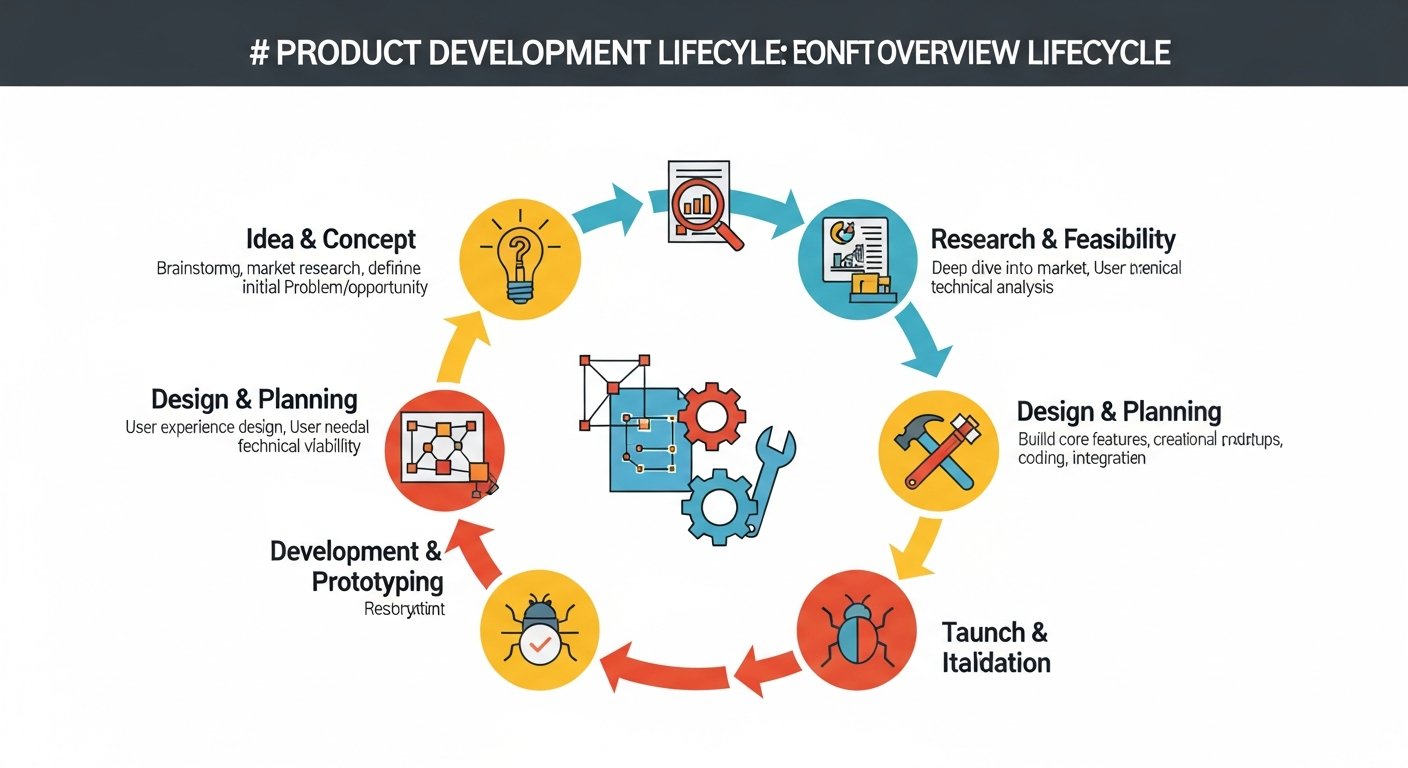
Understanding and meticulously navigating each stage of the product development lifecycle is paramount for any tech startup aiming for sustained growth. Each phase builds upon the last, progressively refining the product idea and ensuring it aligns with market needs and business goals. Integrating digital marketing activities seamlessly into these stages transforms the PDLC from a purely internal development process into a market-aware, customer-centric journey.
[INLINE IMAGE 1: Diagram illustrating the cyclical nature of the PDLC, with arrows flowing through stages like Idea, Concept, Design, Test, Launch, Iterate, and an overlay showing Digital Marketing integrated into each stage.]
Idea Generation & Validation
This initial stage is the birthplace of innovation. It involves brainstorming, identifying market gaps, and pinpointing user pain points that a new product could solve. For tech startups, this often begins with a problem-centric approach, seeking to disrupt existing markets or create entirely new ones.
- Key Activities: Market research, trend analysis, competitor analysis, brainstorming sessions, customer interviews, hypothesis generation.
- Tech Startup Focus: Identifying unique value propositions, defining a minimum viable product (MVP) concept, assessing potential for scalability.
- Digital Marketing Integration:
- Market Research: Leveraging SEO keyword research to understand search intent and demand, conducting social listening to identify prevalent pain points, analyzing competitor digital strategies.
- Audience Segmentation: Beginning to define target personas based on digital behavior and demographics.
Concept Development & Specification
Once an idea is validated, it moves into concept development, where the fuzzy idea transforms into a clearer, more defined product concept. This involves detailing features, functionalities, and the overall user experience.
- Key Activities: Developing user stories, feature prioritization, defining product-market fit criteria, creating a clear value proposition, outlining technical specifications.
- Tech Startup Focus: Ensuring the concept solves the identified problem effectively, aligning features with core user needs, estimating resource requirements.
- Digital Marketing Integration:
- Value Proposition Refinement: Testing messaging and value propositions through low-cost digital ads or surveys.
- Audience Validation: Using survey tools and social media polls to gather early feedback on concepts from potential users, refining target audience segmentation.
Prototyping & Design
This stage translates the refined concept into tangible representations. Prototypes, mockups, and wireframes are created to visualize the product’s interface and functionality, laying the groundwork for the user experience (UX) and user interface (UI) design.
- Key Activities: Wireframing, mockups, UI/UX design, creating interactive prototypes, developing a minimum viable product (MVP).
- Tech Startup Focus: Focusing on intuitive design and core functionality for the MVP, ensuring technical feasibility, preparing for user testing.
- Digital Marketing Integration:
- Early Feedback Collection: Using digital channels (e.g., dedicated landing pages, private social groups) to recruit beta testers and gather feedback on prototypes.
- Messaging Iteration: Refining product messaging and imagery based on early design iterations and user reactions.
Testing & Iteration
With a functional prototype or MVP in hand, the product undergoes rigorous testing to identify flaws, gather user feedback, and validate assumptions. This iterative process is crucial for refining the product before a full-scale launch.
- Key Activities: User testing, A/B testing, beta programs, quality assurance (QA), feedback loops, bug fixing.
- Tech Startup Focus: Prioritizing critical bug fixes, implementing user feedback for key features, validating product-market fit, ensuring a smooth user experience.
- Digital Marketing Integration:
- Beta Program Management: Recruiting and managing beta users through email marketing and community platforms.
- Feedback Collection: Setting up digital surveys and feedback forms, analyzing user behavior data from the MVP, refining content marketing strategies based on observed user pain points and language.
- Refining Go-to-Market Messaging: Using insights from user testing to polish marketing copy and identify compelling testimonials.
Product Launch & Go-to-Market
This is the moment the product is introduced to the wider market. It requires a meticulously planned go-to-market strategy that leverages digital channels to maximize reach and impact.
- Key Activities: Final product development, go-to-market strategy development, public relations (PR), sales enablement, distribution setup.
- Tech Startup Focus: Executing a memorable launch, achieving initial customer acquisition targets, establishing brand presence.
- Digital Marketing Integration:
- Comprehensive Launch Campaign: Executing content marketing (blog posts, whitepapers, case studies), SEO optimization for product pages, social media campaigns, paid advertising (Google Ads, social ads), email marketing sequences, influencer marketing.
- PR & Outreach: Digitally reaching out to tech journalists and relevant publications.
- Analytics Setup: Ensuring all tracking mechanisms are in place to monitor post-launch performance.
Post-Launch & Continuous Improvement
The PDLC doesn’t end at launch; it transitions into a phase of continuous monitoring, optimization, and iteration. Customer feedback and market data drive future updates and enhancements.
- Key Activities: Performance monitoring, customer support, bug fixes, feature updates, market re-evaluation, iteration based on analytics.
- Tech Startup Focus: Driving customer retention, reducing churn, identifying opportunities for expansion, maintaining competitive relevance.
- Digital Marketing Integration:
- Performance Monitoring: Analyzing website analytics, conversion rates, user engagement metrics, digital marketing ROI.
- Customer Feedback Loops: Implementing digital channels for ongoing customer feedback (surveys, in-app prompts, social media monitoring).
- Retention & Upselling: Developing email nurturing campaigns, targeted advertising for feature adoption, content marketing for customer education, SEO for long-tail keywords related to product usage.
- Brand Building: Continuously cultivating online presence and managing reputation.
By following these stages, tech startups can navigate the complex journey of product creation with greater clarity and a higher probability of market success. The integrated nature of digital marketing ensures that the product is not only well-developed but also effectively positioned, promoted, and continuously improved based on real-world feedback.
Table 1: Product Development Lifecycle Stages & Startup Relevance
| PDLC Stage | Key Activities | Tech Startup Focus | Digital Marketing Integration |
|---|---|---|---|
| Idea Generation & Validation | Market research, trend analysis, competitor review, brainstorming, hypothesis generation. | Identify market gaps, define MVP concept, assess scalability, unique value proposition. | SEO keyword research, social listening, competitor digital analysis, initial audience segmentation. |
| Concept Development & Specification | User stories, feature prioritization, product-market fit criteria, value proposition, technical specs. | Solve identified problems, align features with needs, estimate resources, define core offering. | Value proposition testing (ads/surveys), audience validation via polls, refine targeting. |
| Prototyping & Design | Wireframing, mockups, UI/UX design, interactive prototypes, MVP development. | Intuitive design, core MVP functionality, technical feasibility, prepare for user testing. | Recruit beta testers digitally, gather early feedback on designs, refine marketing visuals. |
| Testing & Iteration | User testing, A/B testing, beta programs, QA, feedback loops, bug fixes. | Prioritize bug fixes, implement feedback, validate product-market fit, smooth UX. | Manage beta programs (email), digital surveys, analyze user behavior, refine messaging. |
| Product Launch & Go-to-Market | Final development, GTM strategy, PR, sales enablement, distribution. | Execute memorable launch, achieve initial customer acquisition, establish brand presence. | Content marketing, SEO, social media campaigns, paid ads, email sequences, influencer outreach. |
| Post-Launch & Continuous Improvement | Performance monitoring, customer support, updates, market re-evaluation, iteration. | Drive retention, reduce churn, identify expansion opportunities, maintain relevance. | Analytics monitoring, digital feedback loops, retention campaigns, customer education content, brand reputation management. |
Why is a Strategic PDLC Indispensable for Tech Startup Growth?
In the high-stakes environment of tech startups, where resources are often limited and the pace of innovation relentless, a strategic product development lifecycle is not merely a structured approach—it is a critical differentiator for sustainable growth. A well-executed PDLC serves as the strategic backbone, enabling startups to navigate complexities, mitigate risks, and accelerate their journey towards market leadership and investor appeal.
Risk Reduction and Mitigation
A structured PDLC inherently reduces the risks associated with product development. By breaking down the process into manageable stages, startups can identify potential pitfalls early on, validate assumptions, and pivot if necessary, before significant resources are committed. This proactive approach minimizes the chances of building a product nobody wants, a common pitfall for many fledgling companies. Strategic PDLC processes empower tech startups to make informed decisions, protecting their valuable time and capital.
Enhanced Market Fit and User Adoption
The iterative nature of a robust PDLC, particularly in its emphasis on validation and testing, ensures that the product evolves in direct response to market needs and user feedback. Tech startup growth is inextricably linked to achieving strong product-market fit, which a strategic PDLC facilitates by embedding continuous feedback loops. This results in products that are not only innovative but also deeply resonant with their target audience, leading to higher user adoption and satisfaction rates.
Optimized Resource Allocation and Efficiency
For resource-constrained startups, every dollar and every hour counts. A clear PDLC provides a framework for efficient resource allocation, ensuring that development efforts are focused on high-priority features and activities that directly contribute to the product’s success. This prevents scope creep and wasted efforts, allowing startups to achieve more with less. Optimized resource allocation fuels tech startup growth by maximizing productivity and minimizing operational overheads.
Faster Time-to-Market
While often associated with rigidity, a well-managed PDLC, especially one employing agile or lean methodologies, can actually accelerate time-to-market. By clearly defining stages, responsibilities, and deliverables, teams can work more efficiently and avoid bottlenecks. Getting a viable product to market quickly allows startups to capture early market share, gather real-world data, and outpace competitors, directly contributing to competitive advantage and rapid growth.
Increased Investor Appeal and Confidence
Investors look for more than just a great idea; they seek evidence of structured execution and a clear path to commercialization. A comprehensive PDLC demonstrates a startup’s maturity, foresight, and ability to manage complex projects. It signals that the founding team understands the journey ahead and has a methodical plan to achieve milestones, significantly increasing investor confidence and making the startup more attractive for funding rounds. This appeal is crucial for sustaining tech startup growth through external capital.
Scalability and Future-Proofing
A strategic PDLC considers not just the immediate product launch but also its future evolution and scalability. By building with future iterations and growth in mind, startups can create a foundation that supports expansion into new markets, integration of new features, and handling increased user loads. This forward-thinking approach ensures that the product, and by extension the startup, is built for long-term, sustainable tech startup growth, rather than just a fleeting success.
Integrating Digital Marketing into Every PDLC Stage for Maximum Impact
Traditional thinking often relegates digital marketing to the final stages of the product development lifecycle—primarily during launch. However, for tech startups vying for accelerated growth, this approach is a significant oversight. Integrating digital marketing strategy throughout every PDLC stage is not merely a best practice; it is a transformative strategy that ensures product-market fit, optimizes user acquisition, and builds a powerful brand identity from conception to continuous iteration. Digital marketing acts as the voice of the customer and the beacon to the market, guiding product evolution and amplifying its impact.
[INLINE IMAGE 2: Infographic showing the PDLC stages in a circle, with Digital Marketing activities listed around the outside, demonstrating continuous integration. Icons for SEO, Social Media, Content, Analytics, Feedback Loop are prominent.]
Early Stage (Idea Generation & Concept Development)
Even before a line of code is written, digital marketing plays a crucial role. It’s about listening, understanding, and validating.
- Market Research & Validation: Utilizing SEO keyword research tools to identify search volume and intent around potential problem spaces and solutions. Social listening helps uncover user pain points, sentiment, and trending topics. Competitor analysis via digital footprints reveals successful strategies and unmet needs.
- Audience Segmentation & Persona Development: Digital tools aid in profiling potential users based on online behavior, demographics, and psychographics. This informs the core value proposition and initial feature set.
- Concept Testing: Running micro-campaigns or surveys on social media or using targeted ads to gauge interest in a preliminary concept or value proposition, gathering crucial qualitative and quantitative data at minimal cost.
Mid-Stage (Prototyping & Testing)
As the product takes shape, digital marketing shifts to gathering specific feedback and refining messaging.
- User Testing Recruitment: Digital channels (email lists, social media groups, targeted ads) are highly effective for recruiting beta testers for prototypes or MVPs.
- Feedback Loops: Implementing digital surveys, in-app feedback forms, and dedicated community forums for structured feedback. Analyzing user behavior through analytics on prototype platforms provides data-driven insights.
- Content Strategy & Messaging Refinement: Developing early-stage content (e.g., blog posts addressing the problem the product solves) helps validate messaging and resonate with the target audience. A/B testing headlines, descriptions, and call-to-actions (CTAs) refines the go-to-market narrative.
- Early Brand Building: Establishing a preliminary online presence, even with a landing page, to capture early interest and start building an email list for future engagement.
Launch Stage (Product Launch & Go-to-Market)
This is where digital marketing unleashes its full power to introduce the product to the world.
- Go-to-Market Strategy Execution: A comprehensive digital marketing strategy includes content marketing (blog posts, videos, infographics, case studies), robust SEO optimization for product pages, social media campaigns, paid advertising (Google Ads, display ads, social media ads), and email marketing sequences.
- Lead Generation & Conversion Rate Optimization (CRO): Implementing landing pages designed for conversion, A/B testing various elements, and employing retargeting campaigns to capture and nurture leads.
- PR & Influencer Marketing: Leveraging digital outreach to tech journalists, bloggers, and industry influencers to generate buzz and credible endorsements.
- Analytics & Tracking Setup: Ensuring all digital marketing efforts are meticulously tracked from day one to measure performance against key metrics like customer acquisition cost (CAC), conversion rates, and traffic sources.
Post-Launch Stage (Continuous Improvement)
Digital marketing remains vital for retention, optimization, and future iterations.
- Performance Monitoring & Analytics: Continuously tracking website traffic, user engagement, conversion funnels, and customer behavior through web analytics platforms. This data informs both product improvements and marketing campaign optimizations.
- Customer Feedback & Support: Maintaining open digital channels for customer feedback (social media, dedicated support portals, surveys) and actively monitoring online reviews and mentions to manage brand reputation.
- Retention & Lifecycle Marketing: Developing email nurturing campaigns, personalized recommendations, and targeted content to encourage feature adoption, upsells, and cross-sells, thereby increasing customer lifetime value (LTV).
- SEO for Long-Tail & Evergreen Content: Continuing to build organic authority by creating valuable content that answers user questions, solves advanced problems, and supports the product’s evolving features, capturing more niche search intent.
- Iterative Marketing: Just as the product iterates, so should the marketing. A/B testing, refining campaigns, exploring new channels, and adapting messaging based on performance data is crucial for sustained growth.
By embedding digital marketing expertise at every turn of the PDLC, tech startups can ensure their products are developed with the market in mind, validated by potential users, launched with maximum impact, and continuously optimized for long-term success. This integrated strategy is the hallmark of modern, growth-oriented tech ventures.
Common Challenges and Solutions in Startup Product Development
Even with a well-defined product development lifecycle, tech startups face unique challenges that can derail progress and threaten viability. Recognizing these hurdles and implementing proactive solutions is crucial for sustained tech startup growth. A resilient PDLC accounts for these common pitfalls and builds in mechanisms to overcome them.
Challenge 1: Resource Constraints (Time, Money, Talent)
Tech startups often operate with lean teams, tight budgets, and ambitious timelines. This can lead to rushed decisions, overworked employees, and compromised product quality.
- Solution: Lean Methodologies & Prioritization: Adopt Lean Startup principles to focus on validated learning and building an MVP. ruthlessly prioritize features based on impact and user need, avoiding feature bloat. Leverage outsourced talent for specialized tasks when in-house expertise is limited, being mindful of cost-effectiveness.
- Solution: Phased Funding: Align PDLC milestones with funding rounds. Demonstrating progress at each stage can unlock subsequent investment, providing necessary resources as development progresses.
Challenge 2: Lack of Product-Market Fit
A significant percentage of startups fail because their product doesn’t genuinely solve a problem or resonate with a large enough audience. This often stems from insufficient market validation.
- Solution: Continuous Validation & Feedback Loops: Embed extensive market research and user testing from the idea stage through post-launch. Use digital marketing for continuous feedback. Be prepared to pivot the product or target audience if initial assumptions prove incorrect. Early and frequent iteration is key.
- Solution: Hypothesis-Driven Development: Treat every major feature or product assumption as a hypothesis to be tested and validated with real users and data before committing significant development resources.
Challenge 3: Scope Creep
Adding new features or functionalities beyond the initial scope can extend timelines, inflate budgets, and dilute the product’s core value. This is particularly prevalent in rapidly evolving tech environments.
- Solution: Strict Scope Management: Implement rigorous change management processes. Clearly define the MVP and subsequent iterations. Utilize Agile sprints with fixed goals to prevent scope expansion within a given period. Educate stakeholders on the impact of scope changes.
- Solution: User Story Mapping: Visually map out user journeys and prioritize features, making it harder to add non-essential elements without a clear justification for user value.
Challenge 4: Communication Gaps & Misalignment
As teams grow, poor communication between product, engineering, marketing, and sales can lead to misunderstandings, duplicated efforts, and a disjointed product vision.
- Solution: Cross-Functional Teams & Clear Communication Channels: Foster cross-functional collaboration from the outset. Use project management tools for transparency. Implement regular stand-ups, review meetings, and share documentation across departments. Digital marketing should be integrated into product discussions, not siloed.
- Solution: Shared Vision & KPIs: Ensure all teams understand the overarching product vision and contribute to shared Key Performance Indicators (KPIs) that align with tech startup growth.
Challenge 5: Rapid Market Changes & Competition
The tech landscape evolves rapidly, with new competitors emerging and user expectations shifting. A product that’s relevant today might be obsolete tomorrow.
- Solution: Agile & Lean Methodologies: Adopt flexible PDLC methodologies that allow for rapid adaptation. Continuously monitor market trends and competitor activities through digital intelligence. Be prepared to iterate quickly and release updates frequently.
- Solution: Customer-Centricity: Stay intensely focused on customer needs and pain points. Building strong customer relationships and feedback mechanisms (leveraged through digital marketing) helps anticipate shifts and build loyalty.
By proactively addressing these common challenges, tech startups can strengthen their product development lifecycle, increase their chances of achieving product-market fit, and ultimately secure a path toward sustainable and accelerated growth.
Key Methodologies for Agile & Lean Product Development
In the fast-paced, uncertain world of tech startups, traditional linear product development models often fall short. Modern startups thrive on adaptability, speed, and continuous learning. This has led to the widespread adoption of Agile and Lean methodologies within the product development lifecycle, offering frameworks that are highly conducive to accelerating tech startup growth and ensuring market relevance.
Agile Development
Agile is an iterative and incremental approach to product development that emphasizes collaboration, flexibility, customer feedback, and the delivery of working software in short cycles (sprints).
- Core Principles:
- Individuals and interactions over processes and tools.
- Working software over comprehensive documentation.
- Customer collaboration over contract negotiation.
- Responding to change over following a plan.
- How it Works for Startups: Agile breaks down development into small, manageable units called sprints (typically 1-4 weeks). Each sprint aims to deliver a potentially shippable increment of the product. Daily stand-ups, sprint reviews, and retrospectives facilitate continuous improvement and adaptation. This allows tech startups to rapidly test features, gather feedback, and iterate, significantly reducing the risk of building the wrong product.
- Benefits for Tech Startup Growth:
- Speed & Flexibility: Enables quick adaptation to market changes and user feedback.
- Reduced Risk: Early and continuous delivery of working software allows for frequent validation and course correction.
- Customer Satisfaction: Direct customer involvement throughout the process ensures the product meets real user needs.
- Improved Team Collaboration: Fosters a highly communicative and self-organizing team environment.
Lean Startup Principles
The Lean Startup methodology, popularized by Eric Ries, is fundamentally about validated learning and reducing waste. It emphasizes rapidly testing business hypotheses by building a minimum viable product (MVP), measuring its impact, and learning from the results (the Build-Measure-Learn feedback loop).
- Core Principles:
- Build: Create an MVP to test a hypothesis with minimal resources.
- Measure: Collect quantitative and qualitative data on user interaction with the MVP.
- Learn: Analyze data to validate or invalidate the hypothesis, leading to a decision to pivot (change strategy) or persevere (continue with the current strategy).
- How it Works for Startups: Lean principles are applied across the entire PDLC. In the idea stage, startups use Lean to define core hypotheses about their target market and value proposition. In prototyping, they create an MVP with just enough features to test these hypotheses. Digital marketing plays a crucial role in the “Measure” phase, providing analytics and user feedback. This continuous loop allows tech startups to avoid spending extensive time and money on features or products that lack market demand.
- Benefits for Tech Startup Growth:
- Waste Reduction: Minimizes development of unneeded features, saving precious time and capital.
- Accelerated Learning: Provides rapid insights into what customers truly want.
- Data-Driven Decisions: Emphasizes empirical evidence over intuition.
- Higher Success Rate: Increased likelihood of achieving product-market fit by continuously adapting.
Waterfall Approach (and why it’s less common for startups)
The Waterfall model is a linear, sequential design process where each stage of the PDLC must be completed before the next can begin (e.g., requirements → design → implementation → testing → maintenance).
- Core Principle: Completing one phase entirely before moving to the next.
- Why it’s Less Common for Startups:
- Rigidity: It lacks flexibility to incorporate changes or new information once a phase is complete, which is detrimental in dynamic startup environments.
- Late Feedback: User feedback is typically gathered only after significant development, making course correction expensive and time-consuming.
- High Risk: Large upfront planning and long development cycles increase the risk of building a product that is no longer relevant by the time it launches.
- Slow Time-to-Market: The sequential nature inherently makes the process slower, hindering a startup’s need for rapid market entry.
While Waterfall can be suitable for projects with extremely clear, stable requirements, its inherent inflexibility makes it largely unsuitable for the unpredictable and iterative nature of tech startup product development, where rapid learning and adaptation are key drivers of growth.
Table 2: PDLC Methodologies Comparison for Startups
| Methodology | Core Principle | Best For (Startup Context) | Key Advantages | Potential Disadvantages |
|---|---|---|---|---|
| Agile Development | Iterative development, collaboration, customer feedback, adaptability. | Projects with evolving requirements, frequent user input, rapid delivery cycles. | Flexibility, speed, higher customer satisfaction, reduced risk, continuous improvement. | Requires active customer involvement, can be less predictable in long-term planning, needs strong team self-organization. |
| Lean Startup Principles | Validated learning, build-measure-learn, MVP, waste reduction, pivot/persevere. | Testing new product ideas, market validation, early-stage product development, resource efficiency. | Minimizes waste, accelerates learning, data-driven decisions, higher chance of product-market fit. | Can be too focused on short-term metrics, risk of endless pivoting without clear direction, requires constant hypothesis testing. |
| Waterfall Approach | Linear, sequential progression; each phase completed before the next begins. | Projects with fixed, well-understood requirements and stable environments (rare for tech startups). | Simple to manage, clear documentation, predictable timeline if requirements are stable. | Inflexible to changes, late feedback, high risk of irrelevance, slow time-to-market for dynamic products. |
Measuring PDLC Success: Metrics for Sustainable Tech Startup Growth
For tech startups, the product development lifecycle is a continuous investment of time, resources, and innovation. To justify this investment and ensure a path to sustainable growth, it’s crucial to measure the success of the PDLC at various stages. These metrics not only gauge product performance but also inform both product development strategy and digital marketing efforts, creating a virtuous cycle of improvement and expansion.
1. Time-to-Market (TTM)
- Definition: The duration from the initial idea conception to the product’s launch in the market.
- Relevance to Growth/Marketing: A shorter TTM allows startups to capitalize on market opportunities quickly, gain a first-mover advantage, and respond rapidly to competitive pressures. From a marketing perspective, it means earlier access to user data and faster brand building.
- Example Application: Tracking the average time it takes to release an MVP from validated idea, or the time for a major feature update from concept to deployment. Aiming to reduce TTM for key features by 15% using agile sprints.
2. Customer Acquisition Cost (CAC)
- Definition: The total cost of sales and marketing efforts required to acquire one new customer.
- Relevance to Growth/Marketing: While primarily a marketing metric, a well-developed product with strong market fit (a result of an effective PDLC) can significantly lower CAC. It directly impacts profitability and scalability for tech startup growth.
- Example Application: Calculating CAC for different digital marketing channels (e.g., paid ads, content marketing, SEO) and optimizing PDLC stages to create a product that generates organic interest, thus reducing reliance on expensive paid acquisition.
3. Customer Lifetime Value (LTV)
- Definition: The predicted net profit attributed to the entire future relationship with a customer.
- Relevance to Growth/Marketing: A high LTV indicates customer satisfaction and retention, which are direct outcomes of a product that continuously evolves to meet user needs (post-launch PDLC). It’s a critical metric for long-term tech startup growth, as it shows the sustainable value of each acquired customer.
- Example Application: Improving product features based on user feedback to reduce churn and increase customer engagement, thereby boosting LTV. Digital marketing campaigns targeting customer loyalty and upsells are key.
4. User Engagement Rate
- Definition: Metrics that quantify how actively users are interacting with the product (e.g., daily active users, feature adoption rates, session duration, time spent in-app).
- Relevance to Growth/Marketing: High engagement signifies that the product is sticky and provides ongoing value, validating the PDLC’s effectiveness in design and iteration. It correlates with reduced churn and positive word-of-mouth, which aids digital marketing efforts.
- Example Application: Monitoring feature adoption rates after a new release. If a feature has low adoption, it triggers a PDLC review to understand user friction, leading to design improvements or better in-app marketing.
5. Product-Market Fit (PMF) Score
- Definition: A qualitative and quantitative measure of how well a product satisfies strong market demand. Often measured by asking users “how disappointed would you be if you could no longer use this product?” (where >40% “very disappointed” is a strong indicator).
- Relevance to Growth/Marketing: PMF is the holy grail for startups. A high score means the PDLC has successfully identified and met a crucial market need. It’s foundational for scalable tech startup growth and makes all digital marketing efforts significantly more effective.
- Example Application: Conducting regular PMF surveys among early adopters and beta users. Low scores trigger a critical review of the product concept, features, and target audience, potentially leading to a pivot in the PDLC.
6. Churn Rate
- Definition: The rate at which customers stop using a product or service over a given period.
- Relevance to Growth/Marketing: High churn indicates that the product is failing to retain users, pointing to issues in the PDLC (e.g., poor UX, unmet expectations, bugginess) or inadequate post-launch marketing/support. Reducing churn is vital for sustainable growth.
- Example Application: Analyzing churn data to identify common drop-off points or features associated with churn. This directly informs product backlog prioritization for the next PDLC iteration, complemented by digital marketing re-engagement campaigns.
7. Net Promoter Score (NPS)
- Definition: A metric that measures customer loyalty by asking “On a scale of 0-10, how likely are you to recommend this product/service to a friend or colleague?”
- Relevance to Growth/Marketing: NPS is a strong indicator of customer satisfaction and propensity for advocacy. A high NPS is a result of a well-executed PDLC delivering a superior product and directly fuels viral marketing and positive word-of-mouth, which are invaluable for tech startup growth.
- Example Application: Regularly collecting NPS feedback through in-app prompts or email surveys. Low scores trigger deep dives into product issues or customer service gaps, leading to product improvements or targeted digital marketing to address concerns.
Table 3: Key Metrics for PDLC Success in Tech Startups
| Metric | Definition | Relevance to Growth/Marketing | Example Application |
|---|---|---|---|
| Time-to-Market (TTM) | Duration from idea to market launch. | Early market capture, competitive response, faster access to user data. | Reduce MVP release time by optimizing agile sprints. |
| Customer Acquisition Cost (CAC) | Cost to acquire one new customer. | Directly impacts profitability, scalability; improved by strong product-market fit. | Lower CAC by building product features that generate organic interest. |
| Customer Lifetime Value (LTV) | Predicted net profit from a customer relationship. | Indicates retention & satisfaction, crucial for long-term growth. | Improve product features to reduce churn and boost engagement. |
| User Engagement Rate | How actively users interact with the product. | Signifies product stickiness, reduces churn, drives word-of-mouth. | Monitor feature adoption post-launch to inform next iterations. |
| Product-Market Fit (PMF) Score | Measure of how well product satisfies market demand. | Foundational for scalable growth, amplifies marketing effectiveness. | Conduct regular surveys (e.g., “how disappointed?”) to validate core value. |
| Churn Rate | Rate at which customers stop using the product. | Indicates product issues or marketing/support gaps; vital for sustainable growth. | Analyze churn data to prioritize product fixes or re-engagement campaigns. |
| Net Promoter Score (NPS) | Measures customer loyalty and advocacy. | Fuels viral marketing, positive brand reputation, reflects product quality. | Collect feedback to identify issues and drive product/service improvements. |
By diligently tracking and analyzing these metrics, tech startups can gain actionable insights into the effectiveness of their product development lifecycle. This data-driven approach not only validates past decisions but also informs future strategies, ensuring that both product evolution and digital marketing efforts are continuously optimized for sustainable tech startup growth.
Conclusion: The PDLC as the Engine of Sustainable Tech Startup Growth
The product development lifecycle is far more than a sequential process; it is the strategic engine that propels tech startups from initial concept to market dominance and sustained growth. By providing a structured yet flexible framework, the PDLC empowers startups to innovate responsibly, validate assumptions rigorously, and iterate with agility, effectively mitigating the inherent risks of the startup journey.
Critically, the true power of the PDLC is unleashed when it is seamlessly integrated with a proactive digital marketing strategy. From the earliest stages of idea validation and market research, through the iterative cycles of prototyping and testing, to the comprehensive execution of launch campaigns and continuous post-launch optimization, digital marketing serves as the crucial connective tissue. It ensures that product development is inherently customer-centric, market-aware, and aligned with measurable business objectives.
Tech startups that embrace a comprehensive and integrated PDLC – one that prioritizes continuous feedback, harnesses agile and lean methodologies, and meticulously tracks key performance metrics – are those best positioned for success. This strategic approach minimizes wasted resources, accelerates time-to-market, fosters strong product-market fit, and ultimately builds products that resonate deeply with users. In the competitive landscape of 2026 and beyond, mastering the product development lifecycle with an integrated digital marketing strategy is not just an advantage; it is the fundamental blueprint for achieving sustainable tech startup growth and achieving a lasting impact.