Mastering SaaS Pricing Strategies for Startup Business Growth and Digital Transformation
For any startup navigating the competitive landscape of digital transformation, an effective SaaS pricing strategy is far more than just setting a number; it’s a foundational pillar for sustainable business growth. SaaS pricing strategies define how your software as a service product generates revenue, directly impacting customer acquisition costs, customer lifetime value, and ultimately, your ability to scale successfully. Choosing the right model is critical for securing a strong product-market fit, attracting target customers, and ensuring your startup can thrive in an evolving digital economy.
This comprehensive guide delves into the core SaaS pricing strategies that empower startups to achieve their growth objectives and lead digital transformation initiatives. We will explore each model, its benefits, key considerations, and how it aligns with your strategic goals to maximize revenue and foster sustainable success.
What is Value-Based Pricing and How Does it Drive Startup Growth?
What is Value-Based Pricing and Why Does it Matter for Startups?
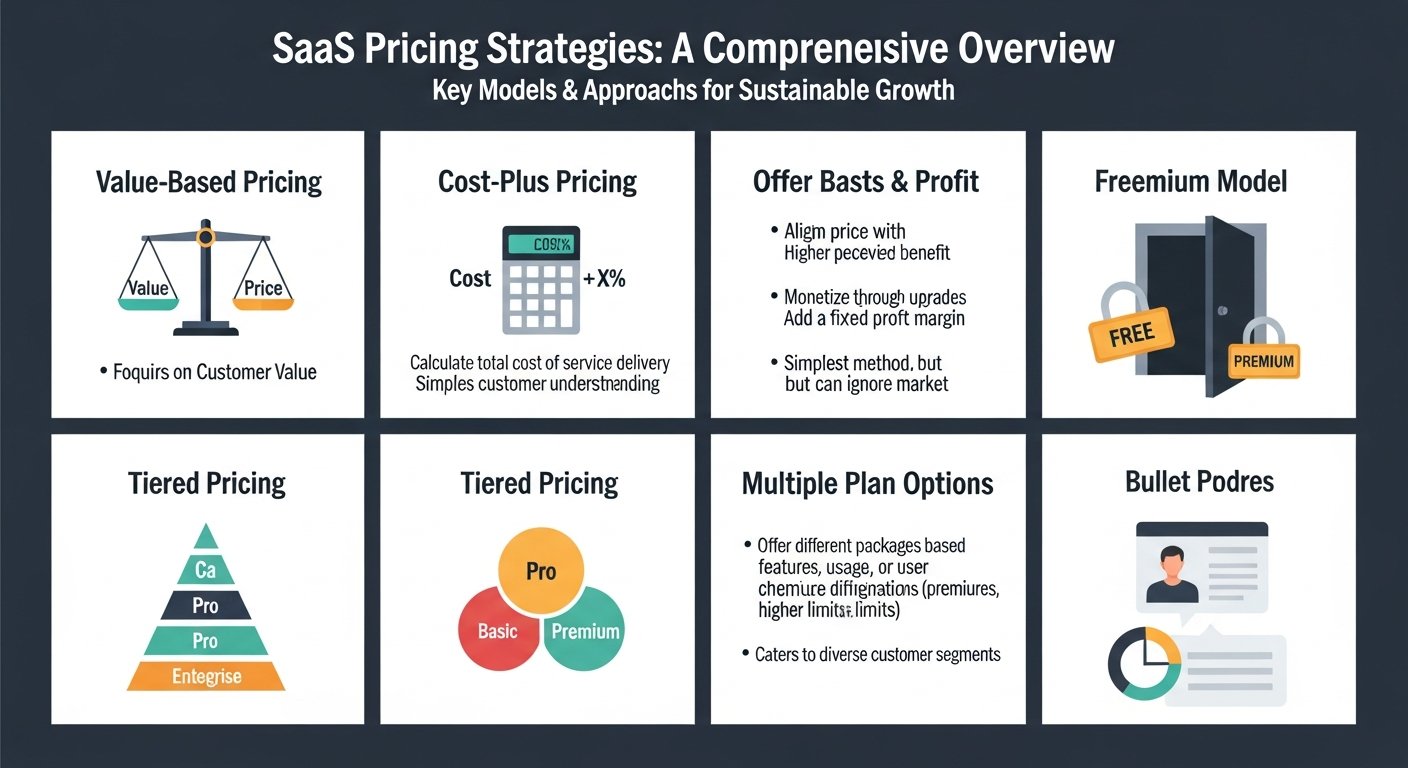
Value-based pricing is a strategy where the price of a SaaS product is determined by the perceived value it delivers to the customer, rather than by the cost of production or competitor pricing. For startups, this approach is paramount because it shifts the focus from internal costs to external customer benefits. It means pricing your software based on the tangible outcomes and improvements customers experience, such as increased revenue, reduced costs, enhanced efficiency, or improved decision-making. This strategy is particularly effective for startups offering innovative solutions that solve significant pain points, as it allows them to capture a greater share of the value they create for their users. It’s about demonstrating and quantifying the ROI your SaaS provides.
What are the Benefits of Value-Based Pricing for Startup Business Growth & Digital Transformation?
- Higher Revenue Potential: By tying price to value, startups can charge premium prices for products that deliver substantial benefits, leading to higher average revenue per user (ARPU).
- Stronger Customer Relationships: This model necessitates a deep understanding of customer needs and business objectives, fostering stronger relationships built on mutual value creation.
- Enhanced Product-Market Fit: Continuously assessing and communicating value helps refine your product and messaging, ensuring it resonates deeply with your target market.
- Competitive Advantage: Differentiating your offering based on value rather than just features allows startups to stand out in crowded markets and avoid direct price wars.
- Supports Digital Transformation Adoption: Startups can position their SaaS as an essential tool for digital transformation, justifying higher prices by demonstrating its critical role in modernizing business processes and achieving strategic goals.
How to Implement Value-Based Pricing: Key Considerations
- How to Quantify Value for Value-Based Pricing? Startups must invest time in understanding and quantifying the economic value their solution provides. This might involve case studies, ROI calculators, or clear metrics.
- Target Audience Segmentation: Different customer segments may derive different levels of value, requiring tailored pricing tiers or value propositions.
- Communication of Value: Clearly articulate the benefits and ROI to potential customers through compelling marketing and sales narratives.
- Regular Review: Value perception can change over time. Regularly review your pricing strategy to ensure it still reflects the value delivered and market dynamics.
- Data-Driven Insights: Utilize customer data and feedback to continuously refine your understanding of perceived value and optimize pricing.
How Does the Freemium Model Accelerate SaaS Startup Growth?
How Does the Freemium Model Accelerate Startup Growth?
The freemium model offers a basic version of a SaaS product for free, with advanced features, increased capacity, or enhanced support available through a paid subscription (the “premium” tier). For startups focused on rapid customer acquisition and broad market penetration, freemium can be a powerful accelerator. It lowers the barrier to entry, allowing users to experience the product’s core value firsthand without commitment. This approach builds a large user base, generates product awareness, and provides valuable data on user behavior. By converting a percentage of these free users into paying customers, startups can achieve significant business growth and establish a strong market presence, especially crucial in the early stages of digital transformation when adoption is key.

What are the Pros and Cons of the Freemium Model for Digital Transformation Initiatives?
Pros:
- Rapid User Acquisition: Attracts a large volume of users quickly, fueling growth in adoption.
- Reduced CAC: The cost of acquiring a free user is typically lower than a paid one, making it cost-effective for initial market entry.
- Product Virality: Free users often share the product, leading to organic growth and word-of-mouth marketing.
- Market Research: A large free user base provides extensive data for product development and understanding user needs, vital for evolving digital solutions.
- Facilitates Digital Transformation Adoption: Allows businesses to experiment with new digital tools without upfront financial risk, encouraging wider adoption.
Cons:
- High Churn for Free Users: Many free users may never convert, leading to high support costs for non-revenue generating users.
- Revenue Challenges: Generating sufficient revenue from conversions can be difficult if the premium offering isn’t compelling enough.
- Feature Dilution: Balancing valuable free features with enticing premium ones requires careful planning to avoid devaluing the paid offering.
- Resource Strain: Supporting a large free user base can consume significant resources (servers, customer support) without immediate ROI.
- Conversion Optimization: Requires continuous effort in onboarding, engagement, and nudges to convert free users to paid.
How to Optimize Conversions in a Freemium SaaS Model?
- Clear Value Proposition: Ensure free users clearly understand the benefits of upgrading to the premium version.
- Strategic Feature Gating: Limit features that drive significant business value to the paid tier, without crippling the free experience.
- Targeted Nudges: Implement in-app messages, emails, and timely prompts that highlight premium benefits relevant to user behavior.
- Exceptional Onboarding: Guide free users to experience the product’s core “aha! moment” quickly to demonstrate value.
- Time-Limited Trials: Offer a free trial of the premium version to give users a taste of the full experience.
- Analyze User Data: Identify patterns and behaviors of converting users versus non-converting users to refine your strategy.
How Can Tiered Pricing Cater to Diverse SaaS Customer Segments?
How to Structure Tiers for Maximum Revenue Growth in SaaS?
Tiered pricing involves offering multiple packages (e.g., Basic, Pro, Enterprise) at different price points, each with varying levels of features, usage limits, or support. This strategy is highly effective for startups that serve a diverse customer base, from small businesses to large enterprises, all undergoing different stages of digital transformation. By structuring tiers effectively, startups can capture revenue from a wider range of customers and maximize their average revenue per user (ARPU) by encouraging upgrades as customer needs grow. The key is to differentiate tiers based on attributes that customers genuinely value and are willing to pay more for, such as advanced analytics, increased user seats, deeper integrations, or priority support.
- Identify Key Value Drivers: Determine what features, usage limits, or support levels are most valuable to different customer segments.
- Create Clear Differentiation: Ensure each tier offers distinct benefits that justify the price difference. Avoid overwhelming customers with too many options.
- Design an Upgrade Path: Make it intuitive for customers to understand how moving to a higher tier will unlock more value as their business needs evolve.
- Anchor Pricing: Position a middle tier as the “most popular” or “best value” to guide customer choice and create perceived value for other tiers.
- Scalability in Mind: Ensure your tiered pricing model can accommodate future product enhancements and customer growth without needing frequent overhauls.
What is the Impact of Tiered Pricing on Customer Lifetime Value (CLTV)?
Tiered pricing directly influences Customer Lifetime Value (CLTV) by facilitating upselling and cross-selling opportunities. As a startup’s customers grow and their digital transformation initiatives mature, their requirements for software capabilities often expand. A well-designed tiered model enables customers to seamlessly upgrade to higher-priced plans that offer more functionality, thereby increasing the revenue generated from each customer over their relationship with the product. This incremental revenue generation, coupled with improved customer retention due to fulfilling evolving needs, significantly boosts the overall CLTV. Furthermore, by addressing specific needs within different tiers, startups can reduce churn by preventing customers from feeling they are paying for features they don’t use or, conversely, are limited by their current plan.
When Should Your SaaS Choose Tiered Pricing?
Tiered pricing is an excellent choice for SaaS startups when:
- Diverse Customer Segments: You serve customers with varying needs, budgets, and operational scales (e.g., freelancers vs. SMBs vs. large enterprises).
- Feature-Rich Product: Your product offers a wide array of features, some of which are more valuable to advanced users or larger organizations.
- Scalability is Key: Your customers’ usage or feature requirements are expected to grow over time, necessitating an easy upgrade path.
- Competitors Use Tiers: It’s a common pricing model in your industry, and you need to compete effectively while offering differentiation.
- Desire for Predictable Revenue: While usage might vary within a tier, the monthly subscription fee for each tier offers a degree of revenue predictability.
Is Usage-Based Pricing the Right SaaS Strategy for Your Startup?
Is Usage-Based Pricing Right for Your SaaS Startup?
Usage-based pricing, also known as pay-as-you-go or consumption-based pricing, charges customers based on how much of the service they consume. This could be data storage, API calls, active users, transactions processed, or compute time. For startups, this model aligns customer cost directly with the value received and provides inherent scalability. It’s particularly appealing for infrastructure-as-a-service (IaaS), platform-as-a-service (PaaS), or specific SaaS solutions where consumption can be easily metered and directly correlates with the customer’s business activity or growth. Deciding if usage-based pricing is right involves evaluating if your product’s value directly scales with quantifiable consumption metrics and if your target market prefers flexibility over fixed costs for their digital transformation journey.
What are the Advantages of Usage-Based Pricing for Scalability and Flexibility?
- Fairness and Transparency: Customers only pay for what they use, which is perceived as fair and transparent, fostering trust.
- Low Barrier to Entry: Often starts with a very low or no upfront cost, encouraging adoption and reducing friction for new users.
- Revenue Scales with Value: As customers derive more value and increase their usage, your revenue automatically grows, providing a natural revenue expansion mechanism.
- Agility for Startups: Allows startups to be agile, offering flexibility to customers whose needs might fluctuate, a common scenario in dynamic digital transformation projects.
- Better Cost Alignment: Reduces the risk of underpricing for heavy users and overpricing for light users, optimizing revenue potential across the customer base.
What are the Challenges of Usage-Based Pricing and How Can They Be Mitigated?
- What are the Challenges to Revenue Predictability with Usage-Based Pricing? Can be challenging to forecast revenue accurately due to variable consumption patterns.
- Mitigation: Implement minimum usage tiers, commit-based discounts, or hybrid models that include a base subscription.
- Why is Billing Complexity a Challenge for Usage-Based Pricing? Requires robust metering and billing systems, which can be complex for early-stage startups.
- Mitigation: Leverage specialized billing platforms (e.g., Chargebee, Stripe Billing) and ensure clear usage dashboards for customers.
- How to Prevent “Bill Shock” with Usage-Based Pricing? Customers may find it difficult to predict their own costs, leading to “bill shock.”
- Mitigation: Provide transparent usage tracking, real-time alerts, and clear cost calculators. Offer caps or budget controls.
- Does Usage-Based Pricing Discourage Usage? Customers might limit their usage to control costs, potentially hindering their full adoption of the product’s value.
- Mitigation: Focus on demonstrating the ROI of increased usage and offer tiered pricing breaks for higher consumption.

Why is Flat-Rate Pricing Simple for Early-Stage SaaS Startups?
Understanding the Flat-Rate Model for SaaS
Flat-rate pricing is the simplest SaaS pricing strategy, offering a single product with all its features and functionalities at a single, fixed monthly or annual price. There are no tiers, no usage meters, and no per-user charges. For early-stage startups, particularly those with a very focused product and a clear target audience, this model offers unparalleled simplicity in both implementation and communication. It makes budgeting straightforward for customers and revenue forecasting relatively easy for the startup. While it lacks the flexibility of other models, its directness can be a significant advantage in specific market conditions, especially when introducing a new digital solution.
When is Flat-Rate Pricing Effective for Startup Growth?
Flat-rate pricing can be highly effective for startups in several scenarios:
- Niche Products: When your SaaS solves a very specific problem for a well-defined audience, and the value proposition is consistent across all users.
- New Market Entry: For products entering a new market where simplicity can reduce adoption friction and accelerate market penetration.
- Low Feature Complexity: If your product has a relatively uniform feature set and doesn’t naturally lend itself to tiered or usage-based differentiation.
- Focus on Simplicity: When ease of decision-making and straightforward budgeting for customers are top priorities, particularly for smaller businesses or individual users engaging in digital transformation.
- Predictable Value: If the value derived from your product is relatively constant regardless of usage volume or number of users.
What are the Limitations of Flat-Rate Pricing and How to Transition Away From It?
Limitations:
- Limited Revenue Growth: Lacks natural mechanisms for revenue expansion, as all customers pay the same, regardless of their value derived or usage.
- Missed Opportunities: May leave money on the table by undercharging high-value customers or overpricing low-value customers.
- Difficulty with Diverse Users: Not suitable for products serving a wide range of customer sizes or needs.
- Scalability Challenges: As the product evolves or customer base diversifies, a flat rate can become unsustainable or uncompetitive.
Exit Strategies (Transitioning from Flat-Rate):
- Introduce Tiers: As your product matures, segment your features and customer base to introduce a tiered pricing structure.
- Add-ons/Modules: Keep the core flat rate but introduce optional premium add-ons for specific advanced functionalities.
- Hybrid Models: Combine the flat rate with a per-user or usage-based component for certain features.
- Grandfathering: Allow existing customers to stay on their flat rate for a period while new customers are moved to a new model.
How Does Per-User Pricing Offer Predictability for Team-Based SaaS?
The Mechanics of Per-User Pricing for SaaS
Per-user pricing, also known as per-seat pricing, charges customers a fixed fee for each user or seat that accesses the SaaS product. This is one of the most common and straightforward pricing models, especially for business-to-business (B2B) SaaS solutions that are inherently collaborative or team-oriented. The cost scales directly with the size of the team or organization using the software. This model offers transparency and predictability for customers, as they can easily calculate their monthly costs based on their headcount. For startups, it provides a clear path to revenue growth as customers expand their teams and require more user licenses, supporting their internal digital transformation efforts by scaling access to critical tools.
What are the Ideal Scenarios for Per-User Pricing in Digital Transformation Solutions?
Per-user pricing is particularly well-suited for SaaS products that:
- Team Collaboration Tools: Project management, CRM, communication platforms, and document collaboration software often benefit from this model.
- License-Based Access: When individual access and accountability are crucial, such as for design tools, development environments, or specialized analytical software.
- Predictable Usage: If the value of the software is largely derived from individual access to its features, rather than overall consumption or external value.
- Onboarding & Support Costs: When there is a direct correlation between the number of users and the cost of onboarding, training, and ongoing support for the startup.
- Encourage Wider Adoption: For organizations undergoing digital transformation, per-user pricing can encourage broader internal adoption of new tools by making it easy to add new team members.
How to Balance Affordability and Profitability with Per-User Pricing?
- Discount for Volume: Offer tiered discounts for larger numbers of users (e.g., 1-10 users at $X/user, 11-50 users at $Y/user) to encourage broader adoption and secure larger accounts.
- Feature Differentiation: Consider combining per-user pricing with a tiered model, where higher tiers unlock more features in addition to allowing more users.
- Defining “User”: Clearly define what constitutes a “user” (e.g., active user, licensed user, role-based user) to avoid confusion and ensure fair billing.
- Consider Usage Caps: For very large organizations, a pure per-user model might become prohibitively expensive. Consider capping the per-user fee at a certain point or transitioning to an enterprise-level flat fee or usage-based model.
- Monitor Churn: High per-user costs can lead to churn if customers scale down their teams or find more affordable alternatives. Continuously evaluate the competitive landscape.
- Value Justification: Continuously demonstrate the value each user gains from the software to justify the per-user cost, especially for managers responsible for budgeting during digital transformation projects.
What are Common SaaS Pricing Mistakes Startups Must Avoid?
While the right SaaS pricing strategy can propel a startup toward exponential business growth, several common pitfalls can derail even the most innovative products. Understanding and actively avoiding these mistakes is crucial for sustainable digital transformation and market success.
Why is Underpricing a Common Mistake for SaaS Startups?
One of the most frequent mistakes startups make is underpricing their SaaS product. This often stems from a fear of losing customers to competitors or a lack of confidence in their value proposition. However, underpricing can have severe long-term consequences:
- Perceived Low Quality: Customers may associate a low price with low quality or an inferior solution, undermining your brand’s credibility.
- Insufficient Revenue for Growth: Inadequate pricing limits your ability to invest in product development, customer support, and marketing, hindering scalability.
- Difficulty Raising Prices: It’s significantly harder to increase prices substantially later without alienating your existing customer base.
- Attracting Wrong Customers: Low prices often attract price-sensitive customers who are more likely to churn, less loyal, and require more support relative to their spend.
Startups must conduct thorough market research and internal value assessments to ensure their pricing accurately reflects the significant impact their solution delivers, especially when contributing to critical digital transformation initiatives.
Why is Ignoring Customer Feedback and Market Signals a Critical SaaS Pricing Error?
SaaS pricing is not a one-time decision; it’s an ongoing process that requires constant iteration. Ignoring customer feedback and market signals is a critical error that can lead to misaligned pricing. This includes:
- Lack of Customer Interviews: Not engaging directly with potential and existing customers to understand their willingness to pay, perceived value, and desired features.
- Disregarding Competitor Analysis: Failing to monitor competitors’ pricing models, value propositions, and market positioning.
- Not Analyzing Usage Data: Overlooking insights from how customers interact with your product, which can inform feature gating, tier differentiation, and value perception.
- Static Pricing: Keeping pricing unchanged for too long, even as your product evolves, the market shifts, or your value proposition strengthens.
Successful startups continuously listen, learn, and adapt their SaaS pricing strategies to stay competitive and relevant, ensuring their digital transformation solutions remain attractive.
How Does a Lack of Flexibility and Scalability Impact SaaS Pricing?
A rigid pricing model that cannot adapt to evolving customer needs or internal growth stages is a significant drawback for any startup aiming for long-term business growth. Mistakes include:
- One-Size-Fits-All Approach: Imposing a single pricing model on a diverse customer base, failing to cater to different budget sizes, usage patterns, or feature requirements.
- No Upgrade Path: A pricing structure that doesn’t allow customers to easily scale up their usage or access more advanced features as their needs grow, leading to churn.
- Ignoring Future Product Development: Creating a pricing model that doesn’t account for future features or new modules, making it difficult to monetize innovations.
- Lack of Enterprise Options: Failing to provide a clear path for larger enterprise clients, who often require custom pricing, SLAs, or dedicated support, particularly for complex digital transformation projects.
SaaS pricing strategies should be designed with inherent flexibility and scalability, allowing startups to evolve their offerings and continue to meet the changing demands of their growing customer base.
What Tools and Analytics Optimize SaaS Pricing Strategies?
Effective SaaS pricing is not solely an art; it’s also a science driven by data and robust tools. Startups leveraging the right platforms and analytics can continuously optimize their pricing strategies for maximum revenue growth and customer satisfaction in their digital transformation journey.
What Pricing Software and Platforms Can Help Optimize SaaS Pricing?
Specialized pricing tools and platforms streamline the process of implementing, managing, and optimizing SaaS pricing models. These solutions often integrate with existing CRM, billing, and analytics systems.
- Subscription Billing Platforms: Tools like Chargebee, Stripe Billing, Recurly, and Zuora automate recurring billing, subscription management, and often support complex pricing models (e.g., tiered, usage-based, freemium conversions).
- Pricing Optimization Software: Platforms such as Price intelligently analyze market data, competitor pricing, and customer willingness to pay to recommend optimal price points. They often use AI and machine learning to predict customer behavior.
- Customer Data Platforms (CDPs): CDPs (e.g., Segment, Mixpanel) consolidate customer data from various touchpoints, providing a unified view of user behavior, feature usage, and conversion paths, which are invaluable for refining pricing tiers and value propositions.
- Experimentation Tools: A/B testing platforms (e.g., Optimizely, VWO) allow startups to test different pricing pages, feature combinations, and messaging to identify what resonates best with various customer segments.
These tools are essential for startups to manage the complexity of SaaS pricing strategies and ensure they are always aligning their prices with perceived customer value and market dynamics.
What are the Key Metrics for Evaluating SaaS Pricing Performance?
Monitoring specific key performance indicators (KPIs) is fundamental to understanding the health and effectiveness of your SaaS pricing strategy:
- Average Revenue Per User (ARPU): This metric calculates the average revenue generated by each active user or subscriber over a period. A healthy ARPU indicates effective monetization and potential for upselling.
- Churn Rate (Customer Churn & Revenue Churn): Customer churn measures the percentage of customers who cancel their subscriptions. Revenue churn measures the percentage of recurring revenue lost. High churn rates can indicate pricing issues, perceived low value, or poor product-market fit.
- Customer Lifetime Value (LTV): LTV estimates the total revenue a startup can reasonably expect from a single customer account over the entire period of their relationship. A high LTV relative to CAC is a sign of a sustainable and profitable pricing strategy.
- Customer Acquisition Cost (CAC): CAC is the total cost associated with acquiring a new customer. By comparing CAC to LTV, startups can assess the profitability of their customer acquisition efforts and ensure their pricing can sustain their growth engine.
- Conversion Rate: For freemium models, this measures the percentage of free users who convert to paid subscriptions. For trials, it’s the percentage of trial users who become paying customers.
- Expansion Revenue: Revenue generated from existing customers through upsells, cross-sells, or increased usage. This is a crucial indicator of a scalable pricing model and customer success.
Regularly tracking and analyzing these metrics provides invaluable insights, allowing startups to make data-driven decisions to optimize their SaaS pricing strategies and fuel sustainable business growth within their digital transformation initiatives.
What are the Future Trends in SaaS Pricing for Digital Transformation?
The landscape of SaaS pricing is continuously evolving, driven by advancements in technology, changing customer expectations, and the acceleration of digital transformation across industries. Startups that anticipate and embrace these emerging trends will be better positioned for sustained growth and competitive advantage.
How is AI-Driven Dynamic Pricing Shaping the Future of SaaS?
Artificial Intelligence (AI) and machine learning are poised to revolutionize SaaS pricing by enabling dynamic pricing models. Instead of static prices, AI-driven systems can:
- Personalize Pricing: Offer customized pricing based on individual customer profiles, usage patterns, perceived value, negotiation history, and even external factors like industry trends.
- Real-Time Optimization: Adjust prices in real-time based on supply and demand, competitor pricing changes, conversion rates, and other market signals.
- Predictive Analytics: Forecast customer churn or propensity to upgrade, allowing for proactive pricing adjustments or personalized offers.
- Automate Experimentation: Continuously run A/B tests on different pricing strategies and feature combinations without manual intervention.
For startups, this means moving beyond reactive pricing adjustments to a proactive, intelligent system that maximizes revenue while optimizing customer acquisition and retention. This level of sophistication will be a cornerstone for many digital transformation solutions in the coming years.
What are Outcome-Based Pricing Models and Their Impact on SaaS?
Building on the principles of value-based pricing, outcome-based models represent a significant shift towards truly aligning pricing with the success of the customer. In this model, customers pay only when specific, predefined business outcomes are achieved through the use of the SaaS product. Examples include:
- Revenue Share: The SaaS provider takes a percentage of the additional revenue generated by the customer using the software.
- Cost Savings Share: The provider receives a portion of the cost savings realized by the customer.
- Performance-Based Fees: Payment is tied to specific KPIs, like lead generation, conversion rates, or operational efficiency improvements.
This approach significantly de-risks the investment for the customer, making it highly attractive for those embarking on complex digital transformation projects where tangible ROI is paramount. For startups, it requires a high degree of confidence in their product’s ability to deliver measurable results and robust tracking mechanisms, but the potential for higher revenue share and deep customer partnerships is substantial. It represents the ultimate alignment of interests, where the startup’s success is directly tied to the customer’s success.
As startups continue to drive business growth and digital transformation, the strategic deployment of SaaS pricing strategies will remain a critical determinant of their success. By understanding these models, avoiding common pitfalls, and embracing future trends, startups can craft a pricing strategy that not only generates revenue but also fosters deep customer relationships and enables sustainable scaling in an increasingly digital world.
| Strategy | Primary Benefit | Best For | Potential Drawback | Key Metric to Track | Digital Transformation Impact |
|---|---|---|---|---|---|
| Value-Based | Maximizes revenue by aligning with customer ROI. | High-impact solutions, innovative products. | Requires strong value quantification, complex to implement. | ARPU, Customer ROI, Value Proposition Acceptance. | Justifies investment in critical transformation tools. |
| Freemium | Rapid customer acquisition, product virality. | Products with wide appeal, low barrier to entry. | High churn of free users, conversion challenges. | Conversion Rate (Free to Paid), Free User Engagement. | Accelerates initial adoption of new digital solutions. |
| Tiered | Caters to diverse customer segments, clear upgrade path. | Products with varied features/usage needs, diverse market. | Complexity in tier differentiation, potential for feature bloat. | ARPU, Expansion Revenue, Upsell Rate. | Scales digital capabilities with organizational growth. |
| Usage-Based | Fairness, scales with customer consumption. | Infrastructure/API-heavy products, variable usage. | Revenue unpredictability, potential “bill shock.” | Usage Volume, Revenue Per Usage Unit, Cost per Transaction. | Enables flexible scaling of digital resources/consumption. |
| Flat-Rate | Simplicity for both startup and customer. | Niche products, early market entry, low complexity. | Limited revenue growth, not suitable for diverse users. | Customer Acquisition Cost (CAC), Churn Rate (overall). | Eases initial entry for simple digital tools. |
| Per-User | Predictable revenue, scales with team size. | Collaborative tools, license-based access for teams. | Discourages wider adoption, can be costly for large teams. | User Churn, ARPU (per user), Expansion Revenue (user adds). | Supports scaled access to collaborative digital platforms. |
| Attribute | Value-Based | Freemium | Tiered | Usage-Based |
|---|---|---|---|---|
| Scalability | High (revenue scales with value) | Medium (user base scales, revenue depends on conversion) | High (clear upgrade path for growth) | Very High (revenue scales directly with consumption) |
| Customer Acquisition | Medium (focus on high-value leads) | Very High (low barrier to entry) | High (caters to varied entry points) | High (low initial cost encourages trial) |
| Revenue Predictability | Medium (tied to perceived value, can fluctuate) | Low (dependent on conversion rates) | High (fixed prices per tier) | Low (variable based on consumption) |
| Market Penetration | Medium (targets specific high-value segments) | Very High (broad reach with free offering) | High (addresses multiple market segments) | High (low entry cost, pay-as-you-grow) |
| Customer Retention | High (strong alignment with customer success) | Medium (depends on value of premium offering) | High (can upgrade as needs evolve) | High (fairness, no overpayment) |
| Digital Transformation Alignment | Strong (focus on outcomes & ROI) | Excellent (encourages adoption of new tools) | Good (scales solutions with evolving needs) | Excellent (flexible resource allocation) |
| Complexity of Implementation | High (requires deep market research & value quantification) | Medium (requires strong conversion funnel & product strategy) | Medium (needs clear tier differentiation & feature gating) | High (requires robust metering & billing infrastructure) |