

The modern enterprise operates as a complex ecosystem of specialized applications, disparate databases, and interconnected systems. In an era demanding agility, real-time data flow, and seamless user experiences, the traditional silos of information are no longer sustainable. Enter Application Programming Interfaces (APIs)—the unsung heroes of digital transformation. Far from being mere technical connectors, modern APIs are the strategic conduits that enable enterprise applications to communicate, collaborate, and innovate at an unprecedented pace. For tech entrepreneurs and established businesses alike, understanding how these sophisticated interfaces knit together the intricate fabric of the enterprise is not just advantageous, it’s foundational to building scalable, resilient, and future-proof digital infrastructures. This article delves into the transformative power of modern APIs, exploring their role in integrating complex systems, driving operational efficiency, and unlocking new avenues for innovation across the enterprise landscape.
The Evolution of Enterprise Connectivity: From Monoliths to Microservices
For decades, enterprise software development was dominated by monolithic architectures. These colossal, tightly coupled applications housed all functionalities within a single codebase, from user interface to business logic and data access layers. While seemingly straightforward in their initial deployment, monoliths quickly became impediments to progress. Their inherent complexity led to slow development cycles, as even minor changes required extensive testing and redeployment of the entire system. Vendor lock-in was common, and scaling specific components without scaling the whole application was virtually impossible, leading to inefficient resource utilization. Integrating new technologies or third-party services into these behemoths was a notoriously cumbersome and expensive undertaking, often resulting in brittle, point-to-point connections that were difficult to maintain and scale.
The digital revolution, characterized by the explosion of cloud computing, mobile devices, and data-driven insights, exposed the critical limitations of this traditional approach. Enterprises demanded greater agility, faster innovation cycles, and the ability to adapt swiftly to market changes. This imperative fueled a paradigm shift towards distributed systems, most notably microservices architectures. In this model, large applications are broken down into smaller, independent services, each responsible for a specific business capability, running in its own process, and communicating over well-defined interfaces. The rise of Software-as-a-Service (SaaS) platforms and cloud-native applications further accelerated this transition, as businesses increasingly relied on a diverse portfolio of best-of-breed solutions rather than a single, all-encompassing suite.
This architectural evolution created a fundamental need for a new, more robust, and flexible mechanism for these independent components to communicate. Traditional integration methods, such as Enterprise Service Buses (ESBs) or direct database access, proved too rigid or too tightly coupled for the dynamic nature of microservices and cloud environments. It was in this context that modern APIs emerged as the indispensable connective tissue. They provide the standardized, loosely coupled communication channels necessary for disparate services, both internal and external, to interact seamlessly, share data, and orchestrate complex business processes without compromising the independence and scalability benefits of distributed systems. This shift from monolithic, internal-only systems to a highly interconnected ecosystem fundamentally reshaped how enterprises approach connectivity and innovation.
Unpacking Modern APIs: Beyond Simple Data Exchange
While the concept of an API—an interface allowing software components to interact—has existed for decades, what defines a “modern API” extends far beyond simple data exchange. Modern APIs are characterized by a set of principles, technologies, and practices designed for the agility, scalability, and security demands of today’s interconnected enterprise. They are not merely technical connectors; they are strategic assets, often treated as products themselves, enabling businesses to create new revenue streams, foster partnerships, and build robust digital ecosystems.
At their core, many modern APIs adhere to architectural styles like REST (Representational State Transfer), which leverages standard HTTP methods (GET, POST, PUT, DELETE) for stateless communication and resource manipulation. This approach promotes simplicity, discoverability, and broad compatibility. However, the API landscape is constantly evolving, with newer paradigms like GraphQL emerging to offer more efficient data fetching by allowing clients to request exactly the data they need, reducing over-fetching and under-fetching. Similarly, gRPC (Google Remote Procedure Call) provides high-performance, language-agnostic communication, often favored for internal microservices communication due to its efficiency and strong typing capabilities. Furthermore, event-driven architectures, where APIs facilitate asynchronous communication via events and messages, are gaining prominence for real-time responsiveness and decoupled systems.
Beyond their architectural style, modern APIs are defined by several critical attributes:
- Standardization and Documentation: They are well-documented, often using specifications like OpenAPI (Swagger), making them easy for developers to understand, integrate, and consume.
- Security: Robust security measures such as OAuth 2.0 for authorization, JWT (JSON Web Tokens) for secure information exchange, API keys for access control, and comprehensive encryption are built-in from the ground up.
- Versioning: They incorporate clear versioning strategies to ensure backward compatibility and smooth transitions as APIs evolve.
- Lifecycle Management: Modern APIs are managed throughout their lifecycle, from design and development to deployment, monitoring, and deprecation.
- API Gateways: They often sit behind API gateways, which centralize concerns like authentication, rate limiting, routing, and analytics, providing a unified entry point and enhanced control.
The strategic value of these sophisticated interfaces cannot be overstated. By exposing business functionalities and data in a controlled, consumable manner, modern APIs empower enterprises to innovate faster, integrate seamlessly with partners and third-party services, and create personalized experiences for customers. They transform internal capabilities into external opportunities, fostering a culture of openness and accelerating digital transformation.
The Strategic Imperative of API Integration for Enterprises
In today’s hyper-connected business environment, the phrase “What Is API Integration?” transcends a mere technical definition; it represents a strategic imperative for any enterprise aiming to remain competitive and agile. At its core, API integration refers to the process of connecting two or more applications or systems through their APIs to enable them to exchange data and functionality seamlessly. However, for enterprises, this isn’t just about linking isolated data points; it’s about weaving a unified, intelligent data fabric across the entire organization, breaking down the traditional silos that have long hindered efficiency and innovation.
The benefits of robust API integration are profound and multifaceted:
- Improved Operational Efficiency: By automating data transfer and workflow orchestration between systems like CRM, ERP, HR, and supply chain management, manual data entry is minimized, reducing errors and freeing up human resources for more strategic tasks. Real-time data synchronization ensures that all departments operate with the most current information, leading to better decision-making and streamlined processes.
- Enhanced Customer Experiences: APIs enable businesses to create personalized, omnichannel customer journeys. Integrating customer data from various touchpoints (website, mobile app, social media, call center) allows for a 360-degree view of the customer, facilitating tailored recommendations, proactive support, and seamless interactions across all channels.
- Faster Time-to-Market: With pre-built integrations or easily consumable APIs, enterprises can rapidly assemble new products, services, or features by leveraging existing functionalities and third-party solutions. This agility significantly shortens development cycles and allows businesses to respond quickly to market demands and competitive pressures.
- Unlocking Data Value: API integration facilitates the aggregation and analysis of data from diverse sources, providing deeper insights into business performance, customer behavior, and market trends. This data-driven intelligence is crucial for strategic planning and innovation.
- Ecosystem Expansion and Partnership Enablement: By exposing well-documented APIs, enterprises can foster developer ecosystems, allowing partners and third-party developers to build innovative applications and services on top of their platforms. This creates new revenue streams and expands the reach and value of the enterprise’s offerings.
To manage the complexity of integrating numerous applications, many enterprises turn to Integration Platform as a Service (iPaaS) solutions. These cloud-based platforms offer tools and services to develop, execute, and govern integration flows between various applications, both on-premises and in the cloud, significantly simplifying the integration landscape. Whether it’s connecting a legacy ERP system with a modern cloud CRM, optimizing a global supply chain with real-time inventory updates, or personalizing a customer’s journey across multiple digital touchpoints, API integration is no longer a technical afterthought but a foundational strategy for digital transformation and sustained growth.
Architectural Paradigms: How APIs Drive Digital Transformation
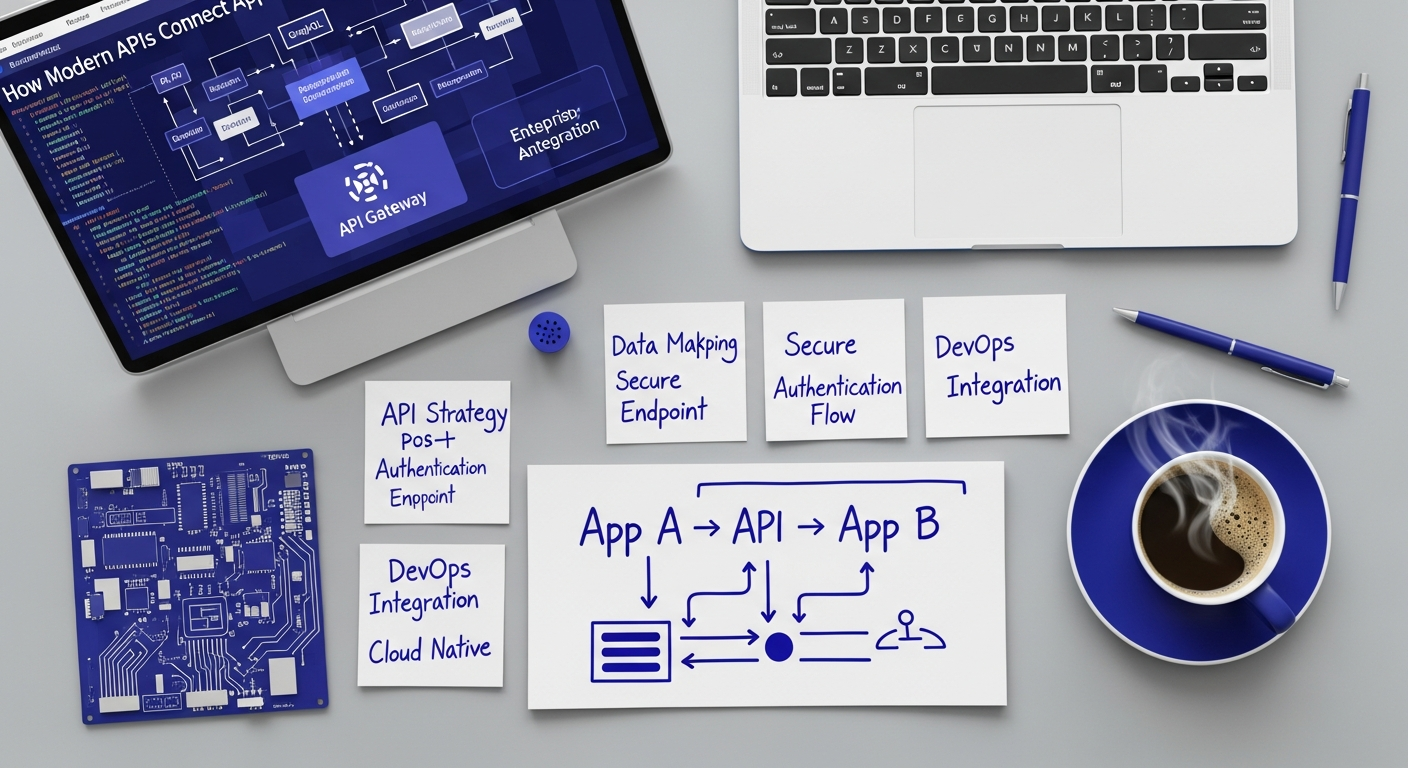
The transformative power of APIs is most evident in their fundamental role in enabling modern architectural paradigms that underpin digital transformation initiatives. APIs are not just connectors; they are the architectural glue that allows enterprises to break free from rigid legacy systems and embrace flexible, scalable, and innovative approaches to software development and deployment.
One of the most significant shifts driven by APIs is the widespread adoption of Microservices Architecture. In a microservices paradigm, an application is composed of many small, independent services, each performing a specific business function. APIs serve as the primary communication mechanism between these services. Each microservice exposes its functionality through well-defined APIs, allowing other services to interact with it without needing to know its internal implementation details. This loose coupling enables independent development, deployment, and scaling of individual services, drastically improving developer productivity, system resilience, and the ability to update specific components without affecting the entire application. The move from monolithic applications to an API-driven microservices architecture is a cornerstone of enterprise agility.
Another crucial paradigm is Headless Commerce and Content Management Systems (CMS). In a traditional setup, the frontend (the “head” – e.g., a website) and the backend (the “body” – e.g., product catalog, content database) are tightly coupled. Headless architectures decouple these layers, with the backend exposing its content and functionalities purely through APIs. This means the same backend data can be delivered to any frontend channel—a website, mobile app, IoT device, smartwatch, or even a voice assistant—via APIs. This API-first approach enables true omnichannel experiences, allowing enterprises to quickly adapt to new customer touchpoints without rebuilding their entire backend infrastructure. This empowers businesses to deliver rich, consistent experiences across a fragmented digital landscape.
APIs are also central to Event-Driven Architectures (EDA), which are becoming increasingly important for real-time responsiveness and complex distributed systems. In an EDA, services communicate by producing and consuming events (e.g., “order placed,” “inventory updated”). APIs, often in conjunction with message queues or streaming platforms like Apache Kafka, facilitate this asynchronous communication. This allows systems to react instantly to changes, scale independently, and maintain high availability, making them ideal for scenarios requiring immediate processing and strong decoupling, such as financial transactions, IoT data processing, or real-time personalization engines.
Finally, the API-first approach represents a fundamental change in how software is designed. Instead of building an application and then exposing its functionalities through APIs, an API-first strategy involves designing and defining the APIs first. This ensures that the application is built from the ground up to be consumable, reusable, and interoperable, both internally and externally. By prioritizing the API contract, enterprises foster a culture of modularity, consistency, and external engagement, accelerating innovation and ensuring their systems are future-proof and ready for integration within an ever-expanding digital ecosystem.
APIs and Operational Excellence: The DevOps Connection
The synergy between modern APIs and DevOps principles is profound and mutually reinforcing. DevOps, defined by its emphasis on automation, collaboration, and continuous delivery across the entire software development lifecycle, finds its most potent enabler in the pervasive use of APIs. For tech entrepreneurs striving for operational excellence, understanding this connection is paramount. APIs are not just technical interfaces; they are the connective tissue that allows DevOps practices to flourish, transforming how software is built, deployed, and managed.
What Is DevOps? At its core, DevOps is a set of practices that combines software development (Dev) and IT operations (Ops) to shorten the systems development life cycle and provide continuous delivery with high software quality. It advocates for automation, monitoring, collaboration, and sharing of responsibilities across development, QA, and operations teams. APIs are fundamental to achieving these goals:
- Automation of the CI/CD Pipeline: APIs allow development teams to automate virtually every stage of the Continuous Integration/Continuous Delivery (CI/CD) pipeline. From triggering builds in source code repositories (like GitHub or GitLab) to running automated tests, deploying code to various environments (staging, production), and configuring infrastructure as code, APIs provide the programmatic hooks necessary for seamless, hands-off execution. Build tools, testing frameworks, and deployment platforms all leverage APIs to communicate and orchestrate the flow of code from commit to production.
- Infrastructure as Code (IaC) and Cloud Automation: Modern cloud providers (AWS, Azure, GCP) expose their entire infrastructure as APIs. This enables operations teams to provision, configure, and manage servers, databases, networks, and other resources programmatically using tools like Terraform or CloudFormation. This “Infrastructure as Code” approach, driven by APIs, ensures consistency, repeatability, and version control for infrastructure, a cornerstone of DevOps.
- Microservices and Containerization: As discussed, APIs are the communication backbone of microservices architectures. This architectural style, heavily adopted in DevOps, allows services to be developed, tested, and deployed independently, facilitating faster release cycles and reducing dependencies. Container orchestration platforms like Kubernetes, which are integral to modern DevOps, rely heavily on APIs for managing and scaling containerized applications.
- Observability and Monitoring: APIs are crucial for collecting and exposing metrics, logs, and traces from applications and infrastructure. Monitoring tools (e.g., Prometheus, Grafana, Datadog) use APIs to ingest data from various sources, providing comprehensive observability into system performance, health, and user experience. This real-time feedback loop is vital for identifying issues quickly and ensuring system reliability, a key DevOps outcome.
Furthermore, APIs play a critical role in fostering the collaboration that is central to DevOps. By providing standardized interfaces, APIs reduce friction between development and operations teams, allowing them to work with consistent contracts and expectations. Developers can build and test against well-defined APIs, while operations teams can deploy and manage services with predictable interfaces. This shared understanding and automated interaction streamline workflows and break down traditional organizational barriers.
In the context of supporting modern, distributed teams, especially those working remotely, APIs are indispensable. Many enterprises now leverage Best Tools for Remote Team Management that are heavily API-driven. Project management platforms (e.g., Jira, Asana), communication tools (e.g., Slack, Microsoft Teams), code collaboration platforms (e.g., GitHub, GitLab), and CI/CD services (e.g., Jenkins, CircleCI) all expose robust APIs. These APIs enable seamless integration between these disparate tools, allowing for automated updates, notifications, and data synchronization across the entire project lifecycle. For instance, an API integration might automatically update a Jira ticket when a pull request is merged in GitHub, or send a Slack notification when a build fails in Jenkins. This interoperability ensures that remote teams, regardless of their geographical location, can maintain high levels of productivity, transparency, and collaboration, effectively mirroring the synchronized workflows of an in-office environment.
Ultimately, APIs empower DevOps teams to achieve continuous innovation, rapid iteration, and superior operational stability, making them an indispensable component of any modern enterprise’s digital strategy.
Security, Scalability, and Management: The Pillars of Enterprise API Success
For modern APIs to truly serve as the strategic backbone connecting enterprise applications and systems, they must be built upon three non-negotiable pillars: security, scalability, and comprehensive management. Neglecting any of these aspects can undermine the entire digital infrastructure, leading to vulnerabilities, performance bottlenecks, or operational chaos. For tech entrepreneurs, understanding and implementing robust strategies in these areas is crucial for building resilient and trustworthy API ecosystems.
API Security: Fortifying the Digital Gates
As APIs become the primary interface to enterprise data and functionalities, they also become prime targets for cyberattacks. A single compromised API can expose sensitive customer data, intellectual property, or critical business operations. Therefore, a robust API security strategy is paramount. Key considerations include:
- Authentication and Authorization: Implementing strong authentication mechanisms like OAuth 2.0, OpenID Connect, or API keys to verify the identity of API consumers. Authorization controls must then ensure that authenticated users or applications only access resources they are permitted to.
- Encryption in Transit and at Rest: All API communication should be encrypted using HTTPS/TLS. Sensitive data stored or processed by APIs must also be encrypted.
- Input Validation and Threat Protection: Rigorous validation of all incoming API requests to prevent common vulnerabilities like injection attacks (SQL, XSS), broken object-level authorization, and mass assignment. API gateways often include Web Application Firewalls (WAFs) and threat detection capabilities to identify and block malicious traffic.
- Rate Limiting and Throttling: Implementing controls to limit the number of requests an API consumer can make within a given timeframe, preventing abuse, denial-of-service (DoS) attacks, and ensuring fair resource usage.
- Auditing and Monitoring: Comprehensive logging of API access and activity, coupled with real-time monitoring and alerting, is essential for detecting suspicious behavior and responding to incidents promptly.
Treating API security as an integral part of the development lifecycle, rather than an afterthought, is critical for enterprise success.
API Scalability: Growing with Demand
Enterprise applications must handle fluctuating and often rapidly increasing loads. Modern APIs must be designed for scalability to ensure consistent performance and availability as demand grows. This involves several architectural and operational considerations:
- Statelessness: Designing RESTful APIs to be stateless, meaning each request from a client to a server contains all the information needed to understand the request. This allows for easier scaling by distributing requests across multiple servers without session affinity issues.
- Caching: Implementing caching mechanisms at various layers (API gateway, CDN, application level) to store frequently accessed data and reduce the load on backend systems.
- Load Balancing: Distributing incoming API traffic across multiple instances of API services to prevent any single server from becoming a bottleneck and to ensure high availability.
- Microservices and Serverless Architectures: These architectures inherently promote scalability. Individual microservices can be scaled independently based on their specific demand, and serverless functions automatically scale up or down based on event triggers, eliminating the need for manual capacity planning.
- Database Optimization: Ensuring that backend databases are optimized for performance, with proper indexing, query optimization, and potentially replication or sharding strategies.
A scalable API infrastructure ensures that the enterprise can grow and innovate without being hampered by performance limitations.
API Management: Orchestrating the Ecosystem
As the number of APIs within an enterprise grows, effective API management becomes indispensable. API management platforms provide the tools and processes to design, develop, publish, document, secure, and analyze APIs throughout their lifecycle. Key components of API management include:
- API Gateway: As mentioned, a central point for routing, policy enforcement (security, rate limiting), and traffic management.
- Developer Portal: A self-service platform where internal and external developers can discover, learn about, and subscribe to APIs
Recommended Resources
You might also enjoy How To Speed Up A Slow Computer from Bookmark Sharer.
Check out Figma For Beginners Complete Guide on Layout Scene for a deeper dive.
Point-to-Point Integration vs. Alternatives: A Decision Framework
Not all integration challenges require the same solution. Understanding the spectrum of integration patterns helps architects choose the right approach for their specific constraints.
Integration Patterns Compared
| Pattern | Best For | Scalability | Complexity | Example Tools |
|---|---|---|---|---|
| Point-to-Point | 2–3 system integrations, low volume | Low (N² connections) | Low to start, high to maintain | Direct REST/SOAP, custom scripts |
| Hub-and-Spoke (ESB) | Enterprise with many legacy systems | Medium (hub bottleneck) | High — requires ESB expertise | IBM App Connect, TIBCO BusinessWorks, WSO2 Enterprise Integrator |
| iPaaS (Cloud Integration) | SaaS-heavy organizations, moderate complexity | High | Medium — low-code visual flows | MuleSoft Anypoint, Dell Boomi, Workato, Informatica |
| Event-Driven (Message Broker) | Real-time data, microservices, high throughput | Very High | Medium-High — async patterns | Apache Kafka, RabbitMQ, AWS EventBridge, NATS, ActiveMQ |
| API Gateway + Orchestration | Developer ecosystems, external APIs | High | Medium | Kong, Google Apigee, AWS API Gateway, Azure API Management |
The N² Problem: Point-to-point integration creates a direct connection between each pair of systems. With N systems, you need N×(N–1)/2 connections — 3 systems = 3 connections, 10 systems = 45 connections, 20 systems = 190 connections. This exponential growth is why enterprises eventually migrate to centralized integration patterns.
Legacy Integration Protocols: What You’ll Encounter in Enterprise Systems
Modern REST and GraphQL APIs are not the only integration protocols in enterprise environments. Legacy systems often use older standards that integration architects must understand:
- SOAP (Simple Object Access Protocol): XML-based messaging protocol with WSDL (Web Services Description Language) contracts. Dominant in enterprise systems before REST — still prevalent in banking, insurance, healthcare (HL7 FHIR often interoperates with SOAP-based legacy systems). Offers built-in WS-Security, ACID transactions, and formal contracts.
- JMS (Java Message Service): Java API specification for message-oriented middleware. Implementations include Apache ActiveMQ, IBM MQ, and Oracle AQ. JMS provides point-to-point queues and publish/subscribe topics — the foundation for many enterprise message broker deployments.
- EDI (Electronic Data Interchange): Industry-specific document exchange standard — X12 (North America) and EDIFACT (international) define structured formats for purchase orders, invoices, shipping notifications. Critical in retail, manufacturing, healthcare (HIPAA 834/837 transactions). Modern EDI commonly moves through VAN (Value-Added Networks) or AS2/AS4 protocols.
- SFTP/FTP (Secure/File Transfer Protocol): Batch file-based integration — still widely used for B2B data exchange, payroll files, EDI document delivery, and reporting exports. SFTP adds SSH encryption; MFT (Managed File Transfer) platforms like IBM Sterling MFT and Axway AMPLIFY provide governance and monitoring.
iPaaS and API Management Vendors: The Modern Integration Stack
The integration platform market has matured significantly. Key vendors and their positioning:
- MuleSoft Anypoint Platform (acquired by Salesforce, 2018): The leading enterprise iPaaS and API management platform. Anypoint Exchange is a reusable asset marketplace for connectors and APIs. Targets large enterprises standardizing on API-led connectivity (System APIs → Process APIs → Experience APIs).
- Dell Boomi (now Boomi, private equity backed): Low-code/no-code integration with a strong connector library (1,000+ pre-built connectors). Popular in mid-market for HR/ERP integrations (Workday, SAP, NetSuite). AtomSphere platform deploys lightweight Atom runtime agents on-premise or cloud.
- Workato: Enterprise automation and integration — positions between iPaaS and RPA. Strong in recipe-based automation for Salesforce, Slack, and business teams. Increasingly adopted for Intelligent Automation (IA) use cases.
- WSO2: Open-source enterprise integration — WSO2 API Manager, WSO2 Micro Integrator, and WSO2 Enterprise Integrator. Popular in regulated industries (healthcare, government) that require on-premise deployment and full source access.
- Kong: API Gateway and service mesh — open-source Kong Gateway, Kong Mesh for microservices environments. Particularly strong in Kubernetes-native deployments.
- Google Apigee: Google’s enterprise API management platform — strong analytics, developer portal, and monetization features. Often chosen by organizations in the Google Cloud ecosystem.
Message Brokers and Event Streaming: When Real-Time Matters
For event-driven architectures requiring asynchronous communication, message brokers decouple producers from consumers:
- Apache Kafka: Distributed event streaming platform — handles millions of events per second with persistent, replayable event logs. Born at LinkedIn, now under Apache Foundation. Used for real-time data pipelines, event sourcing, and microservices choreography. Confluent Cloud is the leading managed Kafka service.
- RabbitMQ: Traditional message broker implementing AMQP (Advanced Message Queuing Protocol) — flexible routing with exchanges and bindings. Better for complex routing logic and RPC patterns than Kafka’s log-based model. Strong in workload queuing and task distribution.
- Amazon EventBridge: AWS serverless event bus — routes events between AWS services, SaaS applications (Salesforce, Zendesk, Datadog), and custom applications. Native AWS integration makes it ideal for serverless architectures and AWS-centric organizations.
- NATS: Lightweight, high-performance messaging system from CNCF (Cloud Native Computing Foundation). JetStream adds persistence for at-least-once delivery. Favored in cloud-native and IoT deployments for its minimal footprint and sub-millisecond latency.
Q: When should I use point-to-point integration vs. an iPaaS or ESB?
Use point-to-point when: you have 2–3 systems to connect, integration requirements are stable and unlikely to grow, and development speed matters more than long-term maintainability. Use iPaaS (MuleSoft, Boomi, Workato) when: you have 5+ systems to integrate, require pre-built connectors for common SaaS platforms, or need business teams to manage integration logic without deep engineering involvement. Use an ESB (WSO2, IBM App Connect) when: you have many legacy SOAP/EDI systems, need on-premise deployment for compliance, and have dedicated integration architects. Use an event-driven architecture (Kafka, RabbitMQ) when: real-time event processing is required, throughput exceeds thousands of events per second, or microservices need to be fully decoupled.
Q: How do I migrate from point-to-point integrations to a scalable architecture?
Migration follows a four-phase approach: (1) Discovery — map all existing point-to-point connections, document data flows, and identify the N² problem scope (how many connections exist). (2) Rationalization — group connections by domain (finance, HR, customer data) and identify which can be replaced by a single integration hub. (3) Pilot — select one high-pain integration cluster, implement it on your chosen platform (iPaaS/ESB), and validate before expanding. (4) Decommission — systematically retire old point-to-point connections as new integrations go live. API versioning is critical during migration to avoid breaking existing consumers while transitioning to the new integration layer.
Service Mesh, Observability, and Advanced API Patterns
Service Mesh: Traffic Management for Microservices
As microservices architectures scale to hundreds of services, a service mesh provides infrastructure-level traffic management, security, and observability without modifying application code. The three dominant open-source service mesh implementations are:
- Istio — The most widely adopted service mesh. Istio provides mutual TLS (mTLS) between services, fine-grained traffic routing (canary deployments, circuit breakers, retries), and telemetry collection. Runs as a sidecar proxy (Envoy) injected alongside each microservice pod in Kubernetes. Managed offering: Google Cloud’s Anthos Service Mesh.
- Linkerd — Lightweight, Kubernetes-native service mesh focused on simplicity and minimal latency overhead. Linkerd uses a Rust-based micro-proxy (lighter than Envoy). Originally developed at Buoyant; now a CNCF graduated project. Preferred for teams that need service mesh capabilities without Istio’s configuration complexity.
- Consul (HashiCorp) — Service mesh that works across Kubernetes, VMs, and bare metal — not limited to containerized environments. Consul Connect provides mTLS via certificate rotation and supports multi-datacenter service discovery. Particularly strong in hybrid cloud and HashiStack environments (Vault + Terraform + Consul).
API Security: OIDC, mTLS, and SAML
Modern API security extends beyond OAuth 2.0 to include:
- OpenID Connect (OIDC) — Identity layer built on top of OAuth 2.0. While OAuth 2.0 handles authorization (what you can do), OIDC handles authentication (who you are) via ID tokens (JWT format). OIDC is the protocol underlying enterprise SSO integrations with Okta, Azure AD/Entra, and Google Workspace. All modern API platforms support OIDC for user-facing authentication flows.
- Mutual TLS (mTLS) — Bi-directional TLS certificate authentication where both client and server present certificates. Standard for service-to-service authentication inside service meshes (Istio/Linkerd enforce mTLS between services automatically). Unlike one-way TLS (server authenticates to client only), mTLS prevents impersonation attacks in east-west traffic.
- SAML 2.0 (Security Assertion Markup Language) — XML-based federation standard for enterprise SSO, predominantly used in SOAP/enterprise web application contexts. Legacy systems (Workday, Salesforce classic, Oracle EBS SSO) often use SAML; modern applications prefer OIDC. Integration architects must bridge SAML-to-OIDC when connecting legacy enterprise identity providers to modern APIs.
Data Contracts: Avro, Protobuf, Schema Registry, and AsyncAPI
In event-driven architectures, data format governance is as important as API contracts:
- Apache Avro — Binary serialization format with schema stored separately in a Schema Registry. Avro is the default format for Kafka-based event streaming. Its compact binary encoding (5-10x smaller than JSON) makes it efficient for high-throughput event pipelines. Schema evolution rules (backward/forward compatibility) prevent breaking consumers when schemas change.
- Protocol Buffers (Protobuf) — Google’s binary serialization format used by gRPC. Protobuf is 3-10x faster to serialize/deserialize than JSON and produces significantly smaller payloads. Used internally at Google, Netflix, and Uber for inter-service communication. The
.protofile serves as the contract between services. - Confluent Schema Registry — Centralized repository for Avro, Protobuf, and JSON Schema schemas used in Kafka-based architectures. Every Kafka producer registers its schema; consumers validate incoming messages against the registered schema version. Prevents schema drift in large event-driven systems. Available as managed service in Confluent Cloud.
- AsyncAPI — Open specification for event-driven and message-driven APIs — the equivalent of OpenAPI/Swagger for asynchronous systems. AsyncAPI documents Kafka topics, AMQP queues, WebSocket channels, and MQTT topics with the same level of detail that OpenAPI provides for REST endpoints. Version 3.0 (2023) added support for bidirectional communication patterns.
Distributed Tracing and API Observability
In distributed microservices environments, a single API request may traverse dozens of services. Distributed tracing provides end-to-end visibility:
- OpenTelemetry (OTEL) — CNCF project that provides a vendor-neutral SDK and collector for traces, metrics, and logs. OpenTelemetry has become the industry standard for instrumenting applications — replacing proprietary SDKs from Datadog, Dynatrace, and Jaeger. Supports auto-instrumentation for Python, Java, Go, Node.js, and .NET. OpenTelemetry data is exported to observability backends of choice.
- Jaeger — Open-source distributed tracing system (originally developed at Uber, now a CNCF graduated project). Jaeger visualizes the path of a request across microservices as a waterfall trace with timing for each span. Used to identify latency bottlenecks in API call chains.
- Zipkin — Distributed tracing system originally developed at Twitter (based on Google Dapper). Zipkin’s trace model (trace ID + span ID + parent span ID) influenced the OpenTelemetry trace specification. Simpler to deploy than Jaeger; popular in smaller microservices environments.
Advanced API Design Patterns
- Backend-for-Frontend (BFF) — API design pattern where each client type (mobile app, web frontend, IoT device) gets a dedicated backend API tailored to its specific data needs. BFF eliminates over-fetching and under-fetching by allowing the mobile BFF to return exactly the data structure the mobile app needs, independently of what the web BFF returns. Pattern introduced by Sam Newman; widely used at Netflix, SoundCloud, and Spotify.
- API Versioning Strategies — Three dominant approaches: (1) URL path versioning (
/v1/users,/v2/users) — simplest and most widely understood; (2) Header versioning (Accept: application/vnd.api+json;version=2) — keeps URLs clean; (3) Query parameter versioning (/users?version=2) — easy for clients but less REST-pure. Stripe’s versioning strategy (date-based:2024-01-01) is widely cited as a best practice for enterprise APIs. - GraphQL Federation — Architecture pattern (formalized by Apollo Federation) for composing multiple GraphQL services into a single unified graph. Each service owns its portion of the schema (subgraph) and federation layer composes them into a supergraph. Used by Netflix, Expedia, and Wayfair to serve a single GraphQL API backed by dozens of microservices — without requiring all teams to coordinate schema changes.