
Customer Acquisition Cost (CAC) Guide 2026: Optimize Startup Growth
TL;DR: This Customer Acquisition Cost (CAC) guide 2026 is a vital resource for startups, measuring the total cost to acquire a new customer. It details how to calculate, optimize, and benchmark CAC, emphasizing its critical relationship with Customer Lifetime Value (LTV) for sustainable growth in a dynamic market.
What is Customer Acquisition Cost (CAC) and Why is it Crucial for Startup Growth in 2026?
In the high-stakes world of tech startups and digital marketing, every dollar counts. Customer Acquisition Cost (CAC) is the ultimate metric that tells you precisely how much you’re spending to bring a new customer through your digital doors. It’s not just a number; it’s a strategic indicator of your marketing and sales efficiency, directly impacting your profitability and runway. For 2026, understanding CAC goes beyond basic calculation; it involves recognizing the nuanced forces shaping today’s acquisition landscape.
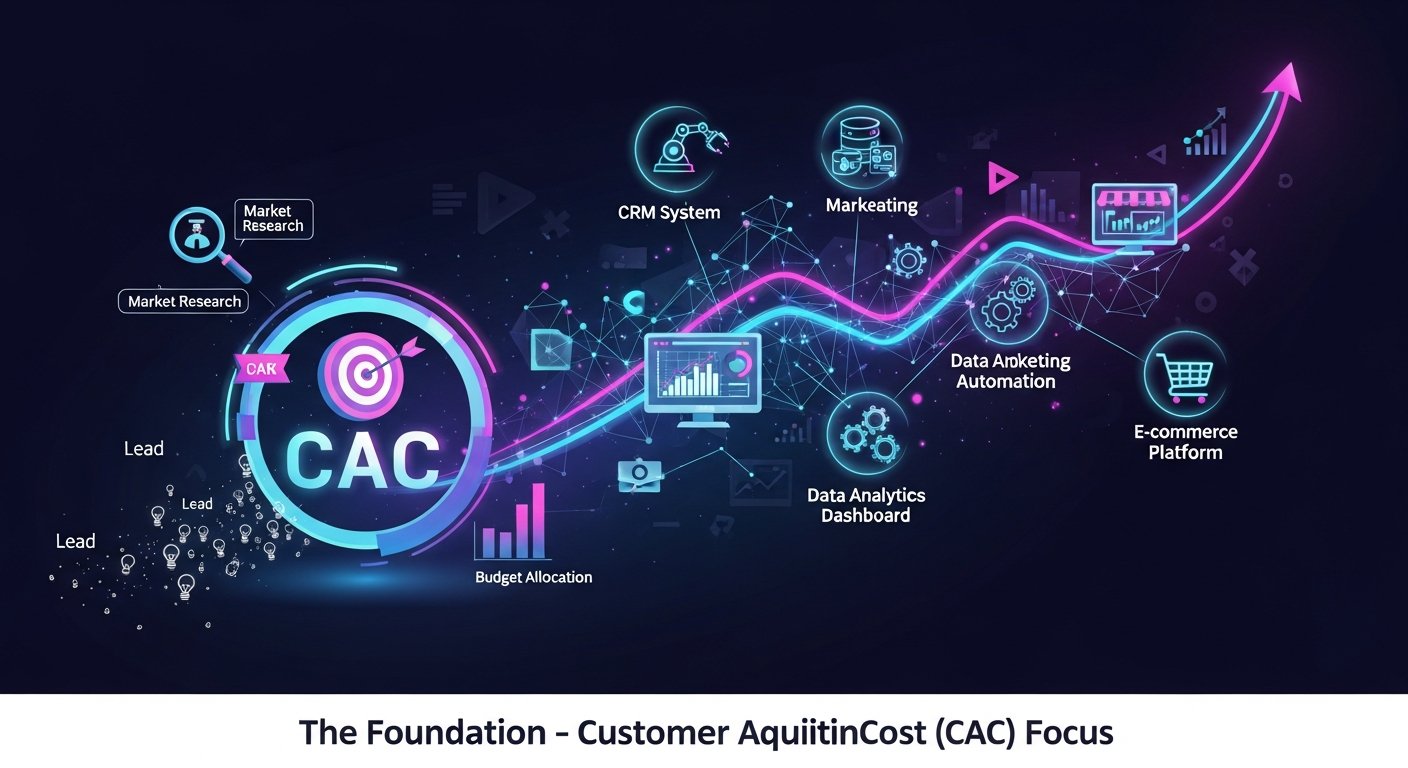
CAC is defined as the total sales and marketing expenses required to acquire a new customer over a specific period. It encompasses everything from advertising spend on platforms like Google Ads and Meta to salaries for your sales and marketing teams, software subscriptions (CRM, analytics, automation), content creation costs, PR, and even event sponsorships. If it contributes to bringing in a new customer, it belongs in your CAC calculation. Why is this more critical than ever in 2026? Because the cost of doing business is rising. Ad platform algorithms are more sophisticated, competition for attention is intense, and evolving data privacy regulations (like the ongoing impact of GDPR and CCPA, and new regional variants) are making targeted advertising more challenging and potentially more expensive. (Source: Digital Marketing Trends Report 2025-2026)
Many founders confuse CAC with Cost Per Acquisition (CPA). While related, they are distinct. CPA typically refers to the cost of acquiring a lead or a specific action (e.g., a download, a signup) within a single campaign or channel. CAC, however, is a holistic, company-wide metric that accounts for *all* costs associated with converting a lead into a paying customer across *all* channels. A low CPA on a specific campaign might feel good, but if your overall CAC is still too high, you’re bleeding money elsewhere. Startups, especially those in the SaaS space, must master CAC. A high CAC can quickly deplete funding, while an optimized CAC fuels aggressive, yet sustainable, expansion. It’s the difference between a fleeting moment of growth and building an enduring enterprise.
Consider a hypothetical SaaS startup, “InnovateCRM,” aiming to disrupt the small business CRM market. If InnovateCRM spends $100,000 on sales and marketing in a quarter and acquires 200 new paying customers, their CAC is $500. This single number immediately provides a critical benchmark: is $500 per customer sustainable given their average subscription value and customer lifetime? Without this clarity, InnovateCRM might be celebrating impressive user growth while unknowingly heading towards a cash crunch. In 2026, with the increasing sophistication of AI-driven ad platforms and personalized outreach tools, the potential for both hyper-efficient targeting and costly missteps has never been greater. A robust understanding of CAC ensures you’re leveraging these advancements for profit, not just for vanity metrics.
How to Calculate Customer Acquisition Cost (CAC) Accurately in 2026?
What is the Core Formula for Customer Acquisition Cost?
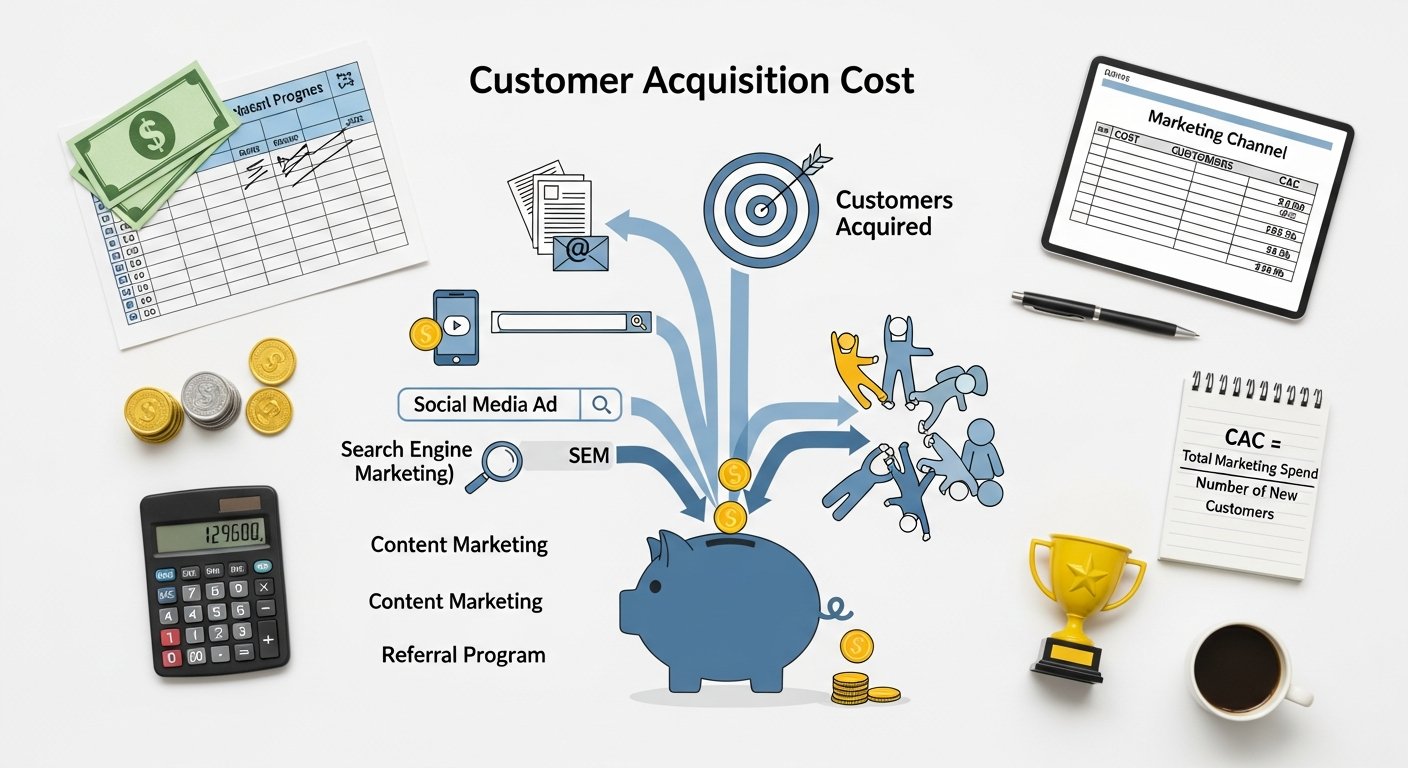
CAC = (Total Sales Expenses + Total Marketing Expenses) / Number of New Customers Acquired

How to Break Down Total Sales & Marketing Expenses for CAC Calculation?
This isn’t just your ad spend. It’s a comprehensive tally of every cost incurred to attract and convert a new customer over a specific period (e.g., a month, quarter, or year). Here’s what needs to be included:
- Advertising & Promotion Costs: All paid campaigns across Google Ads, Meta Ads (Facebook/Instagram), LinkedIn Ads, TikTok, programmatic advertising, influencer marketing, sponsored content, and any other paid media. This is often the largest component for many digital-first businesses.
- Salaries & Commissions: The salaries of your sales team, marketing team, content creators, designers, and anyone directly involved in lead generation, nurturing, and closing. Don’t forget sales commissions and bonuses directly tied to new customer acquisition.
- Software & Tools: Subscriptions for CRM platforms (e.g., Salesforce, HubSpot), marketing automation tools (e.g., Mailchimp, ActiveCampaign), SEO tools (e.g., SEMrush, Ahrefs), analytics platforms (e.g., Google Analytics 4, Mixpanel), A/B testing software, and any other tech stack essential for your acquisition efforts.
- Content Creation & SEO: Costs associated with blog posts, videos, whitepapers, case studies, landing page copy, and the ongoing optimization of this content for search engines.
- Events & Webinars: Costs related to hosting or attending industry events, trade shows, webinars, and virtual summits designed to generate leads.
- Overhead: A portion of general overhead that can be reasonably attributed to sales and marketing activities (e.g., office space, utilities, if your teams are physically present).
How to Accurately Count New Customers Acquired for CAC?
This seems simple, but it’s crucial to ensure you’re counting *only* new, paying customers acquired within the same period as your expenses. Exclude repeat customers, reactivated churned customers (unless your strategy specifically targets these as “new acquisitions” and your costs reflect this), or free trial users who haven’t converted.
What is the Attribution Challenge in CAC Calculation for 2026?
One of the biggest complexities in accurately calculating CAC is attribution. How do you credit multiple touchpoints that lead to a conversion? In 2026, with customers interacting across numerous channels (social, search, email, direct, referral), single-touch attribution models (first-touch or last-touch) are increasingly inadequate. Multi-touch attribution models (linear, time decay, U-shaped, W-shaped) provide a more realistic distribution of credit across the customer journey, leading to a more accurate understanding of which channels truly contribute to acquisition and, therefore, to a more precise CAC.
For example, a customer might discover your product through a LinkedIn ad (first touch), then read a blog post found via organic search, later click an email marketing link, and finally convert after a retargeting ad on Meta (last touch). A last-touch model would give all credit to Meta, potentially misrepresenting the true cost and value of LinkedIn, SEO, and email. Tools like Google Analytics 4, HubSpot, and specialized attribution platforms (e.g., Bizible, AppsFlyer) are essential for navigating this complexity. By meticulously tracking and attributing costs and conversions, you gain the clarity needed to optimize your acquisition strategy, ensuring your CAC calculation is a powerful tool, not just a historical report.
How Can Startups Optimize Customer Acquisition Cost (CAC) for Sustainable Growth in 2026?
Reducing Customer Acquisition Cost isn’t about cutting corners; it’s about smart, strategic investments that yield higher returns. In 2026, with the landscape shifting rapidly due to AI advancements and evolving consumer expectations, optimizing CAC requires a multi-faceted approach. Here are key strategies for founders and digital marketers to significantly improve their acquisition efficiency:
1. How to Double Down on Conversion Rate Optimization (CRO)?
The most direct way to lower CAC without changing your marketing spend is to convert more of your existing traffic. If you spend $10,000 to get 1,000 leads and convert 100, your CAC is $100. If you convert 200 leads with the same spend, your CAC drops to $50. Focus on A/B testing landing pages, checkout flows, call-to-action buttons, and ad copy. Utilize tools like Optimizely, VWO, or even Google Optimize (while it’s still available) to test variations. Personalize user experiences based on segmentation and behavior. For instance, a SaaS company could optimize its free trial signup flow, reducing friction points identified through user session recordings (e.g., Hotjar) and analytics, leading to a 15-20% boost in trial-to-paid conversions.
2. How to Master Inbound Marketing & SEO?
While not “free,” organic channels often have a lower long-term CAC compared to paid advertising. Investing in high-quality content (blogs, videos, podcasts, whitepapers) that addresses your target audience’s pain points, combined with robust SEO strategies, builds an evergreen lead generation machine. A well-ranked piece of content can continuously attract qualified leads for months or years without ongoing ad spend. Tools like SEMrush and Ahrefs are indispensable for keyword research, competitor analysis, and technical SEO audits. For example, a B2B tech company that consistently publishes expert articles on “AI in sales automation” could see its organic traffic and lead generation grow by 30-40% year-over-year, significantly diluting its overall CAC.
3. How to Leverage AI for Hyper-Targeting & Personalization?
AI is no longer a futuristic concept; it’s a present-day CAC optimizer. AI-driven platforms can analyze vast datasets to identify ideal customer profiles, predict purchase intent, and automate personalized outreach. Use AI in your ad platforms (Google Ads’ Performance Max, Meta’s Advantage+ campaigns) to optimize bidding and targeting. Implement AI-powered chatbots for instant lead qualification and customer support, freeing up human resources. For instance, an e-commerce startup using an AI tool like Dynamic Yield or Bloomreach for product recommendations and personalized website experiences can see conversion rates increase by 5-10%, directly impacting CAC.
4. How to Build Robust Referral Programs?
Word-of-mouth is still the most powerful marketing. A well-structured referral program can turn your existing happy customers into your most effective sales force. Offer compelling incentives (discounts, free months, exclusive features) for both the referrer and the referred. Companies like Dropbox and Uber famously grew exponentially through highly effective referral programs, demonstrating how a low-cost, high-trust acquisition channel can dramatically lower CAC. Consider integrating referral software like ReferralCandy or Friendbuy to automate and track your program efficiently.
5. How to Optimize Your Sales Funnel & Reduce Churn?
A leaky sales funnel means wasted marketing spend. Analyze every stage of your funnel to identify drop-off points. Are leads being qualified effectively? Is your sales team closing efficiently? Are there bottlenecks in your onboarding process? Reducing customer churn also indirectly lowers CAC. While churned customers aren’t “new,” preventing churn means you don’t have to spend money to replace them. Focus on customer success initiatives, proactive support, and gathering feedback to improve product stickiness. A 5% reduction in churn can increase profits by 25-95% (Source: Bain & Company), which means less pressure on acquiring new customers at high cost.
By strategically implementing these levers, startups and digital marketers can transform their CAC from a burden into a powerful engine for sustainable, profitable growth in 2026 and beyond.
What are the LTV:CAC Ratio and Payback Period, and Why are They Your Profitability North Stars?

While a low Customer Acquisition Cost (CAC) is desirable, it’s only half the story. The true measure of your acquisition efficiency and business viability lies in its relationship with Customer Lifetime Value (LTV) and the CAC Payback Period. These two metrics are the north stars for founders and digital marketers, guiding investment decisions and ensuring long-term profitability, especially in the competitive landscape of 2026.
What is Customer Lifetime Value (LTV)?
LTV represents the total revenue a business can reasonably expect from a single customer account over their entire relationship with the company. It’s not just about the first purchase; it’s about their entire journey, including repeat purchases, upgrades, and renewals. A common formula for LTV, particularly for subscription-based businesses (SaaS), is:
LTV = (Average Revenue Per User * Average Gross Margin) / Churn Rate
Alternatively, a simpler calculation for non-subscription models might be:
LTV = Average Purchase Value * Average Purchase Frequency * Average Customer Lifespan
Understanding LTV allows you to determine how much you *can afford* to spend on acquiring a customer. If your LTV is $1,000, spending $500 on CAC might be acceptable; if your LTV is only $100, a $50 CAC is unsustainable.
What is a Healthy LTV:CAC Ratio?
This ratio is arguably the most critical metric for evaluating the health of your business model. It tells you how much value you get back for every dollar you spend acquiring a customer. A widely accepted healthy LTV:CAC ratio for SaaS and subscription businesses is 3:1 or higher. This means for every dollar you spend to acquire a customer, you expect to generate at least three dollars in revenue over their lifetime.

- LTV:CAC < 1:1: You’re losing money on every customer acquired. This is a critical situation requiring immediate intervention.
- LTV:CAC ≈ 1:1: You’re breaking even. While not losing money, you’re not generating enough profit to reinvest in growth or cover operational costs.
- LTV:CAC > 3:1: This is generally considered excellent. It indicates a sustainable and profitable growth engine, allowing for reinvestment and expansion.
- LTV:CAC > 5:1: Potentially too high. While seemingly great, it might indicate you’re underinvesting in marketing and sales, leaving significant growth opportunities on the table. You could likely spend more on acquisition to grow faster without compromising profitability.
For example, if your SaaS product has an average monthly revenue of $50, a gross margin of 80%, and a monthly churn rate of 2%, your LTV would be ($50 * 0.80) / 0.02 = $2,000. If your CAC is $500, your LTV:CAC ratio is 4:1, indicating a very healthy and profitable acquisition strategy.
How to Calculate the CAC Payback Period?
This metric answers a crucial question for cash flow management: how long does it take to earn back the money you spent to acquire a customer? It’s especially vital for subscription businesses where revenue is recognized over time.
CAC Payback Period (in months) = CAC / (Average Monthly Revenue Per User * Gross Margin)
A typical benchmark for SaaS companies is a CAC Payback Period of 5-12 months (Source: Bessemer Venture Partners). A shorter payback period means your business generates positive cash flow faster, which is critical for early-stage startups managing limited capital. If your payback period is 24 months, it means you’re operating at a deficit for two years on each new customer, requiring significant upfront capital to scale. For venture-backed startups, investors scrutinize this metric closely as it directly impacts capital efficiency and scalability.
By regularly monitoring and optimizing your LTV:CAC ratio and Payback Period, you gain a holistic view of your customer acquisition strategy’s financial health. It’s about finding the sweet spot where you’re acquiring customers efficiently enough to be profitable, but aggressively enough to achieve your growth targets in the dynamic market of 2026.
What are the Key Customer Acquisition Cost (CAC) Benchmarks and Industry Insights for 2026?
While understanding your own Customer Acquisition Cost (CAC) is paramount, knowing how you stack up against industry benchmarks provides crucial context. In 2026, these benchmarks are dynamic, influenced by factors like market maturity, product complexity, competition, and global economic shifts. Remember, benchmarks are guides, not absolute targets; your “ideal” CAC depends heavily on your specific business model, LTV, and growth strategy.
What are the General Industry Benchmarks for CAC in 2026?
It’s challenging to provide exact figures as they vary wildly, but here are some illustrative ranges for different sectors (Approximate Ranges for 2026, based on various industry reports):
-
SaaS (Software as a Service) CAC Benchmarks:
CAC can range from $200 to $5,000+.
- For SMB-focused SaaS with lower price points, CAC might be $200-$500.
- For mid-market SaaS, CAC could be $500-$2,000.
- For enterprise SaaS with complex sales cycles and high contract values, CAC can easily exceed $2,000, sometimes reaching $10,000 or more.
- Insight: SaaS companies often balance higher CAC with higher LTV, aiming for an LTV:CAC ratio of 3:1 or better. Consider pricing strategies for SaaS to optimize this balance.
-
E-commerce/Retail CAC Benchmarks:
CAC typically ranges from $10 to $100.
- This largely depends on average order value (AOV) and customer repeat purchase rate. A luxury brand will have a higher CAC than a discount retailer.
- Insight: E-commerce focuses heavily on repeat purchases and average cart value to improve LTV and justify higher initial CACs.
-
B2B (Business-to-Business, non-SaaS) CAC Benchmarks:
CAC can be highly variable, from $100 to $10,000+.
- Depends on the complexity of the product/service, sales cycle length, and deal size. High-value consulting or industrial equipment sales will naturally have very high CACs.
- Insight: B2B often involves longer sales cycles, requiring significant investment in sales teams and lead nurturing, which drives up CAC.
-
B2C (Consumer Services/Apps) CAC Benchmarks:
CAC can be anywhere from $5 to $200.
- Highly dependent on the product type (e.g., gaming app vs. financial service), acquisition channels (organic vs. paid), and monetization model.
- Insight: Virality and network effects can dramatically lower B2C CAC.
What Factors Influence Customer Acquisition Cost in 2026?
- Industry & Niche: Highly competitive niches (e.g., FinTech, MarTech) often have higher ad costs and thus higher CAC. Niche markets with less competition might see lower CACs.
- Target Audience: Acquiring C-suite executives for an enterprise solution is inherently more expensive than acquiring general consumers for a free app.
- Product Price Point & Complexity: Higher-priced, more complex products typically require more extensive sales efforts, driving up CAC.
- Sales Cycle Length: Longer sales cycles (common in B2B enterprise) mean more touchpoints, more sales team hours, and thus higher CAC.
- Marketing Channels: Some channels are inherently more expensive than others (e.g., highly targeted LinkedIn Ads vs. organic search traffic).
- Brand Recognition: Established brands often have lower CACs due to trust, brand equity, and direct traffic. New startups typically have to spend more to build awareness.
- Economic Climate: In inflationary environments or economic downturns, ad costs can fluctuate, and consumer/business spending might tighten, impacting CAC.
- Data Privacy Regulations: Post-cookie world and stricter data regulations make personalized targeting more challenging, potentially increasing the cost of reaching the right audience.
What is the Difference Between a “Good” CAC vs. “Bad” CAC in 2026?
A “good” CAC isn’t just a low number; it’s a CAC that allows your business to be profitable and scalable, typically demonstrated by a healthy LTV:CAC ratio (e.g., > 3:1) and a reasonable payback period (e.g., < 12 months for SaaS). If your CAC is below benchmarks but your LTV is even lower, you’re still in trouble. Conversely, a higher-than-benchmark CAC can be justified if your LTV is exceptionally high. For instance, a small startup might initially have a higher CAC as it validates its product-market fit and optimizes its funnels. As it scales and refines its strategies, the CAC should ideally trend downwards or stabilize at a profitable level.
Regularly comparing your CAC to relevant industry benchmarks, while always keeping your LTV and payback period in mind, provides a powerful framework for strategic decision-making in 2026. It helps identify areas for improvement, validate your business model, and communicate your growth potential to investors.
What Tools and Technologies are Essential for Mastering Customer Acquisition Cost (CAC) in 2026?
In the dynamic landscape of 2026, effectively managing and optimizing Customer Acquisition Cost (CAC) requires more than just spreadsheets; it demands a robust tech stack. From comprehensive analytics to AI-powered automation, the right tools can provide the data, insights, and efficiency needed to drive down CAC and boost profitability. Here’s a look at essential tools and technologies every startup and digital marketer should consider.
1. What are the Best Analytics & Business Intelligence Platforms for CAC?
These are the eyes and ears of your acquisition strategy, providing the raw data on customer behavior and campaign performance.
- Google Analytics 4 (GA4): The foundational platform for tracking website and app user behavior, conversion events, and traffic sources. Its event-based model is crucial for understanding multi-touch journeys. Free, but requires expertise for advanced setup.
- Mixpanel/Amplitude: Product analytics platforms that excel at understanding user engagement within your product. They help identify sticky features, conversion bottlenecks, and churn indicators, which indirectly impact CAC by improving LTV. Pricing is tiered, with free plans for smaller usage.
- Segment/RudderStack: Customer data platforms (CDPs) that consolidate customer data from all sources into a single, unified profile. This clean, centralized data is invaluable for accurate attribution, personalized marketing, and effective retargeting, leading to more efficient spend. Enterprise pricing.
2. Which Customer Relationship Management (CRM) Systems are Best for CAC Management?
CRMs are central to managing leads, sales pipelines, and customer interactions, ensuring no lead falls through the cracks and sales processes are optimized.
- HubSpot: A comprehensive platform offering CRM, marketing automation, sales tools, and customer service. Its integrated approach allows for seamless lead tracking from initial touch to conversion and beyond, making CAC calculation more precise. Offers free CRM, with paid tiers for advanced features.
- Salesforce: The industry giant, highly customizable for complex sales processes. Essential for B2B companies with longer sales cycles, enabling detailed tracking of sales activities and costs. Enterprise pricing.
3. What Ad Platforms & Optimization Tools Help with CAC?
These are where much of your direct acquisition spend happens, and their built-in optimization features (often AI-driven) are critical.
- Google Ads: Essential for search engine marketing (SEM) and display advertising. Features like Performance Max and Smart Bidding leverage AI to optimize campaigns for conversions, directly impacting CAC.
- Meta Ads (Facebook/Instagram): Crucial for social media advertising, offering unparalleled audience targeting. Advantage+ campaigns use AI to automate and optimize ad delivery across Meta’s properties.
- SEMrush/Ahrefs: SEO and SEM tools that help identify high-value keywords, analyze competitor ad strategies, and uncover content opportunities. By improving organic visibility, these tools reduce reliance on paid channels, lowering overall CAC. Pricing starts around $100-$200/month.
4. What Marketing Automation & Personalization Platforms Optimize CAC?
Automating repetitive tasks and personalizing interactions can significantly improve conversion rates and reduce the human effort component of CAC.
- ActiveCampaign/Mailchimp: For email marketing and basic marketing automation, nurturing leads through personalized sequences, improving conversion rates from lead to customer. Mailchimp has a free tier; ActiveCampaign starts around $9/month.
- Optimizely/VWO: A/B testing and personalization platforms for website and app experiences. By continuously optimizing landing pages and user flows, they directly improve conversion rates, thus lowering CAC. Enterprise pricing.
5. Which Attribution Platforms are Key for Accurate CAC?
These specialized tools help accurately assign credit to different marketing touchpoints across the customer journey, providing a clearer picture of channel effectiveness.
- Bizible (by Adobe Marketo Engage): Offers advanced multi-touch attribution modeling, integrating with CRMs and ad platforms to show the true ROI of marketing spend. Ideal for B2B. Enterprise pricing.
- AppsFlyer/Branch: Mobile attribution platforms critical for app-based businesses, tracking installs, in-app events, and lifetime value across various ad networks. Tiered pricing, with free options for basic tracking.
6. How do AI-Powered Sales & Marketing Assistants Impact CAC?
The rise of generative AI in 2026 offers new ways to create content, personalize outreach, and automate sales tasks, driving efficiency.
- Jasper/Copy.ai: AI content generation tools that can quickly produce ad copy, social media posts, and blog outlines, reducing content creation costs. Subscription-based.
- Chorus.ai/Gong.io: AI-driven conversation intelligence platforms that analyze sales calls, identify winning strategies, and help train sales reps, leading to higher close rates and lower sales-related CAC. Enterprise pricing.
Integrating a selection of these tools into your tech stack empowers your team to make data-driven decisions, optimize every stage of the customer journey, and ultimately master your CAC for sustainable growth in 2026.
What are the Common Customer Acquisition Cost (CAC) Mistakes Startups Should Avoid for Success?
Even with a clear understanding and sophisticated tools, many startups and digital marketers fall prey to common pitfalls that inflate their Customer Acquisition Cost (CAC) and jeopardize their growth. Avoiding these mistakes is as crucial as implementing best practices, especially when operating with limited resources in a competitive market like 2026.
1. What Happens When You Ignore CAC or Calculate It Incorrectly?
The most fundamental mistake is not tracking CAC at all, or worse, tracking it incorrectly. Many founders only consider direct ad spend, omitting crucial components like team salaries, software subscriptions, content creation, and overhead. This leads to a dangerously underestimated CAC, creating a false sense of security about profitability. Always include ALL sales and marketing-related expenses over the period you’re measuring, and ensure you’re only counting genuinely *new* customers.
2. Why is Chasing “Growth at All Costs” Without Profitability a CAC Mistake?
Especially prevalent in venture-backed startups, the pressure to show rapid user growth can lead to an unsustainable CAC. Acquiring customers at any cost, even if LTV < CAC, is a recipe for disaster. This leads to a negative unit economy, where every new customer acquired drains capital. Always prioritize a healthy LTV:CAC ratio and a reasonable payback period over sheer volume of new users. Growth should be profitable growth.
3. How Does Neglecting Customer Retention and LTV Impact CAC?
A high CAC can sometimes be justified by an even higher Customer Lifetime Value (LTV). However, if you’re spending heavily to acquire customers only for them to churn quickly, your LTV suffers, making your CAC look terrible in comparison. Many companies focus so much on acquisition that they neglect retention efforts. A 5% increase in customer retention can increase company revenue by 25-95% (Source: Harvard Business Review). Investing in customer success, product improvements, and retention strategies can significantly improve your LTV:CAC ratio without directly lowering CAC.
4. Why is Poor Attribution Modeling a Common CAC Mistake?
In the multi-channel world of 2026, relying solely on last-click attribution for CAC calculations is a major mistake. It overvalues direct conversion channels and undervalues earlier touchpoints that contribute to awareness and consideration (e.g., content marketing, social media). This can lead to misallocated marketing budgets, cutting off channels that are actually crucial for initiating customer journeys. Invest in multi-touch attribution models (supported by tools like GA4, HubSpot, or Bizible) to get a more accurate picture of which channels truly drive conversions and optimize your spend accordingly.
5. Why is Failing to Segment CAC by Channel or Cohort a Critical Error?
A single, blended CAC number can be misleading. Different channels (e.g., organic search, paid social, referrals) will have vastly different acquisition costs and conversion rates. Similarly, CAC can vary significantly for different customer segments or product tiers. Failing to segment your CAC means you can’t identify your most efficient channels or profitable customer segments, leading to generalized strategies that miss critical optimization opportunities. Always break down your CAC by channel, campaign, product, and customer cohort to pinpoint where your marketing spend is truly effective and where it’s being wasted.