What are the Key Differences Between IT vs Computer Science, and Which Should You Study?
By Eamped Team | View Author Bio
At Eamped, we’ve seen firsthand how misunderstanding these disciplines can lead to misaligned hires, inefficient resource allocation, and missed opportunities for innovation in the realm of business technology for startups. This comprehensive guide will strip away the jargon, clarify the fundamental differences between IT and Computer Science, explore typical career paths, and provide practical advice to help you determine which field aligns best with your goals, whether you’re looking to launch a product, optimize operations, or embark on a fulfilling tech career that contributes to digital transformation.
What is Information Technology (IT) and How Does it Drive Practical Application?
Information Technology (IT) is the backbone of modern business operations. It’s the field that ensures technology works seamlessly, efficiently, and securely for organizations and individuals. Think of IT professionals as the architects and custodians of digital infrastructure, dedicated to managing, maintaining, and improving the systems and networks that drive day-to-day activities. They are the problem-solvers who keep the digital gears turning, making sure data flows, applications run, and users stay connected.
What is IT? Core Definition
Information Technology, in its essence, encompasses the use of computers, storage, networking, and other physical devices, infrastructure, and processes to create, process, store, secure, and exchange all forms of electronic data. It focuses heavily on the practical application of existing technology to solve real-world problems and support organizational objectives. IT professionals ensure the reliable operation of computer systems, software, and networks, facilitating communication, data management, and operational efficiency within a business environment. It’s about optimizing the tools already at our disposal. It’s also important to grasp the differences between technology and information technology more broadly, as IT is a specific application within the vast domain of technology.
Key Focus Areas and Disciplines within IT
The scope of IT is broad and ever-expanding, covering several critical areas:
- Network Administration: Designing, implementing, and managing computer networks (LANs, WANs, wireless networks) to ensure seamless data flow and connectivity.
- System Administration: Installing, configuring, and maintaining operating systems, servers, and other computer systems, ensuring their optimal performance and availability.
- Database Management: Designing, implementing, and maintaining databases to store, organize, and retrieve critical business data efficiently and securely.
- Data Governance: Establishing policies and procedures for managing data availability, usability, integrity, and security, ensuring compliance with regulations and internal standards.
- Cybersecurity: Protecting computer systems, networks, and data from digital attacks, unauthorized access, and damage. This includes threat detection, incident response, and compliance. For comprehensive strategies, explore startup cybersecurity best practices.
- Cloud Computing: Managing and deploying applications and data over cloud platforms (e.g., AWS, Azure, Google Cloud), enabling scalable and flexible IT infrastructure. Learn more about choosing cloud providers for startups.
- IT Support and Help Desk: Providing technical assistance to users, troubleshooting software and hardware issues, and resolving technical problems to minimize downtime.
- IT Project Management: Overseeing the planning, execution, and closing of IT projects, ensuring they are delivered on time, within budget, and meet specified requirements. This often involves applying agile methodologies for tech startups.
- IT Infrastructure Planning: Strategizing and designing the overall hardware, software, network, and facility components required to support an organization’s IT operations.
Essential Skills for IT Professionals
- Technical Troubleshooting: The ability to diagnose and resolve hardware and software issues efficiently.
- Network Configuration and Management: Proficiency with routers, switches, firewalls, and network protocols.
- Operating System Expertise: Deep knowledge of Windows, Linux, and macOS environments.
- Database Skills: Familiarity with SQL and various database management systems.
- Security Best Practices: Understanding of common vulnerabilities, encryption, and access control.
- Communication: Clearly explaining technical issues to non-technical stakeholders and users.
- Problem-Solving: Analytical thinking to identify root causes and implement effective solutions.
- Customer Service: Patience and empathy when assisting users with technical challenges.
Practical Tip: IT’s Role in Business Operations
For startup founders and small business owners, strong IT is foundational, not optional. It ensures your operations run smoothly, your data is secure, and your team is productive. Investing in competent IT staff or services early can prevent costly downtimes, security breaches, and productivity drains. Consider IT a strategic partner in maintaining operational excellence and safeguarding your digital assets, especially for business technology for startups.
What is Computer Science (CS) and How Does it Drive Theoretical Innovation?
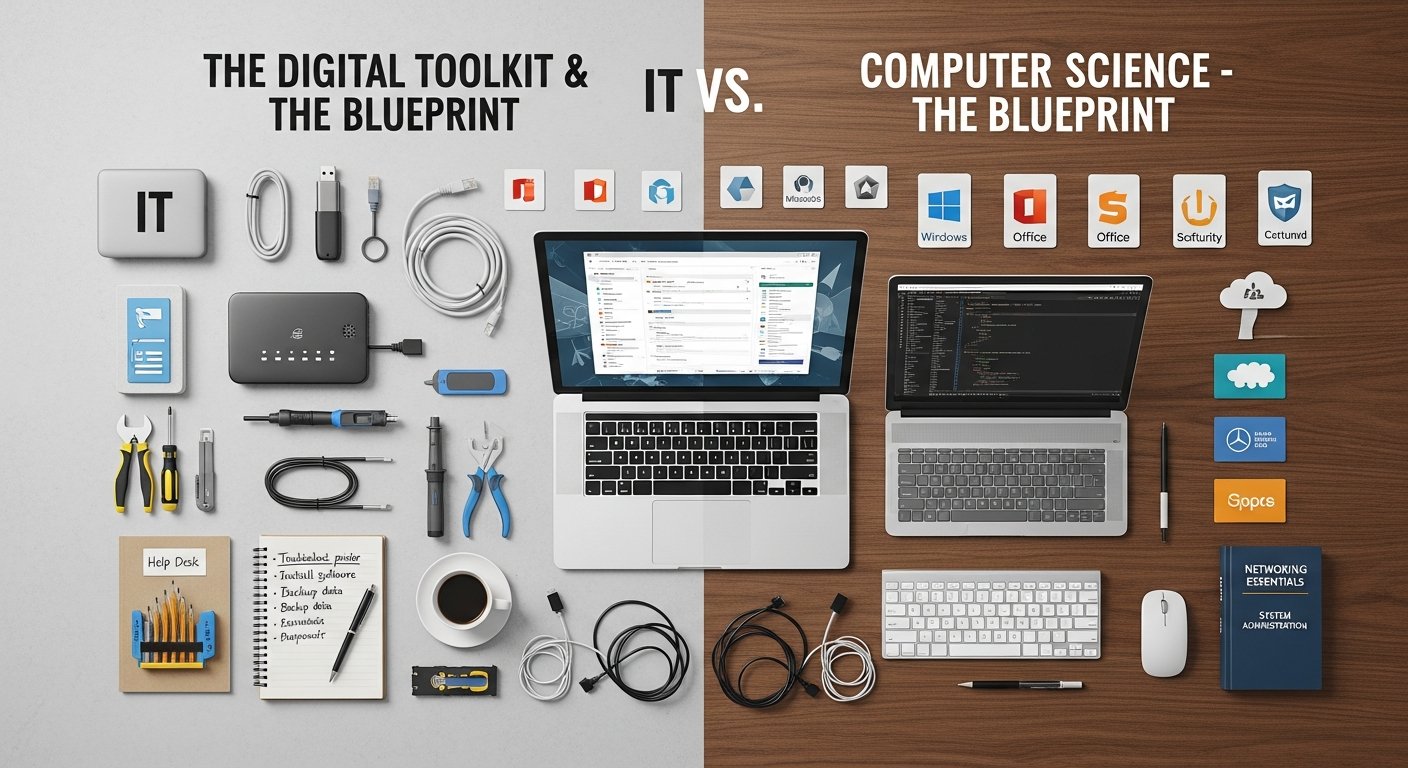
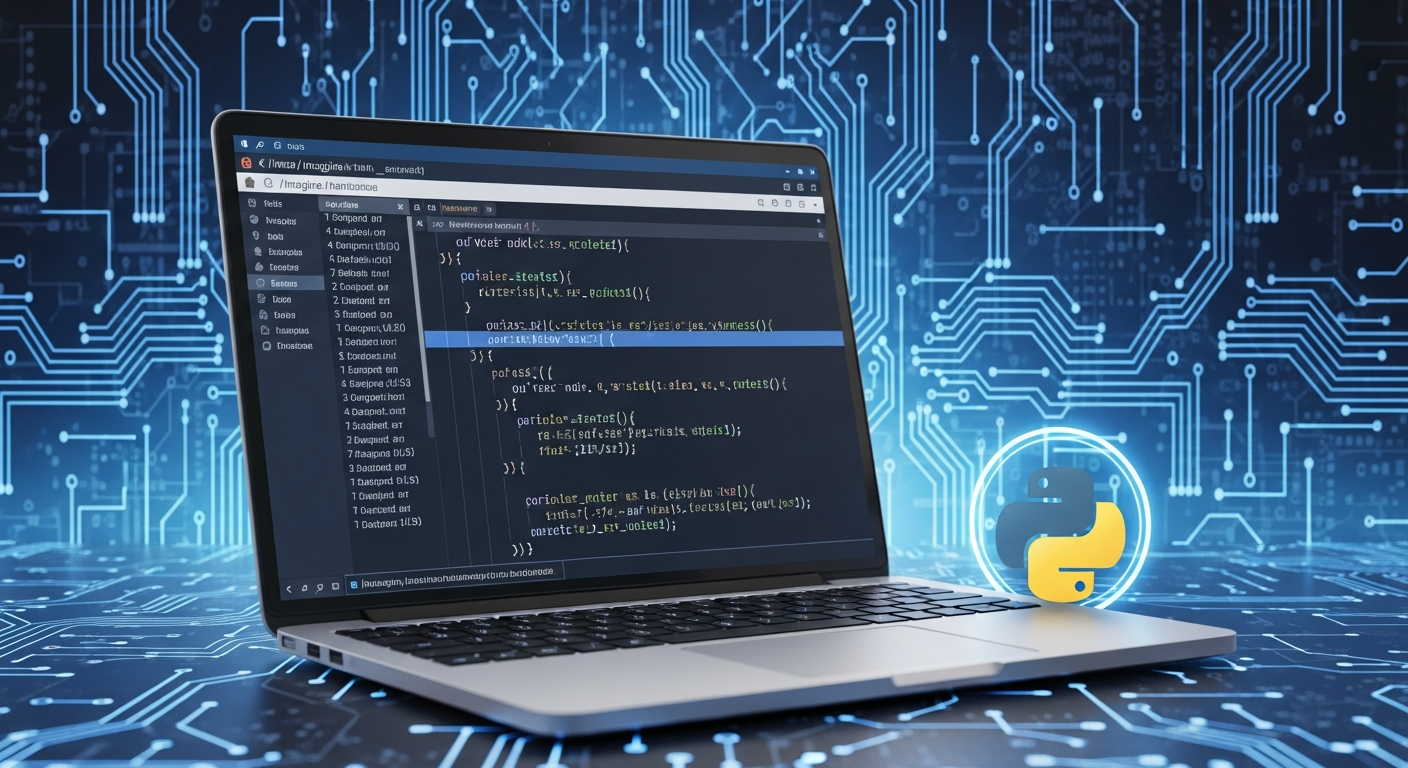
Computer Science (CS) is an academic and practical discipline that deals with the theoretical foundations of computation and information and their implementation and application. Unlike IT, which focuses on the practical application of existing technology, CS is concerned with designing and building the technology itself. Computer scientists are the innovators, researchers, and engineers who push the boundaries of what computers can do, developing new algorithms, software, and computational models.
What is Computer Science? Core Definition
Computer Science is the study of computation, automation, and information. It explores theoretical concepts like algorithms, data structures, computation theory, and artificial intelligence, as well as their practical applications in designing software, hardware, and systems. CS delves into the “how” and “why” of computing, often involving abstract thinking and mathematical principles to create entirely new paradigms for interacting with technology. It’s about understanding the underlying principles that govern computers and using that knowledge to invent the future.
Key Branches and Subfields of Computer Science
Computer Science is a vast field with numerous specialized areas:
- Algorithms and Data Structures: The design and analysis of efficient methods for organizing and processing information.
- Programming Languages: The design, implementation, and theory behind languages like Python, Java, C++, and Rust.
- Artificial Intelligence (AI) and Machine Learning (ML): Developing intelligent systems that can learn, reason, and make decisions, often involving complex statistical models. For strategic implementation, consider AI strategies for digital transformation.
- Ethical AI: Studying the responsible development and deployment of artificial intelligence, addressing fairness, transparency, and accountability in AI systems.
- Software Engineering: Principles and methodologies for designing, developing, testing, and maintaining software systems.
- Computer Graphics: The creation and manipulation of visual content using computers, from games to simulations.
- Cybernetics and Robotics: The study of control and communication in living organisms and machines, leading to autonomous systems.
- Data Science: Extracting knowledge and insights from data using scientific methods, processes, algorithms, and systems. This is crucial for leveraging data analytics for business growth.
- Computational Theory: Investigating the fundamental capabilities and limitations of computation.
Essential Skills for Computer Scientists
A career in CS requires a strong analytical and problem-solving toolkit:
- Strong Mathematical Foundation: Expertise in discrete mathematics, calculus, and linear algebra is crucial for understanding algorithms and models.
- Programming Proficiency: Fluency in multiple programming languages and a deep understanding of programming paradigms.
- Algorithmic Thinking: The ability to design efficient and effective algorithms to solve complex problems.
- Abstract Reasoning: Conceptualizing complex systems and theoretical models.
- Problem Decomposition: Breaking down large, intractable problems into smaller, manageable components.
- Data Structures Knowledge: Understanding how to store and retrieve data efficiently.
- Analytical and Critical Thinking: Evaluating the feasibility, efficiency, and correctness of computational solutions.
- Continuous Learning: The field evolves rapidly, requiring constant skill updates and learning new paradigms.
Practical Tip: CS’s Role in Breakthrough Development
For startups aiming for disruptive innovation, computer science expertise is indispensable. If your business model relies on developing novel software, pioneering AI solutions, or creating entirely new digital products, you need the deep theoretical understanding and problem-solving capabilities that computer scientists bring. They are the ones who can turn abstract ideas into functional, cutting-edge technology, driving the next wave of business technology for startups.
How Do IT vs Computer Science Curricula and Mindsets Compare?
While both IT and Computer Science are pillars of the tech world, their academic foundations, problem-solving approaches, and ultimate goals diverge significantly. Understanding this distinction is paramount for anyone considering a career or seeking to build a tech team. It’s not about one being superior to the other, but rather about their distinct purposes and contributions.
Academic Focus and Coursework
- Information Technology Curriculum:
- Emphasis: Applied knowledge, hands-on skills, practical problem-solving.
- Core Courses: Network administration, database management, operating systems, cybersecurity fundamentals, cloud services, hardware configuration, IT project management, technical support, enterprise resource planning (ERP) systems.
- Learning Style: Often involves labs, simulations, certifications (e.g., CompTIA, Cisco, Microsoft), and direct application of tools and technologies currently used in industry.
- Outcome: Graduates are typically ready to deploy, manage, and secure existing technological solutions.
- Computer Science Curriculum:
- Emphasis: Theoretical foundations, mathematical principles, algorithm design, software development.
- Core Courses: Discrete mathematics, data structures and algorithms, programming languages theory, operating systems principles, computer architecture, artificial intelligence, machine learning, software engineering, computational theory, compiler design.
- Learning Style: Heavily involves abstract problem-solving, proofs, rigorous coding challenges, research projects, and developing novel solutions from first principles.
- Outcome: Graduates are equipped to design and create new software, systems, and computational methods.
Problem-Solving Approaches
- IT Professionals: Tend to be pragmatic and immediate problem-solvers. When a system goes down or a user needs help, an IT specialist diagnoses the issue using known tools and procedures, implements an existing solution, and restores functionality. Their focus is on efficiency, reliability, and maintaining operational continuity with current technologies. They are adept at troubleshooting and optimizing existing infrastructure.
- Computer Scientists: Approach problems from a more fundamental and often abstract perspective. When faced with a challenge that existing solutions cannot adequately address (e.g., how to make an AI model learn faster, or design a more secure encryption algorithm), a computer scientist will invent a new algorithm, develop a novel programming paradigm, or design a completely new system. Their focus is on innovation, efficiency at scale, and pushing the boundaries of what is computationally possible.
The “Why” vs. The “How”
“IT professionals ask, ‘How can we best use this technology to achieve our business goals?’ Computer scientists ask, ‘How can we build new technology to solve problems that existing solutions can’t?’ One optimizes and maintains; the other invents and innovates.”
This distinction highlights the core difference: IT is primarily about the application and management of technology, while CS is about the creation and theory behind technology. Both are essential, but they address different phases of the technology lifecycle.
Actionable Insight: Choosing Your Academic Path
If you’re drawn to hands-on problem-solving, enjoy working with established systems, and thrive on immediate practical impact, an IT degree or vocational training might be your ideal path. If you are fascinated by the underlying logic of computers, enjoy theoretical challenges, possess strong mathematical aptitude, and aspire to create new software or computational models, then a Computer Science degree is likely a better fit. Consider your intrinsic interests and your preferred mode of engagement with technology before committing to a path.
What are the Career Landscapes, Job Roles, and Earning Potentials in IT vs Computer Science?

The tech industry is booming, and both IT and Computer Science graduates are in high demand. However, the specific roles they fill, the industries they typically work in, and their earning potentials can differ significantly. Understanding these career landscapes is crucial for students choosing a major and for businesses looking to hire the right talent for their specific needs.
Career Paths in Information Technology
IT careers are diverse and typically involve ensuring the smooth, secure, and efficient operation of an organization’s technological infrastructure. These roles are critical for almost any business in the digital age.
- IT Support Specialist/Help Desk Technician: Entry-level roles focused on resolving user issues and maintaining basic system functionality.
- Network Administrator: Manages an organization’s networks, ensuring connectivity and security.
- Systems Administrator: Oversees the performance, maintenance, and security of servers and operating systems.
- Database Administrator (DBA): Manages and maintains databases, ensuring data integrity and accessibility.
- Cybersecurity Analyst/Specialist: Protects systems and data from cyber threats, monitors for vulnerabilities, and responds to incidents.
- Cloud Engineer: Designs, implements, and manages cloud-based infrastructure and services.
- IT Project Manager: Leads IT projects from conception to completion, ensuring they meet objectives and deadlines.
- DevOps Engineer: A hybrid role that bridges development and operations, focusing on automating and streamlining software delivery. Learn more about implementing DevOps in a startup environment.
Career Paths in Computer Science
CS careers often involve the creation, design, and innovation of software, algorithms, and computational systems. These roles are at the forefront of technological advancement.
- Software Developer/Engineer: Designs, codes, tests, and maintains software applications for various platforms (web, mobile, desktop).
- Data Scientist: Analyzes complex datasets to extract insights, build predictive models, and inform strategic decisions.
- Machine Learning Engineer: Develops and deploys machine learning models and AI systems.
- Artificial Intelligence Researcher: Explores new AI algorithms and theories, pushing the boundaries of intelligent systems.
- Algorithm Developer: Designs and optimizes algorithms for specific computational problems.
- Game Developer: Creates the software architecture, logic, and sometimes graphics for video games.
- Cybersecurity Researcher/Engineer: Focuses on developing new security technologies, encryption methods, or threat detection systems.
- Quantitative Analyst (Quant): Applies mathematical and computational methods to financial problems, often in investment banks or hedge funds.
Overlap and Hybrid Roles
The lines between IT and CS are becoming increasingly blurred, leading to hybrid roles that require a blend of skills from both fields. For instance, a DevOps engineer needs strong programming skills (CS) for automation but also deep understanding of infrastructure and deployment (IT). Cybersecurity is another area with significant overlap, requiring both defensive IT operations and offensive CS-driven research.
Up-to-Date Data: Salary Expectations and Job Growth
- Information Technology (e.g., Network and Computer Systems Administrators): Median pay around $96,000 per year, with a projected growth of 4% (about average).
- Cybersecurity Analysts: Median pay around $120,000 per year, with a projected growth of 32% (much faster than average).
- Computer Science (e.g., Software Developers, Quality Assurance Analysts, and Testers): Median pay around $132,000 per year, with a projected growth of 25% (much faster than average).
- Data Scientists: Median pay around $108,000 per year, with a projected growth of 35% (much faster than average).
These figures can vary significantly based on experience, location, specific role, and company size. However, they generally illustrate that both fields offer lucrative career paths, with Computer Science often commanding higher entry-level salaries and faster growth in cutting-edge areas like AI and machine learning.
Actionable Tip: Researching Current Market Trends
Before committing to a path, delve into job boards (LinkedIn, Indeed, Glassdoor) and industry reports. Pay attention to the required skills listed for roles that interest you. Do they emphasize specific programming languages and algorithms (CS) or network protocols and system administration tools (IT)? This will give you a real-time pulse on what the market values and help you tailor your education and skill development.
How Do IT and Computer Science Impact Startups and Digital Business?
For founders and digital marketers, understanding the distinct value propositions of IT and Computer Science is crucial for making strategic hiring decisions, allocating resources effectively, and building a robust, future-proof business. A successful tech startup doesn’t just need technology; it needs the right kind of technology expertise at the right time for its business technology for startups strategy.
When Your Startup Needs IT Expertise
Early-stage startups often initially focus on product development, but neglecting IT can lead to significant problems down the line. You need IT expertise when:
- Operational Stability is Key: You need reliable networks, secure systems, and efficient internal tools for your team. IT ensures your employees can work without constant technical glitches.
- Data Security is Paramount: Protecting sensitive customer data and intellectual property from cyber threats is non-negotiable. An IT security specialist will implement firewalls, access controls, and incident response plans.
- Scalable Infrastructure is Required: As your user base grows, you need IT professionals to manage server capacity, cloud resources, and network bandwidth to prevent outages.
- Compliance is a Concern: For regulated industries (e.g., FinTech, HealthTech), IT ensures your systems meet industry standards and data privacy regulations (e.g., GDPR, HIPAA).
- You’re Using Off-the-Shelf Solutions: If your business primarily leverages existing software (SaaS products, CRM, ERP), IT manages their integration, customization, and user support.
Example: A SaaS startup providing marketing automation tools will need IT to manage their internal networks, employee laptops, cloud infrastructure on AWS/Azure, database backups, and internal cybersecurity protocols. Without a robust IT foundation, even the most innovative product won’t be able to operate reliably.
When Your Startup Needs Computer Science Expertise
Computer Science professionals are the innovators who build the core technology that often defines a startup’s unique value proposition. You need CS expertise when:
- Developing a Novel Product: If your product requires creating new algorithms, complex software architectures, or unique computational solutions that don’t yet exist.
- Leveraging AI/ML for Core Functionality: If your business model relies on machine learning for personalization, data analysis, predictive modeling, or automation, you need ML engineers and data scientists.
- Optimizing Performance and Scale: For high-traffic applications or computationally intensive services, CS experts can design highly efficient algorithms and optimize system performance at scale.
- Research and Development are Crucial: If your startup’s competitive edge comes from pushing technological boundaries and developing proprietary intellectual property.
- Building Proprietary Platforms: If you’re building a complex software platform from the ground up, requiring deep knowledge of software engineering principles, data structures, and programming languages.
Example: A startup developing a new AI-powered diagnostic tool for medical imaging will heavily rely on computer scientists to develop the deep learning models, optimize image processing algorithms, and engineer the software platform from scratch.
The Synergy for Success
The most successful tech companies and startups recognize that IT and Computer Science are not mutually exclusive; they are complementary. While CS might build the groundbreaking product, IT ensures that product (and the company itself) can operate reliably, securely, and efficiently. A startup might begin with a strong CS team to build its MVP, but as it scales, the need for robust IT infrastructure and support quickly becomes critical.
Imagine a cutting-edge AI product built by brilliant computer scientists. If the servers housing the AI constantly crash, the network is insecure, or the development team’s internal tools are unreliable, the innovation won’t reach its full potential. Conversely, a perfectly managed IT infrastructure won’t create a revolutionary new product on its own.
Real-world Example: How Successful Startups Leverage Both
Consider a company like Netflix. Their core product—the recommendation engine, streaming algorithms, and personalized user experience—is a triumph of Computer Science and Data Science. Behind the scenes, however, an enormous IT infrastructure manages the vast global network, ensures content delivery, maintains server farms, secures user data, and provides operational support for millions of simultaneous users. Without both working in concert, Netflix wouldn’t be the global powerhouse it is today.
Practical Advice: Building Your Tech Team
- Define Your Core Business: Are you building a novel technology (CS-heavy) or leveraging existing tech to deliver a service (IT-heavy with some CS)?
- Start with Foundational IT: Even if your core is CS, ensure you have basic IT infrastructure, security, and support in place early. Cloud providers can handle much of this initially, but internal IT expertise becomes vital as you grow.
- Hire for Specific Needs: Don’t hire a CS graduate for an IT administrator role unless they explicitly have relevant IT skills and interest. Likewise, don’t expect an IT professional to architect your next-gen AI model.
- Foster Collaboration: Encourage your IT and CS teams to communicate and collaborate. The best solutions often arise when operational insights meet innovative design.
How Can You Choose the Right Path: IT vs Computer Science?
Deciding between a career in Information Technology or Computer Science is a significant decision that impacts your education, skill development, and long-term professional trajectory. There’s no single “better” option; the ideal path depends entirely on your interests, aptitudes, and career aspirations. This section offers a framework for self-assessment to guide your choice.
Are You a Builder or an Innovator?
This is perhaps the most fundamental question to consider. Your inclination here will often dictate which field resonates more with you.
- If you are a “Builder” (IT):
- You enjoy working with existing systems, configuring them, and making them run efficiently.
- You are drawn to troubleshooting, diagnosing problems, and implementing immediate solutions.
- You find satisfaction in managing infrastructure, ensuring security, and supporting users.
- You prefer hands-on, practical work with tangible hardware and software tools.
- You like seeing the direct operational impact of your work within an organization.
- If you are an “Innovator” (CS):
- You are passionate about creating new software, algorithms, and computational models from scratch.
- You enjoy theoretical challenges, abstract thinking, and solving problems that don’t yet have an established solution.
- You are fascinated by the “why” and “how” of computation, often delving into mathematical proofs and logical designs.
- You thrive on pushing technological boundaries and contributing to research and development.
- You are comfortable with ambiguity and the iterative process of invention.
Short-term vs. Long-term Career Vision
Consider where you see yourself in 5, 10, or 20 years. Both fields offer diverse long-term opportunities, but the progression paths differ.
- IT Career Trajectory: Often starts with support roles, moving into administration (network, systems, database), then specializing in cybersecurity, cloud architecture, or IT project management. Senior roles might include IT Director, CIO (Chief Information Officer), or leading IT strategy. The focus tends to remain on the operational and strategic management of technology resources within an organization.
- CS Career Trajectory: Typically begins as a junior developer, progressing to senior software engineer, architect, data scientist, machine learning engineer, or technical lead. Advanced roles could include CTO (Chief Technology Officer), principal engineer, research scientist, or even founding a tech company. The path often involves increasingly complex problem-solving and leadership in technological innovation.
The Value of Foundational Knowledge vs. Applied Skills
Your learning style and what you value in an education also play a role.
- IT emphasizes Applied Skills: Many IT certifications and degrees focus on specific vendor technologies (Cisco, Microsoft, AWS) and practical skills directly applicable to current industry needs. The learning is often “just-in-time” and highly relevant to immediate job demands.
- CS emphasizes Foundational Knowledge: A Computer Science degree provides a strong theoretical and mathematical foundation, equipping graduates with the skills to learn any new technology or programming language. While it might seem less “practical” initially, this deep understanding allows for greater adaptability and innovation in the long run.
Actionable Steps: Self-Assessment and Exploration
- Reflect on Your Interests: What aspects of technology genuinely excite you? Do you enjoy fixing things and ensuring they run smoothly, or do you prefer building entirely new things from scratch?
- Evaluate Your Strengths: Are you strong in mathematics and abstract logic, or do you excel at hands-on problem-solving and communication?
- Talk to Professionals: Conduct informational interviews with people working in various IT and CS roles. Ask them about their daily tasks, challenges, and what they find rewarding about their jobs.
- Try Both: Take introductory courses in programming (CS) and system administration (IT). Experiment with coding projects, set up a home network, or explore cloud platforms. Many free online resources and bootcamps can give you a taste of each field.
- Consider Hybrid Paths: Remember that some roles blend aspects of both. A degree in one field can be augmented with certifications or self-study in the other to create a unique and valuable skill set.
Ultimately, the choice between IT vs Computer Science is a personal one. Both fields are vital to the modern digital economy and offer rewarding, high-demand careers. By honestly assessing your interests, aptitudes, and long-term aspirations, you can confidently choose the path that will lead to your greatest success and satisfaction.
Conclusion
The distinction between Information Technology and Computer Science, while often blurred in casual conversation, is profoundly important for anyone navigating the tech world. IT professionals are the crucial orchestrators of existing technology, ensuring operations run smoothly, data remains secure, and systems are maintained. They are the practical engineers who keep the digital lights on. Computer Scientists, on the other hand, are the visionary architects and inventors, pushing the boundaries of what technology can achieve, developing new algorithms, software, and computational paradigms.
For startup founders, understanding this difference means knowing whether you need an operational expert to manage your infrastructure or an innovator to build your next-generation product. For students and career changers, it’s about aligning your inherent interests—whether in practical application or theoretical invention—with a robust educational and professional pathway. Both fields offer dynamic, high-growth careers essential to the global economy and critical for the success of business technology for startups.
There is no superior choice, only the right choice for you and your specific goals. By carefully evaluating your passions, skills, and long-term vision, you can confidently embark on a fulfilling journey in either IT or Computer Science, or even a hybrid path that leverages the strengths of both. The digital future is vast, and there’s ample room for both the guardians of our current tech and the pioneers of tomorrow’s innovations.
Ready to Dive Deeper into Your Tech Career?
Explore Eamped’s resources on career development, industry trends, and startup insights to further refine your path and build the skills that matter most in today’s evolving tech landscape. Learn more about Eamped and our mission to empower startups and tech professionals.