
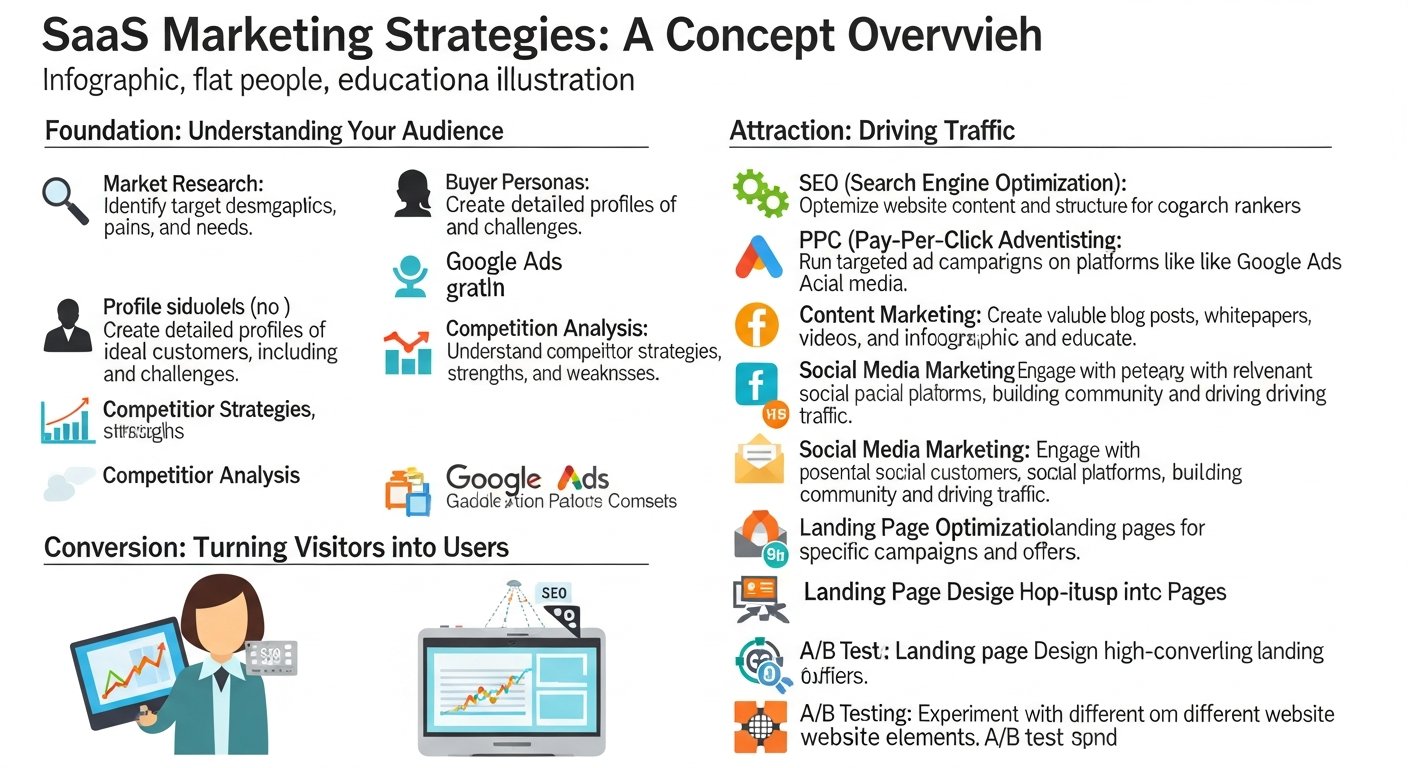
SaaS Marketing Strategies: Fueling Tech Startup Growth with Digital Marketing
In the dynamic landscape of technology, effective SaaS marketing strategies serve as the bedrock for scalable tech startup growth. This comprehensive guide explores effective SaaS marketing strategies, detailing how digital marketing tactics drive tech startup growth, customer acquisition, and retention in the competitive software-as-a-service landscape. It covers key methodologies, tools, and best practices for sustainable expansion, empowering businesses to not only survive but thrive. Understanding and implementing a robust marketing framework is paramount for any software-as-a-service provider aiming for exponential development and market leadership.
What are SaaS Marketing Strategies?
SaaS marketing strategies encompass a specialized set of digital tactics and methodologies specifically designed to acquire, activate, and retain users for software-as-a-service products. These strategies are meticulously tailored to address the unique subscription-based business model, focusing on demonstrating continuous value, managing customer churn, and achieving sustainable digital marketing success. Unlike traditional product marketing, SaaS marketing prioritizes long-term customer relationships, recurring revenue, and proving a consistent return on investment for subscribers. Tech startups leverage these targeted approaches to rapidly expand their user base, enhance brand visibility, and establish a dominant presence in their respective markets. The overarching objective of SaaS marketing strategies is to drive rapid tech startup growth and ensure a consistent stream of Monthly Recurring Revenue (MRR) or Annual Recurring Revenue (ARR).
The core components of SaaS marketing strategies typically involve a blend of inbound and outbound techniques, all harmonized to guide potential customers through a distinct sales funnel: from awareness and consideration to conversion and retention. This holistic approach ensures that every marketing effort contributes directly to the business’s bottom line, fostering loyal customers and maximizing customer lifetime value (LTV). Effective implementation demands a deep understanding of the target audience, the product’s value proposition, and the ever-evolving digital marketing ecosystem.
Core Digital Marketing Strategies for SaaS Growth
Building on the foundational understanding of SaaS marketing, let’s now explore how various core digital marketing strategies further accelerate tech startup growth. Each strategy plays a crucial role in attracting, engaging, and converting prospects into loyal SaaS customers, forming a comprehensive framework for sustainable success.
Why is Content Marketing Crucial for SaaS?
Content marketing fundamentally empowers SaaS companies to attract qualified leads and establish thought leadership within their industry. This strategy focuses on creating and distributing valuable, relevant, and consistent content to a defined audience. For SaaS businesses, its primary objective is to educate potential users, solve their pain points, and build trust in the software solution. Key components and tactics include the development of informative blog posts, comprehensive whitepapers, compelling case studies, insightful webinars, and authoritative thought leadership articles. These content assets serve to attract inbound leads naturally by addressing search queries and providing tangible value.
The benefits for SaaS are profound: enhanced brand authority, increased organic traffic, improved search engine rankings, and a steady flow of high-quality leads. Content marketing also supports customer retention by providing ongoing educational resources and product-related guidance. Potential challenges involve consistently producing high-quality content, measuring its direct ROI, and ensuring distribution across appropriate digital channels. Nevertheless, its role in building a robust pipeline for customer acquisition remains indispensable.
Leveraging SEO for Organic SaaS Visibility
Leveraging Search Engine Optimization (SEO) is a declarative strategy that significantly enhances a SaaS product’s organic visibility and drives targeted traffic. SEO focuses on optimizing a website and its content to rank higher in search engine results pages (SERPs) for relevant keywords. Its primary objective for SaaS companies is to increase organic traffic, attract potential users actively searching for solutions, and reduce customer acquisition costs (CAC). Key components and tactics involve meticulous keyword research to identify high-intent search terms, robust technical SEO to ensure site crawlability and speed, diligent on-page optimization of content and metadata, and strategic backlink acquisition to build domain authority. Achieving higher SERP visibility translates directly into greater brand exposure and increased opportunities for conversions.
The benefits for SaaS include a sustainable source of high-quality organic traffic, improved brand credibility, and a competitive advantage in crowded markets. SEO also provides long-term results, offering an evergreen source of leads once established. Challenges often involve the time investment required for results, keeping up with algorithm changes, and securing high-quality backlinks in a competitive environment. However, the long-term ROI of a well-executed SaaS SEO strategy makes it an essential digital marketing pillar.
Paid Advertising Channels for Rapid SaaS User Acquisition
Paid advertising channels offer a declarative and highly effective method for rapid SaaS user acquisition and immediate visibility. This strategy involves paying to display advertisements on various digital platforms, targeting specific demographics and user behaviors. The primary objective is to drive instant traffic, generate leads, and acquire new users quickly, often for specific campaigns or product launches. Key components and tactics encompass running campaigns on platforms like Google Ads (for search and display), social media ads (e.g., LinkedIn for B2B SaaS, Facebook/Instagram for B2C or freemium models), and retargeting campaigns to re-engage previous visitors. Metrics such as Cost Per Acquisition (CPA) and Return On Ad Spend (ROAS) are critical for optimizing these efforts, alongside meticulously crafted ad creatives and optimized landing pages.
The benefits for SaaS are clear: rapid scalability, precise audience targeting, and immediate measurable results, allowing for quick iteration and optimization. Paid advertising can quickly fill the top of the sales funnel and test new markets. Potential challenges include managing ad spend efficiently, fierce competition driving up costs, and the continuous need for optimization to maintain positive ROAS. Despite these, paid advertising remains a powerful tool for accelerating customer acquisition and driving significant growth for tech startups.
Email Marketing: Nurturing Leads and Retaining SaaS Customers
Email marketing serves as a declarative and highly personalized strategy crucial for nurturing leads and retaining SaaS customers throughout their lifecycle. This approach involves communicating directly with prospects and existing users via email, delivering targeted messages based on their engagement and needs. Its primary objective for SaaS is to guide prospects through the sales funnel, onboard new users effectively, reduce churn rates, and foster long-term customer loyalty. Key components and tactics include automated nurture sequences for leads, welcoming and informative onboarding emails for new subscribers, timely product updates and feature announcements, and strategic segmentation of email lists to deliver highly relevant content. These efforts directly contribute to maximizing customer lifetime value (LTV).
The benefits for SaaS are substantial: high ROI, direct communication with users, improved activation rates, and a powerful mechanism for building relationships and trust. Email marketing facilitates personalized experiences that resonate with users at every stage. Potential challenges include maintaining high deliverability rates, avoiding spam filters, crafting compelling copy that drives action, and ensuring compliance with privacy regulations. Nevertheless, email marketing remains a cornerstone for effective SaaS marketing, driving both acquisition and essential retention.
Product-Led Growth (PLG) and In-App Marketing
Product-Led Growth (PLG) represents a declarative strategy where the product itself serves as the primary driver of customer acquisition, retention, and expansion. This model prioritizes the user experience and empowers customers to discover and adopt the product independently. Its primary objective is to enable users to experience the product’s value firsthand, leading to organic growth and reduced reliance on traditional sales and marketing teams. Key components and tactics include offering freemium models or free trials, implementing intuitive user onboarding flows, utilizing in-app messaging to guide users and highlight features, continuously improving user experience (UX), and designing for product adoption and viral loops. The product’s inherent value and ease of use become the most potent marketing tool.
The benefits for SaaS are significant: lower customer acquisition costs (CAC), faster user adoption, higher retention rates driven by intrinsic value, and the potential for viral growth. PLG fosters a natural connection between the user and the software. Potential challenges involve designing a product that is truly self-serve and provides immediate value, balancing free features with premium offerings, and effectively measuring in-app engagement. Despite these, PLG is increasingly becoming a dominant strategy for tech startups aiming for scalable and efficient growth.
Community Building and Social Media Engagement
Community building and social media engagement constitute a declarative strategy focused on fostering connections with users and amplifying brand presence. This approach leverages various digital platforms to interact with current and prospective customers, gather feedback, and cultivate a loyal brand community. Its primary objective for SaaS companies is to enhance brand awareness, build trust, provide customer support, and drive user engagement. Key components and tactics involve active participation on relevant social media platforms (e.g., LinkedIn for professional networking, Twitter for real-time updates, Reddit for niche communities), creating dedicated online forums or groups, running interactive campaigns, and sharing valuable content. These efforts encourage organic discussions and user-generated content.
The benefits for SaaS are numerous: increased brand visibility, direct customer feedback loops, improved customer loyalty and advocacy, and a channel for real-time communication. Community building helps humanize the brand and creates a sense of belonging. Potential challenges include managing diverse communities, responding effectively to feedback (both positive and negative), and measuring the direct ROI of engagement activities. Nevertheless, a strong community and active social media presence are vital for sustained tech startup growth and fostering deep customer relationships.
[INLINE IMAGE 1: SaaS Marketing Funnel showcasing awareness, consideration, conversion, retention stages with various strategies mapped to each stage.]
| Strategy | Primary Goal | Key Tactics | Best For | Common Metrics |
|---|---|---|---|---|
| Content Marketing | Attracting and educating leads, thought leadership | Blog posts, whitepapers, case studies, webinars | Inbound lead generation, brand authority | Organic traffic, lead conversion rate, content engagement |
| SEO | Increasing organic visibility and traffic | Keyword research, technical SEO, backlinks, on-page optimization | Long-term organic growth, reducing CAC | SERP rankings, organic sessions, keyword positions |
| Paid Advertising | Rapid user acquisition, targeted reach | Google Ads, social media ads, retargeting, landing pages | Immediate traffic, market testing, scalability | CPA, ROAS, click-through rate (CTR), conversion rate |
| Email Marketing | Lead nurturing, customer retention, churn reduction | Nurture sequences, onboarding emails, segmentation, product updates | LTV maximization, personalized communication | Open rate, click-through rate, churn rate reduction |
| Product-Led Growth (PLG) | Organic acquisition, user adoption via product | Freemium/free trials, in-app messaging, UX optimization | Low CAC, viral loops, high user retention | Activation rate, product adoption, trial conversion rate |
| Social Media Marketing | Brand awareness, community engagement, support | Platform engagement, content sharing, community forums | Brand loyalty, customer feedback, thought leadership | Engagement rate, follower growth, sentiment analysis |
Measuring SaaS Marketing Success: Key Metrics & Analytics
Accurately measuring the success of SaaS marketing strategies is paramount for continuous optimization and demonstrating ROI. This section explores the essential metrics and analytical approaches that enable tech startups to evaluate performance and make data-driven decisions. Understanding these measurements directly contributes to identifying effective strategies and areas for improvement, fueling sustained growth.
Key Performance Indicators (KPIs) for SaaS Marketing
Key Performance Indicators (KPIs) for SaaS marketing provide critical insights into the health and trajectory of a tech startup’s growth. These declarative metrics help assess the efficiency and effectiveness of various marketing efforts. Understanding and tracking these KPIs is essential for strategic planning and resource allocation:
- Customer Acquisition Cost (CAC): This metric defines the total cost of sales and marketing efforts required to acquire one new customer. Its importance for SaaS lies in understanding the efficiency of acquisition channels; lower CAC indicates more efficient marketing spend.
- How to Calculate: (Total Sales & Marketing Spend) / (Number of New Customers Acquired)
- Customer Lifetime Value (LTV): LTV represents the total revenue a business can reasonably expect from a single customer account over the duration of their relationship. Its importance for SaaS is profound, as it dictates how much a company can afford to spend on CAC while remaining profitable. A high LTV relative to CAC is a strong indicator of a healthy business model.
- How to Calculate: (Average Revenue Per User) x (Average Customer Lifespan)
- Churn Rate: Churn rate measures the percentage of customers who cancel their subscriptions or stop using the service over a given period. Its importance for SaaS is critical for retention; high churn directly impacts MRR/ARR and necessitates higher acquisition efforts just to stay even. Minimizing churn is often more cost-effective than acquiring new customers.
- How to Calculate: (Number of Customers Lost in a Period) / (Number of Customers at the Start of the Period)
- Monthly Recurring Revenue (MRR) / Annual Recurring Revenue (ARR): MRR and ARR represent the predictable revenue that a business expects to generate every month or year, respectively, from its active subscriptions. Their importance for SaaS is foundational, as they are direct indicators of the business’s financial health, growth trajectory, and scalability.
- How to Calculate MRR: (Average Revenue Per Account) x (Number of Active Accounts)
- How to Calculate ARR: MRR x 12
- Conversion Rate: Conversion rate measures the percentage of visitors or leads who complete a desired action, such as signing up for a trial, downloading a whitepaper, or becoming a paying customer. Its importance for SaaS highlights the effectiveness of marketing funnels and calls to action. Higher conversion rates indicate more persuasive marketing and a more compelling product.
- How to Calculate: (Number of Conversions) / (Total Number of Visitors/Leads) x 100%
- Activation Rate: Activation rate tracks the percentage of new users who reach a specific milestone or “aha moment” within the product, indicating they’ve experienced its core value. Its importance for SaaS is crucial for early retention and product-led growth; a low activation rate often precedes high churn.
- How to Calculate: (Number of Activated Users) / (Number of New Sign-ups) x 100%
Attribution Models: Understanding Customer Journeys
Attribution models are fundamental tools for understanding the complex customer journeys that lead to conversion in the SaaS landscape. These models assign credit to various touchpoints a customer interacts with across different marketing channels before making a purchase or signing up. Their importance for SaaS marketing lies in providing insights into which digital channels are most effective and how they contribute collectively to customer acquisition. Without proper attribution, marketers risk misallocating budgets and underestimating the impact of certain strategies.
Common attribution models include:
- First-Touch Attribution: This model assigns 100% of the credit to the very first marketing touchpoint a customer encountered. It’s useful for understanding initial awareness and lead generation sources.
- Last-Touch Attribution: Conversely, this model gives full credit to the final touchpoint immediately preceding the conversion. It’s often used for optimizing conversion-focused campaigns.
- Linear Attribution: This model distributes credit equally across all touchpoints in the customer journey. It provides a more balanced view of all contributing channels.
- Time Decay Attribution: This model assigns more credit to touchpoints that occurred closer in time to the conversion. It acknowledges that recent interactions often have more influence.
- Position-Based Attribution (U-shaped): This model assigns more credit to the first and last touchpoints (e.g., 40% each) and distributes the remaining credit (20%) among the middle touchpoints. It recognizes the importance of both initial discovery and final decision.
Selecting the right attribution model for a SaaS tech startup depends on its specific marketing goals and the complexity of its customer journey. A multi-touch attribution model (like linear or time decay) often provides a more accurate picture, allowing marketers to optimize across the entire funnel rather than just the beginning or end. This holistic view helps to refine SaaS marketing strategies, ensuring every effort contributes effectively to tech startup growth.
| Metric | Definition | Importance for SaaS | How to Calculate |
|---|---|---|---|
| Customer Acquisition Cost (CAC) | Total sales and marketing spend to acquire one new customer. | Crucial for understanding marketing efficiency and budget allocation. | (Total Sales & Marketing Spend) / (Number of New Customers Acquired) |
| Customer Lifetime Value (LTV) | Total revenue expected from a single customer over their relationship. | Indicates long-term profitability and sustainable growth. Should ideally be > 3x CAC. | (Average Revenue Per User) x (Average Customer Lifespan) |
| Churn Rate | Percentage of customers who cancel their subscriptions in a period. | Directly impacts recurring revenue; lower churn means higher retention. | (Number of Customers Lost) / (Number of Customers at Start of Period) |
| Monthly Recurring Revenue (MRR) | Predictable monthly revenue from active subscriptions. | Fundamental for assessing financial health and growth trajectory. | (Average Revenue Per Account) x (Number of Active Accounts) |
| Annual Recurring Revenue (ARR) | Predictable annual revenue from active subscriptions. | Long-term financial health indicator, especially for larger contracts. | MRR x 12 |
| Conversion Rate | Percentage of visitors/leads completing a desired action. | Measures effectiveness of marketing funnels and calls to action. | (Number of Conversions) / (Total Visitors/Leads) x 100% |
Challenges and Future Trends in SaaS Marketing
The landscape of SaaS marketing is in constant evolution, presenting both unique challenges and exciting new opportunities for tech startups. Navigating these complexities requires foresight, adaptability, and a continuous commitment to innovation. This section explores some common pitfalls to avoid and crucial future trends shaping the trajectory of SaaS marketing strategies.
Common Pitfalls in SaaS Marketing: What to Avoid
While the path to successful SaaS marketing offers immense opportunities for tech startup growth, several common pitfalls can derail even the most promising efforts. Recognizing and actively avoiding these mistakes is as crucial as implementing effective strategies.
- Ignoring Customer Churn: Focusing solely on customer acquisition without robust customer retention strategies is a critical error. High churn rates can quickly negate new growth, leading to unsustainable business models. SaaS companies must prioritize customer success, onboarding, and continuous value delivery to minimize churn.
- Lack of Clear Value Proposition: Many SaaS products struggle because their marketing fails to articulate a clear, compelling value proposition. Without a distinct message explaining “why us,” products get lost in crowded markets. Marketers must precisely define the problem their software solves and the unique benefits it offers.
- Underestimating the Importance of SEO: Relying solely on paid advertising for growth can be costly and unsustainable. Neglecting SEO means missing out on a powerful, cost-effective channel for organic visibility and long-term lead generation. Investing in comprehensive SEO is a declarative move for future stability.
- Ineffective Onboarding: A poorly designed user onboarding process is a major cause of early churn. If new users cannot quickly grasp how to use the product and experience its core value, they are likely to abandon it. SaaS marketers must collaborate closely with product teams to create seamless, value-driven onboarding flows.
- Failing to Measure and Optimize: Launching marketing campaigns without clear KPIs and a system for tracking performance is a recipe for wasted resources. A lack of data-driven decision-making prevents optimization and makes it impossible to identify what truly works. Every strategy must be measurable, allowing for continuous iteration and improvement.
- Disregarding Customer Feedback: Ignoring user feedback, reviews, and support queries means missing out on invaluable insights for product improvement and marketing messaging. Customers are the best source of information for understanding pain points and validating new features.
- Over-Complicating Pricing: Confusing or overly complex pricing models can deter potential customers. SaaS pricing should be transparent, easy to understand, and clearly aligned with the value delivered.
The Role of Sales in SaaS Growth Beyond Marketing
While marketing plays a pivotal role in generating interest and leads, the synergy between sales and marketing is a declarative driver of holistic SaaS growth. Marketing efforts create the initial momentum and pipeline, but sales teams are essential for converting qualified leads into paying customers and expanding accounts. This related but distinct entity/process ensures that the customer journey is seamless from initial awareness to finalized contract.
Sales teams for SaaS products often engage in:
- Lead Qualification: Beyond marketing automation, sales representatives conduct deeper qualification calls to assess a lead’s genuine need, budget, and timeline, ensuring they are a good fit for the product.
- Product Demonstrations: Sales professionals skillfully showcase the software’s features and benefits, directly addressing prospect pain points and demonstrating how the solution provides tangible value.
- Negotiation and Closing: They manage the sales cycle, address objections, negotiate terms, and ultimately close deals, converting qualified leads into recurring revenue customers.
- Upselling and Cross-selling: For existing customers, sales (or account management) teams identify opportunities to expand product usage, upgrade plans, or introduce additional modules, significantly contributing to LTV.
- Feedback Loop: Sales teams are on the front lines, gathering crucial feedback directly from prospects and customers. This information is invaluable for marketing to refine messaging and for product development to enhance features.
Effective “Smarketing” (Sales + Marketing) alignment ensures that marketing generates high-quality leads that sales can efficiently convert, and sales provides insights that inform future marketing strategies. This collaborative approach maximizes the impact of both departments, driving robust tech startup growth beyond what either could achieve in isolation.
[INLINE IMAGE 2: Diagram showcasing the interconnectedness of marketing, sales, and customer success in a SaaS company’s growth loop.]
Implementing and Optimizing Your SaaS Marketing Stack
To effectively execute sophisticated SaaS marketing strategies and ensure scalable tech startup growth, businesses rely on a robust suite of tools and technologies. This section discusses the importance of a well-chosen marketing stack and offers a comparison of popular tools that streamline various aspects of digital marketing.
A “marketing stack” refers to the collection of technologies that marketers use to manage, execute, and analyze their marketing efforts. For SaaS companies, selecting the right tools is critical for efficiency, automation, and data consolidation. These tools often integrate with each other to provide a holistic view of marketing performance and customer interactions.
| Tool | Category | Key Features | Best Use Case | Pricing Model |
|---|---|---|---|---|
| HubSpot | CRM, Marketing Automation, Sales, Service | All-in-one platform for inbound marketing, sales CRM, customer service, CMS. | Businesses seeking a unified platform for all customer-facing operations. | Freemium with tiered paid plans based on contacts/features. |
| Salesforce Marketing Cloud | Marketing Automation, CRM, Analytics | Advanced email marketing, journey builder, social media, advertising, personalization. | Large enterprises needing highly scalable, sophisticated cross-channel marketing. | Modular pricing, quote-based. |
| SEMrush | SEO, Content Marketing, PPC, Market Research | Keyword research, competitor analysis, site audit, content topic research, ad analysis. | Marketers focused on improving organic visibility, content strategy, and competitive intelligence. | Subscription-based, tiered plans. |
| Mailchimp | Email Marketing, Marketing Automation, CRM | Email campaign creation, audience segmentation, landing pages, basic CRM. | Small to medium-sized businesses for email newsletters and automation. | Freemium with tiered paid plans based on contacts/emails. |
| Mixpanel | Product Analytics, User Behavior Tracking | Event tracking, funnel analysis, retention reports, user flows, A/B testing. | SaaS companies focused on understanding product usage, user activation, and retention. | Usage-based pricing (events/MTUs), freemium options. |
When selecting tools, tech startups should consider several factors:
- Integration Capabilities: How well does the tool integrate with existing systems (CRM, other marketing tools)? Seamless data flow is crucial.
- Scalability: Can the tool grow with the business? Will it support increasing user bases and more complex campaigns?
- Features and Functionality: Does it meet specific needs for content creation, SEO, email, analytics, etc.?
- Ease of Use: Is the learning curve manageable for the team? User-friendliness impacts adoption and efficiency.
- Cost-Effectiveness: Does the pricing align with the budget and deliver a clear ROI?
Regularly reviewing and optimizing the marketing stack ensures that SaaS companies are utilizing the most efficient and powerful tools available, thereby maximizing the impact of their SaaS marketing strategies and driving continuous tech startup growth.
Last Updated: October 2026