The Ultimate SaaS GTM Plan: Launch and Scale Your SaaS Product in 2026
By eamped Editorial Team — Senior editors with 10+ years of subject-matter experience.
Published 2026-05-26 · Last Updated 2026-05-26
Affiliate disclosure: This article may contain affiliate links. Recommendations are independent and editorially driven.
In the fiercely competitive SaaS landscape of 2026, a well-defined and executable SaaS GTM plan is not just a strategic advantage—it’s an absolute necessity. Whether you’re a startup poised for your inaugural product launch or an established company introducing a new feature set, your go-to-market strategy dictates everything from initial traction to long-term scalability and profitability. Without a meticulously crafted SaaS go-to-market plan, even the most innovative software can falter, lost in the noise of a crowded market.
This comprehensive guide from eamped will walk you through every critical component of building a winning SaaS GTM plan. We’ll delve into the foundational market research, strategic product positioning, optimal pricing models, and effective channel strategies that drive growth. You’ll learn how to navigate the complexities of launch execution and, crucially, how to optimize and scale your efforts post-launch to ensure sustained success. Prepare to equip yourself with the insights and actionable steps needed to launch and scale your SaaS product with confidence in 2026 and beyond.
TL;DR: Key Takeaways for Your SaaS GTM Plan
- Strategic Imperative: A robust SaaS GTM plan is essential for navigating the competitive 2026 market, driving initial adoption, and ensuring long-term scalability.
- Foundation First: Begin with deep market research, defining your Ideal Customer Profile (ICP), analyzing competitors, and achieving strong Product-Market Fit (PMF).
- Product & Pricing Harmony: Align your product features with identified market needs and establish a pricing model (e.g., subscription, freemium, usage-based) that reflects value and market dynamics.
- GTM Model Selection: Choose the right go-to-market model (Product-Led Growth (PLG), Sales-Led Growth (SLG), Marketing-Led Growth (MLG), or a hybrid) based on your product, market, and target audience.
- Channel Strategy: Develop a multi-channel approach leveraging content marketing, SEO, paid ads, partnerships, and sales enablement to reach and convert your target users.
- Launch & Iterate: Execute a well-orchestrated pre-launch and launch plan, then continuously monitor KPIs (CAC, CLTV, churn), gather feedback, and iterate to optimize and scale your SaaS GTM plan.
- Tools & Resources: Utilize modern tools for CRM, marketing automation, product analytics, and project management to streamline and enhance your go-to-market efforts.
- Downloadable Resource: Don’t forget to leverage our comprehensive SaaS GTM plan template and checklist to streamline your planning process.
1. Understanding the Core of a SaaS GTM Plan
At its heart, a SaaS Go-to-Market (GTM) plan is a comprehensive strategy that outlines how you will bring your software product to market and acquire customers. It’s more than just a launch checklist; it’s a blueprint for growth, covering everything from identifying your target audience to choosing the right channels and pricing your offering effectively. For any SaaS company aiming for sustainable success in 2026, a well-thought-out GTM plan is non-negotiable.
What is a SaaS GTM Plan?
A SaaS GTM plan is a detailed, actionable strategy that specifies how a software company will deliver its product to end-users and achieve business objectives, typically around customer acquisition, revenue growth, and market share. It encompasses understanding the market, defining product positioning, outlining sales and marketing tactics, and establishing clear metrics for success. Unlike a general business plan, a GTM plan is specifically focused on the journey from product development to market adoption and scaling.
Why is a Dedicated SaaS GTM Plan Essential?
Launching a SaaS product without a robust go-to-market plan is akin to setting sail without a map or compass. The risks are substantial, and the likelihood of failure dramatically increases. Here’s why a dedicated SaaS GTM plan is not just beneficial, but critical:
- Mitigates Risks: A GTM plan forces you to anticipate challenges, understand market dynamics, and validate assumptions before committing significant resources. This reduces the risk of market rejection, inefficient spending, and competitive setbacks.
- Ensures Alignment: It brings all internal teams—product, sales, marketing, customer success—onto the same page, ensuring everyone is working towards shared goals with a unified message and strategy. This alignment is crucial for delivering a consistent customer experience.
- Optimizes Resource Allocation: By clearly defining your target audience, channels, and tactics, you can allocate your budget, time, and human resources more efficiently, focusing on activities that yield the highest ROI.
- Accelerates Time to Market (and Value): A structured plan helps streamline processes, avoid delays, and ensures that your product reaches the right customers at the right time, maximizing your window of opportunity. It also focuses on communicating value quickly to users.
- Drives Scalable Growth: A well-articulated SaaS GTM plan includes strategies for not just initial acquisition but also for retention, expansion, and scaling into new markets or segments, providing a clear path for sustainable growth.
- Provides a Benchmark for Success: With predefined KPIs and metrics, your GTM plan allows you to measure performance, identify what’s working (and what’s not), and make data-driven adjustments quickly.
The Anatomy of a Winning SaaS GTM Plan
While specific elements may vary, a truly effective SaaS GTM plan typically comprises several interconnected phases and components. These include deep market analysis, precise product positioning, a clear pricing strategy, a robust distribution and channel strategy, a sales and marketing plan, and a framework for post-launch optimization and feedback. Each of these components must be meticulously developed and integrated to form a cohesive and powerful strategy.
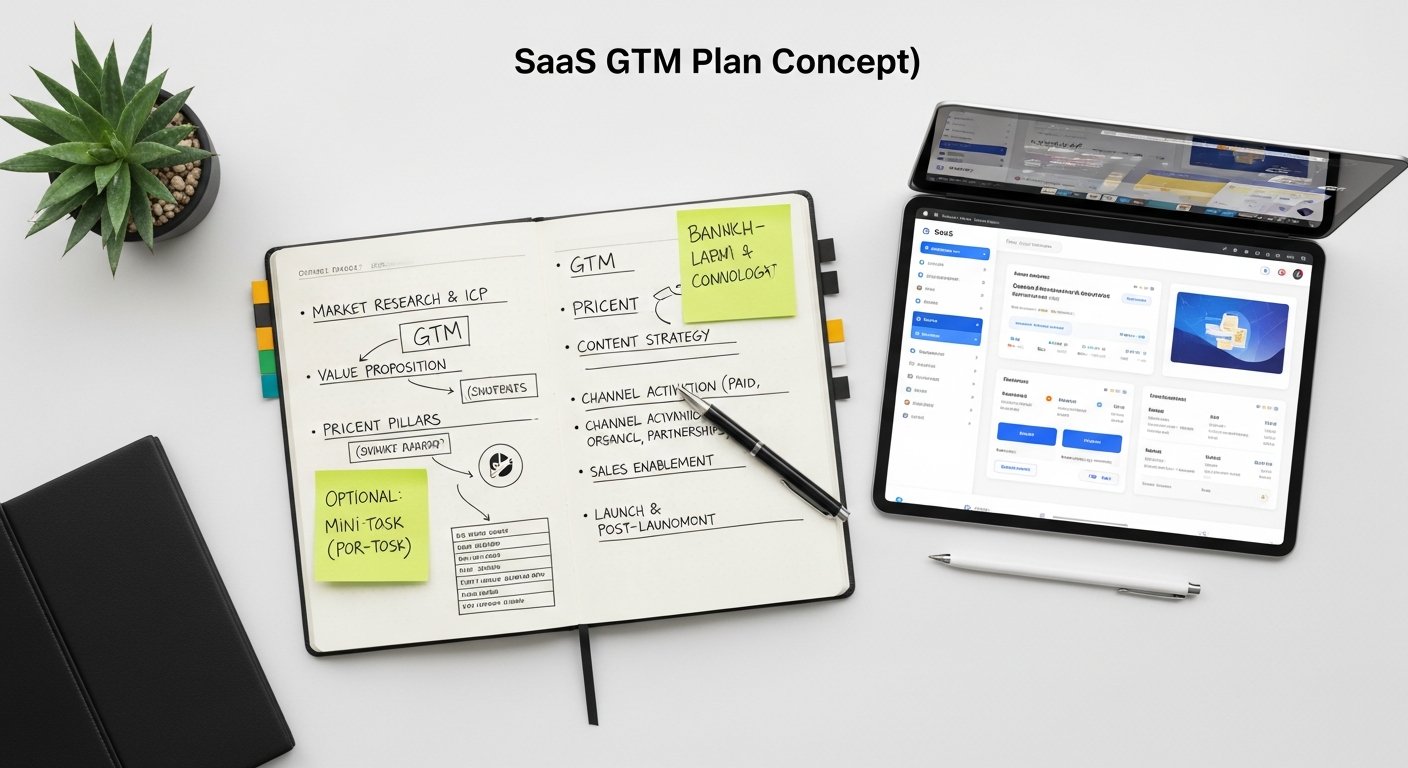
[INLINE IMAGE 1: place after second H2 | alt=”saas gtm plan concept illustration”]
2. Phase 1: Market Research & Strategic Foundations
The bedrock of any successful SaaS GTM plan is thorough market research. Before you even think about launching, you need to deeply understand the landscape you’re entering, the people you aim to serve, and the rivals you’ll face. This foundational phase is where you validate your assumptions and build a data-driven strategy.
Defining Your Target Market & Ideal Customer Profile (ICP)
Who are you building your SaaS product for? This isn’t a rhetorical question. A vague understanding of your audience leads to diluted messaging, inefficient marketing, and ultimately, poor conversion rates. You need to define your target market with precision and develop a detailed Ideal Customer Profile (ICP).
- Target Market: This defines the broader segment of the market your product addresses. Consider factors like industry, company size (SMB, Mid-market, Enterprise), geographic location, and specific departmental needs. For instance, your target market might be “small to medium-sized e-commerce businesses in North America looking for inventory management solutions.”
- Ideal Customer Profile (ICP): The ICP goes deeper, describing the specific company attributes that make an organization an ideal fit for your solution. This includes:
- Demographics: Company size (revenue, employee count), industry, location, tech stack currently in use.
- Psychographics: Business goals, pain points they are actively trying to solve, values, growth aspirations, budget for solutions like yours.
- Firmographics: Specific tools or integrations they use, compliance requirements, organizational structure.
Developing an ICP helps you focus your efforts on prospects who will derive the most value from your product, have the budget to pay for it, and are most likely to become long-term, happy customers. This precision significantly lowers Customer Acquisition Cost (CAC) and increases Customer Lifetime Value (CLTV).
Analyzing the Competitive Landscape
No SaaS product exists in a vacuum. Understanding your competitors is crucial for differentiating your offering and identifying market gaps. Your competitive analysis should go beyond just listing names; it needs to dissect their strategies, strengths, and weaknesses.
- Direct Competitors: Offer similar solutions to the same target market. What are their core features, pricing, marketing messages, and GTM strategies?
- Indirect Competitors: Solve the same problem but with a different type of solution (e.g., spreadsheets vs. your SaaS project management tool).
- Substitute Products: Customers might be using workarounds or manual processes that your SaaS aims to replace.
For each competitor, analyze their:
- Product Features: What do they do well? What are their gaps?
- Pricing Models: How do they structure their plans? Are they freemium, subscription-based, usage-based?
- Marketing & Sales Strategies: What channels do they use? What’s their unique selling proposition? How do they position themselves?
- Customer Reviews & Feedback: What are users saying about them (pros and cons)? This often reveals unmet needs or frustrations your product can address.
This analysis helps you pinpoint opportunities for differentiation and validate the existence of demand for your unique approach.
Identifying Your Unique Value Proposition (UVP)
Once you understand your target market and competitors, you can articulate your Unique Value Proposition (UVP). Your UVP is a clear, concise statement that explains how your product solves your customer’s problem better or differently than anyone else, and the specific benefits they will receive.
- Clarity: Easy to understand.
- Relevance: Addresses a core pain point or desire of your ICP.
- Differentiation: Highlights what makes you distinct from competitors.
- Quantifiable Benefit (where possible): Shows measurable value (e.g., “reduces onboarding time by 50%,” “increases lead conversion by 15%”).
A strong UVP guides all your messaging—from website copy to sales pitches—ensuring consistency and resonance with your target audience. It is a cornerstone of your go-to-market strategy for SaaS products.
Achieving Product-Market Fit (PMF)
Product-Market Fit (PMF) is a critical concept, especially for a SaaS GTM plan. It means being in a good market with a product that can satisfy that market. You’ve achieved PMF when customers are consistently getting value from your product, telling others about it, and you have strong retention and engagement metrics.
- Early Indicators of PMF:
- High user engagement and retention rates.
- Organic word-of-mouth referrals.
- Positive customer testimonials and case studies.
- Users are willing to pay for your product and express disappointment if they couldn’t use it.
- Iterative Process: PMF isn’t a one-time achievement; it’s an ongoing journey. Continuously gather feedback, iterate on your product, and monitor key metrics to ensure you maintain PMF as your market evolves and your product grows. For early-stage SaaS, focusing on PMF before aggressively scaling your GTM is crucial to avoid wasting resources on a product nobody truly needs or wants.
Without PMF, any go-to-market strategy will struggle to gain traction and will likely result in high churn rates and unsustainable customer acquisition costs. It’s the ultimate validation that your product solves a real problem for a real audience.
3. Phase 2: Product & Pricing Strategy
Once your strategic foundations are laid, the next crucial step in your SaaS GTM plan is to meticulously define your product’s offering and how you will monetize it. This phase connects the ‘what’ (your product) with the ‘how much’ (your pricing) to ensure market alignment and revenue generation.
Aligning Product with Market Needs
Your product strategy must be a direct response to the market research conducted in Phase 1. It’s not just about building features; it’s about solving problems and delivering tangible value to your ICP. Every feature, every roadmap decision, should align with identified market needs and your Unique Value Proposition.
- Feature Prioritization: Focus on core features that deliver the most immediate and impactful solutions for your target audience. Avoid feature bloat, which can overwhelm users and divert development resources.
- User Experience (UX): A seamless, intuitive, and enjoyable user experience is paramount for SaaS. Users expect simplicity, speed, and efficiency. Poor UX can negate even the most powerful features.
- Onboarding Experience: The initial moments a user spends with your product are critical. Design an onboarding flow that quickly guides users to their “aha!” moment, demonstrating immediate value and reducing time-to-value. This directly impacts activation and retention rates.
- Scalability & Performance: Ensure your product is built on a scalable architecture that can handle growth in users and data without performance degradation. This is vital for long-term customer satisfaction and operational efficiency.
- Integration Ecosystem: Consider how your SaaS product integrates with other tools your ICP uses. A robust integration ecosystem can significantly enhance your product’s value and stickiness.
Crafting Your SaaS Pricing Model
Pricing is one of the most challenging yet impactful components of your SaaS GTM plan. It directly affects revenue, market perception, and the types of customers you attract. There’s no one-size-fits-all, but several common models exist:
- Subscription/Tiered Pricing: The most common, where users pay a recurring fee (monthly/annually) for access to features, often segmented into tiers (e.g., Basic, Pro, Enterprise) with varying feature sets, user limits, or support levels.
- Freemium: Offers a free version of the product with limited features or usage, enticing users to upgrade to a paid version for full functionality. Excellent for viral growth and product-led strategies.
- Usage-Based/Consumption: Customers pay based on their actual consumption of a specific metric (e.g., API calls, data storage, active users, gigabytes processed). This model aligns cost directly with value and is popular for infrastructure or platform SaaS.
- Per-User Pricing: Customers pay a fixed fee per active user. Simple and predictable, but can be a barrier for growing teams.
- Value-Based Pricing: Aligns pricing directly with the measurable value your product delivers to the customer. This requires deep understanding of customer ROI.
Pricing Tiers & Packaging
Most SaaS products use a tiered pricing structure to cater to different customer segments. When designing your tiers:
- Target Specific ICP Segments: Each tier should appeal to a distinct ideal customer segment (e.g., solopreneurs, small teams, large enterprises) with specific needs and budget capacities.
- Feature Differentiation: Clearly define what features are included in each tier. The jump in features and value should justify the increase in price.
- Pricing Anchoring: Often, a middle tier is designed to be the “most popular” or “best value,” anchoring customer perception.
- Psychological Pricing: Consider pricing strategies like ending prices in .99 or using round numbers for enterprise solutions.
- Annual vs. Monthly: Offer discounts for annual commitments to reduce churn and improve cash flow.
Value-Based Pricing Principles
For SaaS, value-based pricing is often the most lucrative strategy. Instead of focusing on your costs or competitor prices, you price your product based on the perceived and measurable value it delivers to the customer. This requires:
- Understanding Customer ROI: Quantify how your product saves time, increases revenue, reduces costs, or improves efficiency for your customers.
- Communicating Value: Clearly articulate the ROI and benefits, not just features. “Reduce customer support tickets by 30%” is more powerful than “Advanced AI chatbot.”
- Flexibility: Be prepared to adapt pricing as your product evolves and market dynamics shift. Regular reviews of your pricing strategy are essential.
A well-executed pricing strategy, informed by customer value and market demand, is a powerful engine for your SaaS GTM plan, directly impacting your revenue goals and market penetration.
4. Phase 3: Go-to-Market Model & Channel Strategy
With your product and pricing clearly defined, the next critical phase of your SaaS GTM plan involves deciding how you will reach your target customers and which channels will be most effective. This decision impacts everything from your sales organization to your marketing budget and overall growth trajectory. Choosing the right go-to-market model is paramount.
Choosing Your GTM Model: PLG, SLG, MLG, or Hybrid
The GTM model you adopt dictates how you acquire users and drive revenue. There are three primary models, often combined into hybrid approaches:
Product-Led Growth (PLG)
PLG is a strategy where the product itself serves as the primary driver of customer acquisition, retention, and expansion. Users can typically experience the core value of the product firsthand, often through a freemium model or a free trial, before committing to a purchase. The sales motion is minimal, often relying on self-service or inbound inquiries from active users.
- Characteristics: Low CAC, high virality potential, strong emphasis on user experience, self-service onboarding, usage-based triggers for upgrades.
- Best for: Products with immediate time-to-value, intuitive UX, broad appeal, and a strong network effect. Think Slack, Zoom, HubSpot (initially).
- Key Metrics: Product qualified leads (PQLs), activation rate, usage frequency, conversion from free to paid.
Sales-Led Growth (SLG)
SLG relies on a direct sales force to identify, qualify, and convert leads. This model is characterized by high-touch interactions, detailed demonstrations, and often longer sales cycles. Marketing supports sales by generating qualified leads (MQLs) and providing sales enablement content.
- Characteristics: Higher CAC, focuses on high Average Revenue Per User (ARPU), complex sales cycles, strong need for sales collateral and CRM.
- Best for: Enterprise SaaS, products with high price points, complex implementation, require significant change management, or target highly specialized industries. Think Salesforce, Oracle.
- Key Metrics: Sales Qualified Leads (SQLs), conversion rates through sales funnel, average deal size, sales cycle length.
Marketing-Led Growth (MLG)
MLG emphasizes marketing efforts to generate leads and drive customer acquisition, often with a lighter touch sales process than SLG. Content marketing, SEO, paid advertising, email marketing, and webinars are key components. Leads are nurtured through marketing automation until they are sales-ready or convert through self-service options.
- Characteristics: Focus on lead generation and nurturing, brand building, content creation, measurable marketing ROI.
- Best for: SaaS products with a clear value proposition, moderate price points, and a target audience that can be reached effectively through digital channels. Many SMB-focused SaaS companies utilize MLG heavily.
- Key Metrics: MQLs, website traffic, conversion rates on landing pages, cost per lead, email engagement.
Hybrid Models
Most successful SaaS companies in 2026 employ a hybrid approach, combining elements of PLG, SLG, and MLG. For example, a company might use PLG for initial adoption and small teams, then layer in an SLG motion for enterprise expansion or upselling, all while using MLG to fuel brand awareness and lead generation. This nuanced approach allows for flexibility and caters to diverse customer segments and their varying needs.
Building Your Channel Strategy
Once you’ve chosen your GTM model, you need to identify the specific channels you’ll use to reach your ICP and communicate your UVP. A multi-channel approach is almost always necessary to maximize reach and effectiveness.
- Content Marketing & SEO: Create valuable blog posts, whitepapers, case studies, and guides that address your ICP’s pain points. Optimize this content for search engines (SEO) to attract organic traffic searching for solutions. This is a long-term play but builds authority and trust. For instance, creating comprehensive guides around specific industry challenges your software solves can attract highly qualified leads.
- Paid Advertising (SEM, Social, Display): Run targeted campaigns on Google Search (SEM), LinkedIn, Facebook, and other relevant platforms. These channels offer immediate visibility and precise targeting based on demographics, interests, and behaviors. Optimize for Cost Per Acquisition (CPA) and ensure your ad copy aligns with your UVP.
- Social Media Marketing: Engage with your audience on platforms where they spend their time. This can be for brand building, thought leadership, customer support, or direct lead generation, depending on the platform and your strategy. LinkedIn is often critical for B2B SaaS.
- Email Marketing: Build an email list and nurture leads with valuable content, product updates, and personalized offers. Email remains one of the most effective channels for conversion and retention.
- Partnerships & Integrations: Collaborate with complementary software providers, industry influencers, or channel partners (resellers, agencies). This can provide access to new audiences and enhance your product’s ecosystem.
- Affiliate Marketing: Leverage a network of affiliates who promote your product in exchange for a commission on sales or leads.
- Events & Webinars: Host or participate in industry events, conferences, and webinars to showcase your product, generate leads, and establish thought leadership.
- Public Relations (PR): Secure media coverage in tech publications, industry journals, and podcasts to build brand awareness and credibility.
Sales Enablement & Onboarding
Regardless of your GTM model, your sales team (even if it’s a small internal team or purely self-service support) needs to be fully enabled. This means providing them with:
- Comprehensive Training: Deep understanding of the product, its features, benefits, and how it solves specific customer problems.
- Sales Collateral: Up-to-date presentations, case studies, competitive battle cards, whitepapers, and demos.
- CRM & Automation: Tools to manage leads, track interactions, and automate follow-ups.
- Clear Messaging: Consistent messaging that aligns with your UVP and marketing efforts.
A well-oiled sales enablement process ensures your team can effectively communicate value, overcome objections, and close deals efficiently. Similarly, the onboarding experience for new users, whether self-service or guided by customer success, is paramount for initial activation and long-term retention.
[INLINE IMAGE 2: place after fourth H2 | alt=”saas gtm plan comparison illustration”]
Comparison of GTM Models for SaaS
Understanding the nuances of each GTM model is crucial for making an informed decision. Here’s a comparative overview:
| GTM Model | Primary Driver | Typical Customer Profile | Pros | Cons | Best Use Case Example |
|---|---|---|---|---|---|
| Product-Led Growth (PLG) | Product usage, self-service | Individuals, SMBs, bottom-up adoption in enterprises | Lower CAC, faster growth, high virality, higher retention if product is sticky | Requires highly intuitive product, revenue can be slower, difficulty monetizing free users | Collaboration tools (Slack, Zoom Free), project management for small teams (Asana Free) |
| Sales-Led Growth (SLG) | Direct sales team interaction | Mid-market, Enterprise, complex B2B solutions | Higher ARPU, better for complex products, deep customer relationships, handles objections effectively | Higher CAC, longer sales cycles, scaling sales team is expensive, less agile | CRM for large enterprises (Salesforce), complex ERP systems, cybersecurity solutions |
| Marketing-Led Growth (MLG) | Marketing campaigns, content, lead nurturing | SMBs, prosumers, specific niches, products with clear problem/solution fit | Scalable lead generation, strong brand building, measurable marketing ROI, can support both PLG/SLG | Requires continuous content and campaign optimization, potential for lower lead quality if not targeted well | Marketing automation platforms (HubSpot), email marketing tools, SEO software |
5. Phase 4: Pre-Launch & Launch Execution
The groundwork is laid; now it’s time to bring your SaaS product to the market. This phase of your SaaS GTM plan is all about meticulous planning and flawless execution to ensure a successful debut and capture initial market share.
Developing Your Pre-Launch Buzz Strategy
A successful launch isn’t a single event; it’s the culmination of carefully orchestrated efforts, often beginning long before the product is publicly available. A pre-launch strategy is designed to build anticipation, gather early adopters, and generate buzz.
- Landing Page & Waitlist: Create a compelling landing page that clearly articulates your UVP and offers visitors the chance to sign up for early access, a beta program, or a notification list. This helps build an audience and gauge interest.
- Content Teasers: Release snippets of information, sneak peeks, or behind-the-scenes content on social media, blogs, or industry forums.
- Early Access/Beta Programs: Invite a select group of users (from your ICP) to test your product. Their feedback is invaluable for final refinements, and their early success stories can become powerful testimonials.
- Press & Influencer Outreach: Begin reaching out to relevant tech journalists, industry analysts, and influencers well in advance of your launch. Provide them with early access and exclusive information to secure coverage.
- Partnership Announcements: If you have key integrations or strategic partnerships, coordinate announcements to maximize impact and reach broader audiences.
Crafting a Compelling Launch Message
Your launch message is the core communication that introduces your product to the world. It must be clear, concise, and immediately convey your value proposition. This message should be consistently applied across all channels and materials.
- Problem-Solution-Benefit Framework:
- Clearly state the problem your target audience faces.
- Introduce your SaaS product as the unique solution.
- Explain the specific benefits and positive outcomes users will experience.
- Highlight Differentiation: Reiterate what makes your product stand out from competitors.
- Call to Action: Make it crystal clear what you want people to do next (e.g., “Sign up for free,” “Request a demo,” “Start your trial”).
Website & Content Readiness
Your website is often the first point of contact for potential customers. Before launch, ensure it’s fully optimized:
- Landing Pages: High-converting landing pages for specific campaigns or features.
- Product Pages: Detailed yet digestible information about features, benefits, use cases, and integrations.
- Pricing Page: Transparent and easy-to-understand pricing tiers that align with your pricing strategy.
- Resource Center/Blog: A hub of educational content that answers common questions and establishes your authority.
- SEO Optimization: Ensure all pages are optimized for relevant keywords, load quickly, and are mobile-responsive.
- Help Documentation: Comprehensive support articles and FAQs to empower self-service.
Sales Team Training & Alignment
If you have a sales team (or even a customer success team handling inquiries), they need to be fully prepared for launch day. This means:
- Product Deep Dive: In-depth knowledge of all features, benefits, and common use cases.
- Objection Handling: Training on how to address potential customer concerns and competitive challenges.
- Demo Readiness: Polished demo scripts and presentations.
- Messaging Consistency: Ensuring their pitch aligns perfectly with marketing messages.
- Lead Routing: Clear processes for handling incoming leads generated by the launch.
The Big Launch Day: What to Expect
Launch day is exciting but can also be chaotic. Be prepared for:
- Monitoring: Closely monitor website traffic, sign-ups, social media mentions, and news coverage. Have a team dedicated to real-time response.
- Support Readiness: Ensure your support channels (chat, email, phone) are fully staffed and ready to handle an influx of inquiries.
- Bug Reporting: Have a clear process for users to report bugs and for your product team to address critical issues swiftly.
- Celebration & Acknowledgment: Don’t forget to celebrate your team’s hard work and acknowledge early adopters!
Mini Case Study: Launch Success Story: CloudFlow CRM
Challenge: CloudFlow, a new CRM for SMBs, faced a crowded market dominated by established players. Their UVP centered on hyper-automation for sales workflows, promising a 40% reduction in manual data entry.
GTM Plan Execution:
- Pre-Launch: Six months prior, CloudFlow launched a “Future of Sales” blog series, positioning itself as thought leaders. They captured 10,000 email sign-ups via a landing page offering a “Sales Automation Checklist” lead magnet. Three months before launch, they opened a beta to 500 qualified prospects, securing early testimonials and refining the product based on feedback.
- Launch Day: Orchestrated a major tech press release, supported by targeted LinkedIn ads reaching sales leaders. The launch message focused on “Reclaim Your Sales Day: CloudFlow CRM Automates 40% of Your Manual Tasks.”
- Initial Metrics: Within the first month, CloudFlow saw 2,500 new sign-ups (free trial), a 15% trial-to-paid conversion rate, and an average time-to-value of 3 days due to their streamlined onboarding. Their initial CAC was $75, significantly below the industry average due to organic buzz and targeted lead generation.
Outcome: CloudFlow successfully carved out a niche by demonstrating clear, quantifiable value, leading to strong initial adoption and a solid foundation for future growth.
Discover how targeted content marketing can boost your SaaS launch.
6. Phase 5: Post-Launch Optimization & Scaling
A successful launch is not the finish line; it’s the starting gun. The final, and ongoing, phase of your SaaS GTM plan is dedicated to monitoring, learning, iterating, and scaling. This continuous feedback loop is what drives sustainable growth and keeps your product relevant in a dynamic market.
Monitoring Key Performance Indicators (KPIs)
Data is your most valuable asset post-launch. Establish a robust system for tracking key performance indicators (KPIs) that directly reflect the health of your SaaS business and the effectiveness of your
The Ultimate SaaS GTM Plan: Launch and Scale Your SaaS Product in 2026
By eamped Editorial Team — Senior editors with 10+ years of subject-matter experience.
Published 2026-05-26 · Last Updated 2026-05-26
Affiliate disclosure: This article may contain affiliate links. Recommendations are independent and editorially driven.
In the fiercely competitive SaaS landscape of 2026, a well-defined and executable SaaS GTM plan is not just a strategic advantage—it’s an absolute necessity. Whether you’re a startup poised for your inaugural product launch or an established company introducing a new feature set, your go-to-market strategy dictates everything from initial traction to long-term scalability and profitability. Without a meticulously crafted SaaS go-to-market plan, even the most innovative software can falter, lost in the noise of a crowded market.
This comprehensive guide from eamped will walk you through every critical component of building a winning SaaS GTM plan. We’ll delve into the foundational market research, strategic product positioning, optimal pricing models, and effective channel strategies that drive growth. You’ll learn how to navigate the complexities of launch execution and, crucially, how to optimize and scale your efforts post-launch to ensure sustained success. Prepare to equip yourself with the insights and actionable steps needed to launch and scale your SaaS product with confidence in 2026 and beyond.
TL;DR: Key Takeaways for Your SaaS GTM Plan
- Strategic Imperative: A robust SaaS GTM plan is essential for navigating the competitive 2026 market, driving initial adoption, and ensuring long-term scalability.
- Foundation First: Begin with deep market research, defining your Ideal Customer Profile (ICP), analyzing competitors, and achieving strong Product-Market Fit (PMF).
- Product & Pricing Harmony: Align your product features with identified market needs and establish a pricing model (e.g., subscription, freemium, usage-based) that reflects value and market dynamics.
- GTM Model Selection: Choose the right go-to-market model (Product-Led Growth (PLG), Sales-Led Growth (SLG), Marketing-Led Growth (MLG), or a hybrid) based on your product, market, and target audience.
- Channel Strategy: Develop a multi-channel approach leveraging content marketing, SEO, paid ads, partnerships, and sales enablement to reach and convert your target users.
- Launch & Iterate: Execute a well-orchestrated pre-launch and launch plan, then continuously monitor KPIs (CAC, CLTV, churn), gather feedback, and iterate to optimize and scale your SaaS GTM plan.
- Tools & Resources: Utilize modern tools for CRM, marketing automation, product analytics, and project management to streamline and enhance your go-to-market efforts.
- Downloadable Resource: Don’t forget to leverage our comprehensive SaaS GTM plan template and checklist to streamline your planning process.
1. Understanding the Core of a SaaS GTM Plan
At its heart, a SaaS Go-to-Market (GTM) plan is a comprehensive strategy that outlines how you will bring your software product to market and acquire customers. It’s more than just a launch checklist; it’s a blueprint for growth, covering everything from identifying your target audience to choosing the right channels and pricing your offering effectively. For any SaaS company aiming for sustainable success in 2026, a well-thought-out GTM plan is non-negotiable.
What is a SaaS GTM Plan?
A SaaS GTM plan is a detailed, actionable strategy that specifies how a software company will deliver its product to end-users and achieve business objectives, typically around customer acquisition, revenue growth, and market share. It encompasses understanding the market, defining product positioning, outlining sales and marketing tactics, and establishing clear metrics for success. Unlike a general business plan, a GTM plan is specifically focused on the journey from product development to market adoption and scaling.
Why is a Dedicated SaaS GTM Plan Essential?
Launching a SaaS product without a robust go-to-market plan is akin to setting sail without a map or compass. The risks are substantial, and the likelihood of failure dramatically increases. Here’s why a dedicated SaaS GTM plan is not just beneficial, but critical:
- Mitigates Risks: A GTM plan forces you to anticipate challenges, understand market dynamics, and validate assumptions before committing significant resources. This reduces the risk of market rejection, inefficient spending, and competitive setbacks.
- Ensures Alignment: It brings all internal teams—product, sales, marketing, customer success—onto the same page, ensuring everyone is working towards shared goals with a unified message and strategy. This alignment is crucial for delivering a consistent customer experience.
- Optimizes Resource Allocation: By clearly defining your target audience, channels, and tactics, you can allocate your budget, time, and human resources more efficiently, focusing on activities that yield the highest ROI.
- Accelerates Time to Market (and Value): A structured plan helps streamline processes, avoid delays, and ensures that your product reaches the right customers at the right time, maximizing your window of opportunity. It also focuses on communicating value quickly to users.
- Drives Scalable Growth: A well-articulated SaaS GTM plan includes strategies for not just initial acquisition but also for retention, expansion, and scaling into new markets or segments, providing a clear path for sustainable growth.
- Provides a Benchmark for Success: With predefined KPIs and metrics, your GTM plan allows you to measure performance, identify what’s working (and what’s not), and make data-driven adjustments quickly.
The Anatomy of a Winning SaaS GTM Plan
While specific elements may vary, a truly effective SaaS GTM plan typically comprises several interconnected phases and components. These include deep market analysis, precise product positioning, a clear pricing strategy, a robust distribution and channel strategy, a sales and marketing plan, and a framework for post-launch optimization and feedback. Each of these components must be meticulously developed and integrated to form a cohesive and powerful strategy.
[INLINE IMAGE 1: place after second H2 | alt=”saas gtm plan concept illustration”]
2. Phase 1: Market Research & Strategic Foundations
The bedrock of any successful SaaS GTM plan is thorough market research. Before you even think about launching, you need to deeply understand the landscape you’re entering, the people you aim to serve, and the rivals you’ll face. This foundational phase is where you validate your assumptions and build a data-driven strategy.
Defining Your Target Market & Ideal Customer Profile (ICP)
Who are you building your SaaS product for? This isn’t a rhetorical question. A vague understanding of your audience leads to diluted messaging, inefficient marketing, and ultimately, poor conversion rates. You need to define your target market with precision and develop a detailed Ideal Customer Profile (ICP).
- Target Market: This defines the broader segment of the market your product addresses. Consider factors like industry, company size (SMB, Mid-market, Enterprise), geographic location, and specific departmental needs. For instance, your target market might be “small to medium-sized e-commerce businesses in North America looking for inventory management solutions.”
- Ideal Customer Profile (ICP): The ICP goes deeper, describing the specific company attributes that make an organization an ideal fit for your solution. This includes:
- Demographics: Company size (revenue, employee count), industry, location, tech stack currently in use.
- Psychographics: Business goals, pain points they are actively trying to solve, values, growth aspirations, budget for solutions like yours.
- Firmographics: Specific tools or integrations they use, compliance requirements, organizational structure.
Developing an ICP helps you focus your efforts on prospects who will derive the most value from your product, have the budget to pay for it, and are most likely to become long-term, happy customers. This precision significantly lowers Customer Acquisition Cost (CAC) and increases Customer Lifetime Value (CLTV).
Analyzing the Competitive Landscape
No SaaS product exists in a vacuum. Understanding your competitors is crucial for differentiating your offering and identifying market gaps. Your competitive analysis should go beyond just listing names; it needs to dissect their strategies, strengths, and weaknesses.
- Direct Competitors: Offer similar solutions to the same target market. What are their core features, pricing, marketing messages, and GTM strategies?
- Indirect Competitors: Solve the same problem but with a different type of solution (e.g., spreadsheets vs. your SaaS project management tool).
- Substitute Products: Customers might be using workarounds or manual processes that your SaaS aims to replace.
For each competitor, analyze their:
- Product Features: What do they do well? What are their gaps?
- Pricing Models: How do they structure their plans? Are they freemium, subscription-based, usage-based?
- Marketing & Sales Strategies: What channels do they use? What’s their unique selling proposition? How do they position themselves?
- Customer Reviews & Feedback: What are users saying about them (pros and cons)? This often reveals unmet needs or frustrations your product can address.
This analysis helps you pinpoint opportunities for differentiation and validate the existence of demand for your unique approach.
Identifying Your Unique Value Proposition (UVP)
Once you understand your target market and competitors, you can articulate your Unique Value Proposition (UVP). Your UVP is a clear, concise statement that explains how your product solves your customer’s problem better or differently than anyone else, and the specific benefits they will receive.
- Clarity: Easy to understand.
- Relevance: Addresses a core pain point or desire of your ICP.
- Differentiation: Highlights what makes you distinct from competitors.
- Quantifiable Benefit (where possible): Shows measurable value (e.g., “reduces onboarding time by 50%,” “increases lead conversion by 15%”).
A strong UVP guides all your messaging—from website copy to sales pitches—ensuring consistency and resonance with your target audience. It is a cornerstone of your go-to-market strategy for SaaS products.
Achieving Product-Market Fit (PMF)
Product-Market Fit (PMF) is a critical concept, especially for a SaaS GTM plan. It means being in a good market with a product that can satisfy that market. You’ve achieved PMF when customers are consistently getting value from your product, telling others about it, and you have strong retention and engagement metrics.
- Early Indicators of PMF:
- High user engagement and retention rates.
- Organic word-of-mouth referrals.
- Positive customer testimonials and case studies.
- Users are willing to pay for your product and express disappointment if they couldn’t use it.
- Iterative Process: PMF isn’t a one-time achievement; it’s an ongoing journey. Continuously gather feedback, iterate on your product, and monitor key metrics to ensure you maintain PMF as your market evolves and your product grows. For early-stage SaaS, focusing on PMF before aggressively scaling your GTM is crucial to avoid wasting resources on a product nobody truly needs or wants.
Without PMF, any go-to-market strategy will struggle to gain traction and will likely result in high churn rates and unsustainable customer acquisition costs. It’s the ultimate validation that your product solves a real problem for a real audience.
3. Phase 2: Product & Pricing Strategy
Once your strategic foundations are laid, the next crucial step in your SaaS GTM plan is to meticulously define your product’s offering and how you will monetize it. This phase connects the ‘what’ (your product) with the ‘how much’ (your pricing) to ensure market alignment and revenue generation.
Aligning Product with Market Needs
Your product strategy must be a direct response to the market research conducted in Phase 1. It’s not just about building features; it’s about solving problems and delivering tangible value to your ICP. Every feature, every roadmap decision, should align with identified market needs and your Unique Value Proposition.
- Feature Prioritization: Focus on core features that deliver the most immediate and impactful solutions for your target audience. Avoid feature bloat, which can overwhelm users and divert development resources.
- User Experience (UX): A seamless, intuitive, and enjoyable user experience is paramount for SaaS. Users expect simplicity, speed, and efficiency. Poor UX can negate even the most powerful features.
- Onboarding Experience: The initial moments a user spends with your product are critical. Design an onboarding flow that quickly guides users to their “aha!” moment, demonstrating immediate value and reducing time-to-value. This directly impacts activation and retention rates.
- Scalability & Performance: Ensure your product is built on a scalable architecture that can handle growth in users and data without performance degradation. This is vital for long-term customer satisfaction and operational efficiency.
- Integration Ecosystem: Consider how your SaaS product integrates with other tools your ICP uses. A robust integration ecosystem can significantly enhance your product’s value and stickiness.
Crafting Your SaaS Pricing Model
Pricing is one of the most challenging yet impactful components of your SaaS GTM plan. It directly affects revenue, market perception, and the types of customers you attract. There’s no one-size-fits-all, but several common models exist:
- Subscription/Tiered Pricing: The most common, where users pay a recurring fee (monthly/annually) for access to features, often segmented into tiers (e.g., Basic, Pro, Enterprise) with varying feature sets, user limits, or support levels.
- Freemium: Offers a free version of the product with limited features or usage, enticing users to upgrade to a paid version for full functionality. Excellent for viral growth and product-led strategies.
- Usage-Based/Consumption: Customers pay based on their actual consumption of a specific metric (e.g., API calls, data storage, active users, gigabytes processed). This model aligns cost directly with value and is popular for infrastructure or platform SaaS.
- Per-User Pricing: Customers pay a fixed fee per active user. Simple and predictable, but can be a barrier for growing teams.
- Value-Based Pricing: Aligns pricing directly with the measurable value your product delivers to the customer. This requires deep understanding of customer ROI.
Pricing Tiers & Packaging
Most SaaS products use a tiered pricing structure to cater to different customer segments. When designing your tiers:
- Target Specific ICP Segments: Each tier should appeal to a distinct ideal customer segment (e.g., solopreneurs, small teams, large enterprises) with specific needs and budget capacities.
- Feature Differentiation: Clearly define what features are included in each tier. The jump in features and value should justify the increase in price.
- Pricing Anchoring: Often, a middle tier is designed to be the “most popular” or “best value,” anchoring customer perception.
- Psychological Pricing: Consider pricing strategies like ending prices in .99 or using round numbers for enterprise solutions.
- Annual vs. Monthly: Offer discounts for annual commitments to reduce churn and improve cash flow.
Value-Based Pricing Principles
For SaaS, value-based pricing is often the most lucrative strategy. Instead of focusing on your costs or competitor prices, you price your product based on the perceived and measurable value it delivers to the customer. This requires:
- Understanding Customer ROI: Quantify how your product saves time, increases revenue, reduces costs, or improves efficiency for your customers.
- Communicating Value: Clearly articulate the ROI and benefits, not just features. “Reduce customer support tickets by 30%” is more powerful than “Advanced AI chatbot.”
- Flexibility: Be prepared to adapt pricing as your product evolves and market dynamics shift. Regular reviews of your pricing strategy are essential.
A well-executed pricing strategy, informed by customer value and market demand, is a powerful engine for your SaaS GTM plan, directly impacting your revenue goals and market penetration.
4. Phase 3: Go-to-Market Model & Channel Strategy
With your product and pricing clearly defined, the next critical phase of your SaaS GTM plan involves deciding how you will reach your target customers and which channels will be most effective. This decision impacts everything from your sales organization to your marketing budget and overall growth trajectory. Choosing the right go-to-market model is paramount.
Choosing Your GTM Model: PLG, SLG, MLG, or Hybrid
The GTM model you adopt dictates how you acquire users and drive revenue. There are three primary models, often combined into hybrid approaches:
Product-Led Growth (PLG)
PLG is a strategy where the product itself serves as the primary driver of customer acquisition, retention, and expansion. Users can typically experience the core value of the product firsthand, often through a freemium model or a free trial, before committing to a purchase. The sales motion is minimal, often relying on self-service or inbound inquiries from active users.
- Characteristics: Low CAC, high virality potential, strong emphasis on user experience, self-service onboarding, usage-based triggers for upgrades.
- Best for: Products with immediate time-to-value, intuitive UX, broad appeal, and a strong network effect. Think Slack, Zoom, HubSpot (initially).
- Key Metrics: Product qualified leads (PQLs), activation rate, usage frequency, conversion from free to paid.
Sales-Led Growth (SLG)
SLG relies on a direct sales force to identify, qualify, and convert leads. This model is characterized by high-touch interactions, detailed demonstrations, and often longer sales cycles. Marketing supports sales by generating qualified leads (MQLs) and providing sales enablement content.
- Characteristics: Higher CAC, focuses on high Average Revenue Per User (ARPU), complex sales cycles, strong need for sales collateral and CRM.
- Best for: Enterprise SaaS, products with high price points, complex implementation, require significant change management, or target highly specialized industries. Think Salesforce, Oracle.
- Key Metrics: Sales Qualified Leads (SQLs), conversion rates through sales funnel, average deal size, sales cycle length.
Marketing-Led Growth (MLG)
MLG emphasizes marketing efforts to generate leads and drive customer acquisition, often with a lighter touch sales process than SLG. Content marketing, SEO, paid advertising, email marketing, and webinars are key components. Leads are nurtured through marketing automation until they are sales-ready or convert through self-service options.
- Characteristics: Focus on lead generation and nurturing, brand building, content creation, measurable marketing ROI.
- Best for: SaaS products with a clear value proposition, moderate price points, and a target audience that can be reached effectively through digital channels. Many SMB-focused SaaS companies utilize MLG heavily.
- Key Metrics: MQLs, website traffic, conversion rates on landing pages, cost per lead, email engagement.
Hybrid Models
Most successful SaaS companies in 2026 employ a hybrid approach, combining elements of PLG, SLG, and MLG. For example, a company might use PLG for initial adoption and small teams, then layer in an SLG motion for enterprise expansion or upselling, all while using MLG to fuel brand awareness and lead generation. This nuanced approach allows for flexibility and caters to diverse customer segments and their varying needs.
Building Your Channel Strategy
Once you’ve chosen your GTM model, you need to identify the specific channels you’ll use to reach your ICP and communicate your UVP. A multi-channel approach is almost always necessary to maximize reach and effectiveness.
- Content Marketing & SEO: Create valuable blog posts, whitepapers, case studies, and guides that address your ICP’s pain points. Optimize this content for search engines (SEO) to attract organic traffic searching for solutions. This is a long-term play but builds authority and trust. For instance, creating comprehensive guides around specific industry challenges your software solves can attract highly qualified leads.
- Paid Advertising (SEM, Social, Display): Run targeted campaigns on Google Search (SEM), LinkedIn, Facebook, and other relevant platforms. These channels offer immediate visibility and precise targeting based on demographics, interests, and behaviors. Optimize for Cost Per Acquisition (CPA) and ensure your ad copy aligns with your UVP.
- Social Media Marketing: Engage with your audience on platforms where they spend their time. This can be for brand building, thought leadership, customer support, or direct lead generation, depending on the platform and your strategy. LinkedIn is often critical for B2B SaaS.
- Email Marketing: Build an email list and nurture leads with valuable content, product updates, and personalized offers. Email remains one of the most effective channels for conversion and retention.
- Partnerships & Integrations: Collaborate with complementary software providers, industry influencers, or channel partners (resellers, agencies). This can provide access to new audiences and enhance your product’s ecosystem.
- Affiliate Marketing: Leverage a network of affiliates who promote your product in exchange for a commission on sales or leads.
- Events & Webinars: Host or participate in industry events, conferences, and webinars to showcase your product, generate leads, and establish thought leadership.
- Public Relations (PR): Secure media coverage in tech publications, industry journals, and podcasts to build brand awareness and credibility.
Sales Enablement & Onboarding
Regardless of your GTM model, your sales team (even if it’s a small internal team or purely self-service support) needs to be fully enabled. This means providing them with:
- Comprehensive Training: Deep understanding of the product, its features, benefits, and how it solves specific customer problems.
- Sales Collateral: Up-to-date presentations, case studies, competitive battle cards, whitepapers, and demos.
- CRM & Automation: Tools to manage leads, track interactions, and automate follow-ups.
- Clear Messaging: Consistent messaging that aligns with your UVP and marketing efforts.
A well-oiled sales enablement process ensures your team can effectively communicate value, overcome objections, and close deals efficiently. Similarly, the onboarding experience for new users, whether self-service or guided by customer success, is paramount for initial activation and long-term retention.
[INLINE IMAGE 2: place after fourth H2 | alt=”saas gtm plan comparison illustration”]
Comparison of GTM Models for SaaS
Understanding the nuances of each GTM model is crucial for making an informed decision. Here’s a comparative overview:
| GTM Model | Primary Driver | Typical Customer Profile | Pros | Cons | Best Use Case Example |
|---|---|---|---|---|---|
| Product-Led Growth (PLG) | Product usage, self-service | Individuals, SMBs, bottom-up adoption in enterprises | Lower CAC, faster growth, high virality, higher retention if product is sticky | Requires highly intuitive product, revenue can be slower, difficulty monetizing free users | Collaboration tools (Slack, Zoom Free), project management for small teams (Asana Free) |
| Sales-Led Growth (SLG) | Direct sales team interaction | Mid-market, Enterprise, complex B2B solutions | Higher ARPU, better for complex products, deep customer relationships, handles objections effectively | Higher CAC, longer sales cycles, scaling sales team is expensive, less agile | CRM for large enterprises (Salesforce), complex ERP systems, cybersecurity solutions |
| Marketing-Led Growth (MLG) | Marketing campaigns, content, lead nurturing | SMBs, prosumers, specific niches, products with clear problem/solution fit | Scalable lead generation, strong brand building, measurable marketing ROI, can support both PLG/SLG | Requires continuous content and campaign optimization, potential for lower lead quality if not targeted well | Marketing automation platforms (HubSpot), email marketing tools, SEO software |
5. Phase 4: Pre-Launch & Launch Execution
The groundwork is laid; now it’s time to bring your SaaS product to the market. This phase of your SaaS GTM plan is all about meticulous planning and flawless execution to ensure a successful debut and capture initial market share.
Developing Your Pre-Launch Buzz Strategy
A successful launch isn’t a single event; it’s the culmination of carefully orchestrated efforts, often beginning long before the product is publicly available. A pre-launch strategy is designed to build anticipation, gather early adopters, and generate buzz.
- Landing Page & Waitlist: Create a compelling landing page that clearly articulates your UVP and offers visitors the chance to sign up for early access, a beta program, or a notification list. This helps build an audience and gauge interest.
- Content Teasers: Release snippets of information, sneak peeks, or behind-the-scenes content on social media, blogs, or industry forums.
- Early Access/Beta Programs: Invite a select group of users (from your ICP) to test your product. Their feedback is invaluable for final refinements, and their early success stories can become powerful testimonials.
- Press & Influencer Outreach: Begin reaching out to relevant tech journalists, industry analysts, and influencers well in advance of your launch. Provide them with early access and exclusive information to secure coverage.
- Partnership Announcements: If you have key integrations or strategic partnerships, coordinate announcements to maximize impact and reach broader audiences.
Crafting a Compelling Launch Message
Your launch message is the core communication that introduces your product to the world. It must be clear, concise, and immediately convey your value proposition. This message should be consistently applied across all channels and materials.
- Problem-Solution-Benefit Framework:
- Clearly state the problem your target audience faces.
- Introduce your SaaS product as the unique solution.
- Explain the specific benefits and positive outcomes users will experience.
- Highlight Differentiation: Reiterate what makes your product stand out from competitors.
- Call to Action: Make it crystal clear what you want people to do next (e.g., “Sign up for free,” “Request a demo,” “Start your trial”).
Website & Content Readiness
Your website is often the first point of contact for potential customers. Before launch, ensure it’s fully optimized:
- Landing Pages: High-converting landing pages for specific campaigns or features.
- Product Pages: Detailed yet digestible information about features, benefits, use cases, and integrations.
- Pricing Page: Transparent and easy-to-understand pricing tiers that align with your pricing strategy.
- Resource Center/Blog: A hub of educational content that answers common questions and establishes your authority.
- SEO Optimization: Ensure all pages are optimized for relevant keywords, load quickly, and are mobile-responsive.
- Help Documentation: Comprehensive support articles and FAQs to empower self-service.
Sales Team Training & Alignment
If you have a sales team (or even a customer success team handling inquiries), they need to be fully prepared for launch day. This means:
- Product Deep Dive: In-depth knowledge of all features, benefits, and common use cases.
- Objection Handling: Training on how to address potential customer concerns and competitive challenges.
- Demo Readiness: Polished demo scripts and presentations.
- Messaging Consistency: Ensuring their pitch aligns perfectly with marketing messages.
- Lead Routing: Clear processes for handling incoming leads generated by the launch.
The Big Launch Day: What to Expect
Launch day is exciting but can also be chaotic. Be prepared for:
- Monitoring: Closely monitor website traffic, sign-ups, social media mentions, and news coverage. Have a team dedicated to real-time response.
- Support Readiness: Ensure your support channels (chat, email, phone) are fully staffed and ready to handle an influx of inquiries.
- Bug Reporting: Have a clear process for users to report bugs and for your product team to address critical issues swiftly.
- Celebration & Acknowledgment: Don’t forget to celebrate your team’s hard work and acknowledge early adopters!
Mini Case Study: Launch Success Story: CloudFlow CRM
Challenge: CloudFlow, a new CRM for SMBs, faced a crowded market dominated by established players. Their UVP centered on hyper-automation for sales workflows, promising a 40% reduction in manual data entry.
GTM Plan Execution:
- Pre-Launch: Six months prior, CloudFlow launched a “Future of Sales” blog series, positioning itself as thought leaders. They captured 10,000 email sign-ups via a landing page offering a “Sales Automation Checklist” lead magnet. Three months before launch, they opened a beta to 500 qualified prospects, securing early testimonials and refining the product based on feedback.
- Launch Day: Orchestrated a major tech press release, supported by targeted LinkedIn ads reaching sales leaders. The launch message focused on “Reclaim Your Sales Day: CloudFlow CRM Automates 40% of Your Manual Tasks.”
- Initial Metrics: Within the first month, CloudFlow saw 2,500 new sign-ups (free trial), a 15% trial-to-paid conversion rate, and an average time-to-value of 3 days due to their streamlined onboarding. Their initial CAC was $75, significantly below the industry average due to organic buzz and targeted lead generation.
Outcome: CloudFlow successfully carved out a niche by demonstrating clear, quantifiable value, leading to strong initial adoption and a solid foundation for future growth.
Discover how targeted content marketing can boost your SaaS launch.
6. Phase 5: Post-Launch Optimization & Scaling
A successful launch is not the finish line; it’s the starting gun. The final, and ongoing, phase of your SaaS GTM plan is dedicated to monitoring, learning, iterating, and scaling. This continuous feedback loop is what drives sustainable growth and keeps your product relevant in a dynamic market.
Monitoring Key Performance Indicators (KPIs)
Data is your most valuable asset post-launch. Establish a robust system for tracking key performance indicators (KPIs) that directly reflect the health of your SaaS business and the effectiveness of your
