ActiveCampaign vs Mailchimp for SaaS: The Ultimate 2026 Comparison for Startup Growth
Affiliate disclosure: This article may contain affiliate links. Recommendations are independent and editorially driven.
In the dynamic world of tech startups, where customer acquisition, onboarding, and retention are paramount, choosing the right marketing automation and email marketing platform can be the difference between stagnant growth and explosive success. For SaaS businesses, in particular, the need for sophisticated tools to manage complex customer lifecycles, deliver personalized experiences, and automate sales processes is non-negotiable. Two giants frequently stand out in this arena: ActiveCampaign and Mailchimp.
While both platforms are formidable players in the digital marketing landscape, their philosophies, feature sets, and ideal use cases diverge significantly. This comprehensive guide will dissect ActiveCampaign vs Mailchimp for SaaS companies in 2026, offering an expert perspective on which solution is best equipped to fuel your startup’s go-to-market strategy, streamline operations, and ultimately, drive sustainable growth. We’ll delve into everything from deep-dive automation capabilities and integrated CRM functionalities to email marketing prowess, pricing structures, and scalability, ensuring you have all the insights needed to make an informed decision for your unique business needs.
Understanding the Core Philosophy: Automation Power vs. Email Simplicity for SaaS
Before diving into a feature-by-feature comparison, it’s crucial for SaaS founders and marketers to grasp the foundational philosophies underpinning ActiveCampaign and Mailchimp. This understanding sets the stage for appreciating their respective strengths and weaknesses when applied to the specific demands of a software-as-a-service business model.
ActiveCampaign: The Automation & CRM Powerhouse
ActiveCampaign positions itself primarily as a Customer Experience Automation (CXA) platform. Its core philosophy revolves around delivering highly personalized, automated experiences across the entire customer lifecycle – from lead generation and nurturing to onboarding, retention, and even win-back strategies. For a SaaS business, this translates into a powerful suite of tools designed to:
- Automate Complex Workflows: Go beyond simple autoresponders to build intricate customer journeys based on user behavior, subscription status, feature usage, and more.
- Integrate Sales and Marketing: Offer a native CRM that tightly integrates with marketing efforts, allowing for seamless lead hand-off and coordinated sales outreach.
- Personalize at Scale: Utilize deep segmentation capabilities, conditional content, and predictive sending to make every interaction feel bespoke, even with a massive user base.
- Drive Customer Lifetime Value (CLTV): Focus on not just acquiring, but also engaging, retaining, and upselling customers throughout their subscription journey.
ActiveCampaign is built for businesses that require granular control over their customer interactions and are prepared to invest time in setting up sophisticated automation sequences to maximize CLTV.
Mailchimp: The Email Marketing & Audience Builder for Startups
Mailchimp, on the other hand, began its journey as a pure-play email marketing service and, while it has expanded considerably, its foundational strength and core philosophy remain rooted in ease-of-use email marketing and audience management. For SaaS companies, especially those in their early stages, Mailchimp offers:
- Intuitive Email Creation: A renowned drag-and-drop email builder that makes creating visually appealing campaigns simple and quick, even for non-designers.
- Audience-First Approach: Strong tools for segmenting contacts and managing audience lists, albeit with less depth than ActiveCampaign’s CRM.
- Integrated Marketing Hub: Expansions into landing pages, websites, social media posting, and basic automation, aiming to provide an all-in-one marketing solution for small to medium-sized businesses.
- User-Friendly Interface: A famously approachable UI/UX that lowers the barrier to entry for marketing automation, making it ideal for teams with limited technical resources.
Mailchimp is often the go-to for SaaS startups prioritizing straightforward email communication, brand building, and a quick launch without the immediate need for highly complex, multi-channel automation or integrated sales pipelines.
The choice between these two, therefore, often hinges on whether your SaaS prioritizes deep, intricate automation and an integrated CRM (ActiveCampaign) or a user-friendly, email-centric platform to get your marketing efforts off the ground swiftly (Mailchimp).
Advanced Marketing Automation: The Heartbeat of SaaS Growth
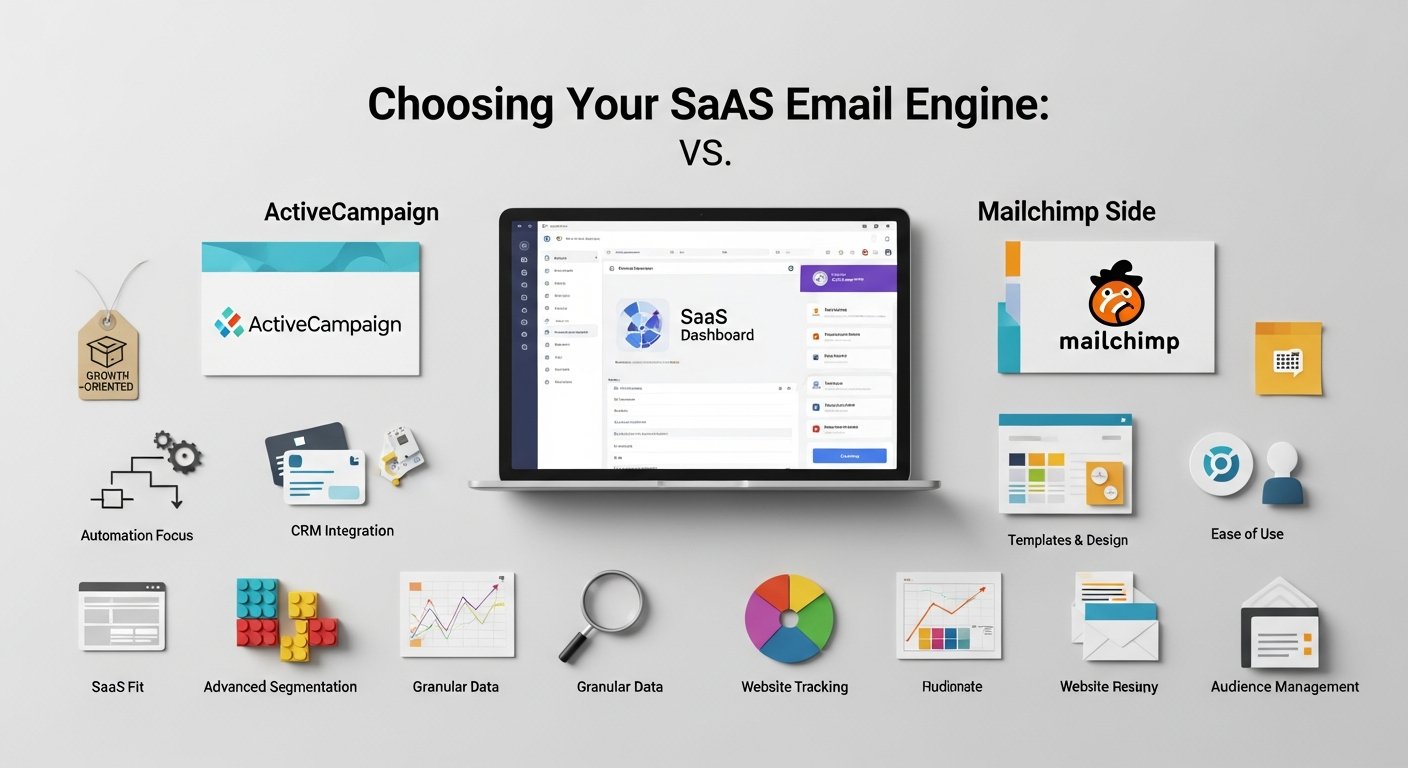
For SaaS businesses, marketing automation isn’t a luxury; it’s a necessity. From trial sign-up to feature adoption, subscription renewal, and churn prevention, automated workflows ensure that users receive timely, relevant communications without manual intervention. This is where the distinction between ActiveCampaign and Mailchimp becomes most pronounced.
[INLINE IMAGE 1: place after second H2 | alt=”activecampaign vs mailchimp for saas concept illustration”]
ActiveCampaign’s Automation Prowess for SaaS
ActiveCampaign is often lauded as one of the most powerful marketing automation platforms on the market, a reputation it has earned through its incredibly flexible and robust automation builder. For SaaS companies, its capabilities are transformative:
- Visual Automation Builder: ActiveCampaign’s drag-and-drop automation builder is a sophisticated canvas where you can design complex workflows with ease. You can incorporate multiple entry points, conditional logic (if/then statements), split testing within automations, goals, and webhooks to connect with virtually any other system.
- Behavioral Triggers: This is a game-changer for SaaS. Automations can be triggered not just by email opens or clicks, but by specific actions users take on your website or within your application. Think: “User viewed pricing page but didn’t sign up,” “User completed onboarding step 1 but not step 2,” “User hasn’t logged in for 7 days,” or “User interacted with a specific feature X times.”
- Site & Event Tracking: ActiveCampaign offers robust site tracking, allowing you to monitor page visits and custom events. This data is invaluable for personalizing follow-up sequences, identifying power users, and detecting potential churn signals.
- Lead Scoring & Deal Stages: Integrated lead scoring automatically ranks prospects based on engagement and demographic data. Automations can then move leads through different sales stages in the CRM, assign them to sales reps, or trigger specific sales tasks.
- Advanced Segmentation within Automations: You can apply and remove tags, update custom fields, and segment contacts dynamically based on their journey within an automation. This allows for highly nuanced paths and personalized content delivery.
- SMS & Site Messages: Beyond email, ActiveCampaign can incorporate SMS messages and on-site chat messages directly into your automation workflows, enabling multi-channel communication strategies.
For a SaaS company looking to meticulously map out and automate every touchpoint of their customer journey, from free trial to enterprise client, ActiveCampaign provides the depth and flexibility to achieve it. This level of automation is critical for driving product adoption, reducing time-to-value, and minimizing churn.
Mailchimp’s Approach to Automation for SaaS
Mailchimp has significantly evolved its automation capabilities over the years, moving beyond basic autoresponders to offer more sophisticated options. However, its approach remains more streamlined and less complex than ActiveCampaign’s, catering to a different segment of the market.
- Pre-built Automation Journeys: Mailchimp offers a library of pre-built “Customer Journeys” for common scenarios like welcome series, abandoned cart reminders (for e-commerce, but adaptable), birthday messages, and product recommendations. While customizable, they tend to follow more linear paths.
- Basic Behavioral Triggers: You can trigger automations based on specific events like an email signup, a purchase (if integrated with an e-commerce platform), or certain website activity (e.g., visiting a specific URL). However, the depth of custom event tracking is more limited compared to ActiveCampaign.
- Email-Centric Workflows: Mailchimp’s automations are primarily email-focused. While it integrates with landing pages and forms, complex multi-channel sequences involving SMS or integrated CRM tasks are not its strong suit.
- Audience Segmentation: You can segment your audience based on various criteria (e.g., signup source, email engagement, basic demographic data) and use these segments to trigger automations or personalize content. The depth of segmentation, especially behavioral, is less granular than ActiveCampaign.
- Transactional Email (Mandrill): For critical operational emails (password resets, invoice notifications, signup confirmations), Mailchimp offers Mandrill as a separate, powerful transactional email API. While essential for SaaS, its integration with general marketing automations is not as seamless as ActiveCampaign’s unified approach.
Mailchimp’s automation is excellent for SaaS startups that need to manage foundational email sequences efficiently – welcoming new users, nurturing prospects with a series of educational emails, or sending re-engagement campaigns. It’s user-friendly and effective for common use cases, but it may hit limitations when attempting to build highly intricate, branching, and data-driven customer journeys specific to complex SaaS product usage.
In essence, ActiveCampaign provides the scalpel for precision automation in SaaS, allowing for deep customization and behavioral responsiveness. Mailchimp offers a reliable, user-friendly hammer for the most common automation nails, ideal for getting started quickly and effectively without overwhelming complexity.
CRM and Sales Automation for SaaS: Bridging Marketing and Revenue
For SaaS companies, the line between marketing and sales is often blurred. Leads generated by marketing become prospects for sales, and existing customers need nurturing to reduce churn and encourage upsells. A platform that seamlessly integrates CRM and sales automation is invaluable. Here, ActiveCampaign takes a significantly different approach from Mailchimp.
ActiveCampaign’s Integrated CRM and Sales Suite
ActiveCampaign isn’t just a marketing automation platform; it includes a full-fledged CRM designed to help sales teams manage leads, track deals, and automate sales processes. This integrated approach offers immense benefits for SaaS:
- Native CRM: ActiveCampaign features a built-in CRM that allows you to manage contacts, companies, and deal pipelines directly within the platform. Sales reps can see a complete history of every interaction a lead has had with marketing (emails opened, website pages visited, forms submitted).
- Deal Management: You can create and customize multiple sales pipelines, assign deals to specific sales team members, update deal stages, add tasks, and set reminders. This provides a clear overview of your sales funnel.
- Sales Automation: This is a major differentiator. ActiveCampaign allows you to automate sales tasks based on deal stage changes, lead scores, or contact activity. Examples include:
- Automatically sending an internal notification to a sales rep when a lead reaches a high score.
- Assigning a lead to a specific sales person based on their industry or interest.
- Scheduling follow-up tasks for sales reps if a prospect hasn’t responded to an email.
- Triggering a specific email sequence if a deal moves from “Discovery” to “Proposal.”
- Lead Scoring: Beyond just email engagement, ActiveCampaign’s lead scoring can be configured to factor in website visits, feature usage (via integrations or custom events), and demographic data, providing a more accurate assessment of a lead’s readiness.
- Custom Objects (Enterprise Plans): For highly specific SaaS use cases, ActiveCampaign’s enterprise plans offer Custom Objects, allowing you to store and automate based on unique data points relevant to your product (e.g., specific plan types, feature usage statistics, renewal dates from an external billing system). This enables a deeper level of personalization and automation.
- Integrations: While it has a native CRM, ActiveCampaign also integrates deeply with popular third-party CRMs like Salesforce and HubSpot, allowing for flexible workflows if you already have an established sales stack.
For SaaS companies with a dedicated sales team, or even those where founders handle initial sales, ActiveCampaign’s integrated CRM and sales automation provide a unified platform to manage the entire prospect-to-customer journey, ensuring no lead falls through the cracks and every sales interaction is timely and informed.
Mailchimp’s Approach to CRM and Sales
Mailchimp’s philosophy leans more towards “Audience Management” than a traditional CRM. While it has expanded its capabilities, it does not offer a native, full-featured sales CRM comparable to ActiveCampaign.
- Audience Management: Mailchimp excels at managing your contacts (“Audience”). You can segment contacts based on tags, groups, and basic demographic data. It provides a good overview of who your subscribers are and their engagement with your emails.
- Contact Profiles: Each contact has a profile where you can see their activity, email history, and any custom fields you’ve added. This provides a limited form of customer intelligence.
- No Native Sales Pipelines: Mailchimp does not have built-in sales pipelines, deal stages, or sales task management. It’s not designed to track individual deals or manage a sales team’s workflow.
- Basic Lead Capture: It offers robust form builders and landing page capabilities to capture leads, and these leads automatically feed into your Mailchimp audience.
- Third-Party Integrations: To bridge this gap, Mailchimp relies heavily on integrations with third-party CRMs like Salesforce, HubSpot, or various smaller sales tools. While these integrations can work, they often require more manual setup or Zapier-based workflows and don’t offer the seamless, unified experience of ActiveCampaign’s native solution.
- E-commerce Focus: Many of Mailchimp’s “CRM-like” features, particularly its purchase data tracking and abandoned cart automations, are geared towards e-commerce businesses. While some principles can be adapted for SaaS (e.g., tracking a “purchase” as a subscription signup), it’s not as inherently aligned with SaaS sales cycles.
For a bootstrapped SaaS startup where the founders handle early sales and customer success, Mailchimp’s audience management might suffice for keeping track of initial leads and communications. However, as the business scales and a dedicated sales function emerges, its lack of a native CRM and sales automation will likely become a significant bottleneck, necessitating the adoption of a separate CRM solution and additional integration overhead.
Therefore, if your SaaS business requires tight coordination between marketing and sales, with automated lead hand-offs, deal tracking, and sales task automation, ActiveCampaign offers a far more complete and integrated solution. Mailchimp serves primarily as a marketing communication platform that can capture leads, but it’s not built to manage the sales process itself.
Email Marketing Capabilities: Deliverability, Design, and Personalization
At the core of both ActiveCampaign and Mailchimp lies their email marketing functionality. While both can send emails, the nuances in their capabilities – especially concerning design flexibility, personalization at scale, and deliverability – are crucial for SaaS companies seeking to build strong user relationships and drive engagement.
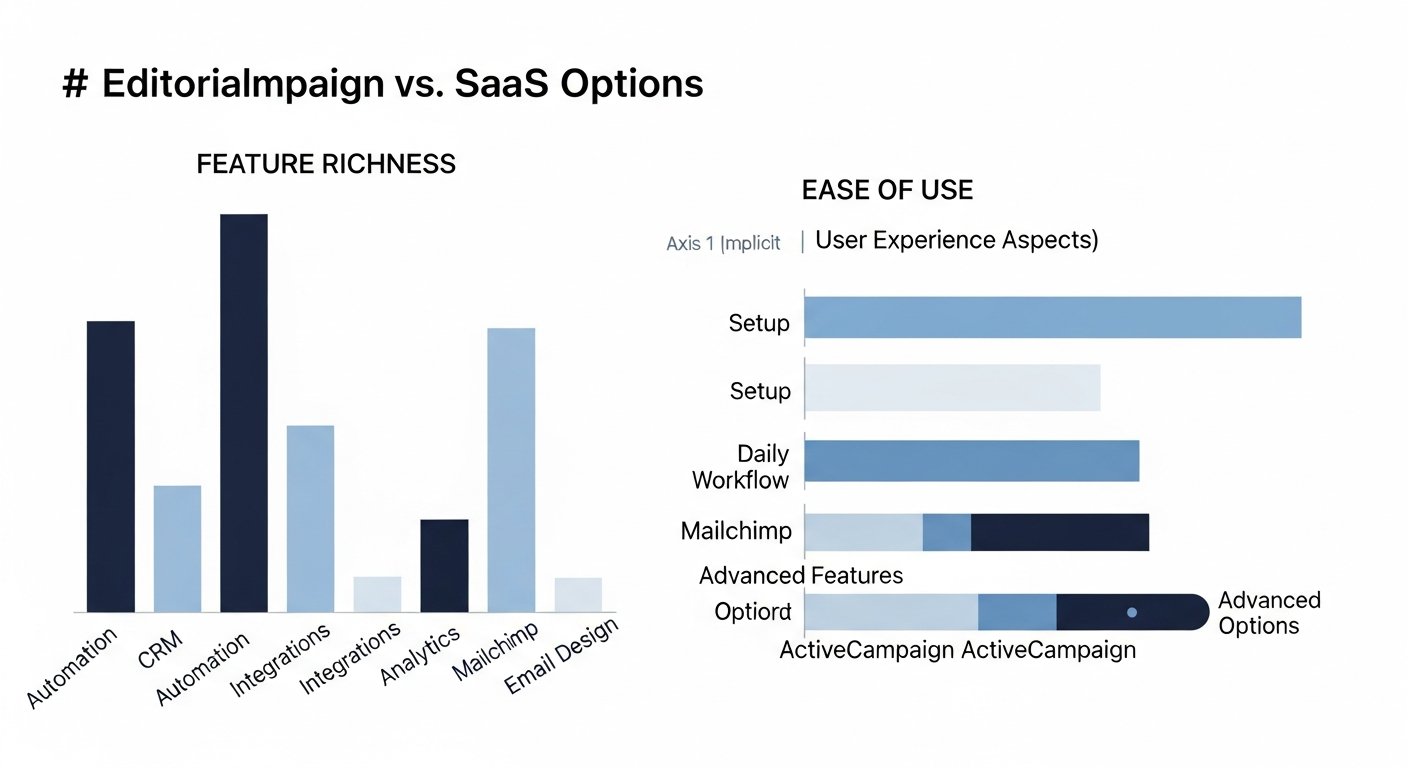
[INLINE IMAGE 2: place after fourth H2 | alt=”activecampaign vs mailchimp for saas comparison illustration”]
Mailchimp’s Email Marketing Strengths
Mailchimp built its reputation on excellent email marketing, and it continues to excel in this domain, particularly for its user-friendliness and design capabilities:
- Intuitive Drag-and-Drop Builder: Mailchimp’s email builder is arguably one of the easiest and most enjoyable to use. It offers a wide range of pre-designed templates, customizable blocks, and responsive design features, making it simple for anyone to create professional-looking emails quickly.
- Template Library: A vast and visually appealing template library caters to various campaign types, helping SaaS companies get started without needing a dedicated designer.
- A/B Testing: Mailchimp offers robust A/B testing capabilities for subject lines, content, send times, and even full email designs, allowing you to optimize performance effectively.
- Segmentation for Campaigns: While not as deep as ActiveCampaign’s, Mailchimp provides good segmentation options for targeting specific audience groups with particular campaigns based on tags, groups, and basic contact data.
- Deliverability Reputation: Mailchimp has historically maintained a strong sender reputation, which contributes to high deliverability rates, ensuring your emails land in inboxes rather than spam folders. This is critical for onboarding and transactional emails in SaaS.
- Content Studio: A centralized hub for storing images, files, and brand assets, streamlining the email creation process.
- Inbox Previews: Tools to preview how your emails will look across different email clients and devices.
Mailchimp is an excellent choice for SaaS businesses prioritizing beautiful, easy-to-create emails, a strong focus on audience engagement, and robust A/B testing for campaign optimization. Its deliverability reputation is also a significant advantage.
ActiveCampaign’s Email Marketing Strengths
ActiveCampaign’s email marketing capabilities are equally strong, but they are deeply intertwined with its automation and personalization features, making them particularly potent for SaaS:
- Flexible Email Builder: ActiveCampaign offers a powerful drag-and-drop email builder that is highly customizable. While perhaps not as aesthetically polished out-of-the-box as Mailchimp for absolute beginners, it provides immense flexibility for dynamic content.
- Conditional Content: This is a massive advantage for SaaS. You can display different blocks of content, images, or calls-to-action within a single email based on a subscriber’s tags, custom fields, segments, or even their behavior. For example, a single onboarding email could show different tips depending on whether a user has completed a specific setup step.
- Predictive Sending: ActiveCampaign uses machine learning to predict the optimal time to send an email to each individual subscriber for maximum engagement. This can significantly boost open and click-through rates.
- Deep Personalization: Leverage all the data stored in the CRM – custom fields, tags, deal stages, site visits, event data – to hyper-personalize email content. This moves beyond just “Hello [First Name]” to “Here are features for your [Industry] business plan” or “Since you used [Feature X], you might like [Feature Y].”
- Automation-Driven Campaigns: Every email in ActiveCampaign can be part of an automation. This means emails are sent contextually, triggered by user actions or specific events, rather than just broadcast at a set time.
- SMS Integration: As mentioned, SMS can be seamlessly integrated into email campaigns and automations, providing an additional critical channel for urgent updates or re-engagement.
- Email Split Testing: Comprehensive A/B testing allows you to test various elements within your emails and automations.
ActiveCampaign’s email marketing shines brightest when combined with its automation and CRM capabilities. It allows SaaS companies to move beyond batch-and-blast emails to truly individualized, behavior-driven communications that are crucial for complex user journeys and product adoption.
While Mailchimp excels in making visually appealing emails easy to create, ActiveCampaign empowers SaaS marketers to create incredibly intelligent and personalized email flows that adapt to each user’s unique journey within the product and sales funnel. The choice here depends on whether your priority is beautiful simplicity or dynamic, data-driven personalization at scale.
Integrations and Scalability: Growing with Your SaaS Business
As a SaaS business scales, its technology stack often grows in complexity. The ability of your marketing automation platform to integrate seamlessly with other tools – from CRMs and payment gateways to customer support platforms and analytics tools – is paramount. Moreover, the platform must be able to handle increasing contact volumes, complex data, and growing automation needs without breaking the bank or requiring a complete overhaul. This section examines ActiveCampaign vs Mailchimp for SaaS in terms of their integration capabilities and overall scalability.
ActiveCampaign: Built for a Connected Ecosystem and Enterprise Scale
ActiveCampaign is designed with integrations and scalability at its core, making it a robust choice for growing SaaS businesses:
- Extensive Native Integrations: ActiveCampaign boasts hundreds of direct integrations with popular business tools. This includes major CRMs (Salesforce, HubSpot), e-commerce platforms (Shopify, WooCommerce), payment processors (Stripe, PayPal), webinar platforms (Zoom, GoToWebinar), lead generation tools, and more. For SaaS, integrations with tools like Intercom, Calendly, Zapier, and even custom APIs are critical for a unified customer view.
- Zapier Integration: Its deep integration with Zapier unlocks connections to thousands of additional applications, allowing for virtually limitless custom workflows. If a native integration doesn’t exist, Zapier often provides a bridge.
- Robust API: For developers, ActiveCampaign offers a comprehensive and well-documented API. This is crucial for SaaS companies that need to connect their product directly to ActiveCampaign to send custom events, update user data, or trigger specific automations based on in-app behavior. This level of programmatic control is a significant advantage.
- Webhooks: Automations can easily send data to or receive data from external systems using webhooks, further extending its integration capabilities.
- Custom Objects (Enterprise): As mentioned previously, the ability to create and manage custom objects in enterprise plans means ActiveCampaign can truly become the central hub for all customer-related data, even highly specific SaaS metrics.
- Scalability in Features and Performance: ActiveCampaign’s infrastructure is built to handle millions of contacts and complex automation workflows without performance degradation. Its feature set scales from basic to highly advanced, meaning a SaaS company can start with what they need and unlock more sophisticated features as they grow.
- Multi-User Management: Advanced user permissions and team management features ensure that as your team grows, you can control access and workflows effectively.
ActiveCampaign provides a future-proof foundation for SaaS companies that anticipate rapid growth and will require a tightly integrated, data-rich marketing and sales ecosystem. Its API and webhook capabilities are especially valuable for product-led growth strategies.
Discover best practices for marketing automation to supercharge your SaaS growth.
Mailchimp: Expanding Ecosystem with Ease-of-Use Integrations
Mailchimp has significantly expanded its integration ecosystem, moving beyond its email-centric origins. It now offers a respectable array of integrations, though its focus and depth often differ from ActiveCampaign:
- Growing Native Integrations: Mailchimp offers a good number of direct integrations, particularly with e-commerce platforms (Shopify, BigCommerce), social media networks, and website builders (WordPress). It also connects with popular productivity and lead generation tools.
- Zapier Support: Like ActiveCampaign, Mailchimp integrates with Zapier, allowing it to connect with thousands of other applications. This helps bridge gaps in native integrations, though complex multi-step Zaps can add costs and complexity.
- API Access: Mailchimp also provides an API for developers, enabling custom connections. While robust for email and audience management, its API might not offer the same depth of control over automation workflows or CRM data as ActiveCampaign’s for highly customized SaaS product integrations.
- Mandrill for Transactional Email: For high-volume transactional emails (e.g., password resets, notifications), Mailchimp offers Mandrill as a separate service. While powerful, managing it separately can add a layer of complexity compared to ActiveCampaign’s more unified approach to sending.
- Scalability in Contacts: Mailchimp can handle large numbers of contacts, and its pricing scales accordingly. For sending large volumes of emails, it’s a reliable platform.
- Feature Set Growth: Mailchimp has continuously added features like landing pages, website builders, and basic CRM-like functionalities, making it more of an all-in-one marketing platform for smaller businesses.
Mailchimp’s integrations are generally geared towards ease of setup and common use cases. For SaaS businesses primarily focused on email communication and managing a growing audience, it scales well in terms of contact volume and campaign sending. However, for deep product integrations, highly customized behavioral triggers, or integrating tightly with a sales CRM, it might require more workarounds or a separate tool in your stack compared to ActiveCampaign.
In essence, ActiveCampaign offers a more robust and developer-friendly integration landscape, ideal for SaaS companies needing to build a tightly integrated, data-driven ecosystem around their product. Mailchimp provides a simpler, broader set of integrations that are easier to deploy, suitable for those whose integration needs are less complex or more focused on front-end marketing activities.
Pricing Models: A Cost-Benefit Analysis for SaaS Startups
Pricing is often a critical factor for SaaS startups, where managing burn rate and optimizing ROI are constant priorities. Both ActiveCampaign and Mailchimp employ subscription-based pricing models, but their structures, features included at each tier, and how they scale with contacts and usage differ significantly. Understanding these nuances is key to selecting a platform that aligns with your budget and growth trajectory.
ActiveCampaign’s Tiered Pricing for Deep Features
ActiveCampaign’s pricing is generally perceived as more complex, primarily because it offers a much deeper feature set across multiple tiers. It typically scales based on two main factors:
- Number of Contacts: The primary driver of cost. As your contact list grows, so does your monthly fee.
- Feature Tier: ActiveCampaign offers several plans (Lite, Plus, Professional, Enterprise), each unlocking progressively more advanced features.
Key Considerations for SaaS:
- Lite Plan: This is the most basic plan, offering core email marketing and automation. However, it lacks crucial SaaS features like the native CRM, lead scoring, and advanced integrations. It might be suitable for very early-stage SaaS just needing basic email sequences.
- Plus Plan: This is often the starting point for most serious SaaS businesses. It includes the integrated CRM, lead scoring, SMS marketing, and deeper integrations. This is where ActiveCampaign truly begins to shine for sales and marketing alignment.
- Professional & Enterprise Plans: These plans unlock advanced features like predictive sending, site messages, split automations, attribution, and custom objects. For scaling SaaS companies requiring highly sophisticated customer experience automation and in-depth analytics, these tiers become necessary.
- Value for Features: While ActiveCampaign can appear more expensive at higher contact counts or feature tiers, the cost often reflects the immense value delivered through deep automation, integrated CRM, and advanced personalization. For a SaaS business focused on CLTV, the investment can quickly pay for itself through improved retention and upsells.
- Predictability: The cost scales linearly with contacts, making it predictable, but you need to monitor your contact list closely to avoid unexpected jumps in pricing.
A SaaS company needs to carefully assess which features are truly essential for their current and near-future growth. Starting with a Plus plan is often recommended to leverage ActiveCampaign’s full potential for SaaS-specific challenges.
Mailchimp’s Simpler, Audience-Based Pricing
Mailchimp’s pricing model is generally simpler and more straightforward, primarily driven by the number of contacts in your audience. It also offers tiered plans, but the feature differentiation is perhaps less steep than ActiveCampaign’s until you reach the higher tiers.
Key Considerations for SaaS:
- Free Plan: Mailchimp famously offers a free plan for up to 500 contacts and 1,000 email sends per month. This is an excellent starting point for bootstrapped SaaS startups to test the waters, collect early leads, and send basic newsletters without upfront cost. It includes basic email creation, landing pages, and forms.
- Essentials Plan: This entry-level paid plan removes Mailchimp branding, increases contact and send limits, and unlocks A/B testing and more advanced templates. It’s suitable for SaaS companies needing to send more emails and professionalize their communications.
- Standard Plan: This plan introduces more robust automation (Customer Journeys), predictive segmentation, and better reporting. This is often the sweet spot for growing SaaS businesses that need more than just basic email but aren’t ready for ActiveCampaign’s depth.
- Premium Plan: The highest tier offers advanced segmentation, unlimited seats, phone support, and more comprehensive analytics. This plan starts to approach the complexity of ActiveCampaign but still lacks the integrated CRM and sales automation depth.
- Cost-Effective for Email: For purely email-centric marketing and audience management, Mailchimp often proves more cost-effective, especially at lower contact volumes.
- Transactional Email (Mandrill): Mandrill, Mailchimp’s transactional email service, is a separate paid add-on, billed based on blocks of emails sent. This is an additional cost to factor in for critical SaaS notifications.
Mailchimp is highly attractive for early-stage SaaS due to its free plan and relatively affordable paid tiers for core email marketing. However, as the need for integrated sales, deep behavioral automation, and multi-channel customer journeys grows, the cost of Mailchimp’s higher tiers might approach ActiveCampaign’s without providing the same level of integrated functionality.
Learn how to build an effective SaaS go-to-market strategy.
Here’s a simplified comparison table to illustrate the pricing and feature considerations:
| Feature/Consideration | ActiveCampaign (SaaS-Oriented View) | Mailchimp (SaaS-Oriented View) |
|---|---|---|
| Core Philosophy | CXA, Deep Automation, Integrated CRM | Email Marketing, Audience Management, Ease of Use |
| Pricing Model | Tiered by Contacts & Features (Lite, Plus, Pro, Enterprise) | Tiered by Contacts (Free, Essentials, Standard, Premium) |
| Entry-Level Cost for Key SaaS Features | Typically requires ‘Plus’ plan for CRM & sales automation | Free plan available; ‘Standard’ for robust automation |
| Integrated CRM | Yes, native & robust with sales pipelines | Basic audience management; no native sales CRM |
| Advanced Automation | Highly flexible visual builder, behavioral triggers, SMS | Pre-built journeys, simpler logic, primarily email-focused |
| Transactional Email | Included in main platform (part of sending limits) | Mandrill (separate, paid add-on) |
| Ideal for SaaS at Stage | Growing & mature SaaS with complex funnels & sales teams | Early-stage & SMB SaaS needing strong email comms |
| Scalability | Scales well with complex feature needs & integrations | Scales well for contact volume & email sending |
Ultimately, the “cheaper” option depends on your specific needs. If you need the depth and integration that ActiveCampaign offers for sales and marketing synergy, paying more for a higher tier might save you money in the long run by consolidating tools and improving efficiency. If your current needs are primarily focused on effective email communication and audience management, Mailchimp offers a more budget-friendly entry point.
Ease of Use and Learning Curve: Getting Your Team Productive
Even the most powerful marketing platform is useless if your team can’t figure out how to use it. For SaaS startups, where resources are often stretched thin and time is money, the ease of use and associated learning curve are critical factors. This section compares ActiveCampaign vs Mailchimp for SaaS in terms of their user experience, onboarding, and overall approachability.
Mailchimp: Renowned for User-Friendly Design
Mailchimp has long been celebrated for its intuitive interface and gentle learning curve. It’s often the platform of choice for individuals or small teams new to email marketing and automation, and for good reason:
- Clean and Intuitive UI: Mailchimp’s dashboard is exceptionally clean, well-organized, and visually appealing. Navigation is straightforward, with clear menus and logical flows for creating campaigns, managing audiences, and building basic automations.
- Drag-and-Drop Excellence: Its email and landing page builders are among the best in the industry for ease of use. The drag-and-drop functionality is highly responsive, and the options are presented clearly, making it simple to design professional-looking assets without technical expertise.
- Guided Onboarding: Mailchimp typically offers helpful prompts and guided tours for new users, helping them set up their first campaign or audience with minimal friction.
- Simpler Concepts: Because its core offerings are (relatively) less complex than ActiveCampaign’s, the concepts and terminology used are generally easier for beginners to grasp.
- Quick Setup: For basic email marketing, getting a campaign launched or a welcome automation set up in Mailchimp can be incredibly fast, allowing SaaS startups to start engaging their audience almost immediately.
For a SaaS startup where marketing might be handled by a founder or a generalist without deep marketing automation experience, Mailchimp’s user-friendly nature significantly lowers the barrier to entry, enabling quick action and effective communication.
ActiveCampaign: Powerful, with a Steeper but Rewarding Curve
ActiveCampaign, with its extensive feature set and deep customization options, naturally presents a steeper learning curve than Mailchimp. However, this complexity is a trade-off for its immense power and flexibility.
- Feature-Rich Interface: The ActiveCampaign dashboard offers a vast array of options for automations, CRM, campaigns, and integrations. This can initially feel overwhelming, especially for new users accustomed to simpler platforms.
- Automation Builder Complexity: While visual and drag-and-drop, the automation builder allows for intricate, branching workflows, conditional logic, and integration with sales processes. Mastering this requires a deeper understanding of marketing automation principles and strategy.
- CRM Integration: Learning to effectively use the integrated CRM, manage deals, and automate sales tasks adds another layer of functionality that requires dedicated learning.
- Strategic Planning Required: To truly leverage ActiveCampaign, a SaaS business needs a clear strategy for its customer lifecycle, lead scoring, and sales process. This strategic thinking is prerequisite to building effective automations, which can take time to map out.
- Initial Setup Investment: Setting up complex automations, custom fields, lead scoring, and integrations takes more time and strategic planning upfront. However, once established, these systems run efficiently.
- Rewarding for the Investment: Despite the initial learning curve, the investment in understanding ActiveCampaign pays off significantly. The platform’s ability to automate complex SaaS customer journeys, personalize at scale, and align marketing with sales can unlock substantial growth and efficiency.
For SaaS companies with dedicated marketing and sales teams, or founders willing to invest the time, ActiveCampaign provides the tools to build incredibly powerful and personalized customer experiences. The learning curve is a gateway to unparalleled customization and strategic control, essential for sophisticated SaaS go-to-market strategies.
In summary, Mailchimp offers immediate gratification with its ease of use, making it perfect for rapid deployment of core email marketing. ActiveCampaign demands more upfront investment in learning and setup, but it rewards that investment with a level of power and customization that is essential for sophisticated SaaS growth, making it a critical asset for building complex, data-driven customer journeys.
Customer Support and Resources: Help When You Need It
Even the most intuitive platforms can present challenges, and for SaaS businesses running critical operations, reliable customer support and comprehensive resources are essential. When comparing ActiveCampaign vs Mailchimp for SaaS, understanding the breadth and quality of their support offerings is as important as comparing features.
ActiveCampaign’s Comprehensive Support and Education
ActiveCampaign places a strong emphasis on providing extensive support and educational resources to help users maximize the platform’s advanced capabilities:
- Multi-Channel Support: ActiveCampaign offers support through various channels, including live chat, email, and (for higher tiers) phone support. Response times are generally good, reflecting their commitment to assisting users with complex automation needs.
- Extensive Knowledge Base: Their help center is robust, featuring a vast library of articles, guides, and tutorials that cover every aspect of the platform. These resources are often detailed and include step-by-step instructions.
- Video Tutorials and Webinars: ActiveCampaign provides a wealth of video content, including tutorial series and regular webinars, which are incredibly helpful for visual learners and for understanding complex automation concepts.
- Active Community Forum: An engaged community forum allows users to ask questions, share tips, and learn from other ActiveCampaign users, fostering a collaborative learning environment.
- One-on-One Training & Migrations: For higher-tier plans, ActiveCampaign often includes one-on-one training sessions and migration services, which can be invaluable for SaaS companies transitioning from another platform or needing expert guidance on setting up complex automations.
- Dedicated Account Manager (Enterprise): Enterprise-level plans typically come with a dedicated account manager, providing personalized support and strategic advice, which is a significant advantage
ActiveCampaign vs Mailchimp for SaaS: The Ultimate 2026 Comparison for Startup Growth
Affiliate disclosure: This article may contain affiliate links. Recommendations are independent and editorially driven.
In the dynamic world of tech startups, where customer acquisition, onboarding, and retention are paramount, choosing the right marketing automation and email marketing platform can be the difference between stagnant growth and explosive success. For SaaS businesses, in particular, the need for sophisticated tools to manage complex customer lifecycles, deliver personalized experiences, and automate sales processes is non-negotiable. Two giants frequently stand out in this arena: ActiveCampaign and Mailchimp.
While both platforms are formidable players in the digital marketing landscape, their philosophies, feature sets, and ideal use cases diverge significantly. This comprehensive guide will dissect ActiveCampaign vs Mailchimp for SaaS companies in 2026, offering an expert perspective on which solution is best equipped to fuel your startup’s go-to-market strategy, streamline operations, and ultimately, drive sustainable growth. We’ll delve into everything from deep-dive automation capabilities and integrated CRM functionalities to email marketing prowess, pricing structures, and scalability, ensuring you have all the insights needed to make an informed decision for your unique business needs.
Understanding the Core Philosophy: Automation Power vs. Email Simplicity for SaaS
Before diving into a feature-by-feature comparison, it’s crucial for SaaS founders and marketers to grasp the foundational philosophies underpinning ActiveCampaign and Mailchimp. This understanding sets the stage for appreciating their respective strengths and weaknesses when applied to the specific demands of a software-as-a-service business model.
ActiveCampaign: The Automation & CRM Powerhouse
ActiveCampaign positions itself primarily as a Customer Experience Automation (CXA) platform. Its core philosophy revolves around delivering highly personalized, automated experiences across the entire customer lifecycle – from lead generation and nurturing to onboarding, retention, and even win-back strategies. For a SaaS business, this translates into a powerful suite of tools designed to:
- Automate Complex Workflows: Go beyond simple autoresponders to build intricate customer journeys based on user behavior, subscription status, feature usage, and more.
- Integrate Sales and Marketing: Offer a native CRM that tightly integrates with marketing efforts, allowing for seamless lead hand-off and coordinated sales outreach.
- Personalize at Scale: Utilize deep segmentation capabilities, conditional content, and predictive sending to make every interaction feel bespoke, even with a massive user base.
- Drive Customer Lifetime Value (CLTV): Focus on not just acquiring, but also engaging, retaining, and upselling customers throughout their subscription journey.
ActiveCampaign is built for businesses that require granular control over their customer interactions and are prepared to invest time in setting up sophisticated automation sequences to maximize CLTV.
Mailchimp: The Email Marketing & Audience Builder for Startups
Mailchimp, on the other hand, began its journey as a pure-play email marketing service and, while it has expanded considerably, its foundational strength and core philosophy remain rooted in ease-of-use email marketing and audience management. For SaaS companies, especially those in their early stages, Mailchimp offers:
- Intuitive Email Creation: A renowned drag-and-drop email builder that makes creating visually appealing campaigns simple and quick, even for non-designers.
- Audience-First Approach: Strong tools for segmenting contacts and managing audience lists, albeit with less depth than ActiveCampaign’s CRM.
- Integrated Marketing Hub: Expansions into landing pages, websites, social media posting, and basic automation, aiming to provide an all-in-one marketing solution for small to medium-sized businesses.
- User-Friendly Interface: A famously approachable UI/UX that lowers the barrier to entry for marketing automation, making it ideal for teams with limited technical resources.
Mailchimp is often the go-to for SaaS startups prioritizing straightforward email communication, brand building, and a quick launch without the immediate need for highly complex, multi-channel automation or integrated sales pipelines.
The choice between these two, therefore, often hinges on whether your SaaS prioritizes deep, intricate automation and an integrated CRM (ActiveCampaign) or a user-friendly, email-centric platform to get your marketing efforts off the ground swiftly (Mailchimp).
Advanced Marketing Automation: The Heartbeat of SaaS Growth
For SaaS businesses, marketing automation isn’t a luxury; it’s a necessity. From trial sign-up to feature adoption, subscription renewal, and churn prevention, automated workflows ensure that users receive timely, relevant communications without manual intervention. This is where the distinction between ActiveCampaign and Mailchimp becomes most pronounced.
[INLINE IMAGE 1: place after second H2 | alt=”activecampaign vs mailchimp for saas concept illustration”]
ActiveCampaign’s Automation Prowess for SaaS
ActiveCampaign is often lauded as one of the most powerful marketing automation platforms on the market, a reputation it has earned through its incredibly flexible and robust automation builder. For SaaS companies, its capabilities are transformative:
- Visual Automation Builder: ActiveCampaign’s drag-and-drop automation builder is a sophisticated canvas where you can design complex workflows with ease. You can incorporate multiple entry points, conditional logic (if/then statements), split testing within automations, goals, and webhooks to connect with virtually any other system.
- Behavioral Triggers: This is a game-changer for SaaS. Automations can be triggered not just by email opens or clicks, but by specific actions users take on your website or within your application. Think: “User viewed pricing page but didn’t sign up,” “User completed onboarding step 1 but not step 2,” “User hasn’t logged in for 7 days,” or “User interacted with a specific feature X times.”
- Site & Event Tracking: ActiveCampaign offers robust site tracking, allowing you to monitor page visits and custom events. This data is invaluable for personalizing follow-up sequences, identifying power users, and detecting potential churn signals.
- Lead Scoring & Deal Stages: Integrated lead scoring automatically ranks prospects based on engagement and demographic data. Automations can then move leads through different sales stages in the CRM, assign them to sales reps, or trigger specific sales tasks.
- Advanced Segmentation within Automations: You can apply and remove tags, update custom fields, and segment contacts dynamically based on their journey within an automation. This allows for highly nuanced paths and personalized content delivery.
- SMS & Site Messages: Beyond email, ActiveCampaign can incorporate SMS messages and on-site chat messages directly into your automation workflows, enabling multi-channel communication strategies.
For a SaaS company looking to meticulously map out and automate every touchpoint of their customer journey, from free trial to enterprise client, ActiveCampaign provides the depth and flexibility to achieve it. This level of automation is critical for driving product adoption, reducing time-to-value, and minimizing churn.
Mailchimp’s Approach to Automation for SaaS
Mailchimp has significantly evolved its automation capabilities over the years, moving beyond basic autoresponders to offer more sophisticated options. However, its approach remains more streamlined and less complex than ActiveCampaign’s, catering to a different segment of the market.
- Pre-built Automation Journeys: Mailchimp offers a library of pre-built “Customer Journeys” for common scenarios like welcome series, abandoned cart reminders (for e-commerce, but adaptable), birthday messages, and product recommendations. While customizable, they tend to follow more linear paths.
- Basic Behavioral Triggers: You can trigger automations based on specific events like an email signup, a purchase (if integrated with an e-commerce platform), or certain website activity (e.g., visiting a specific URL). However, the depth of custom event tracking is more limited compared to ActiveCampaign.
- Email-Centric Workflows: Mailchimp’s automations are primarily email-focused. While it integrates with landing pages and forms, complex multi-channel sequences involving SMS or integrated CRM tasks are not its strong suit.
- Audience Segmentation: You can segment your audience based on various criteria (e.g., signup source, email engagement, basic demographic data) and use these segments to trigger automations or personalize content. The depth of segmentation, especially behavioral, is less granular than ActiveCampaign.
- Transactional Email (Mandrill): For critical operational emails (password resets, invoice notifications, signup confirmations), Mailchimp offers Mandrill as a separate, powerful transactional email API. While essential for SaaS, its integration with general marketing automations is not as seamless as ActiveCampaign’s unified approach.
Mailchimp’s automation is excellent for SaaS startups that need to manage foundational email sequences efficiently – welcoming new users, nurturing prospects with a series of educational emails, or sending re-engagement campaigns. It’s user-friendly and effective for common use cases, but it may hit limitations when attempting to build highly intricate, branching, and data-driven customer journeys specific to complex SaaS product usage.
In essence, ActiveCampaign provides the scalpel for precision automation in SaaS, allowing for deep customization and behavioral responsiveness. Mailchimp offers a reliable, user-friendly hammer for the most common automation nails, ideal for getting started quickly and effectively without overwhelming complexity.
CRM and Sales Automation for SaaS: Bridging Marketing and Revenue
For SaaS companies, the line between marketing and sales is often blurred. Leads generated by marketing become prospects for sales, and existing customers need nurturing to reduce churn and encourage upsells. A platform that seamlessly integrates CRM and sales automation is invaluable. Here, ActiveCampaign takes a significantly different approach from Mailchimp.
ActiveCampaign’s Integrated CRM and Sales Suite
ActiveCampaign isn’t just a marketing automation platform; it includes a full-fledged CRM designed to help sales teams manage leads, track deals, and automate sales processes. This integrated approach offers immense benefits for SaaS:
- Native CRM: ActiveCampaign features a built-in CRM that allows you to manage contacts, companies, and deal pipelines directly within the platform. Sales reps can see a complete history of every interaction a lead has had with marketing (emails opened, website pages visited, forms submitted).
- Deal Management: You can create and customize multiple sales pipelines, assign deals to specific sales team members, update deal stages, add tasks, and set reminders. This provides a clear overview of your sales funnel.
- Sales Automation: This is a major differentiator. ActiveCampaign allows you to automate sales tasks based on deal stage changes, lead scores, or contact activity. Examples include:
- Automatically sending an internal notification to a sales rep when a lead reaches a high score.
- Assigning a lead to a specific sales person based on their industry or interest.
- Scheduling follow-up tasks for sales reps if a prospect hasn’t responded to an email.
- Triggering a specific email sequence if a deal moves from “Discovery” to “Proposal.”
- Lead Scoring: Beyond just email engagement, ActiveCampaign’s lead scoring can be configured to factor in website visits, feature usage (via integrations or custom events), and demographic data, providing a more accurate assessment of a lead’s readiness.
- Custom Objects (Enterprise Plans): For highly specific SaaS use cases, ActiveCampaign’s enterprise plans offer Custom Objects, allowing you to store and automate based on unique data points relevant to your product (e.g., specific plan types, feature usage statistics, renewal dates from an external billing system). This enables a deeper level of personalization and automation.
- Integrations: While it has a native CRM, ActiveCampaign also integrates deeply with popular third-party CRMs like Salesforce and HubSpot, allowing for flexible workflows if you already have an established sales stack.
For SaaS companies with a dedicated sales team, or even those where founders handle initial sales, ActiveCampaign’s integrated CRM and sales automation provide a unified platform to manage the entire prospect-to-customer journey, ensuring no lead falls through the cracks and every sales interaction is timely and informed.
Mailchimp’s Approach to CRM and Sales
Mailchimp’s philosophy leans more towards “Audience Management” than a traditional CRM. While it has expanded its capabilities, it does not offer a native, full-featured sales CRM comparable to ActiveCampaign.
- Audience Management: Mailchimp excels at managing your contacts (“Audience”). You can segment contacts based on tags, groups, and basic demographic data. It provides a good overview of who your subscribers are and their engagement with your emails.
- Contact Profiles: Each contact has a profile where you can see their activity, email history, and any custom fields you’ve added. This provides a limited form of customer intelligence.
- No Native Sales Pipelines: Mailchimp does not have built-in sales pipelines, deal stages, or sales task management. It’s not designed to track individual deals or manage a sales team’s workflow.
- Basic Lead Capture: It offers robust form builders and landing page capabilities to capture leads, and these leads automatically feed into your Mailchimp audience.
- Third-Party Integrations: To bridge this gap, Mailchimp relies heavily on integrations with third-party CRMs like Salesforce, HubSpot, or various smaller sales tools. While these integrations can work, they often require more manual setup or Zapier-based workflows and don’t offer the seamless, unified experience of ActiveCampaign’s native solution.
- E-commerce Focus: Many of Mailchimp’s “CRM-like” features, particularly its purchase data tracking and abandoned cart automations, are geared towards e-commerce businesses. While some principles can be adapted for SaaS (e.g., tracking a “purchase” as a subscription signup), it’s not as inherently aligned with SaaS sales cycles.
For a bootstrapped SaaS startup where the founders handle early sales and customer success, Mailchimp’s audience management might suffice for keeping track of initial leads and communications. However, as the business scales and a dedicated sales function emerges, its lack of a native CRM and sales automation will likely become a significant bottleneck, necessitating the adoption of a separate CRM solution and additional integration overhead.
Therefore, if your SaaS business requires tight coordination between marketing and sales, with automated lead hand-offs, deal tracking, and sales task automation, ActiveCampaign offers a far more complete and integrated solution. Mailchimp serves primarily as a marketing communication platform that can capture leads, but it’s not built to manage the sales process itself.
Email Marketing Capabilities: Deliverability, Design, and Personalization
At the core of both ActiveCampaign and Mailchimp lies their email marketing functionality. While both can send emails, the nuances in their capabilities – especially concerning design flexibility, personalization at scale, and deliverability – are crucial for SaaS companies seeking to build strong user relationships and drive engagement.
[INLINE IMAGE 2: place after fourth H2 | alt=”activecampaign vs mailchimp for saas comparison illustration”]
Mailchimp’s Email Marketing Strengths
Mailchimp built its reputation on excellent email marketing, and it continues to excel in this domain, particularly for its user-friendliness and design capabilities:
- Intuitive Drag-and-Drop Builder: Mailchimp’s email builder is arguably one of the easiest and most enjoyable to use. It offers a wide range of pre-designed templates, customizable blocks, and responsive design features, making it simple for anyone to create professional-looking emails quickly.
- Template Library: A vast and visually appealing template library caters to various campaign types, helping SaaS companies get started without needing a dedicated designer.
- A/B Testing: Mailchimp offers robust A/B testing capabilities for subject lines, content, send times, and even full email designs, allowing you to optimize performance effectively.
- Segmentation for Campaigns: While not as deep as ActiveCampaign’s, Mailchimp provides good segmentation options for targeting specific audience groups with particular campaigns based on tags, groups, and basic contact data.
- Deliverability Reputation: Mailchimp has historically maintained a strong sender reputation, which contributes to high deliverability rates, ensuring your emails land in inboxes rather than spam folders. This is critical for onboarding and transactional emails in SaaS.
- Content Studio: A centralized hub for storing images, files, and brand assets, streamlining the email creation process.
- Inbox Previews: Tools to preview how your emails will look across different email clients and devices.
Mailchimp is an excellent choice for SaaS businesses prioritizing beautiful, easy-to-create emails, a strong focus on audience engagement, and robust A/B testing for campaign optimization. Its deliverability reputation is also a significant advantage.
ActiveCampaign’s Email Marketing Strengths
ActiveCampaign’s email marketing capabilities are equally strong, but they are deeply intertwined with its automation and personalization features, making them particularly potent for SaaS:
- Flexible Email Builder: ActiveCampaign offers a powerful drag-and-drop email builder that is highly customizable. While perhaps not as aesthetically polished out-of-the-box as Mailchimp for absolute beginners, it provides immense flexibility for dynamic content.
- Conditional Content: This is a massive advantage for SaaS. You can display different blocks of content, images, or calls-to-action within a single email based on a subscriber’s tags, custom fields, segments, or even their behavior. For example, a single onboarding email could show different tips depending on whether a user has completed a specific setup step.
- Predictive Sending: ActiveCampaign uses machine learning to predict the optimal time to send an email to each individual subscriber for maximum engagement. This can significantly boost open and click-through rates.
- Deep Personalization: Leverage all the data stored in the CRM – custom fields, tags, deal stages, site visits, event data – to hyper-personalize email content. This moves beyond just “Hello [First Name]” to “Here are features for your [Industry] business plan” or “Since you used [Feature X], you might like [Feature Y].”
- Automation-Driven Campaigns: Every email in ActiveCampaign can be part of an automation. This means emails are sent contextually, triggered by user actions or specific events, rather than just broadcast at a set time.
- SMS Integration: As mentioned, SMS can be seamlessly integrated into email campaigns and automations, providing an additional critical channel for urgent updates or re-engagement.
- Email Split Testing: Comprehensive A/B testing allows you to test various elements within your emails and automations.
ActiveCampaign’s email marketing shines brightest when combined with its automation and CRM capabilities. It allows SaaS companies to move beyond batch-and-blast emails to truly individualized, behavior-driven communications that are crucial for complex user journeys and product adoption.
While Mailchimp excels in making visually appealing emails easy to create, ActiveCampaign empowers SaaS marketers to create incredibly intelligent and personalized email flows that adapt to each user’s unique journey within the product and sales funnel. The choice here depends on whether your priority is beautiful simplicity or dynamic, data-driven personalization at scale.
Integrations and Scalability: Growing with Your SaaS Business
As a SaaS business scales, its technology stack often grows in complexity. The ability of your marketing automation platform to integrate seamlessly with other tools – from CRMs and payment gateways to customer support platforms and analytics tools – is paramount. Moreover, the platform must be able to handle increasing contact volumes, complex data, and growing automation needs without breaking the bank or requiring a complete overhaul. This section examines ActiveCampaign vs Mailchimp for SaaS in terms of their integration capabilities and overall scalability.
ActiveCampaign: Built for a Connected Ecosystem and Enterprise Scale
ActiveCampaign is designed with integrations and scalability at its core, making it a robust choice for growing SaaS businesses:
- Extensive Native Integrations: ActiveCampaign boasts hundreds of direct integrations with popular business tools. This includes major CRMs (Salesforce, HubSpot), e-commerce platforms (Shopify, WooCommerce), payment processors (Stripe, PayPal), webinar platforms (Zoom, GoToWebinar), lead generation tools, and more. For SaaS, integrations with tools like Intercom, Calendly, Zapier, and even custom APIs are critical for a unified customer view.
- Zapier Integration: Its deep integration with Zapier unlocks connections to thousands of additional applications, allowing for virtually limitless custom workflows. If a native integration doesn’t exist, Zapier often provides a bridge.
- Robust API: For developers, ActiveCampaign offers a comprehensive and well-documented API. This is crucial for SaaS companies that need to connect their product directly to ActiveCampaign to send custom events, update user data, or trigger specific automations based on in-app behavior. This level of programmatic control is a significant advantage.
- Webhooks: Automations can easily send data to or receive data from external systems using webhooks, further extending its integration capabilities.
- Custom Objects (Enterprise): As mentioned previously, the ability to create and manage custom objects in enterprise plans means ActiveCampaign can truly become the central hub for all customer-related data, even highly specific SaaS metrics.
- Scalability in Features and Performance: ActiveCampaign’s infrastructure is built to handle millions of contacts and complex automation workflows without performance degradation. Its feature set scales from basic to highly advanced, meaning a SaaS company can start with what they need and unlock more sophisticated features as they grow.
- Multi-User Management: Advanced user permissions and team management features ensure that as your team grows, you can control access and workflows effectively.
ActiveCampaign provides a future-proof foundation for SaaS companies that anticipate rapid growth and will require a tightly integrated, data-rich marketing and sales ecosystem. Its API and webhook capabilities are especially valuable for product-led growth strategies.
Discover best practices for marketing automation to supercharge your SaaS growth.
Mailchimp: Expanding Ecosystem with Ease-of-Use Integrations
Mailchimp has significantly expanded its integration ecosystem, moving beyond its email-centric origins. It now offers a respectable array of integrations, though its focus and depth often differ from ActiveCampaign:
- Growing Native Integrations: Mailchimp offers a good number of direct integrations, particularly with e-commerce platforms (Shopify, BigCommerce), social media networks, and website builders (WordPress). It also connects with popular productivity and lead generation tools.
- Zapier Support: Like ActiveCampaign, Mailchimp integrates with Zapier, allowing it to connect with thousands of other applications. This helps bridge gaps in native integrations, though complex multi-step Zaps can add costs and complexity.
- API Access: Mailchimp also provides an API for developers, enabling custom connections. While robust for email and audience management, its API might not offer the same depth of control over automation workflows or CRM data as ActiveCampaign’s for highly customized SaaS product integrations.
- Mandrill for Transactional Email: For high-volume transactional emails (e.g., password resets, notifications), Mailchimp offers Mandrill as a separate service. While powerful, managing it separately can add a layer of complexity compared to ActiveCampaign’s more unified approach to sending.
- Scalability in Contacts: Mailchimp can handle large numbers of contacts, and its pricing scales accordingly. For sending large volumes of emails, it’s a reliable platform.
- Feature Set Growth: Mailchimp has continuously added features like landing pages, website builders, and basic CRM-like functionalities, making it more of an all-in-one marketing platform for smaller businesses.
Mailchimp’s integrations are generally geared towards ease of setup and common use cases. For SaaS businesses primarily focused on email communication and managing a growing audience, it scales well in terms of contact volume and campaign sending. However, for deep product integrations, highly customized behavioral triggers, or integrating tightly with a sales CRM, it might require more workarounds or a separate tool in your stack compared to ActiveCampaign.
In essence, ActiveCampaign offers a more robust and developer-friendly integration landscape, ideal for SaaS companies needing to build a tightly integrated, data-driven ecosystem around their product. Mailchimp provides a simpler, broader set of integrations that are easier to deploy, suitable for those whose integration needs are less complex or more focused on front-end marketing activities.
Pricing Models: A Cost-Benefit Analysis for SaaS Startups
Pricing is often a critical factor for SaaS startups, where managing burn rate and optimizing ROI are constant priorities. Both ActiveCampaign and Mailchimp employ subscription-based pricing models, but their structures, features included at each tier, and how they scale with contacts and usage differ significantly. Understanding these nuances is key to selecting a platform that aligns with your budget and growth trajectory.
ActiveCampaign’s Tiered Pricing for Deep Features
ActiveCampaign’s pricing is generally perceived as more complex, primarily because it offers a much deeper feature set across multiple tiers. It typically scales based on two main factors:
- Number of Contacts: The primary driver of cost. As your contact list grows, so does your monthly fee.
- Feature Tier: ActiveCampaign offers several plans (Lite, Plus, Professional, Enterprise), each unlocking progressively more advanced features.
Key Considerations for SaaS:
- Lite Plan: This is the most basic plan, offering core email marketing and automation. However, it lacks crucial SaaS features like the native CRM, lead scoring, and advanced integrations. It might be suitable for very early-stage SaaS just needing basic email sequences.
- Plus Plan: This is often the starting point for most serious SaaS businesses. It includes the integrated CRM, lead scoring, SMS marketing, and deeper integrations. This is where ActiveCampaign truly begins to shine for sales and marketing alignment.
- Professional & Enterprise Plans: These plans unlock advanced features like predictive sending, site messages, split automations, attribution, and custom objects. For scaling SaaS companies requiring highly sophisticated customer experience automation and in-depth analytics, these tiers become necessary.
- Value for Features: While ActiveCampaign can appear more expensive at higher contact counts or feature tiers, the cost often reflects the immense value delivered through deep automation, integrated CRM, and advanced personalization. For a SaaS business focused on CLTV, the investment can quickly pay for itself through improved retention and upsells.
- Predictability: The cost scales linearly with contacts, making it predictable, but you need to monitor your contact list closely to avoid unexpected jumps in pricing.
A SaaS company needs to carefully assess which features are truly essential for their current and near-future growth. Starting with a Plus plan is often recommended to leverage ActiveCampaign’s full potential for SaaS-specific challenges.
Mailchimp’s Simpler, Audience-Based Pricing
Mailchimp’s pricing model is generally simpler and more straightforward, primarily driven by the number of contacts in your audience. It also offers tiered plans, but the feature differentiation is perhaps less steep than ActiveCampaign’s until you reach the higher tiers.
Key Considerations for SaaS:
- Free Plan: Mailchimp famously offers a free plan for up to 500 contacts and 1,000 email sends per month. This is an excellent starting point for bootstrapped SaaS startups to test the waters, collect early leads, and send basic newsletters without upfront cost. It includes basic email creation, landing pages, and forms.
- Essentials Plan: This entry-level paid plan removes Mailchimp branding, increases contact and send limits, and unlocks A/B testing and more advanced templates. It’s suitable for SaaS companies needing to send more emails and professionalize their communications.
- Standard Plan: This plan introduces more robust automation (Customer Journeys), predictive segmentation, and better reporting. This is often the sweet spot for growing SaaS businesses that need more than just basic email but aren’t ready for ActiveCampaign’s depth.
- Premium Plan: The highest tier offers advanced segmentation, unlimited seats, phone support, and more comprehensive analytics. This plan starts to approach the complexity of ActiveCampaign but still lacks the integrated CRM and sales automation depth.
- Cost-Effective for Email: For purely email-centric marketing and audience management, Mailchimp often proves more cost-effective, especially at lower contact volumes.
- Transactional Email (Mandrill): Mandrill, Mailchimp’s transactional email service, is a separate paid add-on, billed based on blocks of emails sent. This is an additional cost to factor in for critical SaaS notifications.
Mailchimp is highly attractive for early-stage SaaS due to its free plan and relatively affordable paid tiers for core email marketing. However, as the need for integrated sales, deep behavioral automation, and multi-channel customer journeys grows, the cost of Mailchimp’s higher tiers might approach ActiveCampaign’s without providing the same level of integrated functionality.
Learn how to build an effective SaaS go-to-market strategy.
Here’s a simplified comparison table to illustrate the pricing and feature considerations:
Feature/Consideration ActiveCampaign (SaaS-Oriented View) Mailchimp (SaaS-Oriented View) Core Philosophy CXA, Deep Automation, Integrated CRM Email Marketing, Audience Management, Ease of Use Pricing Model Tiered by Contacts & Features (Lite, Plus, Pro, Enterprise) Tiered by Contacts (Free, Essentials, Standard, Premium) Entry-Level Cost for Key SaaS Features Typically requires ‘Plus’ plan for CRM & sales automation Free plan available; ‘Standard’ for robust automation Integrated CRM Yes, native & robust with sales pipelines Basic audience management; no native sales CRM Advanced Automation Highly flexible visual builder, behavioral triggers, SMS Pre-built journeys, simpler logic, primarily email-focused Transactional Email Included in main platform (part of sending limits) Mandrill (separate, paid add-on) Ideal for SaaS at Stage Growing & mature SaaS with complex funnels & sales teams Early-stage & SMB SaaS needing strong email comms Scalability Scales well with complex feature needs & integrations Scales well for contact volume & email sending Ultimately, the “cheaper” option depends on your specific needs. If you need the depth and integration that ActiveCampaign offers for sales and marketing synergy, paying more for a higher tier might save you money in the long run by consolidating tools and improving efficiency. If your current needs are primarily focused on effective email communication and audience management, Mailchimp offers a more budget-friendly entry point.
Ease of Use and Learning Curve: Getting Your Team Productive
Even the most powerful marketing platform is useless if your team can’t figure out how to use it. For SaaS startups, where resources are often stretched thin and time is money, the ease of use and associated learning curve are critical factors. This section compares ActiveCampaign vs Mailchimp for SaaS in terms of their user experience, onboarding, and overall approachability.
Mailchimp: Renowned for User-Friendly Design
Mailchimp has long been celebrated for its intuitive interface and gentle learning curve. It’s often the platform of choice for individuals or small teams new to email marketing and automation, and for good reason:
- Clean and Intuitive UI: Mailchimp’s dashboard is exceptionally clean, well-organized, and visually appealing. Navigation is straightforward, with clear menus and logical flows for creating campaigns, managing audiences, and building basic automations.
- Drag-and-Drop Excellence: Its email and landing page builders are among the best in the industry for ease of use. The drag-and-drop functionality is highly responsive, and the options are presented clearly, making it simple to design professional-looking assets without technical expertise.
- Guided Onboarding: Mailchimp typically offers helpful prompts and guided tours for new users, helping them set up their first campaign or audience with minimal friction.
- Simpler Concepts: Because its core offerings are (relatively) less complex than ActiveCampaign’s, the concepts and terminology used are generally easier for beginners to grasp.
- Quick Setup: For basic email marketing, getting a campaign launched or a welcome automation set up in Mailchimp can be incredibly fast, allowing SaaS startups to start engaging their audience almost immediately.
For a SaaS startup where marketing might be handled by a founder or a generalist without deep marketing automation experience, Mailchimp’s user-friendly nature significantly lowers the barrier to entry, enabling quick action and effective communication.
ActiveCampaign: Powerful, with a Steeper but Rewarding Curve
ActiveCampaign, with its extensive feature set and deep customization options, naturally presents a steeper learning curve than Mailchimp. However, this complexity is a trade-off for its immense power and flexibility.
- Feature-Rich Interface: The ActiveCampaign dashboard offers a vast array of options for automations, CRM, campaigns, and integrations. This can initially feel overwhelming, especially for new users accustomed to simpler platforms.
- Automation Builder Complexity: While visual and drag-and-drop, the automation builder allows for intricate, branching workflows, conditional logic, and integration with sales processes. Mastering this requires a deeper understanding of marketing automation principles and strategy.
- CRM Integration: Learning to effectively use the integrated CRM, manage deals, and automate sales tasks adds another layer of functionality that requires dedicated learning.
- Strategic Planning Required: To truly leverage ActiveCampaign, a SaaS business needs a clear strategy for its customer lifecycle, lead scoring, and sales process. This strategic thinking is prerequisite to building effective automations, which can take time to map out.
- Initial Setup Investment: Setting up complex automations, custom fields, lead scoring, and integrations takes more time and strategic planning upfront. However, once established, these systems run efficiently.
- Rewarding for the Investment: Despite the initial learning curve, the investment in understanding ActiveCampaign pays off significantly. The platform’s ability to automate complex SaaS customer journeys, personalize at scale, and align marketing with sales can unlock substantial growth and efficiency.
For SaaS companies with dedicated marketing and sales teams, or founders willing to invest the time, ActiveCampaign provides the tools to build incredibly powerful and personalized customer experiences. The learning curve is a gateway to unparalleled customization and strategic control, essential for sophisticated SaaS go-to-market strategies.
In summary, Mailchimp offers immediate gratification with its ease of use, making it perfect for rapid deployment of core email marketing. ActiveCampaign demands more upfront investment in learning and setup, but it rewards that investment with a level of power and customization that is essential for sophisticated SaaS growth, making it a critical asset for building complex, data-driven customer journeys.
Customer Support and Resources: Help When You Need It
Even the most intuitive platforms can present challenges, and for SaaS businesses running critical operations, reliable customer support and comprehensive resources are essential. When comparing ActiveCampaign vs Mailchimp for SaaS, understanding the breadth and quality of their support offerings is as important as comparing features.
ActiveCampaign’s Comprehensive Support and Education
ActiveCampaign places a strong emphasis on providing extensive support and educational resources to help users maximize the platform’s advanced capabilities:
- Multi-Channel Support: ActiveCampaign offers support through various channels, including live chat, email, and (for higher tiers) phone support. Response times are generally good, reflecting their commitment to assisting users with complex automation needs.
- Extensive Knowledge Base: Their help center is robust, featuring a vast library of articles, guides, and tutorials that cover every aspect of the platform. These resources are often detailed and include step-by-step instructions.
- Video Tutorials and Webinars: ActiveCampaign provides a wealth of video content, including tutorial series and regular webinars, which are incredibly helpful for visual learners and for understanding complex automation concepts.
- Active Community Forum: An engaged community forum allows users to ask questions, share tips, and learn from other ActiveCampaign users, fostering a collaborative learning environment.
- One-on-One Training & Migrations: For higher-tier plans, ActiveCampaign often includes one-on-one training sessions and migration services, which can be invaluable for SaaS companies transitioning from another platform or needing expert guidance on setting up complex automations.
- Dedicated Account Manager (Enterprise): Enterprise-level plans typically come with a dedicated account manager, providing personalized support and strategic advice, which is a significant advantage