The Future of Engineering Velocity: Automating Code Reviews with AI
The traditional code review process has long been the primary bottleneck in the software development lifecycle (SDLC). While essential for maintaining code quality and security, manual peer reviews are often plagued by scheduling conflicts, “nitpicking” over style, and the inherent human limitation of missing deep-seated logic flaws during a long day of coding. For engineering teams operating in 2026, the mandate is clear: move faster without breaking things.
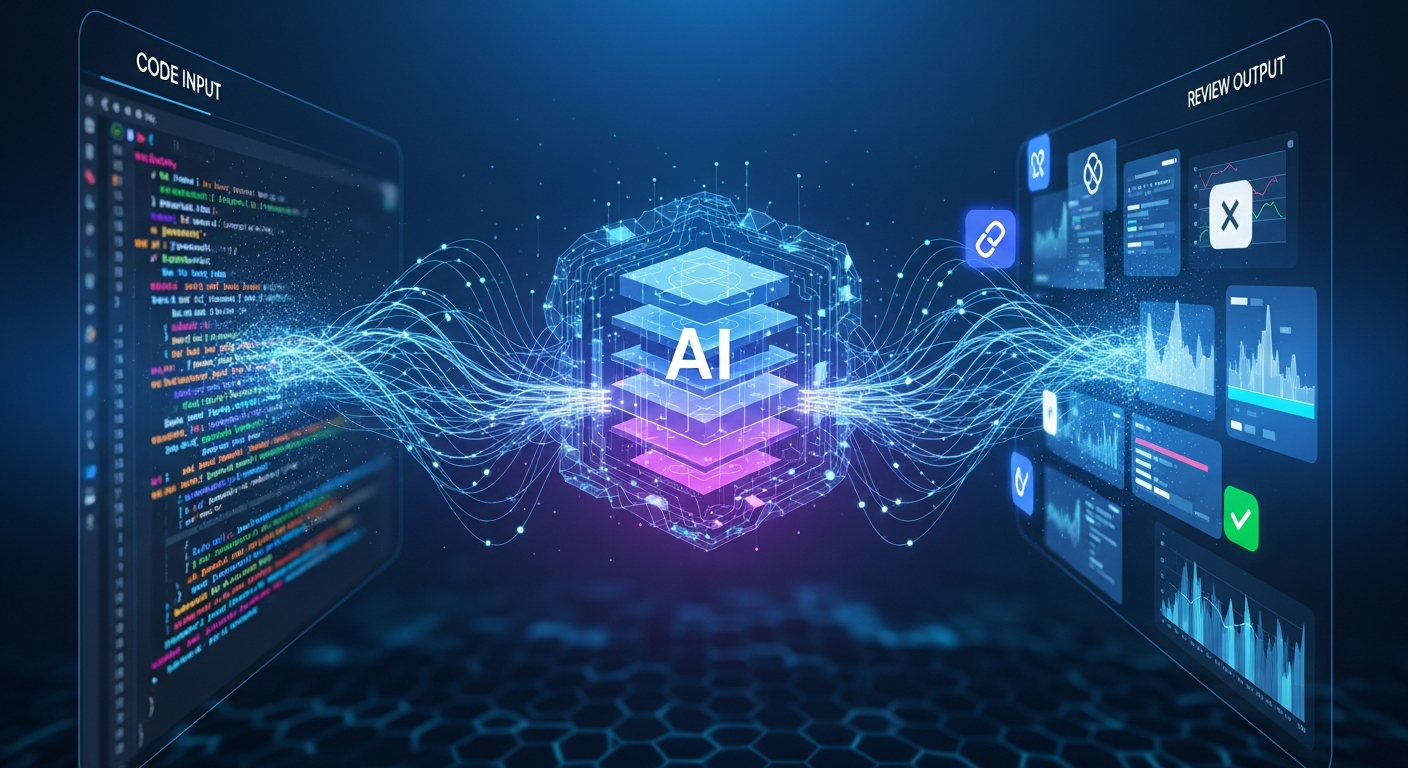
Automating code reviews with AI is no longer a luxury—it is a core infrastructure requirement for high-performing DevOps teams. By integrating Large Language Models (LLMs) and custom automation pipelines into the CI/CD workflow, organizations can shift from reactive bug-fixing to proactive quality assurance. This guide explores the technical architecture, integration strategies, and best practices for building a robust, AI-powered review ecosystem that empowers developers rather than overwhelming them.
1. Beyond Linters: The Shift to Semantic Code Analysis
For decades, developers relied on static analysis tools and linters (like ESLint or Pylint) to catch syntax errors and enforce style guides. While effective for “low-level” checks, these tools lack an understanding of intent. They can tell you if a semicolon is missing, but they cannot tell you if your implementation of a complex business logic flow introduces a race condition.
The paradigm shift in 2026 centers on **Semantic Code Analysis**. Modern AI models treat code not just as text, but as a multi-dimensional graph of logic and intent. By leveraging Transformer-based architectures, AI review agents can understand the context of a change across multiple files. For instance, if a developer modifies a database schema in one module, an AI reviewer can automatically flag potential regressions in a distant microservice that consumes that data.
This evolution allows teams to automate the “boring” parts of the review—style, documentation, and basic security patterns—while providing “high-level” insights that previously required a Senior Architect’s intuition. The result is a reduced cognitive load on human reviewers, allowing them to focus on high-impact architectural decisions rather than missing variable renames.
2. Architecting the AI Review Pipeline: Integrations and Hooks
Building an automated review system requires more than just an API key to an LLM. It requires a resilient integration layer that hooks directly into your version control system (VCS), such as GitHub, GitLab, or Bitbucket.
#
The Trigger Mechanism
The process begins with a Webhook triggered by a “Pull Request” or “Merge Request” event. This webhook notifies an orchestration layer (often a GitHub Action, a GitLab Runner, or a custom microservice running on Kubernetes) that new code is ready for inspection.
#
Contextual Data Gathering
A common mistake in early AI automation was sending only the “diff” to the model. In 2026, sophisticated pipelines use a **Retrieval-Augmented Generation (RAG)** approach. Before the AI analyzes the PR, the system gathers:
* The PR description and linked Jira/Linear tickets.
* The changed files (the diff).
* Related documentation and existing “gold standard” code patterns from the repository.
* Previous review comments to ensure consistency with the team’s specific coding standards.
#
The Inference Engine
The gathered data is bundled into a prompt and sent to an LLM (such as GPT-4o, Claude 3.5, or a self-hosted Llama 3 instance). The model then generates a structured JSON output containing line-specific comments, a summary of the changes, and a “risk score.” This structure allows the automation script to parse the response and post comments directly back to the VCS via API.
3. Implementing RAG for Domain-Specific Code Intelligence
Generic AI models are remarkably capable, but they lack the specific “tribal knowledge” of your organization’s codebase. To make AI code reviews truly effective, you must implement a context-aware layer. This is where Retrieval-Augmented Generation (RAG) becomes the developer’s best friend.
By indexing your entire codebase into a vector database (like Pinecone, Milvus, or Weaviate), the AI reviewer can perform a semantic search every time a PR is opened. If a developer is implementing a new authentication flow, the RAG system retrieves snippets of your existing security protocols and injects them into the AI’s context window.
The prompt might look like this: *”The developer is using the ‘Auth-v2’ module. Based on our internal security guidelines retrieved from the knowledge base, ensure they have implemented the mandatory token-refresh logic found in ‘src/auth/core.ts’.”*
This level of customization prevents the AI from providing generic, unhelpful advice. Instead, it acts as a digital twin of your most experienced engineer, ensuring that every new line of code aligns with the established architectural patterns of the company.
4. Automating the PR Lifecycle: From Feedback to Auto-Fixes
The goal of automating code reviews is not just to point out mistakes, but to accelerate the path to “Merge.” In 2026, automation has moved beyond passive commenting to **active remediation**.
#
Automated Summarization
The first thing an AI agent should do is provide a concise summary of the PR. This helps the human reviewer understand the “What” and “Why” before diving into the “How.” It can also automatically label the PR (e.g., `feature`, `bugfix`, `high-risk`) based on the content of the changes.
#
Suggesting and Applying Fixes
Modern VCS APIs allow AI agents to post “Suggestions” that developers can accept with a single click. If the AI detects a more efficient way to write a loop or identifies a missing error handler, it shouldn’t just complain—it should provide the corrected code block.
#
Self-Correction Loops
By integrating with your CI suite, the AI can even “self-correct.” If a PR fails a unit test, the AI can analyze the test output, compare it to the code changes, and post a suggested fix to resolve the failure. This creates a loop where the developer only sees a “Green” build, with the AI having handled the minor iterations in the background.
5. Navigating Security, Privacy, and Hallucinations
Despite the immense benefits, automating code reviews with AI introduces specific risks that tech professionals must mitigate.
#
Data Privacy and IP Protection
For many enterprises, sending proprietary code to a public LLM provider is a non-starter. To address this, organizations are increasingly turning to self-hosted models or “Enterprise” versions of AI services that guarantee data will not be used for training. Using Virtual Private Clouds (VPC) and ensuring data encryption at rest and in transit are foundational requirements for AI integrations in 2026.
#
Managing Hallucinations
LLMs can occasionally hallucinate—suggesting libraries that don’t exist or identifying bugs that aren’t there. To combat this, your automation pipeline should include a “Confidence Score.” If the AI’s confidence in a specific comment is below a certain threshold (e.g., 80%), the comment should be flagged as “Experimental” or suppressed entirely.
#
The “Human-in-the-Loop” Necessity
AI is a co-pilot, not an autopilot. The most effective workflows use AI to filter out the noise, allowing human reviewers to focus on the final sign-off. Policies should be in place that prevent AI agents from autonomously merging code into the main branch without at least one human approval for critical systems.
6. Future-Proofing Your Workflow for 2026 and Beyond
As we move through 2026, the distinction between “writing code” and “reviewing code” is blurring. We are entering the era of **Agentic Workflows**, where AI agents don’t just comment on PRs; they participate in the entire lifecycle.
#
Multi-Agent Systems
The next step in automation is the use of multiple specialized AI agents. One agent might focus exclusively on performance optimization, another on security (SecOps), and a third on documentation and API consistency. These agents can “debate” a PR in the comments, providing the human reviewer with a 360-degree view of the impact of the change.
#
Predictive Impact Analysis
Future integrations will move beyond the current codebase to look at production telemetry. Imagine an AI reviewer that flags a PR because: *”This change modifies the ‘OrderProcessor’ function, which saw a 20% spike in latency during last week’s peak traffic. Your proposed change might exacerbate this bottleneck.”* This integration of “Code + Context + Runtime” represents the pinnacle of automated code reviews.
By investing in these automation pipelines today, engineering teams are not just saving time—they are building a scalable foundation for a future where software builds itself, checks itself, and heals itself.
***
FAQ: Automating Code Reviews with AI
**Q1: Will AI code reviews replace human developers?**
No. In 2026, AI is viewed as a productivity multiplier. It handles repetitive tasks, enforces standards, and catches common errors, which allows human developers to focus on complex problem-solving, system architecture, and creative feature design.
**Q2: Which LLM is best for code reviews?**
There is no single “best” model. Models like GPT-4o and Claude 3.5 Sonnet are excellent for general logic and natural language explanations. However, many teams use specialized models like CodeLlama or StarCoder for on-premises deployments where data privacy is the primary concern.
**Q3: How do we prevent the AI from “nitpicking” and annoying the team?**
This is managed through prompt engineering and system instructions. You can explicitly instruct your AI agent to ignore style issues (if you already have a linter) and only comment on logic, security, and architectural alignment. Setting a “relevance threshold” also helps filter out minor suggestions.
**Q4: Can AI review code in any programming language?**
Yes, most modern LLMs are polyglots, trained on vast repositories of Open Source code. They excel in popular languages like TypeScript, Python, Rust, and Go, but they are also surprisingly capable in legacy languages like COBOL or specialized DSLs (Domain Specific Languages).
**Q5: What is the cost-to-benefit ratio of AI code reviews?**
While there are API costs or infrastructure costs for hosting models, the ROI is typically high. By reducing the time a developer spends on manual reviews by even 30%, a mid-sized engineering team can save hundreds of thousands of dollars annually in “developer toil” while significantly decreasing the “Time to Market” for new features.
***
Conclusion
The automation of code reviews with AI marks a turning point in the maturity of the DevOps movement. By 2026, the technical hurdles of integration and context-awareness have largely been solved, leaving the path clear for teams to embrace an “AI-first” development culture.
For tech professionals building these integrations, the focus must remain on creating a seamless experience that reduces friction. By combining the power of LLMs with the precision of RAG and the speed of CI/CD pipelines, you can transform the code review process from a dreaded bottleneck into a strategic advantage. The goal is simple: higher code quality, faster deployment cycles, and a happier engineering team that spends more time building and less time auditing. The tools are here; the only question is how quickly your organization will integrate them into the heartbeat of your development workflow.