
Building a Scalable Tech Stack for Startups: The Ultimate Guide to Exponential Growth
Affiliate disclosure: This article may contain affiliate links. Recommendations are independent and editorially driven.
In the dynamic world of entrepreneurship, a startup’s journey from a nascent idea to a market-leading entity is often dictated by its ability to adapt, innovate, and, crucially, scale. At the heart of this capability lies the often-underestimated power of a scalable tech stack for startups. It’s more than just a collection of technologies; it’s the foundational blueprint that determines whether your brilliant product can handle 10 users or 10 million, whether your operations can pivot quickly, and whether your growth trajectory is a gentle incline or a rocket launch.
For many founders, the initial focus is on getting an MVP (Minimum Viable Product) out the door. This often leads to quick, tactical technology choices that serve immediate needs but can become debilitating bottlenecks as the company gains traction. Imagine a finely tuned sports car, designed for speed and agility, suddenly finding itself hitched to a heavy trailer – that’s the feeling of a non-scalable tech stack hindering a fast-growing startup. The consequences range from sluggish performance and poor user experience to exorbitant infrastructure costs and developer burnout, ultimately jeopardizing the startup’s very survival.
This comprehensive guide is engineered for startup founders, CTOs, and technical leads who understand that a strategic approach to technology is not a luxury but a necessity. We will delve deep into what defines a truly scalable tech stack, explore its critical components, dissect strategic considerations, and illuminate the best practices for building and maintaining an architecture that not only supports but actively accelerates your startup’s growth. By the end of this article, you will be equipped with the knowledge to design a technology foundation that is robust, flexible, cost-effective, and ready for whatever the future of your enterprise holds.
Understanding the Core Principles of a Scalable Tech Stack
Before diving into specific technologies, it’s crucial to grasp the fundamental principles that underpin true scalability. A scalable tech stack for startups isn’t merely about adding more servers; it’s about designing a system that can gracefully handle increasing loads, expand its capabilities, and maintain performance without requiring a complete overhaul every time it hits a new milestone.
Defining Scalability: Vertical vs. Horizontal
When discussing scalability, two primary dimensions emerge: vertical and horizontal.
- Vertical Scalability (Scaling Up): This involves increasing the capacity of an existing server or resource. Think of it as upgrading a single computer by adding more RAM, a faster CPU, or larger storage. While simpler to implement initially, vertical scaling has inherent limitations. There’s an upper bound to how powerful a single machine can become, and once that limit is reached, further vertical scaling is impossible. It also introduces a single point of failure; if that one powerful server goes down, your entire application is affected. For startups anticipating rapid growth, relying solely on vertical scaling is a short-sighted strategy.
- Horizontal Scalability (Scaling Out): This involves adding more servers or instances to distribute the workload across multiple resources. Instead of making one car faster, you add more cars to the fleet. This approach is fundamental to building a truly scalable tech stack for startups. It allows for near-limitless growth by adding more machines as demand increases, significantly improves fault tolerance (if one server fails, others can pick up the slack), and enables parallel processing of requests. Modern cloud architectures and containerization are built on the principles of horizontal scaling.
For startups, the emphasis should predominantly be on designing for horizontal scalability from the outset. While initial vertical scaling might be expedient for an MVP, a long-term vision requires an architecture that can easily “scale out.”
The Cost of Inflexibility: Why Early Planning Matters
Many startups fall into the trap of delaying scalability considerations until “they need it.” This reactive approach almost always leads to what’s known as “technical debt.” Technical debt accumulates when quick, suboptimal solutions are chosen over well-engineered, scalable ones. The consequences can be severe:
- Performance Degradation: Slow loading times, unresponsive applications, and frequent crashes frustrate users and drive them away, directly impacting user retention and growth metrics.
- Increased Operational Costs: Patching up an inflexible system often requires more developer hours, more complex monitoring, and inefficient use of infrastructure resources. What might seem cheaper upfront becomes significantly more expensive to maintain and fix down the line.
- Developer Burnout and Morale: Developers spend more time fighting fires and wrestling with legacy code than building new features. This leads to frustration, high turnover, and difficulty attracting top talent.
- Slower Time-to-Market: Every new feature or integration becomes a monumental task, as the underlying architecture resists change. This stifles innovation and allows competitors to pull ahead.
- Missed Opportunities: When your system can’t handle a sudden surge in demand (e.g., a viral marketing campaign, a successful product launch), you lose potential customers and revenue, often irreparably damaging brand reputation.
Proactive planning for a scalable tech stack for startups isn’t about over-engineering; it’s about making informed choices that prevent these costly pitfalls and position the startup for sustainable, rapid growth.
Key Pillars of a Scalable Architecture
A truly scalable architecture is built upon several foundational pillars:
- Loose Coupling: Components of the system should be as independent as possible. Changes to one component should not necessitate changes or breakages in others. This allows for independent development, deployment, and scaling of individual services.
- Statelessness: Where possible, applications should not store user session data on the server itself. Instead, session information should be handled by external, shared services (like databases or caching layers). This enables any server instance to handle any request, making horizontal scaling much simpler.
- Asynchronous Processing: For non-critical or time-consuming tasks (e.g., sending emails, processing images, generating reports), use message queues and background workers. This frees up the main application to handle user-facing requests quickly, improving responsiveness and overall throughput.
- Resilience and Fault Tolerance: The system should be designed to continue operating even if individual components fail. This involves redundancy, automatic failover mechanisms, and robust error handling.
- Observability: The ability to understand the internal state of a system from its external outputs. This includes comprehensive logging, metrics, and tracing, which are essential for identifying bottlenecks and troubleshooting issues in a distributed, scalable environment.
Essential Components of a Modern Scalable Tech Stack
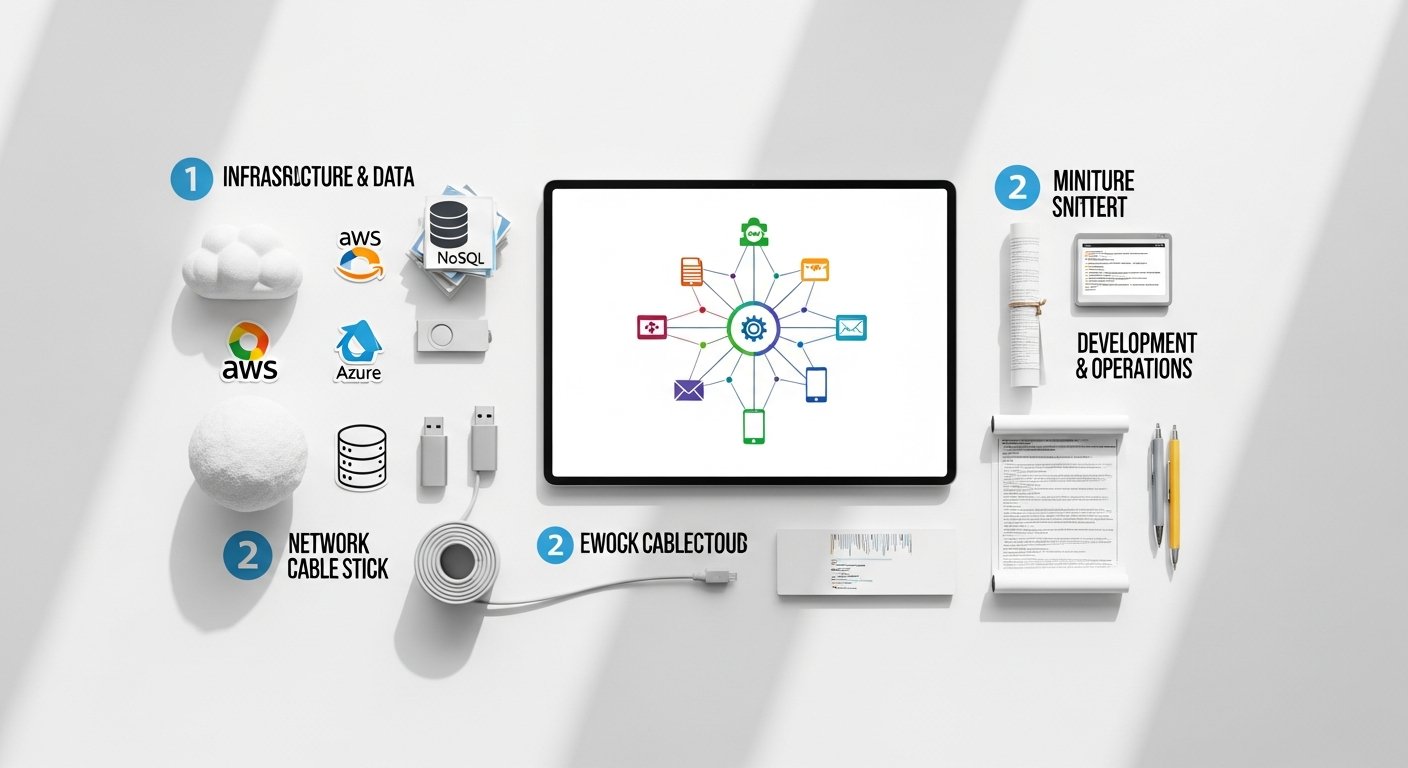
Building a robust and scalable tech stack for startups involves carefully selecting and integrating various technological components. While specific choices will vary based on the startup’s unique needs, certain categories of tools are almost universally present in modern, scalable architectures.
[INLINE IMAGE 1: place after second H2 | alt=”scalable tech stack for startups concept illustration”]
Cloud Infrastructure: The Foundation of Growth
For virtually every startup in 2026, cloud computing is not just an option but a strategic imperative for scalability. Cloud providers offer elastic, on-demand resources that are perfect for handling unpredictable startup growth.
- Infrastructure as a Service (IaaS): Providers like Amazon Web Services (AWS), Google Cloud Platform (GCP), and Microsoft Azure offer virtual machines (EC2, Compute Engine, Virtual Machines), networking, and storage. This gives startups granular control over their infrastructure while benefiting from the cloud’s inherent scalability and global reach.
- Platform as a Service (PaaS): Solutions like Heroku, Google App Engine, or AWS Elastic Beanstalk abstract away much of the underlying infrastructure management, allowing developers to focus solely on code. This can accelerate development initially but might offer less flexibility for highly customized deployments.
- Serverless Computing (Function as a Service – FaaS): Technologies like AWS Lambda, Google Cloud Functions, or Azure Functions execute code in response to events, with the cloud provider automatically managing the underlying servers. This offers unparalleled scalability, pay-per-execution pricing, and removes almost all operational overhead for specific workloads, making it a cornerstone of many modern scalable tech stacks for startups.
Choosing a cloud provider often comes down to ecosystem, pricing, specific service offerings, and team familiarity. Most provide free tiers or startup credits, which are invaluable for early-stage companies.
Backend Frameworks and Languages: Choosing for Performance
The backend forms the core logic of your application, handling data processing, business rules, and API interactions. The choice of language and framework significantly impacts performance, development speed, and ease of scaling.
- Python: Popular for its readability, extensive libraries, and strong community. Frameworks like Django and Flask are excellent for web development, while Python’s strength in data science and machine learning makes it ideal for AI-driven startups. It scales well with proper architecture.
- JavaScript (Node.js): Enables full-stack development with a single language. Node.js is particularly well-suited for highly concurrent, I/O-bound applications (like real-time data streaming or chat apps) due to its asynchronous, non-blocking nature. Express.js is a widely used framework.
- Go (Golang): Developed by Google, Go is known for its excellent performance, concurrency primitives, and efficiency. It’s ideal for building high-performance microservices, APIs, and distributed systems where speed and resource efficiency are paramount.
- Java: A mature, robust, and highly scalable language, particularly with frameworks like Spring Boot. It’s often chosen for large enterprise applications but can be a strong contender for startups requiring extreme reliability and performance, albeit with a steeper learning curve and potentially higher resource consumption than Go or Node.js.
- Ruby (Ruby on Rails): Known for developer productivity and rapid prototyping. While often debated for its raw performance at extreme scale, Rails applications can be highly scalable when combined with smart architecture, caching, and efficient database practices.
The “best” choice depends on your team’s expertise, the specific problem you’re solving, and the desired performance characteristics. Many modern scalable tech stacks for startups leverage multiple backend languages for different services.
Databases: Relational, NoSQL, and Hybrid Strategies
Data storage is critical, and the right database choice can make or break scalability. There isn’t a one-size-fits-all solution; often, a hybrid approach is best.
- Relational Databases (SQL): MySQL, PostgreSQL, and AWS Aurora are powerful choices for structured data where data integrity, complex queries, and ACID (Atomicity, Consistency, Isolation, Durability) properties are crucial. While traditionally seen as challenging to scale horizontally, modern cloud-managed SQL databases (like Aurora) offer excellent read replication and sharding capabilities.
- NoSQL Databases:
- Document Databases (e.g., MongoDB, AWS DocumentDB, Cosmos DB): Store data in flexible, JSON-like documents. Ideal for rapidly changing data models and applications requiring high throughput and availability. Excellent for horizontal scaling.
- Key-Value Stores (e.g., Redis, Memcached, AWS DynamoDB): Offer extremely fast read/write access for simple data retrieval. Perfect for caching, session management, and real-time data. DynamoDB, in particular, is built for massive scale.
- Column-Family Stores (e.g., Cassandra, HBase): Designed for very large datasets distributed across many servers, suitable for big data analytics and time-series data.
- Graph Databases (e.g., Neo4j, AWS Neptune): Optimized for storing and querying highly interconnected data, such as social networks or recommendation engines.
A common strategy for a scalable tech stack for startups is to use a relational database for core transactional data and then leverage NoSQL databases for specific use cases (e.g., Redis for caching, MongoDB for user profiles, DynamoDB for real-time analytics).
Frontend Technologies: User Experience at Scale
The frontend is the face of your application. While often perceived as less directly tied to backend scalability, efficient frontend architecture, and development practices are crucial for a responsive and performant user experience at scale.
- JavaScript Frameworks: React, Angular, and Vue.js are dominant choices, offering component-based architectures that promote reusability, maintainability, and efficient rendering. They enable the creation of Single Page Applications (SPAs) or highly interactive user interfaces.
- Static Site Generators (SSG) & Headless CMS: For content-heavy sites or marketing pages, using tools like Next.js, Gatsby, or Nuxt.js (with React/Vue) alongside a headless CMS (e.g., Contentful, Strapi) allows for pre-rendering content. This significantly boosts performance, SEO, and reduces server load on the backend.
- Progressive Web Apps (PWAs): Building a PWA can enhance user experience by offering offline capabilities, push notifications, and app-like performance, blurring the line between web and native applications.
- Content Delivery Networks (CDNs): Essential for serving static assets (images, CSS, JS files) quickly to users globally. CDNs cache content at edge locations, reducing latency and offloading traffic from your origin servers, making them indispensable for a scalable tech stack for startups.
APIs and Microservices: Enabling Modularity and Integration
Modern scalable architectures heavily rely on APIs (Application Programming Interfaces) to allow different software components to communicate and on microservices to break down monolithic applications into smaller, manageable, and independently deployable units.
- RESTful APIs: The most common type of API, using standard HTTP methods to interact with resources. They are stateless, making them highly scalable.
- GraphQL: Offers a more efficient, flexible, and powerful alternative to REST. Clients can request exactly the data they need, reducing over-fetching and under-fetching, which can improve performance for complex data interactions.
- Microservices Architecture: Instead of one large, monolithic application, a microservices architecture breaks the application into a suite of small, independent services, each running in its own process and communicating via lightweight mechanisms (like HTTP APIs or message queues). This enables:
- Independent deployment and scaling of individual services.
- Use of different technologies for different services (polyglot persistence and programming).
- Improved fault isolation.
- Faster development cycles for individual teams.
While microservices offer immense scalability benefits, they also introduce complexity in terms of distributed systems, monitoring, and debugging. Careful planning and experienced teams are crucial for successful adoption in a startup environment.
Strategic Considerations for Building Your Scalable Tech Stack
Beyond selecting individual components, building a truly scalable tech stack for startups requires strategic foresight and a nuanced understanding of trade-offs. The right architectural decisions made early can save immense headaches and costs down the line.
Balancing Innovation with Stability
Startups are inherently driven by innovation, often needing to rapidly experiment with new features and technologies. However, this desire for innovation must be balanced with the need for stability and reliability. Adopting the bleeding edge of technology might give you a temporary advantage but can also introduce instability, a lack of community support, and difficulty finding skilled talent. Conversely, sticking to overly conservative, outdated technologies will stifle growth.
- Choose technologies with a strong community and ecosystem: This ensures readily available documentation, third-party libraries, and a pool of experienced developers.
- Prioritize proven solutions for core functionality: Use established, robust technologies for critical components (e.g., your database, core API services).
- Experiment with newer tech in non-critical areas: If you want to try a new language or framework, start with a small, isolated microservice or a feature that won’t cripple your entire application if it encounters issues.
- Embrace controlled experimentation: Use A/B testing, feature flags, and canary deployments to roll out new features and technologies gradually and safely.
Open Source vs. Proprietary Solutions
This is a fundamental choice for many components of a scalable tech stack for startups:
- Open Source: Offers flexibility, transparency, no licensing fees (though operational costs apply), and often a vast community. Examples include Linux, PostgreSQL, Node.js, React, Kubernetes. The downside can be a lack of direct vendor support (relying on community), and you’re responsible for maintenance and security patches.
- Proprietary/Commercial Solutions: Often come with dedicated support, guaranteed SLAs, and integrated feature sets. Examples include Oracle Database, Microsoft SQL Server, specific cloud provider services (e.g., AWS Aurora, Google BigQuery). The trade-off is often higher cost, potential vendor lock-in, and less flexibility.
Many startups adopt a hybrid approach, using open-source technologies for much of their core stack, complemented by managed cloud services (which often run open-source software under the hood) for ease of operations, and occasionally proprietary tools for specialized needs.
Vendor Lock-in: Mitigating Risks
Vendor lock-in occurs when your tech stack becomes so deeply integrated with a specific provider (especially a cloud provider) that switching becomes extremely difficult and costly. While some degree of lock-in is almost inevitable when leveraging powerful cloud-native services, it’s crucial for a scalable tech stack for startups to mitigate excessive dependency.
- Abstract infrastructure: Use Infrastructure as Code (IaC) tools like Terraform or Pulumi, which can often be provider-agnostic or easily adapted between providers.
- Containerization: Technologies like Docker and Kubernetes make applications portable across different cloud environments or even on-premise infrastructure.
- Choose open standards: Favor open protocols, data formats, and APIs over proprietary ones.
- Avoid deep reliance on niche cloud services: While managed services are convenient, relying heavily on highly specialized, non-standard cloud features can make migration challenging. Balance convenience with portability.
- Plan for multi-cloud or hybrid cloud (if truly necessary): For most startups, a single cloud provider is sufficient, but designing with the possibility of migration in mind can be beneficial.
Security and Compliance from Day One
Security is not an afterthought; it must be an integral part of designing a scalable tech stack for startups. A single data breach can devastate a startup’s reputation and financial viability.
- Secure by Design: Integrate security considerations at every stage of development, from architecture to deployment.
- Principle of Least Privilege: Grant users, applications, and services only the minimum necessary permissions to perform their functions.
- Data Encryption: Encrypt data at rest (in storage) and in transit (over networks) using industry-standard protocols (TLS/SSL).
- Access Control: Implement robust authentication (MFA) and authorization mechanisms (RBAC – Role-Based Access Control).
- Regular Security Audits and Penetration Testing: Proactively identify and fix vulnerabilities.
- Compliance: Understand and adhere to relevant industry regulations and data privacy laws (e.g., GDPR, CCPA, HIPAA) from the outset, especially if handling sensitive user data.
Cost Optimization and Resource Management
Scalability often comes with costs, and for startups, managing expenses is paramount. A truly scalable tech stack for startups is also a cost-optimized one.
- Monitor resource usage: Continuously track CPU, memory, storage, and network consumption to identify inefficiencies.
- Right-sizing instances: Don’t pay for more compute power than you need. Start small and scale up (vertically) as necessary before scaling out (horizontally).
- Leverage auto-scaling: Configure your cloud resources (VMs, databases, serverless functions) to automatically scale up or down based on demand, preventing over-provisioning during low traffic and ensuring availability during peak loads.
- Spot Instances/Preemptible VMs: Utilize these for fault-tolerant, interruptible workloads to significantly reduce compute costs.
- Caching: Implement aggressive caching strategies (e.g., Redis, CDN) to reduce database load and improve response times, thus requiring fewer backend resources.
- Optimize database queries: Inefficient database operations are often major bottlenecks and resource hogs.
- Serverless cost model: Pay-per-execution can be incredibly cost-effective for intermittent workloads.
- Reserved Instances/Savings Plans: Once usage patterns stabilize, committing to longer-term contracts with cloud providers can yield significant discounts.
Popular Scalable Tech Stacks for Startups (and their Trade-offs)
While there’s no single “best” scalable tech stack for startups, several popular architectural patterns and technology combinations have proven effective. Understanding their strengths and weaknesses can help guide your own choices.
[INLINE IMAGE 2: place after fourth H2 | alt=”scalable tech stack for startups comparison illustration”]
The MEAN/MERN Stack: Agility for Web Apps
The MEAN stack (MongoDB, Express.js, Angular, Node.js) and MERN stack (MongoDB, Express.js, React, Node.js) are extremely popular for web-focused startups. They offer a full-stack JavaScript environment, simplifying development and enabling developers to work across the entire application.
- Pros:
- Single Language: JavaScript across frontend and backend streamlines development and reduces context switching.
- Fast Prototyping: Components like Node.js and Express allow for rapid API development, while React/Angular accelerate UI creation.
- JSON Everywhere: Data consistency with JSON from MongoDB to the frontend.
- Strong Community: Massive communities and rich ecosystems for all components.
- Cons:
- Performance for CPU-bound tasks: Node.js, while excellent for I/O, can be less efficient for heavy CPU computations compared to Go or Java.
- Database Choice: MongoDB’s flexible schema is a double-edged sword; lack of strict schema can lead to data integrity issues if not managed carefully.
- Complexity in Large Apps: Can become unwieldy in very large applications without strict architectural discipline.
Serverless Architectures: Event-Driven Scaling
Serverless computing (FaaS) is increasingly becoming the backbone of a scalable tech stack for startups, especially for event-driven microservices, APIs, and background processing.
- Pros:
- Extreme Scalability: Automatically scales from zero to millions of requests without manual intervention.
- Pay-per-execution: You only pay when your code runs, often resulting in significant cost savings for intermittent workloads.
- Zero Server Management: No servers to provision, patch, or maintain.
- Fast Time-to-Market: Developers focus purely on business logic.
- Cons:
- Cold Starts: Latency can occur when a function hasn’t been invoked recently and needs to “wake up.”
- Vendor Lock-in: Heavily tied to specific cloud providers (AWS Lambda, Azure Functions, GCP Cloud Functions).
- Debugging Complexity: Debugging distributed serverless functions can be challenging.
- Limited Execution Time/Memory: Functions often have execution time limits and memory constraints.
Kubernetes and Containerization: Orchestrating Microservices
Docker for containerization and Kubernetes for container orchestration are powerful tools for managing microservices at scale. They provide a portable, consistent environment for deploying applications.
- Pros:
- Portability: Containers run consistently across different environments (dev, staging, production, different clouds).
- Isolation: Each service runs in its own container, preventing conflicts.
- Automated Scaling & Management: Kubernetes automates deployment, scaling, healing, and management of containerized applications.
- Resource Efficiency: More efficient use of underlying hardware.
- Vendor Agnostic: Kubernetes is an open-source standard, reducing cloud vendor lock-in for compute.
- Cons:
- High Learning Curve: Kubernetes has a steep learning curve and introduces significant operational complexity.
- Overhead: Can be overkill for very small startups or simple applications.
- Infrastructure Costs: Managing a Kubernetes cluster can be expensive if not optimized.
- Debugging: Troubleshooting issues in a distributed containerized environment requires specialized skills and tools.
Cloud-Native Stacks: Leveraging Provider Ecosystems
Many startups choose to embrace a single cloud provider’s entire ecosystem (e.g., AWS, GCP, Azure). This means using their managed databases, message queues, serverless functions, and other services.
- Pros:
- Seamless Integration: Services within a single cloud provider are designed to work together perfectly.
- Managed Services: Reduces operational overhead significantly, as the provider handles infrastructure management, patching, and scaling.
- Comprehensive Tooling: Access to a vast array of specialized services (AI/ML, IoT, data analytics).
- Rapid Development: Can accelerate development by leveraging pre-built, integrated components.
- Cons:
- Strong Vendor Lock-in: The primary drawback; migrating away can be very difficult.
- Complexity of Choice: The sheer number of services can be overwhelming.
- Cost Management: Requires careful monitoring to avoid unexpected costs from various integrated services.
Here’s a comparison table summarizing some key aspects of these popular approaches for a scalable tech stack for startups:
| Stack Type | Primary Benefit for Startups | Key Technologies/Examples | Typical Scaling Mechanism | Complexity Level (Ops) | Cost Profile |
|---|---|---|---|---|---|
| MEAN/MERN Stack | Rapid Web App Development, Full-Stack JS | MongoDB, Express.js, React/Angular, Node.js | Horizontal scaling of Node.js servers, MongoDB replica sets/sharding | Medium | Moderate (VMs/PaaS) |
| Serverless (FaaS) | Extreme Elasticity, Operational Simplicity | AWS Lambda, GCP Cloud Functions, Azure Functions, DynamoDB, SQS | Automatic (triggered by events) | Low (Ops abstraction) | Pay-per-execution, often very low for sparse usage |
| Containerized (Kubernetes) | Microservices Orchestration, Portability | Docker, Kubernetes, Go/Python microservices, Prometheus | Horizontal Pod Autoscaling, Cluster Autoscaling | High | Potentially high (cluster management) but efficient resource use |
| Cloud-Native (e.g., AWS) | Integrated Ecosystem, Managed Services | AWS EC2/ECS/Lambda, RDS/DynamoDB, SQS/SNS, S3 | Cloud provider’s managed scaling for services | Medium (using managed services) | Variable (can be optimized but complex billing) |
| LAMP/LEMP Stack | Mature, Cost-Effective for Web Hosting | Linux, Apache/Nginx, MySQL/PostgreSQL, PHP/Python/Perl | Vertical scaling initially, then horizontal load balancing | Medium-Low (well-understood) | Low to Moderate (self-managed VMs) |
Implementing Scalability: Best Practices and Methodologies
Building a scalable tech stack for startups is as much about process and methodology as it is about technology selection. Adopting modern engineering practices ensures that scalability is not just an architectural concept but a continuous reality.
Infrastructure as Code (IaC): Automating Your Environment
IaC is the practice of managing and provisioning infrastructure through code, rather than manual processes. Tools like Terraform, AWS CloudFormation, or Azure Resource Manager allow you to define your servers, networks, databases, and other resources in configuration files that can be versioned, reviewed, and deployed automatically.
- Consistency: Ensures that your environments (development, staging, production) are identical, reducing “it works on my machine” issues.
- Speed and Efficiency: Deploy entire environments quickly and reliably.
- Reduced Errors: Eliminates human error associated with manual provisioning.
- Version Control: Treat your infrastructure like application code, enabling rollbacks and audits.
- Scalability Foundation: Essential for automating the creation and destruction of resources needed for horizontal scaling.
CI/CD Pipelines: Accelerating Deployment and Iteration
Continuous Integration (CI) and Continuous Delivery/Deployment (CD) are fundamental to modern software development, allowing startups to release updates rapidly and reliably. A robust CI/CD pipeline automates the entire software release process.
- Continuous Integration: Developers frequently merge their code changes into a central repository, where automated tests are run to detect integration errors early.
- Continuous Delivery: Code changes are automatically built, tested, and prepared for release to production. This means the software is always in a deployable state.
- Continuous Deployment: An extension of CD, where every change that passes all automated tests is automatically deployed to production without human intervention.
- Benefits for Scalability:
- Faster Feedback Loops: Quickly identify and resolve bugs.
- Reduced Risk: Small, frequent deployments are less risky than large, infrequent ones.
- Accelerated Innovation: Get new features to users faster, enabling rapid iteration and response to market feedback.
- Automated Rollbacks: The ability to quickly revert to a previous stable version in case of issues.
Tools like Jenkins, GitLab CI/CD, GitHub Actions, AWS CodePipeline, or CircleCI are popular choices for building these pipelines.
Monitoring and Observability: Staying Ahead of Issues
As your scalable tech stack for startups grows in complexity (especially with microservices), understanding its real-time health and performance becomes critical. Monitoring tells you if something is broken; observability helps you understand why.
- Key Metrics: Monitor CPU utilization, memory usage, disk I/O, network traffic, database query performance, API response times, error rates, and user traffic.
- Logging: Centralized logging systems (e.g., ELK Stack – Elasticsearch, Logstash, Kibana; Datadog, Splunk) aggregate logs from all services, making it easy to search, filter, and analyze operational data.
- Tracing: Distributed tracing tools (e.g., Jaeger, Zipkin, AWS X-Ray) track requests as they flow through multiple services, helping identify latency bottlenecks in microservice architectures.
- Alerting: Set up automated alerts for critical thresholds (e.g., high error rates, low disk space, high latency) to notify your team before problems impact users.
- Dashboards: Visualize key metrics and logs on dashboards (e.g., Grafana, custom cloud provider dashboards) for quick operational oversight.
Load Testing and Performance Benchmarking
You can’t guarantee scalability without testing it. Load testing simulates expected (and unexpected) user traffic to identify bottlenecks and validate your system’s ability to handle high demand.
- Identify Bottlenecks: Pinpoint which parts of your system (database, API, network, specific service) break under pressure.
- Validate Scaling Strategies: Confirm that your auto-scaling rules and horizontal scaling mechanisms work as expected.
- Understand Capacity Limits: Determine the maximum user load your current infrastructure can handle before performance degrades.
- Benchmarking: Compare your system’s performance against defined standards or previous versions to track improvements or regressions.
Tools like Apache JMeter, K6, Locust, or cloud-native load testing services can be used for this purpose.
Data Backup and Disaster Recovery Strategies
Scalability also means resilience. Data loss or prolonged downtime can be catastrophic for any startup. Robust backup and disaster recovery (DR) strategies are non-negotiable for a scalable tech stack for startups.
- Regular Backups: Automate regular backups of all critical data (databases, file storage) to secure, offsite locations.
- Point-in-Time Recovery (PITR): For databases, enable PITR to restore data to any specific moment in time, minimizing data loss.
- Redundancy: Store data redundantly across multiple availability zones or regions for immediate failover.
- Disaster Recovery Plan: Develop and regularly test a clear DR plan outlining procedures for restoring services in the event of a major outage. Consider RTO (Recovery Time Objective – how quickly you need to be back up) and RPO (Recovery Point Objective – how much data you can afford to lose).
The Role of AI, ML, and Emerging Technologies in Scalable Stacks
As startups push the boundaries of innovation, their scalable tech stack must also accommodate and leverage cutting-edge technologies like Artificial Intelligence (AI), Machine Learning (ML), and others. Integrating these without compromising scalability is a key challenge.
Integrating AI/ML Workloads
AI and ML are becoming integral to many startup products, from recommendation engines and personalization to fraud detection and natural language processing. Integrating these into a scalable tech stack for startups requires specific considerations:
- Data Pipelines: Robust and scalable data ingestion, processing, and storage solutions (e.g., Apache Kafka for streaming, data lakes on S3/GCS) are essential for feeding ML models.
- Compute Resources: ML model training, especially for deep learning, often requires specialized hardware like GPUs. Cloud providers offer managed GPU instances and services (e.g., AWS SageMaker, Google AI Platform, Azure Machine Learning) that scale on demand.
- Model Deployment (MLOps): Deploying ML models into production requires an MLOps (Machine Learning Operations) pipeline that automates model training, versioning, serving (via APIs), monitoring, and retraining. Serverless functions or containerized microservices are often used for real-time inference.
- Feature Stores: A centralized repository for managing and serving features for ML models, ensuring consistency between training and inference and improving collaboration.
Edge Computing for Low-Latency Applications
Edge computing involves processing data closer to its source, rather than sending it all to a centralized cloud. This is critical for applications requiring extremely low latency, such as IoT devices, real-time gaming, augmented reality, or autonomous vehicles.
- Reduced Latency: By processing data at the edge, round-trip time to a distant cloud server is eliminated.
- Bandwidth Optimization: Only relevant or aggregated data is sent to the cloud, reducing network traffic and costs.
- Improved Reliability: Edge devices can operate even with intermittent or no connectivity to the central cloud.
- Scalable Edge Infrastructure: Managing a distributed network of edge devices and coordinating with the central cloud requires sophisticated orchestration and monitoring tools, often using containerization and specialized edge platforms.
Blockchain and Distributed Ledger Technologies (DLT)
For startups in FinTech, supply chain, digital identity, or Web3, integrating blockchain or DLT into their scalable tech stack is fundamental. While inherently distributed, designing
Building a Scalable Tech Stack for Startups: The Ultimate Guide to Exponential Growth
Affiliate disclosure: This article may contain affiliate links. Recommendations are independent and editorially driven.
In the dynamic world of entrepreneurship, a startup’s journey from a nascent idea to a market-leading entity is often dictated by its ability to adapt, innovate, and, crucially, scale. At the heart of this capability lies the often-underestimated power of a scalable tech stack for startups. It’s more than just a collection of technologies; it’s the foundational blueprint that determines whether your brilliant product can handle 10 users or 10 million, whether your operations can pivot quickly, and whether your growth trajectory is a gentle incline or a rocket launch.
For many founders, the initial focus is on getting an MVP (Minimum Viable Product) out the door. This often leads to quick, tactical technology choices that serve immediate needs but can become debilitating bottlenecks as the company gains traction. Imagine a finely tuned sports car, designed for speed and agility, suddenly finding itself hitched to a heavy trailer – that’s the feeling of a non-scalable tech stack hindering a fast-growing startup. The consequences range from sluggish performance and poor user experience to exorbitant infrastructure costs and developer burnout, ultimately jeopardizing the startup’s very survival.
This comprehensive guide is engineered for startup founders, CTOs, and technical leads who understand that a strategic approach to technology is not a luxury but a necessity. We will delve deep into what defines a truly scalable tech stack, explore its critical components, dissect strategic considerations, and illuminate the best practices for building and maintaining an architecture that not only supports but actively accelerates your startup’s growth. By the end of this article, you will be equipped with the knowledge to design a technology foundation that is robust, flexible, cost-effective, and ready for whatever the future of your enterprise holds.
Understanding the Core Principles of a Scalable Tech Stack
Before diving into specific technologies, it’s crucial to grasp the fundamental principles that underpin true scalability. A scalable tech stack for startups isn’t merely about adding more servers; it’s about designing a system that can gracefully handle increasing loads, expand its capabilities, and maintain performance without requiring a complete overhaul every time it hits a new milestone.
Defining Scalability: Vertical vs. Horizontal
When discussing scalability, two primary dimensions emerge: vertical and horizontal.
- Vertical Scalability (Scaling Up): This involves increasing the capacity of an existing server or resource. Think of it as upgrading a single computer by adding more RAM, a faster CPU, or larger storage. While simpler to implement initially, vertical scaling has inherent limitations. There’s an upper bound to how powerful a single machine can become, and once that limit is reached, further vertical scaling is impossible. It also introduces a single point of failure; if that one powerful server goes down, your entire application is affected. For startups anticipating rapid growth, relying solely on vertical scaling is a short-sighted strategy.
- Horizontal Scalability (Scaling Out): This involves adding more servers or instances to distribute the workload across multiple resources. Instead of making one car faster, you add more cars to the fleet. This approach is fundamental to building a truly scalable tech stack for startups. It allows for near-limitless growth by adding more machines as demand increases, significantly improves fault tolerance (if one server fails, others can pick up the slack), and enables parallel processing of requests. Modern cloud architectures and containerization are built on the principles of horizontal scaling.
For startups, the emphasis should predominantly be on designing for horizontal scalability from the outset. While initial vertical scaling might be expedient for an MVP, a long-term vision requires an architecture that can easily “scale out.”
The Cost of Inflexibility: Why Early Planning Matters
Many startups fall into the trap of delaying scalability considerations until “they need it.” This reactive approach almost always leads to what’s known as “technical debt.” Technical debt accumulates when quick, suboptimal solutions are chosen over well-engineered, scalable ones. The consequences can be severe:
- Performance Degradation: Slow loading times, unresponsive applications, and frequent crashes frustrate users and drive them away, directly impacting user retention and growth metrics.
- Increased Operational Costs: Patching up an inflexible system often requires more developer hours, more complex monitoring, and inefficient use of infrastructure resources. What might seem cheaper upfront becomes significantly more expensive to maintain and fix down the line.
- Developer Burnout and Morale: Developers spend more time fighting fires and wrestling with legacy code than building new features. This leads to frustration, high turnover, and difficulty attracting top talent.
- Slower Time-to-Market: Every new feature or integration becomes a monumental task, as the underlying architecture resists change. This stifles innovation and allows competitors to pull ahead.
- Missed Opportunities: When your system can’t handle a sudden surge in demand (e.g., a viral marketing campaign, a successful product launch), you lose potential customers and revenue, often irreparably damaging brand reputation.
Proactive planning for a scalable tech stack for startups isn’t about over-engineering; it’s about making informed choices that prevent these costly pitfalls and position the startup for sustainable, rapid growth.
Key Pillars of a Scalable Architecture
A truly scalable architecture is built upon several foundational pillars:
- Loose Coupling: Components of the system should be as independent as possible. Changes to one component should not necessitate changes or breakages in others. This allows for independent development, deployment, and scaling of individual services.
- Statelessness: Where possible, applications should not store user session data on the server itself. Instead, session information should be handled by external, shared services (like databases or caching layers). This enables any server instance to handle any request, making horizontal scaling much simpler.
- Asynchronous Processing: For non-critical or time-consuming tasks (e.g., sending emails, processing images, generating reports), use message queues and background workers. This frees up the main application to handle user-facing requests quickly, improving responsiveness and overall throughput.
- Resilience and Fault Tolerance: The system should be designed to continue operating even if individual components fail. This involves redundancy, automatic failover mechanisms, and robust error handling.
- Observability: The ability to understand the internal state of a system from its external outputs. This includes comprehensive logging, metrics, and tracing, which are essential for identifying bottlenecks and troubleshooting issues in a distributed, scalable environment.
Essential Components of a Modern Scalable Tech Stack
Building a robust and scalable tech stack for startups involves carefully selecting and integrating various technological components. While specific choices will vary based on the startup’s unique needs, certain categories of tools are almost universally present in modern, scalable architectures.
[INLINE IMAGE 1: place after second H2 | alt=”scalable tech stack for startups concept illustration”]
Cloud Infrastructure: The Foundation of Growth
For virtually every startup in 2026, cloud computing is not just an option but a strategic imperative for scalability. Cloud providers offer elastic, on-demand resources that are perfect for handling unpredictable startup growth.
- Infrastructure as a Service (IaaS): Providers like Amazon Web Services (AWS), Google Cloud Platform (GCP), and Microsoft Azure offer virtual machines (EC2, Compute Engine, Virtual Machines), networking, and storage. This gives startups granular control over their infrastructure while benefiting from the cloud’s inherent scalability and global reach.
- Platform as a Service (PaaS): Solutions like Heroku, Google App Engine, or AWS Elastic Beanstalk abstract away much of the underlying infrastructure management, allowing developers to focus solely on code. This can accelerate development initially but might offer less flexibility for highly customized deployments.
- Serverless Computing (Function as a Service – FaaS): Technologies like AWS Lambda, Google Cloud Functions, or Azure Functions execute code in response to events, with the cloud provider automatically managing the underlying servers. This offers unparalleled scalability, pay-per-execution pricing, and removes almost all operational overhead for specific workloads, making it a cornerstone of many modern scalable tech stacks for startups.
Choosing a cloud provider often comes down to ecosystem, pricing, specific service offerings, and team familiarity. Most provide free tiers or startup credits, which are invaluable for early-stage companies.
Backend Frameworks and Languages: Choosing for Performance
The backend forms the core logic of your application, handling data processing, business rules, and API interactions. The choice of language and framework significantly impacts performance, development speed, and ease of scaling.
- Python: Popular for its readability, extensive libraries, and strong community. Frameworks like Django and Flask are excellent for web development, while Python’s strength in data science and machine learning makes it ideal for AI-driven startups. It scales well with proper architecture.
- JavaScript (Node.js): Enables full-stack development with a single language. Node.js is particularly well-suited for highly concurrent, I/O-bound applications (like real-time data streaming or chat apps) due to its asynchronous, non-blocking nature. Express.js is a widely used framework.
- Go (Golang): Developed by Google, Go is known for its excellent performance, concurrency primitives, and efficiency. It’s ideal for building high-performance microservices, APIs, and distributed systems where speed and resource efficiency are paramount.
- Java: A mature, robust, and highly scalable language, particularly with frameworks like Spring Boot. It’s often chosen for large enterprise applications but can be a strong contender for startups requiring extreme reliability and performance, albeit with a steeper learning curve and potentially higher resource consumption than Go or Node.js.
- Ruby (Ruby on Rails): Known for developer productivity and rapid prototyping. While often debated for its raw performance at extreme scale, Rails applications can be highly scalable when combined with smart architecture, caching, and efficient database practices.
The “best” choice depends on your team’s expertise, the specific problem you’re solving, and the desired performance characteristics. Many modern scalable tech stacks for startups leverage multiple backend languages for different services.
Databases: Relational, NoSQL, and Hybrid Strategies
Data storage is critical, and the right database choice can make or break scalability. There isn’t a one-size-fits-all solution; often, a hybrid approach is best.
- Relational Databases (SQL): MySQL, PostgreSQL, and AWS Aurora are powerful choices for structured data where data integrity, complex queries, and ACID (Atomicity, Consistency, Isolation, Durability) properties are crucial. While traditionally seen as challenging to scale horizontally, modern cloud-managed SQL databases (like Aurora) offer excellent read replication and sharding capabilities.
- NoSQL Databases:
- Document Databases (e.g., MongoDB, AWS DocumentDB, Cosmos DB): Store data in flexible, JSON-like documents. Ideal for rapidly changing data models and applications requiring high throughput and availability. Excellent for horizontal scaling.
- Key-Value Stores (e.g., Redis, Memcached, AWS DynamoDB): Offer extremely fast read/write access for simple data retrieval. Perfect for caching, session management, and real-time data. DynamoDB, in particular, is built for massive scale.
- Column-Family Stores (e.g., Cassandra, HBase): Designed for very large datasets distributed across many servers, suitable for big data analytics and time-series data.
- Graph Databases (e.g., Neo4j, AWS Neptune): Optimized for storing and querying highly interconnected data, such as social networks or recommendation engines.
A common strategy for a scalable tech stack for startups is to use a relational database for core transactional data and then leverage NoSQL databases for specific use cases (e.g., Redis for caching, MongoDB for user profiles, DynamoDB for real-time analytics).
Frontend Technologies: User Experience at Scale
The frontend is the face of your application. While often perceived as less directly tied to backend scalability, efficient frontend architecture, and development practices are crucial for a responsive and performant user experience at scale.
- JavaScript Frameworks: React, Angular, and Vue.js are dominant choices, offering component-based architectures that promote reusability, maintainability, and efficient rendering. They enable the creation of Single Page Applications (SPAs) or highly interactive user interfaces.
- Static Site Generators (SSG) & Headless CMS: For content-heavy sites or marketing pages, using tools like Next.js, Gatsby, or Nuxt.js (with React/Vue) alongside a headless CMS (e.g., Contentful, Strapi) allows for pre-rendering content. This significantly boosts performance, SEO, and reduces server load on the backend.
- Progressive Web Apps (PWAs): Building a PWA can enhance user experience by offering offline capabilities, push notifications, and app-like performance, blurring the line between web and native applications.
- Content Delivery Networks (CDNs): Essential for serving static assets (images, CSS, JS files) quickly to users globally. CDNs cache content at edge locations, reducing latency and offloading traffic from your origin servers, making them indispensable for a scalable tech stack for startups.
APIs and Microservices: Enabling Modularity and Integration
Modern scalable architectures heavily rely on APIs (Application Programming Interfaces) to allow different software components to communicate and on microservices to break down monolithic applications into smaller, manageable, and independently deployable units.
- RESTful APIs: The most common type of API, using standard HTTP methods to interact with resources. They are stateless, making them highly scalable.
- GraphQL: Offers a more efficient, flexible, and powerful alternative to REST. Clients can request exactly the data they need, reducing over-fetching and under-fetching, which can improve performance for complex data interactions.
- Microservices Architecture: Instead of one large, monolithic application, a microservices architecture breaks the application into a suite of small, independent services, each running in its own process and communicating via lightweight mechanisms (like HTTP APIs or message queues). This enables:
- Independent deployment and scaling of individual services.
- Use of different technologies for different services (polyglot persistence and programming).
- Improved fault isolation.
- Faster development cycles for individual teams.
While microservices offer immense scalability benefits, they also introduce complexity in terms of distributed systems, monitoring, and debugging. Careful planning and experienced teams are crucial for successful adoption in a startup environment.
Strategic Considerations for Building Your Scalable Tech Stack
Beyond selecting individual components, building a truly scalable tech stack for startups requires strategic foresight and a nuanced understanding of trade-offs. The right architectural decisions made early can save immense headaches and costs down the line.
Balancing Innovation with Stability
Startups are inherently driven by innovation, often needing to rapidly experiment with new features and technologies. However, this desire for innovation must be balanced with the need for stability and reliability. Adopting the bleeding edge of technology might give you a temporary advantage but can also introduce instability, a lack of community support, and difficulty finding skilled talent. Conversely, sticking to overly conservative, outdated technologies will stifle growth.
- Choose technologies with a strong community and ecosystem: This ensures readily available documentation, third-party libraries, and a pool of experienced developers.
- Prioritize proven solutions for core functionality: Use established, robust technologies for critical components (e.g., your database, core API services).
- Experiment with newer tech in non-critical areas: If you want to try a new language or framework, start with a small, isolated microservice or a feature that won’t cripple your entire application if it encounters issues.
- Embrace controlled experimentation: Use A/B testing, feature flags, and canary deployments to roll out new features and technologies gradually and safely.
Open Source vs. Proprietary Solutions
This is a fundamental choice for many components of a scalable tech stack for startups:
- Open Source: Offers flexibility, transparency, no licensing fees (though operational costs apply), and often a vast community. Examples include Linux, PostgreSQL, Node.js, React, Kubernetes. The downside can be a lack of direct vendor support (relying on community), and you’re responsible for maintenance and security patches.
- Proprietary/Commercial Solutions: Often come with dedicated support, guaranteed SLAs, and integrated feature sets. Examples include Oracle Database, Microsoft SQL Server, specific cloud provider services (e.g., AWS Aurora, Google BigQuery). The trade-off is often higher cost, potential vendor lock-in, and less flexibility.
Many startups adopt a hybrid approach, using open-source technologies for much of their core stack, complemented by managed cloud services (which often run open-source software under the hood) for ease of operations, and occasionally proprietary tools for specialized needs.
Vendor Lock-in: Mitigating Risks
Vendor lock-in occurs when your tech stack becomes so deeply integrated with a specific provider (especially a cloud provider) that switching becomes extremely difficult and costly. While some degree of lock-in is almost inevitable when leveraging powerful cloud-native services, it’s crucial for a scalable tech stack for startups to mitigate excessive dependency.
- Abstract infrastructure: Use Infrastructure as Code (IaC) tools like Terraform or Pulumi, which can often be provider-agnostic or easily adapted between providers.
- Containerization: Technologies like Docker and Kubernetes make applications portable across different cloud environments or even on-premise infrastructure.
- Choose open standards: Favor open protocols, data formats, and APIs over proprietary ones.
- Avoid deep reliance on niche cloud services: While managed services are convenient, relying heavily on highly specialized, non-standard cloud features can make migration challenging. Balance convenience with portability.
- Plan for multi-cloud or hybrid cloud (if truly necessary): For most startups, a single cloud provider is sufficient, but designing with the possibility of migration in mind can be beneficial.
Security and Compliance from Day One
Security is not an afterthought; it must be an integral part of designing a scalable tech stack for startups. A single data breach can devastate a startup’s reputation and financial viability.
- Secure by Design: Integrate security considerations at every stage of development, from architecture to deployment.
- Principle of Least Privilege: Grant users, applications, and services only the minimum necessary permissions to perform their functions.
- Data Encryption: Encrypt data at rest (in storage) and in transit (over networks) using industry-standard protocols (TLS/SSL).
- Access Control: Implement robust authentication (MFA) and authorization mechanisms (RBAC – Role-Based Access Control).
- Regular Security Audits and Penetration Testing: Proactively identify and fix vulnerabilities.
- Compliance: Understand and adhere to relevant industry regulations and data privacy laws (e.g., GDPR, CCPA, HIPAA) from the outset, especially if handling sensitive user data.
Cost Optimization and Resource Management
Scalability often comes with costs, and for startups, managing expenses is paramount. A truly scalable tech stack for startups is also a cost-optimized one.
- Monitor resource usage: Continuously track CPU, memory, storage, and network consumption to identify inefficiencies.
- Right-sizing instances: Don’t pay for more compute power than you need. Start small and scale up (vertically) as necessary before scaling out (horizontally).
- Leverage auto-scaling: Configure your cloud resources (VMs, databases, serverless functions) to automatically scale up or down based on demand, preventing over-provisioning during low traffic and ensuring availability during peak loads.
- Spot Instances/Preemptible VMs: Utilize these for fault-tolerant, interruptible workloads to significantly reduce compute costs.
- Caching: Implement aggressive caching strategies (e.g., Redis, CDN) to reduce database load and improve response times, thus requiring fewer backend resources.
- Optimize database queries: Inefficient database operations are often major bottlenecks and resource hogs.
- Serverless cost model: Pay-per-execution can be incredibly cost-effective for intermittent workloads.
- Reserved Instances/Savings Plans: Once usage patterns stabilize, committing to longer-term contracts with cloud providers can yield significant discounts.
Popular Scalable Tech Stacks for Startups (and their Trade-offs)
While there’s no single “best” scalable tech stack for startups, several popular architectural patterns and technology combinations have proven effective. Understanding their strengths and weaknesses can help guide your own choices.
[INLINE IMAGE 2: place after fourth H2 | alt=”scalable tech stack for startups comparison illustration”]
The MEAN/MERN Stack: Agility for Web Apps
The MEAN stack (MongoDB, Express.js, Angular, Node.js) and MERN stack (MongoDB, Express.js, React, Node.js) are extremely popular for web-focused startups. They offer a full-stack JavaScript environment, simplifying development and enabling developers to work across the entire application.
- Pros:
- Single Language: JavaScript across frontend and backend streamlines development and reduces context switching.
- Fast Prototyping: Components like Node.js and Express allow for rapid API development, while React/Angular accelerate UI creation.
- JSON Everywhere: Data consistency with JSON from MongoDB to the frontend.
- Strong Community: Massive communities and rich ecosystems for all components.
- Cons:
- Performance for CPU-bound tasks: Node.js, while excellent for I/O, can be less efficient for heavy CPU computations compared to Go or Java.
- Database Choice: MongoDB’s flexible schema is a double-edged sword; lack of strict schema can lead to data integrity issues if not managed carefully.
- Complexity in Large Apps: Can become unwieldy in very large applications without strict architectural discipline.
Serverless Architectures: Event-Driven Scaling
Serverless computing (FaaS) is increasingly becoming the backbone of a scalable tech stack for startups, especially for event-driven microservices, APIs, and background processing.
- Pros:
- Extreme Scalability: Automatically scales from zero to millions of requests without manual intervention.
- Pay-per-execution: You only pay when your code runs, often resulting in significant cost savings for intermittent workloads.
- Zero Server Management: No servers to provision, patch, or maintain.
- Fast Time-to-Market: Developers focus purely on business logic.
- Cons:
- Cold Starts: Latency can occur when a function hasn’t been invoked recently and needs to “wake up.”
- Vendor Lock-in: Heavily tied to specific cloud providers (AWS Lambda, Azure Functions, GCP Cloud Functions).
- Debugging Complexity: Debugging distributed serverless functions can be challenging.
- Limited Execution Time/Memory: Functions often have execution time limits and memory constraints.
Kubernetes and Containerization: Orchestrating Microservices
Docker for containerization and Kubernetes for container orchestration are powerful tools for managing microservices at scale. They provide a portable, consistent environment for deploying applications.
- Pros:
- Portability: Containers run consistently across different environments (dev, staging, production, different clouds).
- Isolation: Each service runs in its own container, preventing conflicts.
- Automated Scaling & Management: Kubernetes automates deployment, scaling, healing, and management of containerized applications.
- Resource Efficiency: More efficient use of underlying hardware.
- Vendor Agnostic: Kubernetes is an open-source standard, reducing cloud vendor lock-in for compute.
- Cons:
- High Learning Curve: Kubernetes has a steep learning curve and introduces significant operational complexity.
- Overhead: Can be overkill for very small startups or simple applications.
- Infrastructure Costs: Managing a Kubernetes cluster can be expensive if not optimized.
- Debugging: Troubleshooting issues in a distributed containerized environment requires specialized skills and tools.
Cloud-Native Stacks: Leveraging Provider Ecosystems
Many startups choose to embrace a single cloud provider’s entire ecosystem (e.g., AWS, GCP, Azure). This means using their managed databases, message queues, serverless functions, and other services.
- Pros:
- Seamless Integration: Services within a single cloud provider are designed to work together perfectly.
- Managed Services: Reduces operational overhead significantly, as the provider handles infrastructure management, patching, and scaling.
- Comprehensive Tooling: Access to a vast array of specialized services (AI/ML, IoT, data analytics).
- Rapid Development: Can accelerate development by leveraging pre-built, integrated components.
- Cons:
- Strong Vendor Lock-in: The primary drawback; migrating away can be very difficult.
- Complexity of Choice: The sheer number of services can be overwhelming.
- Cost Management: Requires careful monitoring to avoid unexpected costs from various integrated services.
Here’s a comparison table summarizing some key aspects of these popular approaches for a scalable tech stack for startups:
| Stack Type | Primary Benefit for Startups | Key Technologies/Examples | Typical Scaling Mechanism | Complexity Level (Ops) | Cost Profile |
|---|---|---|---|---|---|
| MEAN/MERN Stack | Rapid Web App Development, Full-Stack JS | MongoDB, Express.js, React/Angular, Node.js | Horizontal scaling of Node.js servers, MongoDB replica sets/sharding | Medium | Moderate (VMs/PaaS) |
| Serverless (FaaS) | Extreme Elasticity, Operational Simplicity | AWS Lambda, GCP Cloud Functions, Azure Functions, DynamoDB, SQS | Automatic (triggered by events) | Low (Ops abstraction) | Pay-per-execution, often very low for sparse usage |
| Containerized (Kubernetes) | Microservices Orchestration, Portability | Docker, Kubernetes, Go/Python microservices, Prometheus | Horizontal Pod Autoscaling, Cluster Autoscaling | High | Potentially high (cluster management) but efficient resource use |
| Cloud-Native (e.g., AWS) | Integrated Ecosystem, Managed Services | AWS EC2/ECS/Lambda, RDS/DynamoDB, SQS/SNS, S3 | Cloud provider’s managed scaling for services | Medium (using managed services) | Variable (can be optimized but complex billing) |
| LAMP/LEMP Stack | Mature, Cost-Effective for Web Hosting | Linux, Apache/Nginx, MySQL/PostgreSQL, PHP/Python/Perl | Vertical scaling initially, then horizontal load balancing | Medium-Low (well-understood) | Low to Moderate (self-managed VMs) |
Implementing Scalability: Best Practices and Methodologies
Building a scalable tech stack for startups is as much about process and methodology as it is about technology selection. Adopting modern engineering practices ensures that scalability is not just an architectural concept but a continuous reality.
Infrastructure as Code (IaC): Automating Your Environment
IaC is the practice of managing and provisioning infrastructure through code, rather than manual processes. Tools like Terraform, AWS CloudFormation, or Azure Resource Manager allow you to define your servers, networks, databases, and other resources in configuration files that can be versioned, reviewed, and deployed automatically.
- Consistency: Ensures that your environments (development, staging, production) are identical, reducing “it works on my machine” issues.
- Speed and Efficiency: Deploy entire environments quickly and reliably.
- Reduced Errors: Eliminates human error associated with manual provisioning.
- Version Control: Treat your infrastructure like application code, enabling rollbacks and audits.
- Scalability Foundation: Essential for automating the creation and destruction of resources needed for horizontal scaling.
CI/CD Pipelines: Accelerating Deployment and Iteration
Continuous Integration (CI) and Continuous Delivery/Deployment (CD) are fundamental to modern software development, allowing startups to release updates rapidly and reliably. A robust CI/CD pipeline automates the entire software release process.
- Continuous Integration: Developers frequently merge their code changes into a central repository, where automated tests are run to detect integration errors early.
- Continuous Delivery: Code changes are automatically built, tested, and prepared for release to production. This means the software is always in a deployable state.
- Continuous Deployment: An extension of CD, where every change that passes all automated tests is automatically deployed to production without human intervention.
- Benefits for Scalability:
- Faster Feedback Loops: Quickly identify and resolve bugs.
- Reduced Risk: Small, frequent deployments are less risky than large, infrequent ones.
- Accelerated Innovation: Get new features to users faster, enabling rapid iteration and response to market feedback.
- Automated Rollbacks: The ability to quickly revert to a previous stable version in case of issues.
Tools like Jenkins, GitLab CI/CD, GitHub Actions, AWS CodePipeline, or CircleCI are popular choices for building these pipelines.
Monitoring and Observability: Staying Ahead of Issues
As your scalable tech stack for startups grows in complexity (especially with microservices), understanding its real-time health and performance becomes critical. Monitoring tells you if something is broken; observability helps you understand why.
- Key Metrics: Monitor CPU utilization, memory usage, disk I/O, network traffic, database query performance, API response times, error rates, and user traffic.
- Logging: Centralized logging systems (e.g., ELK Stack – Elasticsearch, Logstash, Kibana; Datadog, Splunk) aggregate logs from all services, making it easy to search, filter, and analyze operational data.
- Tracing: Distributed tracing tools (e.g., Jaeger, Zipkin, AWS X-Ray) track requests as they flow through multiple services, helping identify latency bottlenecks in microservice architectures.
- Alerting: Set up automated alerts for critical thresholds (e.g., high error rates, low disk space, high latency) to notify your team before problems impact users.
- Dashboards: Visualize key metrics and logs on dashboards (e.g., Grafana, custom cloud provider dashboards) for quick operational oversight.
Load Testing and Performance Benchmarking
You can’t guarantee scalability without testing it. Load testing simulates expected (and unexpected) user traffic to identify bottlenecks and validate your system’s ability to handle high demand.
- Identify Bottlenecks: Pinpoint which parts of your system (database, API, network, specific service) break under pressure.
- Validate Scaling Strategies: Confirm that your auto-scaling rules and horizontal scaling mechanisms work as expected.
- Understand Capacity Limits: Determine the maximum user load your current infrastructure can handle before performance degrades.
- Benchmarking: Compare your system’s performance against defined standards or previous versions to track improvements or regressions.
Tools like Apache JMeter, K6, Locust, or cloud-native load testing services can be used for this purpose.
Data Backup and Disaster Recovery Strategies
Scalability also means resilience. Data loss or prolonged downtime can be catastrophic for any startup. Robust backup and disaster recovery (DR) strategies are non-negotiable for a scalable tech stack for startups.
- Regular Backups: Automate regular backups of all critical data (databases, file storage) to secure, offsite locations.
- Point-in-Time Recovery (PITR): For databases, enable PITR to restore data to any specific moment in time, minimizing data loss.
- Redundancy: Store data redundantly across multiple availability zones or regions for immediate failover.
- Disaster Recovery Plan: Develop and regularly test a clear DR plan outlining procedures for restoring services in the event of a major outage. Consider RTO (Recovery Time Objective – how quickly you need to be back up) and RPO (Recovery Point Objective – how much data you can afford to lose).
The Role of AI, ML, and Emerging Technologies in Scalable Stacks
As startups push the boundaries of innovation, their scalable tech stack must also accommodate and leverage cutting-edge technologies like Artificial Intelligence (AI), Machine Learning (ML), and others. Integrating these without compromising scalability is a key challenge.
Integrating AI/ML Workloads
AI and ML are becoming integral to many startup products, from recommendation engines and personalization to fraud detection and natural language processing. Integrating these into a scalable tech stack for startups requires specific considerations:
- Data Pipelines: Robust and scalable data ingestion, processing, and storage solutions (e.g., Apache Kafka for streaming, data lakes on S3/GCS) are essential for feeding ML models.
- Compute Resources: ML model training, especially for deep learning, often requires specialized hardware like GPUs. Cloud providers offer managed GPU instances and services (e.g., AWS SageMaker, Google AI Platform, Azure Machine Learning) that scale on demand.
- Model Deployment (MLOps): Deploying ML models into production requires an MLOps (Machine Learning Operations) pipeline that automates model training, versioning, serving (via APIs), monitoring, and retraining. Serverless functions or containerized microservices are often used for real-time inference.
- Feature Stores: A centralized repository for managing and serving features for ML models, ensuring consistency between training and inference and improving collaboration.
Edge Computing for Low-Latency Applications
Edge computing involves processing data closer to its source, rather than sending it all to a centralized cloud. This is critical for applications requiring extremely low latency, such as IoT devices, real-time gaming, augmented reality, or autonomous vehicles.
- Reduced Latency: By processing data at the edge, round-trip time to a distant cloud server is eliminated.
- Bandwidth Optimization: Only relevant or aggregated data is sent to the cloud, reducing network traffic and costs.
- Improved Reliability: Edge devices can operate even with intermittent or no connectivity to the central cloud.
- Scalable Edge Infrastructure: Managing a distributed network of edge devices and coordinating with the central cloud requires sophisticated orchestration and monitoring tools, often using containerization and specialized edge platforms.
Blockchain and Distributed Ledger Technologies (DLT)
For startups in FinTech, supply chain, digital identity, or Web3, integrating blockchain or DLT into their scalable tech stack is fundamental. While inherently distributed, designing