Advanced SEO for Startups: Strategies for Scaling Digital Growth
For modern startups navigating a fiercely competitive digital landscape, merely scratching the surface of search engine optimization is no longer sufficient. To achieve significant digital transformation and ensure sustainable business growth, a strategic leap from basic SEO to sophisticated, advanced SEO techniques is not just an advantage—it’s an imperative. Advanced SEO goes beyond mere keyword stuffing and superficial optimizations; it delves into technical depth, semantic understanding, entity recognition, and robust authority building, tailored specifically to the lean, agile, and often resource-constrained nature of new ventures. By embracing these cutting-edge strategies, founders can gain a decisive competitive edge, rapidly expand their organic reach, and efficiently acquire valuable customers, demonstrating tangible value to potential investors and propelling their venture forward.
Understanding Advanced SEO in the Startup Ecosystem
In the dynamic world of startups, every resource, every minute, and every strategy must contribute directly to business growth. Advanced SEO, in this context, is not a cost center but a potent growth engine. It’s about optimizing for how search engines, particularly Google with its evolving AI and LLMs, truly understand and rank information. For an agile startup with limited resources, this means focusing on high-impact, data-driven strategies that yield disproportionate returns. It’s about being smarter, not just louder, than the competition.
Why Are Advanced SEO Techniques Essential for Startup Business Growth?
The conventional SEO wisdom often falls short for new businesses. Startups face unique challenges such as zero brand recognition, limited budgets for paid advertising, and fierce competition from established players. Advanced SEO techniques address these directly by:
- **Accelerating Authority Building:** Rapidly establishing trust and credibility with search engines, critical for a new entity.
- **Optimizing for Niche Markets:** Dominating specific, high-value long-tail queries where larger competitors may not focus.
- **Maximizing Resource Efficiency:** Focusing efforts on strategies with the highest ROI, crucial for bootstrapping startups.
- **Driving Sustainable User Acquisition:** Creating a pipeline of organic traffic that reduces reliance on expensive paid channels, lowering user acquisition cost.
- **Future-Proofing Digital Presence:** Building a resilient foundation that adapts to algorithm updates and emerging search trends, crucial for long-term digital transformation.
Technical SEO for Startup Scalability: Beyond the Basics
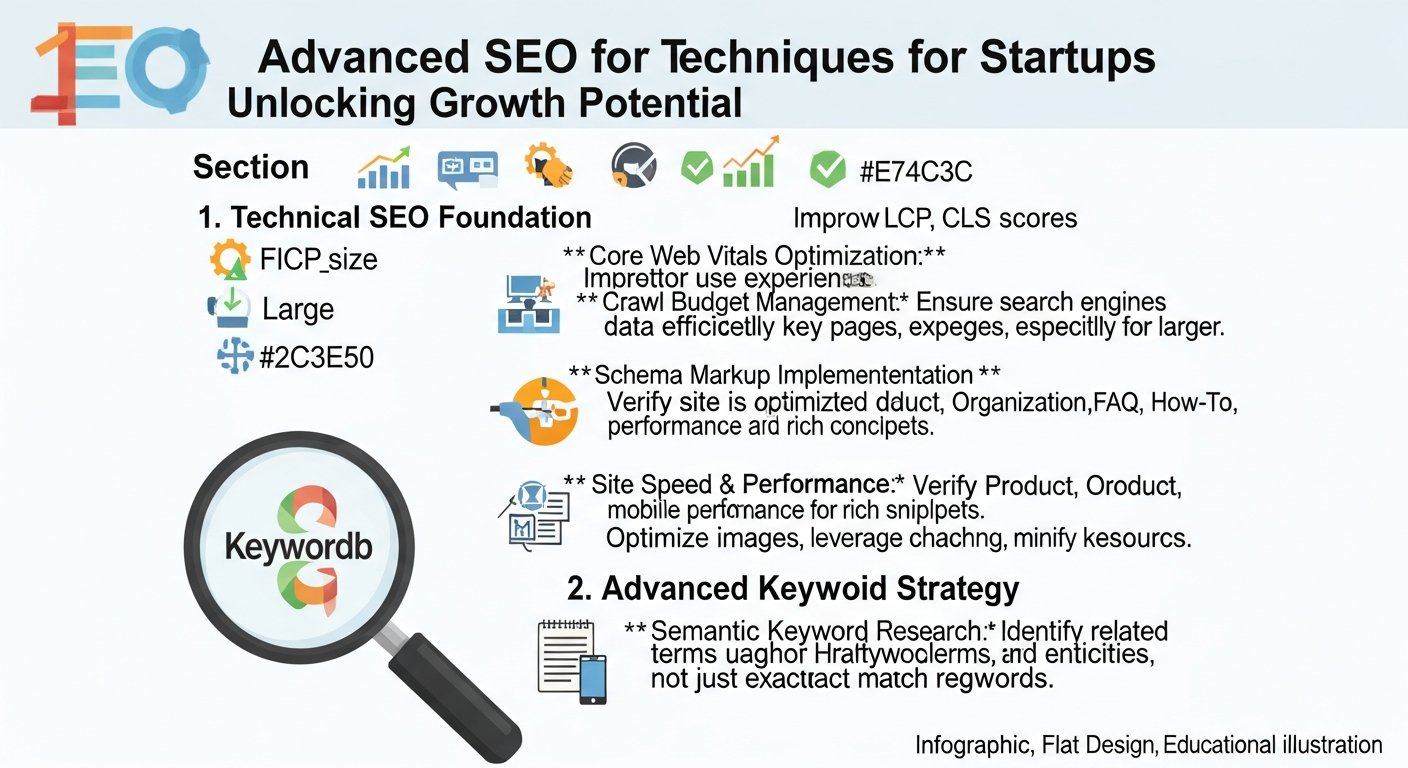
For a startup aiming for rapid business growth and seamless digital transformation, a robust technical SEO foundation is non-negotiable. This isn’t merely about having a fast website; it’s about optimizing the underlying architecture to ensure search engines can efficiently crawl, index, and understand your content at scale. This forms the bedrock upon which all other advanced strategies are built, ensuring your valuable content reaches its intended audience.
[INLINE IMAGE 1: place after second H2]
Optimizing Core Web Vitals for Superior User Experience
Google’s Core Web Vitals (CWV) are critical ranking factors that directly measure user experience. For startups, providing a snappy, responsive, and visually stable website is paramount, especially when vying for attention against established brands. Optimizing for Largest Contentful Paint (LCP), Cumulative Layout Shift (CLS), and First Input Delay (FID) ensures a positive first impression, reduces bounce rates, and signals quality to search engines. Focus on:
- Server Response Time: Choose a reliable hosting provider and optimize server-side rendering for quick content delivery.
- Efficient JavaScript Execution: Minimize render-blocking resources and defer non-critical JS to speed up page loading.
- Image Optimization: Compress images, use modern formats (WebP), and implement lazy loading to reduce bandwidth consumption.
Leveraging Structured Data for Enhanced Visibility
Structured data (Schema Markup) allows startups to communicate the meaning and context of their content directly to search engines. This semantic clarity can lead to rich results (e.g., star ratings, FAQs, product pricing) in SERPs, significantly boosting click-through rates. For a new venture, using Schema types like `Organization`, `Product`, `Service`, `LocalBusiness`, `Review`, and `FAQPage` is crucial for establishing identity and authority early on, providing immediate, valuable context for AI-driven search algorithms.
- Product/Service Schema: Essential for e-commerce or service-based startups to showcase offerings directly in search results.
- Organization Schema: Helps Google understand who your startup is, linking to founders, social profiles, and official contacts, building E-E-A-T.
- LocalBusiness Schema: If applicable, vital for local SEO, helping customers find physical locations or service areas.
Managing Crawl Budget and Mobile-First Indexing
Startups often launch with evolving websites and rapidly expanding content. Efficiently managing crawl budget—how often and how much Googlebot crawls your site—becomes critical. Prioritize important pages, remove low-value content, and ensure proper robots.txt and sitemap configurations. Furthermore, with Google’s mobile-first indexing, a responsive, fast, and fully functional mobile experience is not optional but a fundamental requirement for any startup seeking organic visibility and digital transformation.
- Site Architecture: Develop a logical, hierarchical site structure that allows for easy navigation for both users and crawlers.
- Internal Linking: Strategically link related content to distribute “link equity” and guide crawlers to important pages.
- Eliminate Duplicate Content: Use canonical tags to prevent crawl budget waste on identical or near-identical pages.
Table 1: Essential Technical SEO Optimizations for Startup Scalability
| Optimization Area | Why it Matters for Startups | Specific Action | Expected Impact |
|---|---|---|---|
| Core Web Vitals | Ensures superior user experience, reduces bounce rate, signals quality to search engines. | Optimize server response, compress images, defer non-critical JS. | Improved rankings, higher engagement, better conversion rates. |
| Structured Data | Provides semantic clarity, enables rich results, enhances CTR. | Implement `Organization`, `Product`, `Service`, `FAQPage` Schema types. | Increased visibility, higher qualified traffic, stronger entity recognition. |
| Crawl Budget Management | Ensures efficient indexing of critical content, prevents resource waste. | Optimize robots.txt, sitemap.xml, prune low-value pages, improve internal linking. | Faster indexing, better coverage of important content, improved overall site health. |
| Mobile-First Indexing | Crucial for organic visibility as Google primarily indexes mobile versions. | Ensure responsive design, fast mobile load times, full mobile functionality. | Sustained or improved mobile rankings, better user experience on all devices. |
| Site Architecture | Organizes content logically for users and search engines, supports scalability. | Create a clear hierarchy, logical categorization, and robust internal linking. | Improved user navigation, enhanced crawlability, better distribution of authority. |
Building Topical Authority and E-E-A-T for New Ventures
For any startup, establishing trust and expertise in its niche is paramount. Google’s emphasis on E-E-A-T (Experience, Expertise, Authoritativeness, Trustworthiness) is a clear signal that content quality and the credibility of its creators are vital for ranking. For new ventures, intentionally building topical authority and demonstrating E-E-A-T is an advanced SEO technique that can differentiate them from the competition and rapidly accelerate their digital transformation.
Developing Comprehensive Content Clusters
Rather than chasing individual keywords, startups should focus on building comprehensive content clusters around core topics relevant to their industry. This means creating a pillar page that broadly covers a topic, supported by numerous cluster content pieces that delve into specific sub-topics. This strategy demonstrates deep knowledge and vast coverage of a subject, signaling to search engines that your startup is a definitive source of information. This proactive approach to content creation helps in carving out significant topical authority within niche markets.
- Identify Core Topics: Map out the central problems your startup’s product or service solves.
- Create Pillar Content: Develop an extensive, high-quality guide on the core topic.
- Develop Cluster Content: Write detailed articles on specific sub-aspects, linking them back to the pillar page.
- Internal Linking: Use a robust internal linking structure to connect pillar and cluster content, enhancing semantic relationships.
Showcasing Expert-Level Author Credentials
Google values content created by real experts. For startups, showcasing the credentials of founders, team members, and contributors is a powerful E-E-A-T signal. This includes detailed author bios with links to professional profiles (e.g., LinkedIn, Google Scholar), industry awards, certifications, and previous work. If contributors have published research or spoken at conferences, highlight these achievements. This builds immediate trust and expertise, which is crucial for a new brand.
- Detailed Author Bios: Include relevant experience, qualifications, and affiliations.
- Schema Markup for Authors: Use `Person` Schema to identify authors and their expertise.
- External Portfolio Links: Link to professional profiles, publications, and industry recognitions.
Cultivating External Citations and Brand Mentions
Beyond on-page content, startups need to actively cultivate their off-page E-E-A-T. This involves earning mentions and links from reputable industry sources, academic institutions, and news outlets. This isn’t just about link building; it’s about building a credible brand presence across the web. Citing industry reports, academic papers, and expert interviews within your content also signals depth and a commitment to verifiable information, further enhancing trustworthiness.
- Digital PR & Outreach: Secure features, interviews, and guest posts on authoritative sites.
- Industry Partnerships: Collaborate with other credible businesses or organizations.
- Citations & References: Actively cite reputable sources within your content to back claims.
Semantic SEO & Entity Optimization: Mastering Search Intent
The days of optimizing solely for keywords are long gone. Modern SEO, especially for startups aiming for rapid digital transformation, revolves around understanding semantics and entities. This means optimizing for user intent, the relationships between concepts, and the discrete “things” (entities) that search engines recognize. Mastering semantic SEO allows startups to rank for broader query networks, even with limited initial resources, by providing truly comprehensive and relevant answers.
[INLINE IMAGE 2: place after fourth H2]
Uncovering Query Networks and User Intent
Instead of focusing on individual keywords, startups must investigate “query networks” – the interconnected web of questions, phrases, and concepts users explore around a topic. This requires moving beyond keyword volume to understand the various stages of the customer journey (informational, navigational, transactional, commercial investigation) and mapping content to each. By anticipating and answering all aspects of user intent within a topic, your startup becomes the authoritative resource for that entire query network.
- Deep Keyword Research: Utilize tools to identify related queries, questions, and long-tail variations.
- SERP Analysis: Analyze the top-ranking pages to understand the different intents Google is satisfying for a given query.
- Customer Journey Mapping: Align content with different stages of a customer’s decision-making process.
Mastering Entity Salience and Contextual Vectors
Entities are discrete concepts (people, places, things, ideas) that Google understands as distinct “things.” For a startup, ensuring its content explicitly mentions and semantically links to relevant entities related to its niche is critical. “Contextual vectors” refer to the relationships and nuances between these entities. By ensuring key entities are present, naturally used, and surrounded by relevant contextual information, startups can signal a deeper understanding of their topic, improving their relevance and ranking potential for complex queries, even with limited resources.
- Entity Identification: Research core entities relevant to your niche (e.g., if you’re a CRM startup, entities might include “customer relationship management,” “sales automation,” “lead generation,” “SaaS”).
- Entity Integration: Naturally weave these entities throughout your content, ensuring semantic richness.
- Knowledge Graph Optimization: Understand how your startup’s core entities relate to the wider knowledge graph and optimize for presence.
Implementing Discourse Integration for Semantic Depth
Discourse integration refers to the seamless and logical flow of ideas within a piece of content, ensuring that each sentence and paragraph builds upon the last, contributing to a cohesive and comprehensive understanding of the topic. For startups, this means crafting content that is not only factually accurate but also logically structured, addressing all facets of a query network without disjointed jumps. This depth and coherence signals high quality and expertise to search engines and provides an excellent user experience, furthering digital transformation goals.
- Logical Structure: Outline content with a clear introduction, body paragraphs that develop ideas, and a strong conclusion.
- Cohesive Language: Use transition words and phrases to ensure smooth flow between ideas and sections.
- Comprehensive Coverage: Aim to answer all relevant sub-questions and related queries within a single, well-structured piece of content.
Table 2: Advanced SEO Techniques for Startups: A Strategic Overview
| Technique | Description | Startup Benefit | Key Action for Startups |
|---|---|---|---|
| Technical SEO | Optimizing website infrastructure for crawlability, indexability, and user experience. | Scalability, improved site performance, higher rankings, reduced bounce rate. | Core Web Vitals optimization, structured data implementation, crawl budget management. |
| Semantic SEO | Optimizing for user intent, entities, and conceptual relationships, not just keywords. | Dominance in niche query networks, higher relevance for complex queries, future-proofing. | Query network analysis, entity optimization, discourse integration in content. |
| Topical Authority | Establishing comprehensive expertise and coverage across a specific subject area. | Become a go-to resource, higher E-E-A-T, sustained organic traffic. | Content clusters, pillar pages, extensive internal linking. |
| E-E-A-T Building | Demonstrating Experience, Expertise, Authoritativeness, and Trustworthiness. | Increased credibility, better rankings, stronger brand reputation, investor confidence. | Showcase author credentials, cultivate external citations, build expert bios. |
| Programmatic SEO | Automated content generation for long-tail keywords using data templates. | Rapid content scaling, niche market dominance, efficient long-tail traffic acquisition. | Identify content templates, leverage data sources, automate content creation. |
| AI-Driven SEO | Using AI and LLMs for content optimization, keyword research, and insights. | Efficiency, deeper insights, improved content quality and relevance. | AI for content briefs, summarization, semantic analysis, competitive intelligence. |
Programmatic SEO & AI Integration for Accelerated Growth
For startups with aspirations of rapid business growth and extensive digital transformation, the ability to scale content efficiently is a game-changer. Programmatic SEO and the strategic integration of AI and LLMs offer powerful solutions to generate vast amounts of targeted, high-quality content that can dominate niche markets and long-tail searches without requiring an army of writers.
Strategies for Automated Content Scaling
Programmatic SEO involves using data and templates to automatically generate pages for highly specific, long-tail keyword variations. This is particularly effective for startups offering services or products across many locations, industries, or specific use cases (e.g., “CRM software for [industry],” “project management tools for [team size],” “e-commerce solutions for [city]”). By systematically creating these pages, startups can capture a significant volume of highly targeted organic traffic that competitors might overlook, proving to be a highly efficient strategy even with limited resources.
- Identify Scalable Keywords: Find patterns in long-tail keywords that can be templatized.
- Data Sourcing: Gather structured data relevant to your templated content (e.g., industry data, location data).
- Template Creation: Design high-quality, unique templates that incorporate data dynamically while maintaining E-E-A-T.
- Automated Generation: Use tools or custom scripts to generate pages at scale.
Harnessing AI and LLMs for Content Generation and Optimization
The advent of advanced AI and LLMs has revolutionized content creation and SEO. Startups can leverage these tools to significantly enhance their content strategy. This isn’t about fully automating content creation without human oversight, but rather using AI as a powerful assistant for:
- Content Brief Generation: Quickly creating detailed briefs that incorporate target keywords, entities, and competitor analysis.
- Semantic Optimization: Identifying missing entities or contextual vectors to enrich existing content.
- Content Refinement: Improving readability, grammar, and style; generating summaries or meta descriptions.
- Ideation and Research: Brainstorming new content ideas, summarizing complex topics, and identifying query networks.
- Multilingual Content: Rapidly translating and localizing content for global expansion, aiding in international digital transformation.
Measuring Success & Iteration: Agile SEO for Startups
For startups, every investment, including advanced SEO, must demonstrate a clear return. Measuring success goes beyond basic traffic numbers; it involves tying SEO performance directly to business growth metrics. An agile approach to SEO, characterized by continuous monitoring, analysis, and iteration, is crucial for optimizing campaigns and ensuring they align with overarching digital transformation goals.
Key Performance Indicators (KPIs) for Advanced SEO
While organic traffic remains important, startups must focus on more granular, business-centric KPIs to truly gauge the impact of advanced SEO techniques. These metrics provide insights into user behavior, conversion pathways, and ultimately, profitability:
- Entity-Based Keyword Rankings: Tracking performance for clusters of semantically related keywords, not just isolated terms.
- Topical Authority Score: Developing internal metrics or using specialized tools to assess the depth and breadth of your domain’s expertise.
- Conversion Rate via Organic Search: The percentage of organic visitors who complete a desired action (e.g., sign-up, demo request, purchase), directly impacting user acquisition cost.
- SEO ROI: Calculating the revenue generated from organic search against the investment in SEO, crucial for demonstrating value to investors.
- Customer Acquisition Cost (CAC) via Organic: Comparing the cost of acquiring a customer through organic channels versus paid channels.
- Brand Mentions & Citations: Tracking unlinked and linked mentions across the web as a sign of E-E-A-T and brand recognition.
Implementing Agile SEO Cycles
The digital landscape is constantly evolving, with new algorithm updates from Google and emerging competitors. An agile approach allows startups to quickly adapt and optimize their SEO strategies. This involves:
- **Plan:** Define short-term goals based on data and competitive analysis.
- **Do:** Implement specific advanced SEO techniques (e.g., optimizing a content cluster, deploying new Schema).
- **Check:** Monitor KPIs closely, analyzing the impact of implemented changes.
- **Act:** Iterate on strategies, pivot where necessary, and plan the next cycle based on learnings.
This iterative process ensures that SEO efforts remain aligned with the startup’s evolving needs and market dynamics, sustaining long-term business growth.
Table 3: Measuring Advanced SEO Success & Startup Growth Metrics
| Metric | Definition | Relevance for Startups | Tools |
|---|---|---|---|
| Organic Traffic Growth | Increase in visitors coming from search engines. | Fundamental indicator of increasing visibility and brand awareness. | Google Analytics, Google Search Console |
| Entity-Based Keyword Rankings | Tracking SERP positions for clusters of semantically related terms. | Confirms topical authority and relevance for complex user queries. | SEMrush, Ahrefs, SERPSTAT |
| Topical Authority Score | Internal or tool-generated score reflecting domain expertise on topics. | Measures strength of content clusters and E-E-A-T signals. | Surfer SEO, Clearscope (conceptual score), Custom metrics |
| Conversion Rate (Organic) | Percentage of organic visitors completing a desired action. | Directly links SEO efforts to revenue generation and customer acquisition. | Google Analytics (Goals/Events), CRM data |
| SEO ROI | Return on investment from SEO activities. | Demonstrates financial viability of SEO to stakeholders and investors. | Custom tracking, CRM, attribution models |
| Customer Acquisition Cost (CAC) via Organic | Cost to acquire a new customer through organic channels. | Compares efficiency of organic vs. paid channels for customer acquisition. | Google Analytics, CRM, Cost data |
Future Trends: AI, Personalized Search, and Beyond for Startup SEO
The landscape of search is never static, and for startups, anticipating and adapting to future trends is a crucial component of long-term digital transformation and sustainable business growth. The integration of AI, the rise of personalized search experiences, and the evolution of conversational interfaces will profoundly impact how advanced SEO techniques are applied in the coming years.
The Impact of AI and Personalized Search
Google’s continuous integration of AI (like RankBrain, BERT, MUM, and more recently, advanced LLMs for generative search experiences) signifies a shift towards highly contextual and personalized search results. For startups, this means a greater emphasis on creating content that answers complex queries comprehensively, demonstrates genuine E-E-A-T, and caters to specific user segments. Personalization means that a “one-size-fits-all” SEO approach will become less effective, necessitating a deeper understanding of target audience psychographics and individual user journeys.
- Contextual Relevance: Focus on broader topic authority over isolated keywords.
- User Segmentation: Tailor content to different user personas and their unique search intents.
- Predictive Analytics: Leverage AI tools to anticipate future search trends and user needs.
Voice Search and Conversational SEO Strategies
As voice assistants become ubiquitous, voice search is an increasingly important channel for startups to optimize for. Voice queries are typically longer, more conversational, and often question-based. This requires a shift from traditional keyword optimization to a focus on natural language processing, answering direct questions, and optimizing for featured snippets and “answer boxes.”
- Question-Based Content: Create content that directly answers common questions related to your niche (who, what, when, where, why, how).
- Long-Tail Keyword Focus: Prioritize conversational long-tail queries that mimic natural speech.
- Local SEO Optimization: Many voice searches are local (“near me”), making robust local SEO (Google Business Profile, local Schema) essential for startups with physical locations or service areas.
In conclusion, for startups striving for explosive business growth and a leading position in the era of digital transformation, the adoption of advanced SEO techniques is no longer optional. From meticulously crafting a technical foundation and building unparalleled topical authority to mastering semantic optimization and leveraging cutting-edge AI, these strategies provide the crucial leverage needed to stand out, attract targeted customers, and secure a sustainable future. By embracing an agile, data-driven approach, founders can ensure their SEO efforts are not just a marketing expense, but a foundational investment in their venture’s long-term success.