Beyond the Black Box: The Engineer’s Guide to Low-Code Automation in 2026
For a long time, “low-code” was a dirty word in engineering circles. It conjured images of rigid “drag-and-drop” builders, vendor lock-in, and proprietary “black boxes” that were impossible to version control or debug. To a software engineer, these tools often felt like handcuffs—trading flexibility and power for a superficial speed that ultimately resulted in unmanageable technical debt.
However, as we move into 2026, the paradigm has fundamentally shifted. The new generation of low-code automation isn’t designed to replace engineers; it’s built to empower them. Today’s platforms are “engineering-first,” offering high-level abstractions for the “plumbing” of integrations while providing deep extensibility through custom code, Git-based version control, and robust CLI tools. For tech professionals building complex workflows and microservices, low-code is no longer about avoiding code—it’s about optimizing where that code is written. By automating the boilerplate of API authentication, retry logic, and state management, engineers can focus on the core business logic that actually drives value.
1. The Evolution: From “No-Code” Toys to Engineering-First Platforms
The early days of automation focused on the “citizen developer,” prioritizing ease of use over scalability and security. This led to a massive disconnect between IT departments and the business units using these tools. In 2026, the industry has matured into what many call “Pro-Code Low-Code.”
Modern platforms acknowledge that engineers need more than just a visual canvas. They need a tool that fits into their existing SDLC (Software Development Life Cycle). This means support for environment variables, secrets management, and the ability to export workflows as code. The shift represents a move from “abstraction as a restriction” to “abstraction as a service.” Engineers are now using low-code layers to handle the monotonous aspects of distributed systems—such as managing webhooks, handling rate limits, and normalizing JSON data—without losing the ability to drop into a Python or TypeScript environment when a custom algorithm is required.
2. Solving the “Plumbing” Problem: API Orchestration at Scale
Every engineer knows that the hardest part of building an integration isn’t the logic itself; it’s the glue code. Handling OAuth2 handshakes, managing expired tokens, implementing exponential backoff for failed requests, and ensuring idempotency across distributed systems can consume 70% of a project’s timeline.
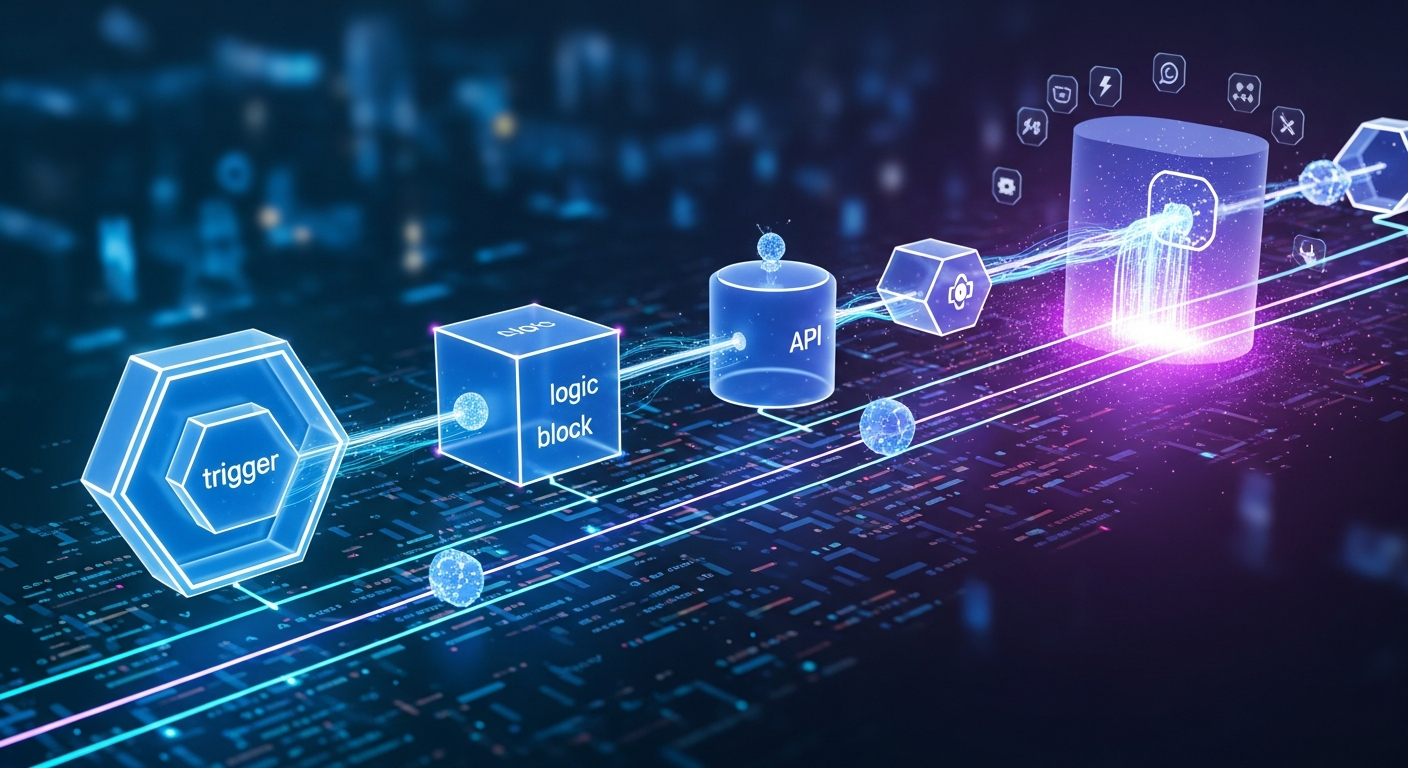
Low-code automation platforms act as a sophisticated middleware layer that standardizes these interactions. Instead of writing a custom wrapper for every SaaS API your company uses, you leverage pre-built, authenticated connectors that are maintained by the platform provider. In 2026, these connectors are no longer static; they are often dynamically updated via OpenAPI specifications. For engineers, this means the “plumbing” is handled out of the box, allowing them to focus on the orchestration logic. Whether you are syncing data between a legacy PostgreSQL database and a modern Snowflake instance or triggering a complex CI/CD pipeline in GitHub Actions based on a Jira ticket status, the focus remains on the data flow rather than the underlying transport mechanics.
3. Infrastructure as Code (IaC) and the DevOps Loop
One of the primary reasons engineers resisted low-code was the lack of visibility. If a workflow lives only in a visual editor, how do you peer-review it? How do you roll back a breaking change?
The leading platforms of 2026 have solved this by treating workflows as code. “Headless” low-code allows engineers to define their visual workflows in YAML or JSON files that reside in a Git repository. When a change is made in the visual UI, it triggers a commit; conversely, a push to the repository updates the visual representation. This enables a seamless DevOps loop where automation workflows are subject to the same pull request (PR) processes, unit testing, and staging environments as any other microservice. By integrating low-code into the CI/CD pipeline, engineering teams can ensure that their automations are scalable, auditable, and compliant with enterprise governance standards.
4. Extensibility: When Drag-and-Drop Reaches Its Limit
The litmus test for any low-code tool used by engineers is what happens when you hit a wall. In the past, if a tool didn’t have a specific feature, you were stuck. Modern engineering-first platforms solve this through high-performance execution environments for custom snippets.
Imagine an automation that processes incoming telemetry data. The platform handles the ingestion via webhooks and the initial filtering through a visual interface. However, the data requires a specific cryptographic signature verification or a complex data transformation that would be messy in a visual builder. In 2026, you simply open an inline IDE window, write the necessary Node.js or Go code, import any required NPM packages or modules, and execute that logic as a native step within the workflow. This “hybrid” approach allows engineers to use the visual layer for high-level visibility and the code layer for technical precision, ensuring that the tool never becomes a bottleneck for complex requirements.
5. Security, Governance, and Error Handling in the Modern Stack
For SREs and Security Engineers, “shadow IT” automations are a nightmare. Low-code for engineers addresses this by providing centralized visibility and enterprise-grade security features. This includes Role-Based Access Control (RBAC), SOC2 compliance, and integration with identity providers like Okta or Azure AD.
Furthermore, error handling in modern low-code tools has evolved far beyond a simple “on failure” notification. Engineers can now define sophisticated error-handling schemas, including global error listeners, try-catch blocks within visual flows, and automated incident creation in tools like PagerDuty or Opsgenie. With the rise of autonomous agents and AI-driven monitoring in 2026, many low-code platforms can now suggest “self-healing” steps—such as restarting a container or purging a cache—when a workflow step consistently fails due to a downstream dependency issue. This level of observability ensures that automation remains a reliable part of the infrastructure rather than a source of “silent failures.”
6. The 2026 Outlook: AI-Augmented Automation and Autonomous Workflows
As we look toward the remainder of 2026, the intersection of Generative AI and low-code is where the most significant gains are being made. Engineers are now using LLM-powered assistants to generate complex workflow structures from natural language prompts. For example, an engineer might prompt: *”Build a workflow that listens for Stripe ‘payment_succeeded’ events, verifies the user in our production DB, and triggers a welcome sequence in Braze, with a Slack notification to the sales team if the value is over $5k.”*
The platform doesn’t just build the visual flow; it suggests the SQL queries, writes the regex for data validation, and sets up the error handling. This isn’t “auto-pilot” for non-coders; it’s a “copilot” for engineers that eliminates the friction of manual configuration. The role of the engineer is shifting from a builder of individual integrations to an architect of autonomous systems that can adapt to changing API schemas and business requirements with minimal manual intervention.
—
FAQ: Low-Code Automation for Tech Professionals
#
1. Won’t low-code tools limit my ability to customize complex logic?
Not anymore. Engineering-first platforms are designed with “escape hatches.” You can write custom code (JavaScript, Python, Go) directly within the workflow whenever the visual blocks are insufficient. Think of the visual layer as the “orchestrator” and your custom code as the “performer.”
#
2. How do we handle version control and deployment?
Modern platforms support Git-sync. You can manage your workflows in a repository, use branches for development, and deploy across environments (Dev, Staging, Prod) using your existing CI/CD tools. Every change is tracked, and rollbacks are as simple as reverting a commit.
#
3. Is the performance of low-code platforms sufficient for high-volume data?
While custom-built Go or Rust services will always be faster for raw computational tasks, modern low-code engines are built on top of serverless architectures (like AWS Lambda or K8s) that scale horizontally. For the vast majority of API-based integrations and business logic, the latency added by the platform is negligible compared to the network latency of the APIs themselves.
#
4. How does low-code impact technical debt?
When used correctly, it actually *reduces* technical debt. By offloading the maintenance of API connectors and authentication protocols to the platform provider, you reduce the surface area of code your team has to manage. However, it requires governance to ensure that “quick fixes” don’t become permanent, undocumented workarounds.
#
5. Can I use my own libraries and dependencies in these workflows?
Yes. Most professional-grade platforms allow you to import NPM or PyPI packages into your custom code steps. Some even allow you to bring your own Docker images to run specialized environments as part of an automated sequence.
—
Conclusion: The Engineer as an Automation Architect
The transition to low-code in 2026 isn’t about doing less; it’s about building more. As the demand for integrations and automated workflows continues to outpace the supply of developer talent, engineers must find ways to increase their leverage. High-level automation platforms provide that leverage by standardizing the tedious parts of the job.
By embracing “pro-code” low-code, engineering teams can move away from being the “integration bottleneck” and toward being the architects of a scalable, automated enterprise. The goal is to spend less time reading API documentation and more time solving high-level architectural challenges. In the modern stack, the most successful engineers won’t be the ones who write the most lines of code, but the ones who build the most resilient and efficient systems using the best tools available—code or no code.