
Community-Led Growth: The Complete SaaS Playbook (2026)
Affiliate disclosure: This article may contain affiliate links. Recommendations are independent and editorially driven.
In the relentlessly competitive landscape of SaaS, the traditional growth playbooks are no longer sufficient. Product-Led Growth (PLG) and Sales-Led Growth (SLG) have carved out their territories, but a powerful, often underestimated third pillar has emerged: Community-Led Growth (CLG). This strategic imperative is rapidly transforming how SaaS companies acquire, retain, and expand their customer base, creating defensible moats and fostering advocacy at scale. Far from a passing fad, CLG is becoming the default operating system for enduring SaaS success, blending authentic engagement with measurable business outcomes.
This comprehensive playbook will dissect the nuances of Community-Led Growth, offering a deeply practical guide for SaaS founders, product leaders, marketing teams, and community managers. We’ll move beyond the buzzwords and into the trenches, providing actionable frameworks, critical metrics, and specific platform recommendations to help you design, launch, and scale a robust community that drives significant, sustainable growth for your SaaS product. Prepare to learn how to integrate CLG seamlessly into your existing growth engines, creating a potent synergy that accelerates go-to-market strategies and supercharges your LTV:CAC ratio.
The Evolution of SaaS Growth Models: PLG, SLG, and the Rise of Community-Led Growth
Understanding where Community-Led Growth fits requires a quick look back at the dominant paradigms that shaped SaaS. For years, the industry leaned heavily on two primary models, often treated as mutually exclusive paths rather than complementary strategies.
Product-Led Growth (PLG): The Self-Serve Revolution
PLG revolutionized SaaS by putting the product at the center of the growth engine. Companies like Slack, Zoom, and Dropbox mastered the art of low-friction onboarding, intuitive user experiences, and viral loops that allowed users to discover, adopt, and even expand their usage without ever speaking to a salesperson. The core tenets of PLG include:
- Self-serve acquisition: Users sign up for free trials or freemium versions, experiencing value firsthand.
- Product as the primary acquisition channel: The product itself markets its value through virality, ease of use, and word-of-mouth.
- Reduced customer acquisition cost (CAC): Less reliance on sales and traditional marketing funnels.
- Focus on user experience and retention: A great product keeps users engaged and encourages upgrades.
While incredibly powerful, PLG can face challenges. It often works best for products with immediate, tangible value, and can struggle with complex enterprise solutions requiring significant trust, integration, or customization.
Sales-Led Growth (SLG): The Human Touchpoint
SLG, the more traditional model, relies on a dedicated sales team to identify, qualify, and close deals. This approach is prevalent in enterprise SaaS, where complex solutions, high contract values, and extensive onboarding processes necessitate human interaction. Key characteristics of SLG include:
- Direct sales engagement: Account executives build relationships and guide prospects through the sales cycle.
- High Average Contract Value (ACV): Often targeting larger businesses with significant budgets.
- Customized solutions: Sales teams work with clients to tailor offerings to specific needs.
- Longer sales cycles: The consultative nature of enterprise sales often extends the decision-making process.
SLG’s downside can be its high CAC due to extensive sales and marketing efforts. It can also be perceived as less authentic in an era where buyers prefer to research solutions independently.
The Emergence of Community-Led Growth (CLG)
Community-Led Growth represents a sophisticated evolution, recognizing that customers don’t just buy products; they join ecosystems. CLG is fundamentally about building a vibrant, engaged community around your product or problem space, leveraging the collective wisdom and advocacy of your users to drive acquisition, product development, retention, and expansion. It’s the strategic integration of authentic human connection into the core growth strategy. Companies like Figma, Notion, and HubSpot have become titans partly because of their masterful command of CLG.
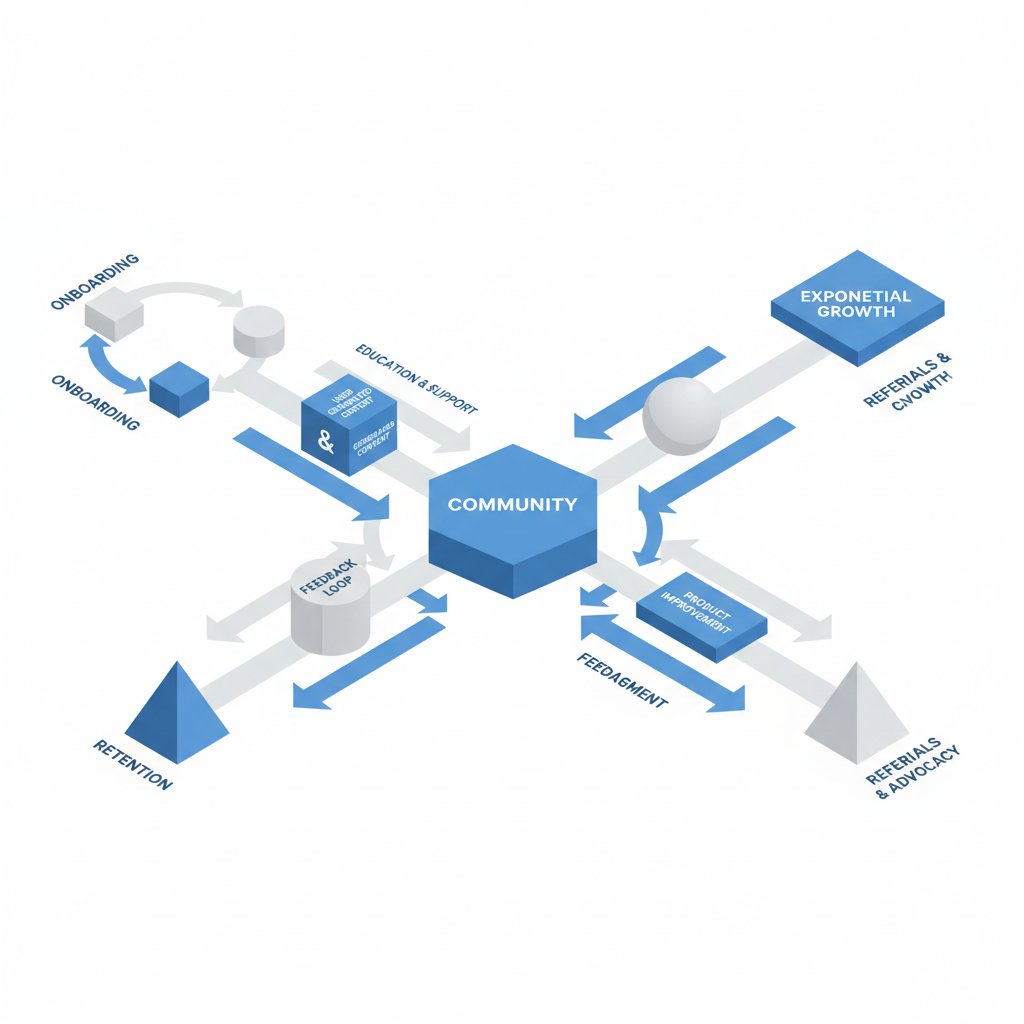
CLG isn’t a replacement for PLG or SLG; it’s a powerful accelerant. It acts as a bridge, reducing the friction in PLG funnels and increasing trust in SLG processes. By cultivating a space where users can learn from each other, get support, provide feedback, and share best practices, CLG generates invaluable flywheel effects:
- Organic marketing and referrals: Community members become your most passionate advocates.
- Faster product feedback loops: Direct insights from power users shape your product roadmap.
- Peer-to-peer support: Reduces pressure on customer support teams.
- Increased user stickiness and retention: Users stay for the community as much as for the product.
- Stronger brand affinity: A sense of belonging fosters loyalty and emotional connection.
[INLINE IMAGE 1: place after second H2 | alt=”Community Led Growth: The Complete SaaS Playbook concept illustration”]
Strategic Foundations: Defining Your Community, Purpose, and Core Value Proposition

Before diving into platforms and tactics, a successful Community-Led Growth strategy requires a clear-eyed understanding of its foundational elements. Without these, your community efforts will lack direction and struggle to deliver tangible business value.
Identifying Your Ideal Community Member Profile (ICMP)
Just as you define an Ideal Customer Profile (ICP), you need an ICMP. Who are the people who will not only use your product but actively contribute to and benefit from a community around it? This isn’t just about demographics; it’s about psychographics, motivations, and pain points:
- What common goals do they share? E.g., “growing my SaaS startup,” “mastering product analytics,” “streamlining design workflows.”
- What challenges do they face that your community can help solve? E.g., “finding expert advice,” “learning new features,” “networking with peers.”
- What knowledge or skills can they contribute? Enthusiastic experts, mentors, or power users are invaluable.
- Where do they currently congregate online and offline? This informs your initial outreach.
A narrow, well-defined ICMP is better than a broad, vague one. Start with a specific segment and grow from there.
Articulating Your Community’s Unique Purpose and Vision
Why should anyone join your community? What overarching goal does it serve, beyond just “talking about your product”? A strong mission statement acts as a guiding star:
- Support-focused: “A place for users to get answers, share tips, and troubleshoot issues.”
- Educational: “Learn best practices, master advanced features, and stay ahead in [industry/skill].”
- Networking/Professional Development: “Connect with peers, find collaborators, and grow your career.”
- Product feedback/Co-creation: “Influence the future of [product name] and contribute to its development.”
Your purpose should align directly with your overall business objectives, whether that’s reducing support tickets, improving product stickiness, or accelerating expansion revenue.
Mapping Community Value to Business Outcomes
The “soft” nature of community often leads to skepticism about its ROI. To counter this, you must explicitly link community activities to hard business metrics. This is essential for gaining executive buy-in and continued investment.
- Acquisition: How does community-generated content (user-generated, testimonials, case studies) attract new leads? How do community events create top-of-funnel awareness?
- Activation: Does peer support and onboarding help new users get started faster and achieve their first “aha!” moment?
- Retention & Churn Reduction: Do engaged community members renew at higher rates? Does the community provide solutions that prevent users from abandoning the product?
- Expansion & Monetization: Do power users in the community discover new use cases, upgrade to higher tiers, or become advocates for specific features?
- Product Development: How does community feedback directly influence roadmap decisions, leading to higher product-market fit?
- Customer Support: How does self-service and peer support within the community deflect tickets and free up your support team?
For example, a community focused on “mastering advanced analytics for marketing” might directly lead to higher adoption of complex features, reducing churn among sophisticated users who might otherwise feel unsupported.
Launching Your Community: Seeding, Platforms, and Initial Engagement Strategies
The launch phase for a Community-Led Growth initiative is crucial. It’s not about opening the doors and waiting; it’s about strategic seeding, platform selection, and deliberate efforts to spark initial engagement.
Step 1: The “Nucleus” Strategy – Choosing Your Beta Users and Founding Members
Don’t launch to everyone at once. Instead, identify and invite a small, highly engaged group of initial members:
- Identify Product Champions: These are your power users, early adopters, or customers who frequently provide valuable feedback. They’re enthusiastic and understand your product deeply.
- Seek Out Influencers: People with an audience in your niche who align with your brand values. Their presence can lend credibility and attract others.
- Select Beta Program Participants: If you have an existing beta program for new features, these users are naturally inclined to collaborate and offer insights.
- Internal Stakeholders: Your own employees who are passionate about the product and can model good community behavior.
This “nucleus” group will be instrumental in setting the tone, generating initial discussions, and providing social proof. They are the initial spark that ignites the fire.
Step 2: Platform Selection – Where to Build Your Digital Home
The choice of platform is critical, impacting features, scalability, and long-term engagement. There’s no one-size-fits-all solution; the best choice depends on your budget, required functionality, and the preferences of your ICMP.
Comparison Table: Community Platforms for SaaS
| Platform | Strengths | Best For | Considerations |
|---|---|---|---|
| Discord | Real-time chat, voice channels, event hosting, bots, highly customizable. Large existing user base. | Gaming, developer communities, fast-paced discussion, event-driven engagement. | Can be noisy, user retention can be challenging without strong moderation, less formal for documentation. |
| Slack | Similar to Discord, popular for internal teams, strong integrations, threaded discussions. | Smaller, more professional groups, internal communities, focused project collaboration with clients. | Price scales with users, less suitable for very large, public communities, discovery within Slack can be challenging. |
| Circle | Dedicated community software, forum-like structure, courses, member profiles, paywalls, excellent content organization. | Content-rich communities, online courses, membership sites, communities where structure and quality content are key. | Higher price point than free chat apps, requires more active content creation, less real-time chat focus. |
| Discourse | Open-source forum software, strong moderation tools, highly customizable, SEO-friendly for public knowledge. | Technical support communities, knowledge bases, long-form discussions, user-generated documentation. | Self-hosted options require technical expertise, UI can feel dated to some users, less emphasis on real-time chat. |
| Bettermode (formerly Tribe) | Modern, customizable community platform, integrations, Q&A, knowledge base, private groups, gamification. | Customer support, product feedback, brand advocacy, communities needing a blend of discussion and structure. | Pricing can be a factor, platform lock-in, some features require higher tiers. |
| Native Solution | Full control, deep integration with your product, complete branding. | Large enterprises with specific, complex needs, high traffic, desire for seamless user experience within their app. | High development cost, ongoing maintenance, long build time, requires significant resources. |
Consider a phased approach: start with a simpler platform like Discord or Slack for quick interaction, and then migrate to a more structured platform like Circle, Discourse, or Bettermode as your community grows and its needs evolve. This allows you to validate interest before significant investment.
Step 3: Crafting Engaging Content and Initial Discussion Prompts
Once your platform is ready and your nucleus invited, you need to provide fuel for interaction:
- Welcome messages and onboarding guides: Explain the community’s purpose and how to get started.
- Personal introductions: Encourage members to share who they are and what they hope to gain.
- Expert Q&A sessions: Host live sessions with product managers, engineers, or industry experts.
- Feature discussions: Ask for feedback on new features or ideas for the roadmap.
- Tutorials and how-tos: Share valuable content related to your product or the problem it solves.
- Challenges or contests: Gamify participation to drive engagement and showcase creativity.
- Icebreaker questions: Simple, low-stakes questions to get people talking.
The goal is to facilitate connection and ensure that early members feel heard and valued. The first discussions set the precedent for the community’s culture.
Discover strategies for kickstarting your community.
Scaling Your Community: Moderation, Engagement, and Program Development
Once your community is launched, the real work begins: nurturing its growth, maintaining its health, and continuously extracting value. This involves robust moderation, innovative engagement programs, and a clear path for members to level up their participation.
Community Operations: From Moderation to Measuring Health
Effective community operations are the backbone of a thriving CLG strategy.
- Moderation Best Practices:
- Clear Guidelines: Establish and enforce a code of conduct from day one.
- Proactive vs. Reactive: Actively watch for issues, don’t just react to complaints.
- Community Moderators: Empower trusted, enthusiastic members to help moderate and manage discussions.
- Conflict Resolution: Have a clear process for handling disagreements and maintaining a positive tone.
- Anti-Spam Measures: Implement tools and strategies to combat unwanted content and users.
- Driving Ongoing Engagement:
- Regular Programming: Scheduled AMAs, workshops, office hours, or themed discussion days.
- Member-Generated Content: Encourage users to share their own tutorials, templates, or success stories.
- Gamification: Leaderboards, badges, points, or exclusive access based on contributions.
- Recognition Programs: Spotlight top contributors, community heroes, or valuable feedback.
- Feedback Loops: Show members how their input directly influences product improvements or decisions.
- Personalized Outreach: Reach out to dormant members to re-engage them with relevant discussions or content.
- Transitioning from Chat to Structured Platforms:
Many communities start on real-time chat platforms like Slack or Discord due to their low barrier to entry. However, as communities grow, the ephemeral nature of chat can become a hindrance. Important discussions get lost, and discoverability suffers. Plan for a migration to a more structured platform (e.g., Circle, Discourse, Bettermode) when:
- There’s a significant volume of repeat questions that could be answered in a searchable knowledge base.
- Important announcements or resources get buried in chat history.
- Members express frustration with the lack of organization or difficulty finding past conversations.
- You need more robust member profiles, content categorization, or integration with other tools (eg. CRM).
This transition should be carefully managed with clear communication, migration support, and highlighting the new platform’s benefits.
[INLINE IMAGE 2: place after fourth H2 | alt=”Community Led Growth: The Complete SaaS Playbook comparison illustration”]
The Community-Led Growth Flywheel: Integrating CLG with PLG & SLG
CLG doesn’t operate in a vacuum. Its true power is unlocked when it amplifies and is amplified by your Product-Led and Sales-Led efforts. Visualize this as a dynamic growth flywheel, where each component feeds the others.
- CLG & PLG Synergy:
- User Activation: Community provides peer support, onboarding guidance, and answers to queries, helping new users overcome initial hurdles and achieve faster “aha!” moments, thus improving activation rates.
- Feature Adoption: Power users in the community showcase advanced use cases, inspiring others to explore and adopt underutilized features.
- Product Feedback: The community becomes a direct, unfiltered channel for essential product ideas, bug reports, and validation, feeding directly into product development and improving product-market fit.
- Content Generation: User-generated content (tutorials, templates, best practices) from the community enriches your product’s educational resources, boosting PLG’s self-serve experience.
- CLG & SLG Synergy:
- Lead Generation: Engaged community members can become Community-Qualified Leads (CQLs), identifiable through their active participation, thoughtful questions, or expressed interest in higher tiers/features. CLG can also attract top-of-funnel prospects looking for solutions.
- Sales Enablement: Sales teams can leverage community discussions to understand common pain points, gather competitive intelligence, and find relevant success stories to share with prospects.
- Trust and Credibility: A vibrant community serves as powerful social proof, reducing sales friction and accelerating deals. Prospects can see real users deriving value.
- Customer Success & Expansion: Post-sale, the community helps new customers adopt the product faster, reducing churn and identifying up-sell/cross-sell opportunities through observed feature usage or expressed needs.
The CLG flywheel accelerates when community insights drive product improvements, which in turn attract more users, who then become active community members, completing the loop. Similarly, community engagement can warm leads for sales, and successful sales bring in more potential community members.
Measuring Success: Key Metrics for Community-Led Growth
To prove the value of your Community-Led Growth efforts, you need robust metrics. These go beyond vanity metrics to demonstrate tangible business impact. Here are essential CLG metrics to track and analyze:
Engagement Metrics: Understanding Activity and Aliveness
- Daily Active Members (DAM) & Monthly Active Members (MAM): These fundamental metrics track the number of unique members engaging with your community on a daily and monthly basis. A healthy ratio indicates consistent activity.
- Engagement Rate: (DAM or MAM / Total Members) x 100. This indicates the proportion of your community that is actively participating.
- Consumption Rate: How many times is content (posts, answers, articles) viewed? This shows passive engagement and interest.
- Creation Rate: Number of new posts, comments, replies, or shared resources created by members. This is a strong indicator of active contribution.
- Top Contributors: Identify the most active and valuable members. These are your superfans and potential moderators.
Retention & Churn Metrics: The Stickiness Factor
- Community Retention Rate: The percentage of members who remain active over a given period. More sophisticated tracking might segment this by product usage.
- Member Churn Rate: The rate at which members become inactive or leave the community.
- Product Churn Correlation: Analyze if highly engaged community members have lower product churn rates compared to non-community members. This directly ties CLG to a critical SaaS metric.
Acquisition & Growth Metrics: Fueling the Top-of-Funnel
- Community-Qualified Leads (CQLs): Define specific actions (e.g., participating in a “pricing” discussion, asking about advanced features, attending a product webinar) that qualify a community member as a potential sales lead.
- Referrals from Community: Track how many new users or customers come directly from community recommendations or discussions.
- Website Traffic from Community: Monitor traffic directed to your product website or landing pages from the community platform.
- Trial-to-Paid Conversion for Community Members: Compare conversion rates for users who engage with the community during their trial versus those who don’t.
Impact on Product & Support: Efficiency and Quality
- Deflected Support Tickets: The number of customer support inquiries that are resolved within the community by peers or through self-service resources. This directly demonstrates cost savings.
- Product Feedback Loop: Quantify how many product ideas originated from the community and how many were implemented into the product roadmap.
- Feature Adoption Rates: Track if specific features see higher adoption among community members who discuss or learn about them in the community.
Overall Business Impact: The LTV:CAC Ratio and NPS
- LTV:CAC Ratio Impact: The ultimate measure. CLG can increase Lifetime Value (LTV) through improved retention and expansion, and decrease Customer Acquisition Cost (CAC) through organic referrals and CQLs. Model the financial impact by comparing LTV:CAC for segments of users that are highly engaged in the community versus those who are not.
- Net Promoter Score (NPS) vs. Active Community Sentiment: While NPS measures overall customer loyalty, active community sentiment (often gauged through surveys within the community, direct feedback, or content analysis) provides a more nuanced, real-time understanding of your most engaged users’ feelings. A high positive sentiment within the community often correlates with a higher NPS and acts as a leading indicator.
Remember to set clear KPIs for each community initiative and regularly report on these metrics to demonstrate tangible value to stakeholders. Data-driven insights are crucial for proving CLG’s effectiveness and securing ongoing investment.
Learn more about SaaS metrics that matter.
Building a Community Team: Roles, Responsibilities, and Skill Sets
A thriving community doesn’t run itself. It requires a dedicated, skilled team to manage, nurture, and strategically direct its growth. The structure and size of your community team will evolve, but certain core roles are essential for any successful Community-Led Growth initiative.
Core Roles in a CLG Team
- Head of Community / Community Director:
- Responsibilities: Owns the overall CLG strategy, sets KPIs, aligns community efforts with business goals, manages the community team, fosters cross-functional collaboration.
- Skills: Strategic thinking, leadership, data analysis, communication, deep understanding of community dynamics and SaaS business models.
- Community Manager:
- Responsibilities: Day-to-day management, content creation, event planning, moderation, engagement initiatives, onboarding new members, identifying power users.
- Skills: Excellent communication (written and verbal), empathy, conflict resolution, organizational skills, creativity, platform proficiency, strong product knowledge.
- Community Operations Specialist:
- Responsibilities: Manages community platforms and tools, sets up automation, monitors data, generates reports, handles technical issues, ensures compliance with guidelines.
- Skills: Technical proficiency (CRM, analytics tools, community platforms), data analysis, process optimization, attention to detail.
- Community Content Strategist / Evangelist:
- Responsibilities: Develops content specific to the community (tutorials, guides, Q&As, success stories), identifies and amplifies user-generated content, drives thought leadership within the community.
- Skills: Content creation (writing, video, live streams), storytelling, SEO knowledge, strong product and industry understanding, audience engagement.
Cross-Functional Collaboration: Integrating Community Across Your Organization
The CLG team cannot operate in isolation. Its success hinges on deep collaboration with other departments.
- Product Team: The community provides invaluable real-time product feedback, bug reports, and validation for new features. The CLG team acts as a conduit, translating community insights into actionable product development requests. The product team should regularly engage directly in the community.
- Marketing Team: Community members are natural advocates and sources of compelling user-generated content (testimonials, case studies). The CLG team can coordinate with marketing to identify and amplify these stories, co-create content, and leverage community events for broader reach.
- Sales Team: CLG helps generate and qualify leads (CQLs) and provides social proof. The sales team benefits from understanding common customer pain points and success stories discovered in the community. The CLG team can educate sales on community value and identify high-potential members.
- Customer Success Team: The community acts as a scalable peer-to-peer support channel, deflecting tickets and enabling customers to help themselves. The CLG team works with CS to identify knowledge gaps, create relevant self-serve content, and ensure a seamless customer journey.
- Leadership Team: Regular reporting on CLG’s impact on business KPIs (retention, acquisition, LTV:CAC) is crucial for securing continued investment and demonstrating its strategic importance.
Fostering a “community-first” mindset across the organization ensures that the value of community is recognized and leveraged at every touchpoint of the customer journey.
Advanced CLG Strategies: Gamification, Advocacy, and Co-creation
Once your core community is established and humming, you can explore more advanced strategies to deepen engagement, formalize advocacy, and truly bake the community into your product’s DNA.
Gamification and Recognition Programs
Humans are inherently driven by status, achievement, and recognition. Gamification taps into these desires to boost participation.
- Badges and Ranks: Award badges for milestones (e.g., “First Post,” “Helpful Human,” “Product Expert”) or create tiered ranking systems (e.g., “Explorer,” “Contributor,” “Maven”).
- Leaderboards: Publicly display top contributors based on various metrics (posts, answers, likes received).
- Points Systems: Assign points for different actions, which can be redeemed for perks.
- Perks and Rewards: Offer exclusive access (beta features, private channels), swag, discounts, virtual coffee chats with product leads, or even public shout-outs.
- Challenges and Contests: Time-bound activities with specific goals and prizes, encouraging creative use of your product.
The key is to make the incentives meaningful to your community members and to ensure the system is transparent and fair.
Formalizing Advocacy and Influencer Programs
Your most passionate community members are your best advocates. Formalizing these relationships can supercharge your marketing efforts.
- Ambassador Programs: Recruit and train a select group of highly engaged, knowledgeable members to represent your brand, answer questions, provide feedback, and promote your product.
- Referral Programs: Provide your community members with easy ways to refer new users, often with mutual benefits (e.g., discounts for referrer and referee).
- User-Generated Content (UGC) Amplification: Actively solicit and promote success stories, reviews, tutorials, and case studies created by your community. Feature them on your website, social media, and in marketing materials.
- Beta Testing and Early Access Programs: Give advocates exclusive early access to new features or products, making them feel valued and leveraging their expertise for critical feedback.
- Speak at Events: Encourage and support community members to speak about their experiences with your product at industry conferences or webinars, extending your reach and credibility.
Co-creation and Product Development Integration
The ultimate level of CLG is when your community actively participates in shaping the future of your product. This goes beyond simple feedback to genuine co-creation.
- Dedicated Feedback Channels: Formalize spaces for submitting feature requests, voting on ideas, and discussing roadmap priorities.
- Product Advisory Boards: Invite a diverse group of power users and experts from your community to serve on a regular advisory board, providing strategic input.
- User Testing Panels: Recruit community members for usability testing, UX research, and early feature validation.
- “Build in Public” Initiatives: Share early designs, mock-ups, and prototypes with the community, inviting comments and suggestions at every stage of development.
- Open Source Contributions (if applicable): For certain tech products, empower community members to contribute code, documentation, or integrations.
By empowering your community to co-create, you not only build a better, more market-aligned product but also foster an unparalleled sense of ownership and loyalty among your users.
Future-Proofing Your CLG Strategy: Trends and Challenges
The landscape of digital communities is constantly evolving. To maintain a robust and effective Community-Led Growth strategy, it’s crucial to stay ahead of emerging trends and proactively address potential challenges.
Emerging Trends in Community-Led Growth
- AI-Powered Community Management: AI tools are increasingly being used for sentiment analysis, content moderation, identifying key trends, and even generating initial responses to common questions, freeing up human moderators for more complex interactions.
- Web3 and Decentralized Communities: The rise of blockchain, NFTs, and DAOs is exploring new models of community ownership, governance, and incentivization. While nascent for most SaaS, these concepts offer glimpses into future possibilities for highly engaged, token-gated communities.
- Hybrid Community Models: Blending online presence with real-world events (meetups, conferences, workshops) to foster deeper connections and enhance brand loyalty. The future of CLG is likely a mix of digital and physical touchpoints.
- “Community-as-a-Product”: Some SaaS companies are realizing that the community itself can be a distinct value proposition, sometimes even monetized separately or offered as a premium add-on, enhancing perceived value of the core product.
- Hyper-Personalization in Community: Leveraging data to tailor community experiences, recommended content, and peer connections to individual member needs and interests, moving beyond generic forums.
Common Challenges and How to Overcome Them
- Maintaining Quality and Preventing Spam: As communities scale, the risk of low-quality content, off-topic discussions, and spam increases. Robust moderation, clear guidelines, and potentially AI tools are essential. Empower a core group of trusted community moderators to help.
- Measuring ROI and Proving Value: This remains a persistent challenge. Overcome it by clearly defining KPIs, meticulously tracking data, and continuously correlating community activity with business outcomes (e.g., showing reduced churn for engaged members). Tell stories with data.
- Burnout for Community Managers: The role of a community manager can be demanding. Ensure adequate staffing, clear boundaries, access to tools, and support systems to prevent burnout. Empowering community members to take on leadership roles can also distribute the workload.
- Lack of Executive Buy-in: Often stemming from the difficulty in quantifying ROI. Address this by proactively educating leadership on the strategic benefits of CLG, presenting compelling case studies, and consistently linking community efforts to revenue, retention, and cost savings.
- Platform Lock-in and Migration Headaches: Choosing a platform is a long-term decision. Be aware of potential lock-in. When migrating, plan meticulously, communicate transparently with your community, and provide clear instructions and support to ease the transition.
- Fostering Diversity and Inclusion: Ensuring your community is welcoming and representative of all your users is critical for its long-term health and growth. Proactively implement inclusive policies, listen to diverse voices, and combat any form of discrimination.
Explore strategies for overcoming SaaS growth challenges.
Community-Led Growth is not a silver bullet, but it is an indispensable component of the modern SaaS growth stack. By strategically integrating community into your product, sales, and marketing engines, you don’t just build a user base; you build a movement. The journey requires commitment, authenticity, and continuous adaptation, but the dividends—in terms of brand loyalty, product innovation, and sustainable growth—are unparalleled.
Frequently Asked Questions
Q1: What is the difference between PLG and CLG?
A1: Product-Led Growth (PLG) focuses on the product itself as the primary driver of acquisition, activation, and retention, emphasizing self-serve user experience. Community-Led Growth (CLG) focuses on building a vibrant community around the product or problem space, leveraging peer-to-peer interaction, support, and advocacy to drive business outcomes. While PLG is about the product’s interface, CLG is about the human interface around the product. They are most powerful when used together to accelerate each other.
Q2: Is Community-Led Growth only for B2B SaaS?
A2: No, Community-Led Growth is highly effective for both B2B and B2C SaaS models. While B2B SaaS often benefits from communities for complex problem-solving, peer networking, and enterprise adoption, B2C SaaS can leverage communities for user support, content creation, brand loyalty, and viral growth (e.g., fitness apps, creative tools). The principles are universal; the application might differ slightly based on the audience and product.
Q3: How do you measure the ROI of Community-Led Growth?
A3: Measuring CLG ROI involves tracking a blend of engagement, operational, and business metrics. Key metrics include Daily/Monthly Active Members, content creation rates, support tickets deflected by the community, lead generation through community (CQLs), conversion rates for community-engaged users, product feedback integration, and the correlation between community engagement and customer retention/LTV. By assigning monetary value or impact to these measurable outcomes, you can demonstrate tangible ROI.
Q4: How important is a dedicated community manager for CLG?
A4: A dedicated community manager is crucial for the success of a CLG strategy. While the entire team can contribute to community efforts, a community manager is responsible for the day-to-day operations, moderation, content strategy, engagement initiatives, and overall health of the community. Without this focused role, communities often languish due to a lack of consistent nurturing and strategic direction.
Q5: When should a SaaS company consider adopting a CLG strategy?
A5: A SaaS company should consider adopting CLG once they have achieved initial product-market fit and have a growing user base. Early on, focus might be on core product development and initial user acquisition. However, as user numbers grow, the need for scalable support, feedback, and differentiation becomes paramount. CLG is especially powerful when your product has a learning curve, benefits from user-generated content, or when your customers value peer connection and shared learning experiences.
Community-Led Growth: The Complete SaaS Playbook (2026)
Affiliate disclosure: This article may contain affiliate links. Recommendations are independent and editorially driven.
In the relentlessly competitive landscape of SaaS, the traditional growth playbooks are no longer sufficient. Product-Led Growth (PLG) and Sales-Led Growth (SLG) have carved out their territories, but a powerful, often underestimated third pillar has emerged: Community-Led Growth (CLG). This strategic imperative is rapidly transforming how SaaS companies acquire, retain, and expand their customer base, creating defensible moats and fostering advocacy at scale. Far from a passing fad, CLG is becoming the default operating system for enduring SaaS success, blending authentic engagement with measurable business outcomes.
This comprehensive playbook will dissect the nuances of Community-Led Growth, offering a deeply practical guide for SaaS founders, product leaders, marketing teams, and community managers. We’ll move beyond the buzzwords and into the trenches, providing actionable frameworks, critical metrics, and specific platform recommendations to help you design, launch, and scale a robust community that drives significant, sustainable growth for your SaaS product. Prepare to learn how to integrate CLG seamlessly into your existing growth engines, creating a potent synergy that accelerates go-to-market strategies and supercharges your LTV:CAC ratio.
The Evolution of SaaS Growth Models: PLG, SLG, and the Rise of Community-Led Growth
Understanding where Community-Led Growth fits requires a quick look back at the dominant paradigms that shaped SaaS. For years, the industry leaned heavily on two primary models, often treated as mutually exclusive paths rather than complementary strategies.
Product-Led Growth (PLG): The Self-Serve Revolution
PLG revolutionized SaaS by putting the product at the center of the growth engine. Companies like Slack, Zoom, and Dropbox mastered the art of low-friction onboarding, intuitive user experiences, and viral loops that allowed users to discover, adopt, and even expand their usage without ever speaking to a salesperson. The core tenets of PLG include:
- Self-serve acquisition: Users sign up for free trials or freemium versions, experiencing value firsthand.
- Product as the primary acquisition channel: The product itself markets its value through virality, ease of use, and word-of-mouth.
- Reduced customer acquisition cost (CAC): Less reliance on sales and traditional marketing funnels.
- Focus on user experience and retention: A great product keeps users engaged and encourages upgrades.
While incredibly powerful, PLG can face challenges. It often works best for products with immediate, tangible value, and can struggle with complex enterprise solutions requiring significant trust, integration, or customization.
Sales-Led Growth (SLG): The Human Touchpoint
SLG, the more traditional model, relies on a dedicated sales team to identify, qualify, and close deals. This approach is prevalent in enterprise SaaS, where complex solutions, high contract values, and extensive onboarding processes necessitate human interaction. Key characteristics of SLG include:
- Direct sales engagement: Account executives build relationships and guide prospects through the sales cycle.
- High Average Contract Value (ACV): Often targeting larger businesses with significant budgets.
- Customized solutions: Sales teams work with clients to tailor offerings to specific needs.
- Longer sales cycles: The consultative nature of enterprise sales often extends the decision-making process.
SLG’s downside can be its high CAC due to extensive sales and marketing efforts. It can also be perceived as less authentic in an era where buyers prefer to research solutions independently.
The Emergence of Community-Led Growth (CLG)
Community-Led Growth represents a sophisticated evolution, recognizing that customers don’t just buy products; they join ecosystems. CLG is fundamentally about building a vibrant, engaged community around your product or problem space, leveraging the collective wisdom and advocacy of your users to drive acquisition, product development, retention, and expansion. It’s the strategic integration of authentic human connection into the core growth strategy. Companies like Figma, Notion, and HubSpot have become titans partly because of their masterful command of CLG.
CLG isn’t a replacement for PLG or SLG; it’s a powerful accelerant. It acts as a bridge, reducing the friction in PLG funnels and increasing trust in SLG processes. By cultivating a space where users can learn from each other, get support, provide feedback, and share best practices, CLG generates invaluable flywheel effects:
- Organic marketing and referrals: Community members become your most passionate advocates.
- Faster product feedback loops: Direct insights from power users shape your product roadmap.
- Peer-to-peer support: Reduces pressure on customer support teams.
- Increased user stickiness and retention: Users stay for the community as much as for the product.
- Stronger brand affinity: A sense of belonging fosters loyalty and emotional connection.
[INLINE IMAGE 1: place after second H2 | alt=”Community Led Growth: The Complete SaaS Playbook concept illustration”]
Strategic Foundations: Defining Your Community, Purpose, and Core Value Proposition
Before diving into platforms and tactics, a successful Community-Led Growth strategy requires a clear-eyed understanding of its foundational elements. Without these, your community efforts will lack direction and struggle to deliver tangible business value.
Identifying Your Ideal Community Member Profile (ICMP)
Just as you define an Ideal Customer Profile (ICP), you need an ICMP. Who are the people who will not only use your product but actively contribute to and benefit from a community around it? This isn’t just about demographics; it’s about psychographics, motivations, and pain points:
- What common goals do they share? E.g., “growing my SaaS startup,” “mastering product analytics,” “streamlining design workflows.”
- What challenges do they face that your community can help solve? E.g., “finding expert advice,” “learning new features,” “networking with peers.”
- What knowledge or skills can they contribute? Enthusiastic experts, mentors, or power users are invaluable.
- Where do they currently congregate online and offline? This informs your initial outreach.
A narrow, well-defined ICMP is better than a broad, vague one. Start with a specific segment and grow from there.
Articulating Your Community’s Unique Purpose and Vision
Why should anyone join your community? What overarching goal does it serve, beyond just “talking about your product”? A strong mission statement acts as a guiding star:
- Support-focused: “A place for users to get answers, share tips, and troubleshoot issues.”
- Educational: “Learn best practices, master advanced features, and stay ahead in [industry/skill].”
- Networking/Professional Development: “Connect with peers, find collaborators, and grow your career.”
- Product feedback/Co-creation: “Influence the future of [product name] and contribute to its development.”
Your purpose should align directly with your overall business objectives, whether that’s reducing support tickets, improving product stickiness, or accelerating expansion revenue.
Mapping Community Value to Business Outcomes
The “soft” nature of community often leads to skepticism about its ROI. To counter this, you must explicitly link community activities to hard business metrics. This is essential for gaining executive buy-in and continued investment.
- Acquisition: How does community-generated content (user-generated, testimonials, case studies) attract new leads? How do community events create top-of-funnel awareness?
- Activation: Does peer support and onboarding help new users get started faster and achieve their first “aha!” moment?
- Retention & Churn Reduction: Do engaged community members renew at higher rates? Does the community provide solutions that prevent users from abandoning the product?
- Expansion & Monetization: Do power users in the community discover new use cases, upgrade to higher tiers, or become advocates for specific features?
- Product Development: How does community feedback directly influence roadmap decisions, leading to higher product-market fit?
- Customer Support: How does self-service and peer support within the community deflect tickets and free up your support team?
For example, a community focused on “mastering advanced analytics for marketing” might directly lead to higher adoption of complex features, reducing churn among sophisticated users who might otherwise feel unsupported.
Launching Your Community: Seeding, Platforms, and Initial Engagement Strategies
The launch phase for a Community-Led Growth initiative is crucial. It’s not about opening the doors and waiting; it’s about strategic seeding, platform selection, and deliberate efforts to spark initial engagement.
Step 1: The “Nucleus” Strategy – Choosing Your Beta Users and Founding Members
Don’t launch to everyone at once. Instead, identify and invite a small, highly engaged group of initial members:
- Identify Product Champions: These are your power users, early adopters, or customers who frequently provide valuable feedback. They’re enthusiastic and understand your product deeply.
- Seek Out Influencers: People with an audience in your niche who align with your brand values. Their presence can lend credibility and attract others.
- Select Beta Program Participants: If you have an existing beta program for new features, these users are naturally inclined to collaborate and offer insights.
- Internal Stakeholders: Your own employees who are passionate about the product and can model good community behavior.
This “nucleus” group will be instrumental in setting the tone, generating initial discussions, and providing social proof. They are the initial spark that ignites the fire.
Step 2: Platform Selection – Where to Build Your Digital Home
The choice of platform is critical, impacting features, scalability, and long-term engagement. There’s no one-size-fits-all solution; the best choice depends on your budget, required functionality, and the preferences of your ICMP.
Comparison Table: Community Platforms for SaaS
| Platform | Strengths | Best For | Considerations |
|---|---|---|---|
| Discord | Real-time chat, voice channels, event hosting, bots, highly customizable. Large existing user base. | Gaming, developer communities, fast-paced discussion, event-driven engagement. | Can be noisy, user retention can be challenging without strong moderation, less formal for documentation. |
| Slack | Similar to Discord, popular for internal teams, strong integrations, threaded discussions. | Smaller, more professional groups, internal communities, focused project collaboration with clients. | Price scales with users, less suitable for very large, public communities, discovery within Slack can be challenging. |
| Circle | Dedicated community software, forum-like structure, courses, member profiles, paywalls, excellent content organization. | Content-rich communities, online courses, membership sites, communities where structure and quality content are key. | Higher price point than free chat apps, requires more active content creation, less real-time chat focus. |
| Discourse | Open-source forum software, strong moderation tools, highly customizable, SEO-friendly for public knowledge. | Technical support communities, knowledge bases, long-form discussions, user-generated documentation. | Self-hosted options require technical expertise, UI can feel dated to some users, less emphasis on real-time chat. |
| Bettermode (formerly Tribe) | Modern, customizable community platform, integrations, Q&A, knowledge base, private groups, gamification. | Customer support, product feedback, brand advocacy, communities needing a blend of discussion and structure. | Pricing can be a factor, platform lock-in, some features require higher tiers. |
| Native Solution | Full control, deep integration with your product, complete branding. | Large enterprises with specific, complex needs, high traffic, desire for seamless user experience within their app. | High development cost, ongoing maintenance, long build time, requires significant resources. |
Consider a phased approach: start with a simpler platform like Discord or Slack for quick interaction, and then migrate to a more structured platform like Circle, Discourse, or Bettermode as your community grows and its needs evolve. This allows you to validate interest before significant investment.
Step 3: Crafting Engaging Content and Initial Discussion Prompts
Once your platform is ready and your nucleus invited, you need to provide fuel for interaction:
- Welcome messages and onboarding guides: Explain the community’s purpose and how to get started.
- Personal introductions: Encourage members to share who they are and what they hope to gain.
- Expert Q&A sessions: Host live sessions with product managers, engineers, or industry experts.
- Feature discussions: Ask for feedback on new features or ideas for the roadmap.
- Tutorials and how-tos: Share valuable content related to your product or the problem it solves.
- Challenges or contests: Gamify participation to drive engagement and showcase creativity.
- Icebreaker questions: Simple, low-stakes questions to get people talking.
The goal is to facilitate connection and ensure that early members feel heard and valued. The first discussions set the precedent for the community’s culture.
Discover strategies for kickstarting your community.
Scaling Your Community: Moderation, Engagement, and Program Development
Once your community is launched, the real work begins: nurturing its growth, maintaining its health, and continuously extracting value. This involves robust moderation, innovative engagement programs, and a clear path for members to level up their participation.
Community Operations: From Moderation to Measuring Health
Effective community operations are the backbone of a thriving CLG strategy.
- Moderation Best Practices:
- Clear Guidelines: Establish and enforce a code of conduct from day one.
- Proactive vs. Reactive: Actively watch for issues, don’t just react to complaints.
- Community Moderators: Empower trusted, enthusiastic members to help moderate and manage discussions.
- Conflict Resolution: Have a clear process for handling disagreements and maintaining a positive tone.
- Anti-Spam Measures: Implement tools and strategies to combat unwanted content and users.
- Driving Ongoing Engagement:
- Regular Programming: Scheduled AMAs, workshops, office hours, or themed discussion days.
- Member-Generated Content: Encourage users to share their own tutorials, templates, or success stories.
- Gamification: Leaderboards, badges, points, or exclusive access based on contributions.
- Recognition Programs: Spotlight top contributors, community heroes, or valuable feedback.
- Feedback Loops: Show members how their input directly influences product improvements or decisions.
- Personalized Outreach: Reach out to dormant members to re-engage them with relevant discussions or content.
- Transitioning from Chat to Structured Platforms:
Many communities start on real-time chat platforms like Slack or Discord due to their low barrier to entry. However, as communities grow, the ephemeral nature of chat can become a hindrance. Important discussions get lost, and discoverability suffers. Plan for a migration to a more structured platform (e.g., Circle, Discourse, Bettermode) when:
- There’s a significant volume of repeat questions that could be answered in a searchable knowledge base.
- Important announcements or resources get buried in chat history.
- Members express frustration with the lack of organization or difficulty finding past conversations.
- You need more robust member profiles, content categorization, or integration with other tools (eg. CRM).
This transition should be carefully managed with clear communication, migration support, and highlighting the new platform’s benefits.
[INLINE IMAGE 2: place after fourth H2 | alt=”Community Led Growth: The Complete SaaS Playbook comparison illustration”]
The Community-Led Growth Flywheel: Integrating CLG with PLG & SLG
CLG doesn’t operate in a vacuum. Its true power is unlocked when it amplifies and is amplified by your Product-Led and Sales-Led efforts. Visualize this as a dynamic growth flywheel, where each component feeds the others.
- CLG & PLG Synergy:
- User Activation: Community provides peer support, onboarding guidance, and answers to queries, helping new users overcome initial hurdles and achieve faster “aha!” moments, thus improving activation rates.
- Feature Adoption: Power users in the community showcase advanced use cases, inspiring others to explore and adopt underutilized features.
- Product Feedback: The community becomes a direct, unfiltered channel for essential product ideas, bug reports, and validation, feeding directly into product development and improving product-market fit.
- Content Generation: User-generated content (tutorials, templates, best practices) from the community enriches your product’s educational resources, boosting PLG’s self-serve experience.
- CLG & SLG Synergy:
- Lead Generation: Engaged community members can become Community-Qualified Leads (CQLs), identifiable through their active participation, thoughtful questions, or expressed interest in higher tiers/features. CLG can also attract top-of-funnel prospects looking for solutions.
- Sales Enablement: Sales teams can leverage community discussions to understand common pain points, gather competitive intelligence, and find relevant success stories to share with prospects.
- Trust and Credibility: A vibrant community serves as powerful social proof, reducing sales friction and accelerating deals. Prospects can see real users deriving value.
- Customer Success & Expansion: Post-sale, the community helps new customers adopt the product faster, reducing churn and identifying up-sell/cross-sell opportunities through observed feature usage or expressed needs.
The CLG flywheel accelerates when community insights drive product improvements, which in turn attract more users, who then become active community members, completing the loop. Similarly, community engagement can warm leads for sales, and successful sales bring in more potential community members.
Measuring Success: Key Metrics for Community-Led Growth
To prove the value of your Community-Led Growth efforts, you need robust metrics. These go beyond vanity metrics to demonstrate tangible business impact. Here are essential CLG metrics to track and analyze:
Engagement Metrics: Understanding Activity and Aliveness
- Daily Active Members (DAM) & Monthly Active Members (MAM): These fundamental metrics track the number of unique members engaging with your community on a daily and monthly basis. A healthy ratio indicates consistent activity.
- Engagement Rate: (DAM or MAM / Total Members) x 100. This indicates the proportion of your community that is actively participating.
- Consumption Rate: How many times is content (posts, answers, articles) viewed? This shows passive engagement and interest.
- Creation Rate: Number of new posts, comments, replies, or shared resources created by members. This is a strong indicator of active contribution.
- Top Contributors: Identify the most active and valuable members. These are your superfans and potential moderators.
Retention & Churn Metrics: The Stickiness Factor
- Community Retention Rate: The percentage of members who remain active over a given period. More sophisticated tracking might segment this by product usage.
- Member Churn Rate: The rate at which members become inactive or leave the community.
- Product Churn Correlation: Analyze if highly engaged community members have lower product churn rates compared to non-community members. This directly ties CLG to a critical SaaS metric.
Acquisition & Growth Metrics: Fueling the Top-of-Funnel
- Community-Qualified Leads (CQLs): Define specific actions (e.g., participating in a “pricing” discussion, asking about advanced features, attending a product webinar) that qualify a community member as a potential sales lead.
- Referrals from Community: Track how many new users or customers come directly from community recommendations or discussions.
- Website Traffic from Community: Monitor traffic directed to your product website or landing pages from the community platform.
- Trial-to-Paid Conversion for Community Members: Compare conversion rates for users who engage with the community during their trial versus those who don’t.
Impact on Product & Support: Efficiency and Quality
- Deflected Support Tickets: The number of customer support inquiries that are resolved within the community by peers or through self-service resources. This directly demonstrates cost savings.
- Product Feedback Loop: Quantify how many product ideas originated from the community and how many were implemented into the product roadmap.
- Feature Adoption Rates: Track if specific features see higher adoption among community members who discuss or learn about them in the community.
Overall Business Impact: The LTV:CAC Ratio and NPS
- LTV:CAC Ratio Impact: The ultimate measure. CLG can increase Lifetime Value (LTV) through improved retention and expansion, and decrease Customer Acquisition Cost (CAC) through organic referrals and CQLs. Model the financial impact by comparing LTV:CAC for segments of users that are highly engaged in the community versus those who are not.
- Net Promoter Score (NPS) vs. Active Community Sentiment: While NPS measures overall customer loyalty, active community sentiment (often gauged through surveys within the community, direct feedback, or content analysis) provides a more nuanced, real-time understanding of your most engaged users’ feelings. A high positive sentiment within the community often correlates with a higher NPS and acts as a leading indicator.
Remember to set clear KPIs for each community initiative and regularly report on these metrics to demonstrate tangible value to stakeholders. Data-driven insights are crucial for proving CLG’s effectiveness and securing ongoing investment.
Learn more about SaaS metrics that matter.
Building a Community Team: Roles, Responsibilities, and Skill Sets
A thriving community doesn’t run itself. It requires a dedicated, skilled team to manage, nurture, and strategically direct its growth. The structure and size of your community team will evolve, but certain core roles are essential for any successful Community-Led Growth initiative.
Core Roles in a CLG Team
- Head of Community / Community Director:
- Responsibilities: Owns the overall CLG strategy, sets KPIs, aligns community efforts with business goals, manages the community team, fosters cross-functional collaboration.
- Skills: Strategic thinking, leadership, data analysis, communication, deep understanding of community dynamics and SaaS business models.
- Community Manager:
- Responsibilities: Day-to-day management, content creation, event planning, moderation, engagement initiatives, onboarding new members, identifying power users.
- Skills: Excellent communication (written and verbal), empathy, conflict resolution, organizational skills, creativity, platform proficiency, strong product knowledge.
- Community Operations Specialist:
- Responsibilities: Manages community platforms and tools, sets up automation, monitors data, generates reports, handles technical issues, ensures compliance with guidelines.
- Skills: Technical proficiency (CRM, analytics tools, community platforms), data analysis, process optimization, attention to detail.
- Community Content Strategist / Evangelist:
- Responsibilities: Develops content specific to the community (tutorials, guides, Q&As, success stories), identifies and amplifies user-generated content, drives thought leadership within the community.
- Skills: Content creation (writing, video, live streams), storytelling, SEO knowledge, strong product and industry understanding, audience engagement.
Cross-Functional Collaboration: Integrating Community Across Your Organization
The CLG team cannot operate in isolation. Its success hinges on deep collaboration with other departments.
- Product Team: The community provides invaluable real-time product feedback, bug reports, and validation for new features. The CLG team acts as a conduit, translating community insights into actionable product development requests. The product team should regularly engage directly in the community.
- Marketing Team: Community members are natural advocates and sources of compelling user-generated content (testimonials, case studies). The CLG team can coordinate with marketing to identify and amplify these stories, co-create content, and leverage community events for broader reach.
- Sales Team: CLG helps generate and qualify leads (CQLs) and provides social proof. The sales team benefits from understanding common customer pain points and success stories discovered in the community. The CLG team can educate sales on community value and identify high-potential members.
- Customer Success Team: The community acts as a scalable peer-to-peer support channel, deflecting tickets and enabling customers to help themselves. The CLG team works with CS to identify knowledge gaps, create relevant self-serve content, and ensure a seamless customer journey.
- Leadership Team: Regular reporting on CLG’s impact on business KPIs (retention, acquisition, LTV:CAC) is crucial for securing continued investment and demonstrating its strategic importance.
Fostering a “community-first” mindset across the organization ensures that the value of community is recognized and leveraged at every touchpoint of the customer journey.
Advanced CLG Strategies: Gamification, Advocacy, and Co-creation
Once your core community is established and humming, you can explore more advanced strategies to deepen engagement, formalize advocacy, and truly bake the community into your product’s DNA.
Gamification and Recognition Programs
Humans are inherently driven by status, achievement, and recognition. Gamification taps into these desires to boost participation.
- Badges and Ranks: Award badges for milestones (e.g., “First Post,” “Helpful Human,” “Product Expert”) or create tiered ranking systems (e.g., “Explorer,” “Contributor,” “Maven”).
- Leaderboards: Publicly display top contributors based on various metrics (posts, answers, likes received).
- Points Systems: Assign points for different actions, which can be redeemed for perks.
- Perks and Rewards: Offer exclusive access (beta features, private channels), swag, discounts, virtual coffee chats with product leads, or even public shout-outs.
- Challenges and Contests: Time-bound activities with specific goals and prizes, encouraging creative use of your product.
The key is to make the incentives meaningful to your community members and to ensure the system is transparent and fair.
Formalizing Advocacy and Influencer Programs
Your most passionate community members are your best advocates. Formalizing these relationships can supercharge your marketing efforts.
- Ambassador Programs: Recruit and train a select group of highly engaged, knowledgeable members to represent your brand, answer questions, provide feedback, and promote your product.
- Referral Programs: Provide your community members with easy ways to refer new users, often with mutual benefits (e.g., discounts for referrer and referee).
- User-Generated Content (UGC) Amplification: Actively solicit and promote success stories, reviews, tutorials, and case studies created by your community. Feature them on your website, social media, and in marketing materials.
- Beta Testing and Early Access Programs: Give advocates exclusive early access to new features or products, making them feel valued and leveraging their expertise for critical feedback.
- Speak at Events: Encourage and support community members to speak about their experiences with your product at industry conferences or webinars, extending your reach and credibility.
Co-creation and Product Development Integration
The ultimate level of CLG is when your community actively participates in shaping the future of your product. This goes beyond simple feedback to genuine co-creation.
- Dedicated Feedback Channels: Formalize spaces for submitting feature requests, voting on ideas, and discussing roadmap priorities.
- Product Advisory Boards: Invite a diverse group of power users and experts from your community to serve on a regular advisory board, providing strategic input.
- User Testing Panels: Recruit community members for usability testing, UX research, and early feature validation.
- “Build in Public” Initiatives: Share early designs, mock-ups, and prototypes with the community, inviting comments and suggestions at every stage of development.
- Open Source Contributions (if applicable): For certain tech products, empower community members to contribute code, documentation, or integrations.
By empowering your community to co-create, you not only build a better, more market-aligned product but also foster an unparalleled sense of ownership and loyalty among your users.
Future-Proofing Your CLG Strategy: Trends and Challenges
The landscape of digital communities is constantly evolving. To maintain a robust and effective Community-Led Growth strategy, it’s crucial to stay ahead of emerging trends and proactively address potential challenges.
Emerging Trends in Community-Led Growth
- AI-Powered Community Management: AI tools are increasingly being used for sentiment analysis, content moderation, identifying key trends, and even generating initial responses to common questions, freeing up human moderators for more complex interactions.
- Web3 and Decentralized Communities: The rise of blockchain, NFTs, and DAOs is exploring new models of community ownership, governance, and incentivization. While nascent for most SaaS, these concepts offer glimpses into future possibilities for highly engaged, token-gated communities.
- Hybrid Community Models: Blending online presence with real-world events (meetups, conferences, workshops) to foster deeper connections and enhance brand loyalty. The future of CLG is likely a mix of digital and physical touchpoints.
- “Community-as-a-Product”: Some SaaS companies are realizing that the community itself can be a distinct value proposition, sometimes even monetized separately or offered as a premium add-on, enhancing perceived value of the core product.
- Hyper-Personalization in Community: Leveraging data to tailor community experiences, recommended content, and peer connections to individual member needs and interests, moving beyond generic forums.
Common Challenges and How to Overcome Them
- Maintaining Quality and Preventing Spam: As communities scale, the risk of low-quality content, off-topic discussions, and spam increases. Robust moderation, clear guidelines, and potentially AI tools are essential. Empower a core group of trusted community moderators to help.
- Measuring ROI and Proving Value: This remains a persistent challenge. Overcome it by clearly defining KPIs, meticulously tracking data, and continuously correlating community activity with business outcomes (e.g., showing reduced churn for engaged members). Tell stories with data.
- Burnout for Community Managers: The role of a community manager can be demanding. Ensure adequate staffing, clear boundaries, access to tools, and support systems to prevent burnout. Empowering community members to take on leadership roles can also distribute the workload.
- Lack of Executive Buy-in: Often stemming from the difficulty in quantifying ROI. Address this by proactively educating leadership on the strategic benefits of CLG, presenting compelling case studies, and consistently linking community efforts to revenue, retention, and cost savings.
- Platform Lock-in and Migration Headaches: Choosing a platform is a long-term decision. Be aware of potential lock-in. When migrating, plan meticulously, communicate transparently with your community, and provide clear instructions and support to ease the transition.
- Fostering Diversity and Inclusion: Ensuring your community is welcoming and representative of all your users is critical for its long-term health and growth. Proactively implement inclusive policies, listen to diverse voices, and combat any form of discrimination.
Explore strategies for overcoming SaaS growth challenges.
Community-Led Growth is not a silver bullet, but it is an indispensable component of the modern SaaS growth stack. By strategically integrating community into your product, sales, and marketing engines, you don’t just build a user base; you build a movement. The journey requires commitment, authenticity, and continuous adaptation, but the dividends—in terms of brand loyalty, product innovation, and sustainable growth—are unparalleled.
Frequently Asked Questions
Q1: What is the difference between PLG and CLG?
A1: Product-Led Growth (PLG) focuses on the product itself as the primary driver of acquisition, activation, and retention, emphasizing self-serve user experience. Community-Led Growth (CLG) focuses on building a vibrant community around the product or problem space, leveraging peer-to-peer interaction, support, and advocacy to drive business outcomes. While PLG is about the product’s interface, CLG is about the human interface around the product. They are most powerful when used together to accelerate each other.
Q2: Is Community-Led Growth only for B2B SaaS?
A2: No, Community-Led Growth is highly effective for both B2B and B2C SaaS models. While B2B SaaS often benefits from communities for complex problem-solving, peer networking, and enterprise adoption, B2C SaaS can leverage communities for user support, content creation, brand loyalty, and viral growth (e.g., fitness apps, creative tools). The principles are universal; the application might differ slightly based on the audience and product.
Q3: How do you measure the ROI of Community-Led Growth?
A3: Measuring CLG ROI involves tracking a blend of engagement, operational, and business metrics. Key metrics include Daily/Monthly Active Members, content creation rates, support tickets deflected by the community, lead generation through community (CQLs), conversion rates for community-engaged users, product feedback integration, and the correlation between community engagement and customer retention/LTV. By assigning monetary value or impact to these measurable outcomes, you can demonstrate tangible ROI.
Q4: How important is a dedicated community manager for CLG?
A4: A dedicated community manager is crucial for the success of a CLG strategy. While the entire team can contribute to community efforts, a community manager is responsible for the day-to-day operations, moderation, content strategy, engagement initiatives, and overall health of the community. Without this focused role, communities often languish due to a lack of consistent nurturing and strategic direction.
Q5: When should a SaaS company consider adopting a CLG strategy?
A5: A SaaS company should consider adopting CLG once they have achieved initial product-market fit and have a growing user base. Early on, focus might be on core product development and initial user acquisition. However, as user numbers grow, the need for scalable support, feedback, and differentiation becomes paramount. CLG is especially powerful when your product has a learning curve, benefits from user-generated content, or when your customers value peer connection and shared learning experiences.