
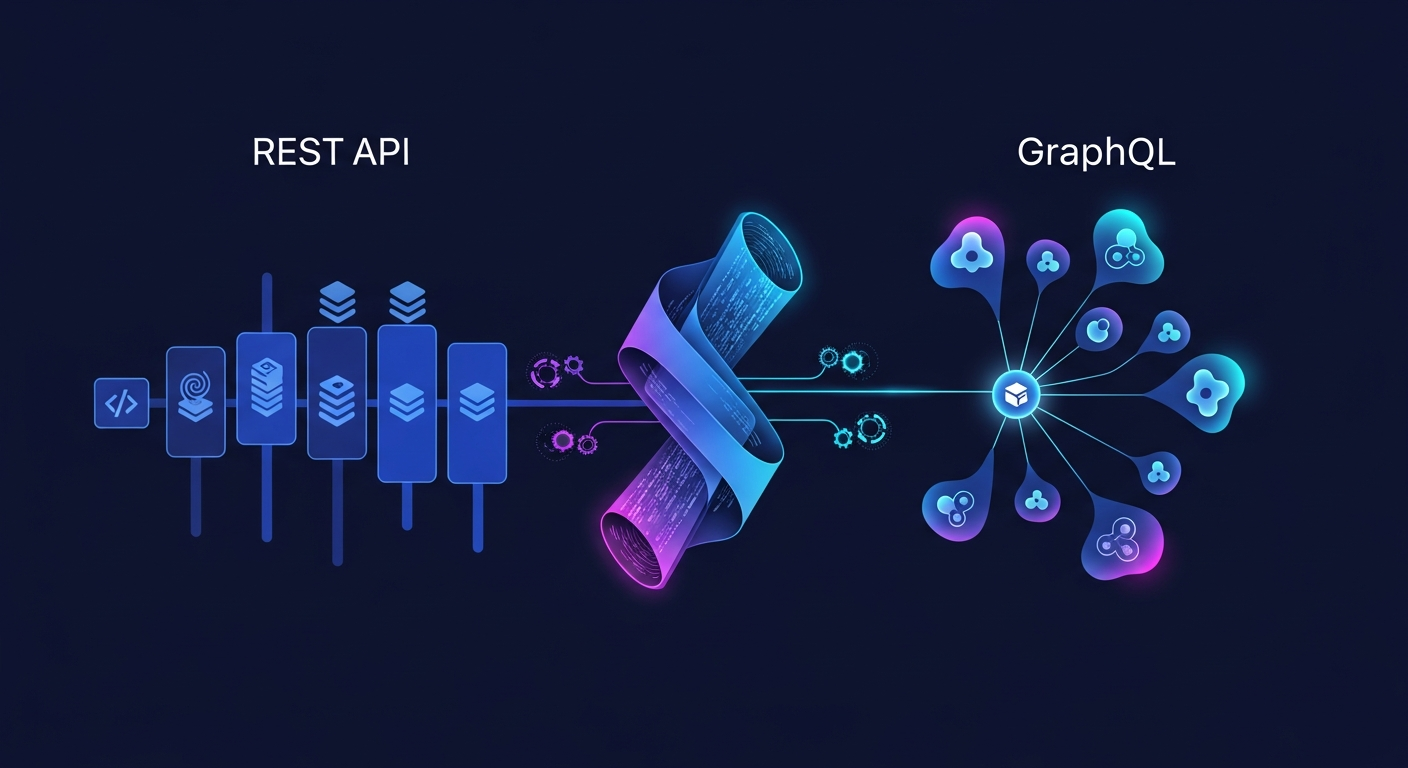
Comparing GraphQL vs REST APIs: The Definitive Guide for 2026 Integrations
In the rapidly evolving landscape of 2026, the demand for seamless data exchange has never been higher. As tech professionals building complex integrations and automating enterprise workflows, the choice between architectural styles is no longer just a matter of preference—it is a strategic decision that impacts latency, scalability, and developer velocity. For over a decade, Representational State Transfer (REST) has been the industry standard, providing a reliable, resource-based approach to web services. However, the rise of GraphQL has challenged this dominance by offering a flexible, query-based alternative that addresses many of REST’s inherent limitations. As we move deeper into an era defined by microservices, serverless architectures, and high-frequency automation, understanding the nuanced differences between these two technologies is critical. This guide provides a deep dive into the GraphQL vs. REST debate, specifically tailored for engineers and architects tasked with building the next generation of interconnected systems.
Architectural Philosophy: Resource-Centric vs. Query-Centric
The fundamental difference between REST and GraphQL lies in their core philosophy regarding data access. REST is built around the concept of “resources.” Each resource (e.g., a user, an order, or a product) is identified by a unique URL (Uniform Resource Identifier). To interact with these resources, developers use standard HTTP methods like GET, POST, PUT, and DELETE. This structure is highly predictable and leverages the existing semantics of the web, making it easy to understand and implement for simple CRUD (Create, Read, Update, Delete) operations.
In contrast, GraphQL operates on a “query-centric” model. Instead of having multiple endpoints for different resources, a GraphQL API typically exposes a single endpoint. Clients send a declarative query to this endpoint, specifying exactly what data they need and in what structure. This shift from “server-defined” to “client-defined” data fetching is revolutionary for workflow automation. While REST forces the client to follow the server’s rigid structure, GraphQL empowers the client to dictate the terms of the data exchange. For integration specialists, this means the ability to aggregate data from multiple entities in a single round-trip, significantly reducing the complexity of the “orchestration layer” in automated scripts.
Data Efficiency: Solving Over-fetching and Under-fetching
One of the most persistent challenges in RESTful integrations is the dual problem of over-fetching and under-fetching. Over-fetching occurs when an endpoint returns more data than the client actually needs. For example, an automation script might only need an “Email Address” to trigger a notification, but the REST `/users/123` endpoint returns the user’s full profile, including address, history, and preferences. This wastes bandwidth and increases processing time.
Under-fetching is the opposite: an endpoint doesn’t provide enough data, forcing the client to make secondary and tertiary requests. If you need a user’s “Recent Order Total,” you might have to call `/users/123`, then `/users/123/orders`, and then `/orders/456`. This “N+1 query problem” at the network level introduces significant latency into automated workflows.
GraphQL eliminates these issues by design. Because the client specifies the fields it requires, the payload is always optimized. In a 2026 enterprise environment where data privacy and egress costs are paramount, GraphQL’s precision is a major advantage. By fetching only the necessary attributes for a specific integration step, developers can build leaner, faster, and more cost-effective automation pipelines.
Versioning and Evolution in Long-term Integrations
Maintaining integrations over time requires a robust strategy for API evolution. In the REST world, changes to the data structure often necessitate versioning—leading to URLs like `/v1/api/` and `/v2/api/`. While this provides a clean break, it creates significant maintenance debt for tech professionals. Old versions must be supported indefinitely to avoid breaking legacy workflows, leading to “version sprawl” and complex routing logic.
GraphQL takes a different approach to evolution. Because clients only request the fields they need, adding new fields to a GraphQL schema is a non-breaking change. Existing integrations will ignore the new fields, while new integrations can begin utilizing them immediately. To remove fields, GraphQL uses a `@deprecated` tag, which warns developers in their IDEs or build tools without immediately breaking the production code.
For professionals building long-lived automation workflows, this “continuous evolution” model is a lifesaver. It reduces the frequency of emergency refactoring and allows for a more fluid integration lifecycle. You can upgrade your data capabilities in 2026 without fearing that you’ll break a critical synchronization script written two years prior.
Developer Experience (DX) and Tooling Ecosystem
The maturity of the ecosystem is a critical factor when choosing between GraphQL and REST. REST has the advantage of time; it is supported by a massive array of tools for testing (Postman, Insomnia), documentation (Swagger/OpenAPI), and monitoring. Virtually every programming language and automation platform (like Zapier, Make, or GitHub Actions) has native, first-class support for REST.
However, GraphQL has rapidly closed the gap, offering a superior Developer Experience (DX) in many modern contexts. The core of this is the GraphQL Schema. Because GraphQL is strongly typed and supports “introspection,” tools can automatically discover the API’s capabilities. This enables features like:
* **Autocompletion:** IDEs can suggest field names and types as you write queries.
* **Self-Documentation:** Tools like GraphiQL or Apollo Studio provide an interactive environment to explore the API without reading external PDFs or Wiki pages.
* **Validation:** Queries can be validated against the schema before they are even executed, catching errors during the development phase rather than at runtime.
For tech professionals building custom integrations, these features translate to faster development cycles. When you are automating a workflow between a CRM and an ERP system, having an interactive playground to test your data shapes in real-time is an immense productivity booster.
Security and Performance Considerations
While GraphQL offers flexibility, it introduces new challenges in security and performance that REST handles more naturally. In REST, because endpoints are fixed, it is relatively simple to implement rate limiting and caching. You can cache the response of `/products/99` at the HTTP level (using CDNs or Varnish) because the response for that URL is consistent.
GraphQL’s single-endpoint, dynamic-query nature makes standard HTTP caching difficult. Since every query can be unique, you cannot rely on the URL as a cache key. Instead, GraphQL requires more complex, client-side caching (like Apollo Client) or specialized server-side persisted queries.
From a security perspective, GraphQL opens the door to “complex query attacks.” A malicious actor could send a deeply nested query that asks for “Users -> Orders -> Products -> Categories -> Users,” potentially crashing the database or overwhelming the server. To mitigate this, GraphQL implementations in 2026 often require:
1. **Query Depth Limiting:** Restricting how deep a query can go.
2. **Query Cost Analysis:** Assigning a “price” to each field and rejecting queries that exceed a certain budget.
3. **Operation Whitelisting:** Only allowing pre-approved queries in production.
REST, by comparison, allows for more straightforward security at the gateway level. For high-security, low-complexity integrations, REST’s simplicity often remains the safer bet.
Strategic Choice: When to Choose Which?
As we look toward the remainder of 2026, the choice between GraphQL and REST should be driven by the specific requirements of your integration project rather than industry hype.
**Choose REST when:**
* You are building simple, public-facing APIs where wide compatibility is the priority.
* Your application is resource-heavy but doesn’t require complex relational data (e.g., a simple file storage service).
* You need to leverage robust, standard HTTP caching mechanisms.
* Your team is more comfortable with the traditional HTTP lifecycle and requires minimal setup time.
**Choose GraphQL when:**
* You are building complex “Backends for Frontends” (BFF) where the UI needs data from multiple sources.
* You are integrating microservices that have complex relationships and interdependencies.
* Bandwidth efficiency is critical (e.g., mobile applications or IoT integrations).
* You want to provide a highly flexible “Data Hub” for other internal teams to consume without constant backend changes.
In many modern enterprise architectures, the answer is actually “both.” Many organizations use REST for their internal microservices and deploy a GraphQL layer as an API Gateway or Federation layer to aggregate those services for the end-users and automation scripts.
—
FAQ
#
1. Is GraphQL fundamentally faster than REST?
Not necessarily. While GraphQL reduces “network time” by minimizing round-trips and payload size, it can increase “server processing time” because the server must parse the query and resolve various fields. For simple requests, REST is often faster due to its lack of overhead.
#
2. Can I use GraphQL with existing REST APIs?
Yes. This is a common pattern called “GraphQL over REST.” You can build a GraphQL server that acts as a wrapper, fetching data from multiple REST endpoints and presenting it as a single unified graph. This is an excellent way to modernize legacy integrations.
#
3. Which is better for serverless functions?
REST is often slightly better for serverless (like AWS Lambda) because the cold start time is lower and the execution overhead is minimal. However, GraphQL is frequently used in serverless environments via managed services like AWS AppSync, which handles the complexity of the execution engine.
#
4. Does GraphQL replace the need for documentation?
While GraphQL’s introspection feature makes it “self-documenting” for technical users, it does not replace the need for business-level documentation. You still need to explain *why* certain fields exist and the business logic behind the mutations.
#
5. How do I handle file uploads in GraphQL vs. REST?
REST handles file uploads natively using `multipart/form-data`. GraphQL does not have a native way to handle file uploads in the core specification. While there are workarounds (like the GraphQL Multipart Request Spec), many developers prefer to use a REST endpoint for the file upload and GraphQL for the metadata.
—
Conclusion
In 2026, the debate of GraphQL vs. REST is less about which technology is “better” and more about which is “fitter” for the task at hand. REST remains the bedrock of the internet—stable, cacheable, and universally understood. It is the ideal choice for standardized, resource-oriented tasks and public APIs. GraphQL, on the other hand, represents the frontier of developer flexibility and data efficiency, making it the superior choice for complex integrations, mobile-first applications, and high-velocity automation workflows.
For the tech professional, the most valuable skill is the ability to recognize the trade-offs. By understanding that REST excels in simplicity and caching, while GraphQL excels in precision and evolution, you can architect systems that are both resilient and performant. Whether you are automating a simple data sync or building a multi-service orchestration layer, choosing the right API style is the first step toward a successful, scalable integration.